

How to Build an Investment Tracking Dashboard with FlutterFlow
15 min
read
Learn how to create a custom investment tracking dashboard using FlutterFlow with step-by-step guidance and best practices.

A FlutterFlow investment tracking dashboard delivers portfolio performance, asset allocation, transaction history, and return analytics in one place. The platform makes a production-quality version achievable in weeks, not months, by connecting to market data APIs through custom actions.
The real question is whether real-time data requirements and advanced analytics needs exceed what the platform handles natively. This article gives you a direct answer.
Key Takeaways
- Investment dashboards suit FlutterFlow well: Portfolio overview, asset allocation charts, performance tracking, and transaction history are all achievable with market data API integration.
- Timelines are short: An investment tracking MVP takes 4 to 8 weeks versus 8 to 16 months with a custom development team.
- Cost is significantly lower: FlutterFlow investment dashboard builds typically run $15,000 to $55,000 versus $80,000 to $200,000 for a custom equivalent.
- Real-time trading execution is not in scope: FlutterFlow builds the viewing and tracking layer; order execution and live trade routing require licensed broker-dealer infrastructure.
- Sub-second data streaming is the performance ceiling: High-frequency price feeds at institutional speed require WebSocket infrastructure that Firestore is not optimised for.
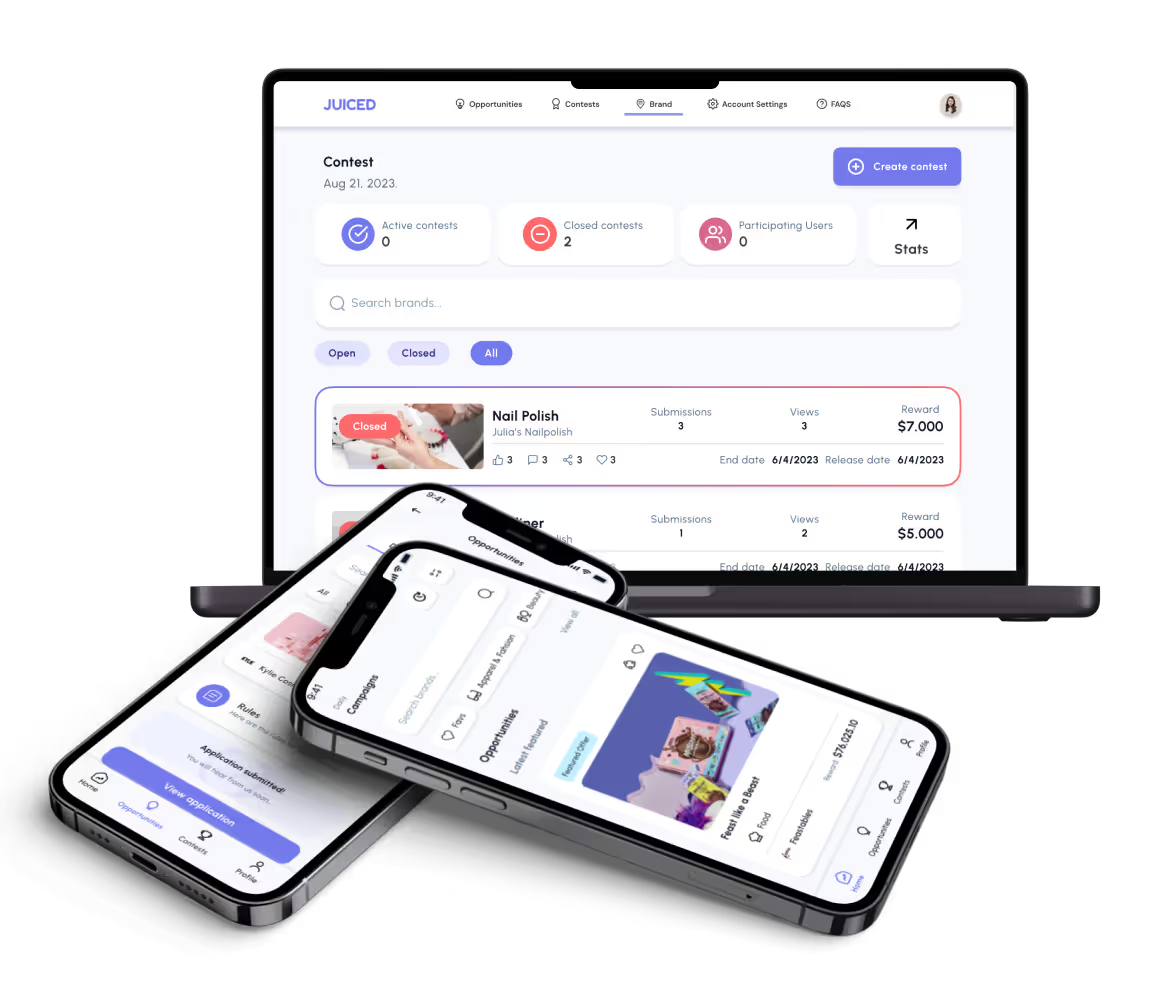

What Can FlutterFlow Build for an Investment Tracking Dashboard?
FlutterFlow can build the complete portfolio tracking and analytics layer of an investment dashboard: portfolio overview, holdings, performance charts, transaction history, watchlists, and market data integration. It cannot execute trades or run proprietary underwriting models.
Since many investment tracking dashboards are used primarily on desktop browsers, understanding the considerations of building an investment dashboard as a web app in FlutterFlow is an important architecture decision.
Portfolio Overview and Net Worth Dashboard
A real-time portfolio summary displays total value, day-over-day change, asset allocation breakdown, and net worth trend. Data populates from market data APIs and user-linked account data.
The overview screen refreshes on a defined schedule or via Firestore listeners, giving users an accurate view of their position at any time.
- Total portfolio value display: Market data API responses update portfolio value in real time, showing current worth and daily change clearly.
- Asset allocation breakdown: A chart component renders allocation by asset class or sector, giving users an immediate read of portfolio composition.
- Net worth trend chart: Historical net worth data from your backend populates a time-series chart covering configurable periods such as 1 month or 1 year.
Asset Performance and Returns Visualisation
FlutterFlow chart components render individual asset performance, portfolio return versus benchmark comparisons, time-weighted returns, and gain/loss summaries across configurable time periods.
Chart data pulls from market data API responses with configurable date range filters built into the query logic.
- Individual asset performance: Each holding's return over selected time periods renders in a chart with percentage and dollar gain/loss displayed.
- Benchmark comparison: Portfolio return displays alongside a benchmark index line, giving users context for whether their returns are competitive.
- Configurable time periods: Users select 1-week, 1-month, 3-month, or custom date ranges, with charts updating from the API accordingly.
Holdings List and Position Detail View
A holdings screen lists all securities, funds, or assets with quantity, current price, market value, average cost, and unrealised gain/loss. Market data API responses update these figures.
Tapping a holding opens a detail view showing the full position history, transactions, and chart for that specific asset.
- Real-time market value: Each holding's current price multiplies against quantity using data from the connected market data API.
- Unrealised gain/loss display: Average cost basis compares against current market value to surface unrealised gain or loss per position clearly.
- Position detail view: Tapping a holding reveals full transaction history, price chart, and position metrics for that specific asset.
Transaction History and Trade Log
A transaction log displays all buy, sell, dividend, and fee events with date, asset, quantity, and price. Data pulls from brokerage integration APIs or manual entry by the user.
Filters by date range, asset, and transaction type allow users to locate specific events quickly.
- Full transaction event log: Buy, sell, dividend, and fee events display chronologically with date, asset, quantity, and execution price shown.
- Brokerage API sync: Integration with Plaid Investments or Alpaca pulls transaction history automatically, eliminating manual data entry for connected accounts.
- Filter and search: Users filter transactions by date range, asset class, or transaction type to locate specific events in the log.
Watchlist and Alerts Management
Users add assets to a watchlist with configurable price alerts. Firebase Cloud Messaging sends a notification when an asset crosses a user-defined price threshold.
Watchlist data stores in Firestore per user, with a scheduled function checking current prices against alert thresholds at defined intervals.
- Asset watchlist management: Users add any tracked asset to a personalised watchlist with current price and day change displayed per item.
- Price alert configuration: Users set upper and lower price thresholds per asset; Firebase Cloud Messaging delivers the alert when the threshold is crossed.
- Alert history log: Past triggered alerts record in Firestore, giving users a history of price events they set watches for.
Market Data Integration via Third-Party API
Custom API actions connect to market data providers including Alpaca, Polygon.io, Yahoo Finance API, or Alpha Vantage. These return current prices, historical OHLCV data, and fundamental metrics.
API rate limit management requires careful implementation, as production dashboards with many users can hit provider limits without throttling logic.
- Real-time price retrieval: Custom API actions fetch current prices from Polygon.io, Alpaca, or Alpha Vantage on a defined refresh interval.
- Historical OHLCV data: Chart components receive open, high, low, close, and volume data from the market data API for time-series visualisation.
- Rate limit handling: Request throttling and response caching logic prevents API limit breaches when multiple users request data simultaneously.
Portfolio Analytics and Allocation Reports
An analytics screen breaks down portfolio allocation by asset class, sector, geography, and currency. Rebalancing suggestions display based on user-defined target allocations.
Allocation calculations run against the holdings data with current market values applied, giving users an accurate composition view at any point.
- Asset class breakdown: Holdings group by asset class with percentage allocation displayed in a chart and summary table alongside each category.
- Sector and geography split: For equity-heavy portfolios, sector and geographic allocation charts provide additional composition context for the user.
- Rebalancing suggestions: Deviation from user-defined target allocations flags visually, showing which positions are overweight or underweight against the plan.
How Long Does It Take to Build an Investment Tracking Dashboard with FlutterFlow?
A simple investment tracking MVP covering portfolio overview, holdings list, and market data takes 4 to 8 weeks. A full-featured dashboard with analytics, alerts, brokerage integration, and transaction history takes 8 to 14 weeks.
Timeline depends heavily on market data API access agreements and brokerage integration approval processes, which are external to the FlutterFlow build itself.
- Simple MVP timeline: Portfolio overview, holdings list, and market data integration ship in 4 to 8 weeks with an experienced FlutterFlow developer.
- Full dashboard timeline: Adding analytics screens, price alerts, brokerage API sync, and transaction history extends the build to 8 to 14 weeks total.
- API access delays: Brokerage API agreements with Plaid Investments or broker-specific providers add lead time independent of the FlutterFlow build schedule.
- Data accuracy testing: Financial calculation accuracy requires a dedicated QA phase; errors in return calculations or gain/loss figures are high-visibility bugs.
- Phased approach advantage: Shipping portfolio overview and market data integration first delivers value immediately while brokerage sync and analytics build in phase two.
FlutterFlow ships investment dashboard interfaces 2 to 3 times faster than custom-built equivalents. The complexity in investment dashboards is in data integration, not UI construction.
What Does a FlutterFlow Investment Tracking Dashboard Cost?
FlutterFlow investment tracking dashboard builds cost $15,000 to $75,000 depending on scope. A portfolio overview MVP with market data sits at the lower end; a full dashboard with brokerage integration, analytics, and alert management sits at the top.
The FlutterFlow dashboard app pricing is predictable, but market data API subscription costs are the largest ongoing variable for an investment tracking product.
- Platform cost is minimal: FlutterFlow's monthly subscription is a small fraction of total project cost; developer time and market data fees drive the budget.
- Market data API is the key ongoing cost: Polygon.io Pro starts at $199 per month; enterprise-grade data feeds scale significantly beyond that figure.
- Freelancer vs agency tradeoff: Freelancers suit simple portfolio display apps; agencies suit dashboards with live market data, brokerage API integration, and multi-asset analytics.
- Hidden cost: brokerage data agreements: Plaid Investments and broker-specific API agreements have their own approval processes and data licensing fees.
- Hidden cost: financial calculation QA: Testing return calculations, gain/loss figures, and allocation percentages for accuracy adds a dedicated QA phase.
- Hidden cost: rate limit management: Production dashboards require API throttling and caching logic to prevent costly overages on market data subscriptions.
Budget a contingency of 15 to 20 percent for market data integration complexity discovered during build. Financial data providers surface edge cases that initial scoping does not anticipate.
How Does FlutterFlow Compare to Custom Development for Investment Tracking Dashboards?
FlutterFlow is 4 to 8 times cheaper than custom-built investment dashboards and deploys in 4 to 14 weeks versus 8 to 18 months for equivalent custom builds. The trade-off is sub-second streaming data and complex financial calculations at scale.
- Speed advantage is significant: FlutterFlow delivers a working investment dashboard in weeks; equivalent custom builds take months to reach the same state.
- Cost advantage is clear: Custom investment dashboard development starts at $80,000; FlutterFlow full platforms run $15,000 to $75,000 for comparable features.
- When FlutterFlow wins: Personal finance dashboards, family office trackers, robo-advisory client portals, and retail investor portfolio visualisation tools are strong use cases.
- When custom development wins: Institutional trading terminals, algorithmic trading platforms, and real-time risk management systems requiring sub-second data refresh exceed FlutterFlow's scope.
For a structured evaluation of where FlutterFlow excels and where it falls short in data-heavy applications, reviewing the FlutterFlow pros and cons for dashboards will inform the technology decision.
What Are the Limitations of FlutterFlow for Investment Tracking Dashboards?
FlutterFlow cannot stream sub-second market data at institutional speed, run complex financial calculations natively, or execute trade orders. These constraints define where the platform is appropriate and where custom infrastructure is required.
Understanding investment dashboard security standards encompasses both data protection and financial data handling obligations; knowing which apply to your product before choosing a backend architecture is essential.
- Sub-second data streaming: WebSocket-based live price feeds at institutional speed require custom Dart implementation; Firestore's listener model is not optimised for high-frequency financial data.
- Complex financial calculations: Precise metrics such as time-weighted returns, IRR, XIRR, and options Greeks require custom Dart logic or external financial calculation APIs.
- Regulatory advice boundaries: If the dashboard displays personalised investment recommendations, securities regulation may apply. This is a legal question independent of the technology choice.
- Brokerage API access timelines: Plaid Investments, MX, and broker-specific APIs have their own approval processes and data agreement requirements that add lead time.
- Large dataset performance: Filtering thousands of transactions or running multi-year historical analytics requires Firestore query optimisation and potentially a relational database for complex aggregations.
- Multi-asset data normalisation: Dashboards handling multiple currencies, crypto, alternatives, and derivatives simultaneously require data normalisation beyond standard API response handling.
Knowing these limits before scoping prevents expensive redesigns when your data architect identifies requirements the FlutterFlow layer cannot satisfy.
How Do You Hire the Right Team to Build a FlutterFlow Investment Tracking Dashboard?
You need a developer or agency with fintech or wealth management domain knowledge and FlutterFlow platform experience. Market data API integration, brokerage connections, and financial chart implementation are the critical skills to verify.
For a data-intensive investment dashboard, working with top FlutterFlow dashboard development agencies with financial API integration experience will prevent data architecture mistakes that are expensive to fix post-launch.
- Required expertise: Market data API integration, Plaid Investments or brokerage API connections, financial chart components, and Firestore query optimisation are baseline requirements.
- Freelancer scope: Freelancers suit simple portfolio display dashboards with manual data entry; they are less suitable for live market data and brokerage API integrations.
- Agency scope: Dashboards with live market data, brokerage API integration, multi-asset analytics, and alert management need a team, not a solo developer.
- Red flag: no financial data portfolio: A developer without market data API integration experience will underestimate rate limit management and financial calculation precision requirements.
- Key interview question: Ask how they handle rate limiting and data freshness in a market data integration and whether they have built a brokerage API connection in FlutterFlow before.
- Expected prototype timeline: A working portfolio overview connected to a real or mocked market data API is a reasonable expectation within 3 to 4 weeks of starting.
Interview at least two developers or agencies and ask for verifiable examples of financial data integrations before committing to a project.
Conclusion
FlutterFlow is a strong platform for investment tracking dashboards. Portfolio overviews, market data integration, performance visualisation, and alert management all map well to the platform's native capabilities.
The ceiling is sub-second streaming data, complex financial calculations at scale, and algorithmic order execution. Define your data sources before engaging any developer: which market data API provides your price data, which brokerage integration aggregates holdings, and which financial metrics must be calculated at launch.
Building an Investment Tracking Dashboard with FlutterFlow? Here Is How LOW/CODE Agency Approaches It.
Investment tracking dashboards are not just chart-building exercises. Market data API integration, brokerage connection architecture, financial calculation precision, and performance testing are where most builds succeed or fail.
As AI development experts, we at LOW/CODE Agency help SMBs ship real software — web and mobile applications, intelligent chatbots, RAG pipelines, and autonomous AI agents built for businesses that need results, not platforms. We build FlutterFlow investment dashboards with the full data architecture behind them: market data API integration, brokerage connection design, financial chart implementation, and performance-tested delivery from a team that understands how financial data must behave in a production product.
- Market data API integration: We connect FlutterFlow dashboards to Polygon.io, Alpaca, and Alpha Vantage with rate limit handling and response caching built in.
- Brokerage API connection: We integrate Plaid Investments and broker-specific APIs with correct authentication scoping and data normalisation for reliable holdings sync.
- Financial chart implementation: We build portfolio performance charts, allocation breakdowns, and return visualisations using FlutterFlow's chart components and custom Dart where precision is required.
- Price alert architecture: We design Firebase Cloud Messaging alert flows with threshold-checking logic that fires reliably without overloading the market data API.
- Financial calculation accuracy: We build custom Dart functions for return calculations, gain/loss figures, and allocation percentages with dedicated QA testing before launch.
- Phased delivery: We scope and ship your portfolio overview and market data MVP first, then layer in brokerage sync, analytics, and alerts in subsequent phases.
- Full product team: Strategy, UX, development, and QA from a single team so your investment dashboard is production-ready, not just visually functional.
We have built 350+ products for clients including Coca-Cola, American Express, and Sotheby's. We know how to scope and deliver FlutterFlow investment dashboards that meet the data precision and performance standards wealth management and fintech products require.
Related Articles
- How to Build a Job Marketplace App with FlutterFlow
- How to Build an Itinerary Planning Tool with FlutterFlow
- How to Build an Invoice Generator App with FlutterFlow
- How to Build an Inventory Scanning App with FlutterFlow
- How to Build an Interactive Media Platform with FlutterFlow
- How to Build Insurance Tech Apps with FlutterFlow
Last updated on
September 24, 2026
.

Jesus is a visionary entrepreneur and tech expert. After nearly a decade working in web development, he founded LOW/CODE Agency to help businesses optimize their operations through custom software solutions.


FAQs
What are the key features to include in an investment tracking dashboard?
Can FlutterFlow handle real-time data updates for investment tracking?
How do I connect external financial APIs to FlutterFlow for data retrieval?
Is it possible to customize the dashboard layout without coding in FlutterFlow?
What security measures should I consider when building an investment dashboard?
How can I optimize the dashboard for mobile devices using FlutterFlow?
Related Articles
FlutterFlow
How to Build a Farm Management App with FlutterFlow
Learn how to create a farm management app using FlutterFlow with step-by-step guidance and key features for efficient farm operations.
FlutterFlow
How to Build a Rental Agreement App with FlutterFlow
Learn how to create a rental agreement app using FlutterFlow with step-by-step guidance and key features to include.

FlutterFlow
How to Build an Events Marketplace Platform with FlutterFlow
Learn how to create an events marketplace platform using FlutterFlow with step-by-step guidance and best practices.

FlutterFlow
How to Build a Real Estate App with FlutterFlow
Learn step-by-step how to create a real estate app using FlutterFlow with no coding required. Start building your property app today.


Why customers trust us for no-code development


