

How to Build a Healthcare Workflow System with FlutterFlow
12 min
read
Learn how to create efficient healthcare workflow systems using FlutterFlow with step-by-step guidance and best practices.


Healthcare operations run on workflows: patient intake, triage, clinical handoff, discharge, billing. Most clinics manage these through a combination of paper, spreadsheets, and disconnected software.
A FlutterFlow healthcare workflow system can digitise and automate these processes in weeks. The complexity of multi-step clinical handoffs and compliance requirements sets real boundaries on what the platform can handle without custom code.
Key Takeaways
- Clinical workflow automation is achievable: Task assignment, status tracking, handoff notifications, and multi-role routing are all buildable in FlutterFlow.
- Timelines are compressed: A healthcare workflow MVP takes 5–9 weeks versus 9–18 months with a custom development team.
- Cost is significantly lower: FlutterFlow workflow system builds run $20,000–$65,000 versus $100,000–$250,000 for a custom equivalent.
- HIPAA compliance is your architecture responsibility: Workflow data that includes PHI requires deliberate backend design; the platform does not provide this automatically.
- Complex conditional logic is the ceiling: Deeply branching clinical triage trees and real-time EHR-triggered workflow automation require custom Dart code or middleware beyond FlutterFlow's visual tooling.
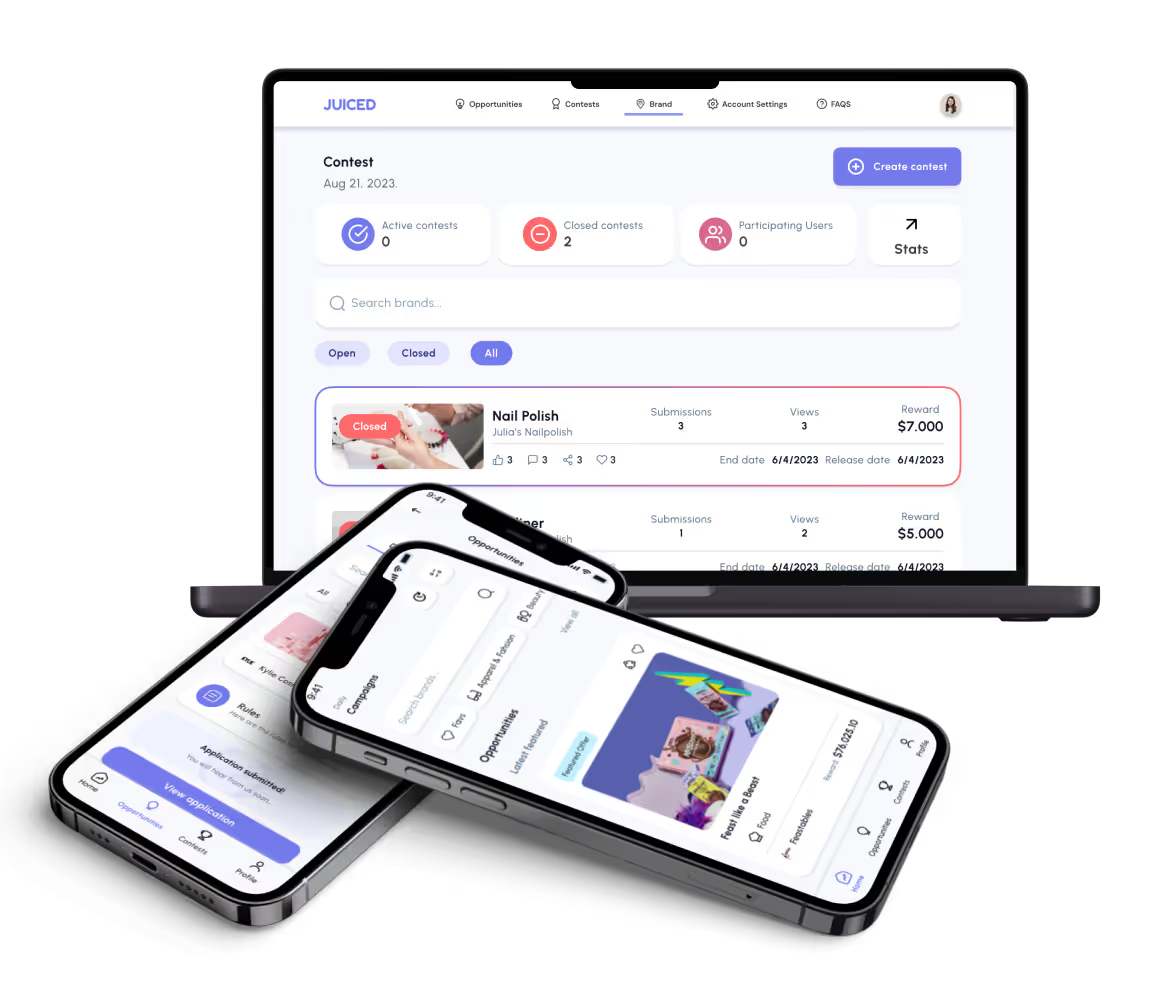

What Can FlutterFlow Build for a Healthcare Workflow System?
FlutterFlow can build a complete clinical workflow system covering patient intake, task assignment, triage queues, multi-role routing, discharge automation, escalation notifications, and workflow reporting. Each workflow step is backed by Firestore state management and Firebase Cloud Messaging alerts.
Each feature below describes the clinical workflow step in operational terms first, then explains the FlutterFlow mechanism that supports it.
Patient Intake and Registration Workflow
A structured multi-step intake flow collects patient demographics, insurance, medical history, and consent. The completed record routes automatically to the clinical team with status flags indicating which action is required next.
Task Assignment and Clinical Handoff Tracking
Firestore-backed task collections allow workflow steps to be assigned to specific staff members with due times, completion confirmation, and automatic next-step routing when a task is marked done by the assigned role.
Triage and Priority Queue Management
A triage screen displays incoming patients ranked by urgency, with colour-coded priority flags, time-in-queue indicators, and one-tap assignment to available clinical staff without navigating away from the queue view.
Multi-Role Workflow Routing
FlutterFlow's user role system routes patients through distinct workflow steps: front desk, triage nurse, clinician, and billing. Each role sees only the workflow steps relevant to their function, preventing information overload and reducing errors.
Discharge and Follow-Up Workflow Automation
When a visit is marked complete, automated follow-up tasks trigger: discharge summary generation, follow-up appointment booking prompt, post-visit satisfaction survey delivery, and billing initiation without manual staff intervention.
Notification and Escalation Alerts
Firebase Cloud Messaging sends task alerts, escalation warnings for overdue steps, and handoff notifications to the relevant staff member when a workflow step requires immediate action or has exceeded its time threshold.
Workflow Reporting and Bottleneck Analysis
Admin dashboard screens show workflow throughput, average time per step, overdue task counts, and staff workload distribution. All data aggregates from Firestore workflow records in near real time for operational visibility.
For practices considering deploying their workflow system to multiple clinic sites, understanding how SaaS workflow tools in FlutterFlow support multi-tenancy will shape the architecture from the start.
How Long Does It Take to Build a Healthcare Workflow System with FlutterFlow?
A simple workflow system MVP covering intake, task assignment, and basic routing takes 5–9 weeks. A full-featured system with multi-role routing, escalation, and reporting takes 10–18 weeks. Clinical workflow mapping with staff and HIPAA compliance architecture review are the primary timeline extenders.
Before selecting a backend, validate your workflow system scalability planning against peak patient volume. Firestore handles mid-scale well but requires deliberate query design at high throughput.
- Phased delivery reaches production faster: Launching intake and task assignment first, then adding escalation and analytics in phase two, consistently reduces time to production by 30–40%.
- Clinical workflow mapping adds time: Documenting every handoff point, role, and notification requirement with clinical staff is time that cannot be skipped without creating a system that staff will not use.
- Staff UAT is different from standard QA: Clinical workflow testing requires real staff in real scenarios; this adds review cycles not present in consumer app development timelines.
Teams that invest in workflow mapping before writing any code deliver systems that reflect how staff actually work, not how a developer assumed they work.
What Does a FlutterFlow Healthcare Workflow System Cost?
The FlutterFlow plan pricing options set the platform cost floor, but for a multi-role clinical workflow system, the backend and integration costs will dominate the budget. Most production workflow systems require the Pro or Teams plan.
A FlutterFlow healthcare workflow system built by an experienced agency runs $25,000–$90,000. A custom-built equivalent typically costs $100,000–$250,000 and takes 9–18 months to deliver.
- Hidden costs are real budget items: Clinical workflow mapping consultancy, staff training, HIPAA compliance review, change management, and system integration testing add cost beyond the development quote.
- EHR middleware adds significant cost: If your workflow system needs to respond to events in an external EHR, budget for API middleware development as a separate line item.
- Post-launch maintenance: Workflow systems require ongoing updates as clinical processes evolve; budget a maintenance retainer from the start rather than discovering this cost after launch.
The cost advantage over custom development is most significant for independent clinics and specialty practices replacing paper or spreadsheet-based workflows for the first time.
How Does FlutterFlow Compare to Custom Development for Healthcare Workflow Systems?
FlutterFlow delivers a healthcare workflow system in 5–18 weeks at $20,000–$90,000. Custom development for an equivalent system takes 9–24 months at $100,000–$300,000 or more. FlutterFlow wins on speed and maintainability for clinic-scale workflow automation.
The comparison is most useful when mapped to the complexity of your clinical process. Simple task routing and status tracking strongly favour FlutterFlow; EHR-native workflow triggers and enterprise-scale orchestration favour custom development.
- FlutterFlow wins for: Independent clinics, specialty practices, and health startups digitising paper-based or spreadsheet-based workflows for the first time.
- Custom wins for: Multi-hospital systems requiring EHR-native workflow triggers, ISO 13485 certified workflow automation, or enterprise-scale process orchestration across dozens of sites.
- Maintenance advantage is real: FlutterFlow workflow systems are easier to update, reroute, and modify as clinical processes evolve; custom systems require engineering involvement for every workflow change.
What Are the Limitations of FlutterFlow for Healthcare Workflow Systems?
HIPAA BAA gaps, complex branching clinical logic, EHR-triggered workflow automation, and audit trail depth are the four areas where FlutterFlow requires engineering beyond its visual tools. These are architectural constraints that must be planned for before development begins.
Understanding healthcare workflow compliance requirements before building, not after, is the most important risk mitigation step in any clinical workflow digitisation project.
- HIPAA BAA is your responsibility: Workflow data that includes patient names, diagnoses, or visit notes requires BAAs with every backend service; FlutterFlow does not provide these automatically.
- Complex branching logic hits a ceiling: Clinical triage decision trees with many conditional branches and real-time data triggers become difficult to maintain in FlutterFlow's visual action system at high complexity.
- EHR-triggered workflows require middleware: Automating workflow steps based on events in an external EHR, such as a new lab result or a discharge event, requires webhook infrastructure and middleware that FlutterFlow does not provide natively.
- FCM is not safety-critical infrastructure: Firebase Cloud Messaging delivery is not guaranteed for critical clinical alerts. Safety-critical task notifications may require a more reliable notification infrastructure.
- Audit trail depth requires deliberate engineering: HIPAA's audit control requirements for workflow access and modifications require immutable logging that must be engineered in Firestore, not assumed to exist automatically.
Multi-site orchestration is also a real constraint. Workflows spanning multiple clinic locations with location-specific routing rules require careful Firestore data modelling that goes beyond FlutterFlow's standard patterns.
How Do You Hire the Right Team to Build a FlutterFlow Healthcare Workflow System?
Finding top FlutterFlow workflow app agencies with proven clinical operations experience is a tighter search than finding general FlutterFlow developers. The domain knowledge gap matters significantly for workflow systems where staff adoption depends on the system reflecting real clinical processes.
Freelancers suit simple, well-defined workflow scopes with minimal compliance requirements. Agencies are strongly preferred for multi-role clinical workflow systems involving compliance review and staff training across departments.
- Workflow portfolio is essential: Ask for a FlutterFlow workflow or task management app they have built and deployed; a portfolio without workflow tools signals general experience that may not cover clinical state management.
- Firestore state management question: Ask directly: "How do you handle workflow state persistence and recovery in Firestore?" A vague answer about using collections is a red flag.
- Clinical domain knowledge matters: Developers who have not worked in a regulated or healthcare context will underestimate compliance requirements, staff training needs, and UAT cycles.
- No healthcare experience is a disqualifier: Developers without regulated industry experience who plan to treat a clinical workflow system like a consumer app will create compliance risk after handoff.
- Expected project timeline from a good team: Scoping call, then clinical workflow mapping, data model design, phased build, staff UAT, and staged rollout by department is the standard progression.
Teams that open the project with clinical workflow mapping, not wireframes, are demonstrating that they understand what makes healthcare workflow systems succeed or fail in actual clinical use.
Conclusion
FlutterFlow is a capable platform for digitising and automating healthcare workflows at the clinic and specialty practice scale. Task assignment, multi-role routing, intake automation, and reporting are all achievable within realistic budgets.
The ceiling is EHR-native workflow triggers and enterprise-scale process orchestration. For most clinical teams replacing paper or spreadsheet workflows, FlutterFlow delivers real operational value.
Map your clinical workflow end to end before engaging any developer. Every handoff point, every role involved, every notification that needs to fire. That map will determine whether FlutterFlow's visual workflow tools cover your process or whether custom logic is needed from the start.
Building a Healthcare Workflow System with FlutterFlow? Here Is How LOW/CODE Agency Approaches It.
Most healthcare workflow system builds fail not because of the technology, but because the clinical workflow was never properly documented before development started. The system ends up reflecting developer assumptions, not clinical reality.
We build AI products for SMBs. At LOW/CODE Agency, our work spans custom web applications, mobile apps, AI chatbots, retrieval-augmented generation systems, and autonomous AI agents — the full scope of what an expert software agency delivers. We start every clinical workflow build with a mapping session, not a wireframe. We document every handoff, every role, and every notification requirement before writing a single FlutterFlow action.
- Clinical workflow mapping: We document your workflow end to end with clinical staff before any development begins, identifying every role, handoff point, and escalation condition.
- Firestore state machine design: We design the task state management model in Firestore to support multi-role routing, completion tracking, and workflow recovery without data loss.
- HIPAA architecture review: We design BAA configuration, data access controls, and audit logging requirements into the backend before any PHI-containing workflow is built.
- Multi-role navigation build: We implement FlutterFlow's role-based visibility and routing so each staff role sees only what their function requires, reducing cognitive load and error risk.
- Escalation and notification design: We implement Firebase Functions-based escalation alerts for overdue workflow steps, tested against real clinical time thresholds during UAT.
- Staff UAT support: We structure testing cycles around actual clinical staff in their real work environment, not just developer QA scripts against a staging database.
- Full product team: Strategy, UX, development, and QA from a single team that understands both the FlutterFlow platform and the operational realities of clinical workflow automation.
We have built 350+ products for clients including Coca-Cola, American Express, and Sotheby's. We know where clinical workflow builds go wrong and address those risks before they become expensive to fix.
Related Articles
- How to Build a Home Services Marketplace with FlutterFlow
- How to Build a Hiring Workflow Tool with FlutterFlow
- How to Build a Helpdesk Ticketing App with FlutterFlow
- How to Build a Healthcare Marketplace with FlutterFlow
- How to Build a Healthcare App with FlutterFlow
- How to Build a Gig Marketplace Platform with FlutterFlow
Partner with our low-code development experts to bring your app idea to life faster.
Last updated on
September 24, 2026
.

Jesus is a visionary entrepreneur and tech expert. After nearly a decade working in web development, he founded LOW/CODE Agency to help businesses optimize their operations through custom software solutions.


FAQs
What are the key features to include in a healthcare workflow system?
How does FlutterFlow simplify building healthcare apps?
Can FlutterFlow handle sensitive patient data securely?
What backend services work best with FlutterFlow for healthcare systems?
How do I test a healthcare workflow app built with FlutterFlow?
What are common challenges when building healthcare workflows in FlutterFlow?
Related Articles

FlutterFlow
How to Build a Live Class Scheduling App with FlutterFlow
Learn how to create a live class scheduling app using FlutterFlow with step-by-step guidance and best practices.

FlutterFlow
How to Build a CRM with FlutterFlow
Learn how to create a CRM using FlutterFlow with easy steps, tips, and best practices for efficient app development.

FlutterFlow
How to Build a Realtor CRM Platform with FlutterFlow
Learn how to create a Realtor CRM platform using FlutterFlow with step-by-step guidance and best practices for real estate professionals.

Comparison
FlutterFlow
FlutterFlow vs Thunkable: 10 Factors to Decide the Best One
Compare FlutterFlow vs Thunkable across 10 key factors like design, logic, scalability, and publishing to choose the right no-code app builder for your goals


Why customers trust us for no-code development


