

How to Build a Gig Marketplace Platform with FlutterFlow
10 min
read
Learn how to create a gig marketplace platform using FlutterFlow with step-by-step tips and best practices for beginners and developers.


A flutterflow gig marketplace platform needs to work in real time. Workers must see jobs instantly, and buyers need confirmed coverage fast. Slow tech kills supply-demand balance before the platform gains traction.
FlutterFlow delivers the job posting, worker matching, payment, and rating layers without a custom backend team. The key is knowing exactly which features require Firebase extensions and which need custom engineering before you start.
Key Takeaways
- Job posting and application flow: FlutterFlow can build the full job post, worker application, and acceptance cycle on Firestore.
- Location-based matching: Gig workers near a job can be surfaced using geolocation queries in Firestore or Algolia Geo.
- Real-time notifications: Push notifications alert workers the moment a relevant job is posted in their category.
- Stripe Connect payouts: Worker earnings route through Stripe Connect after platform commission deduction on job completion.
- Background check integration: KYC and background screening APIs add trust but require custom Cloud Function integration.
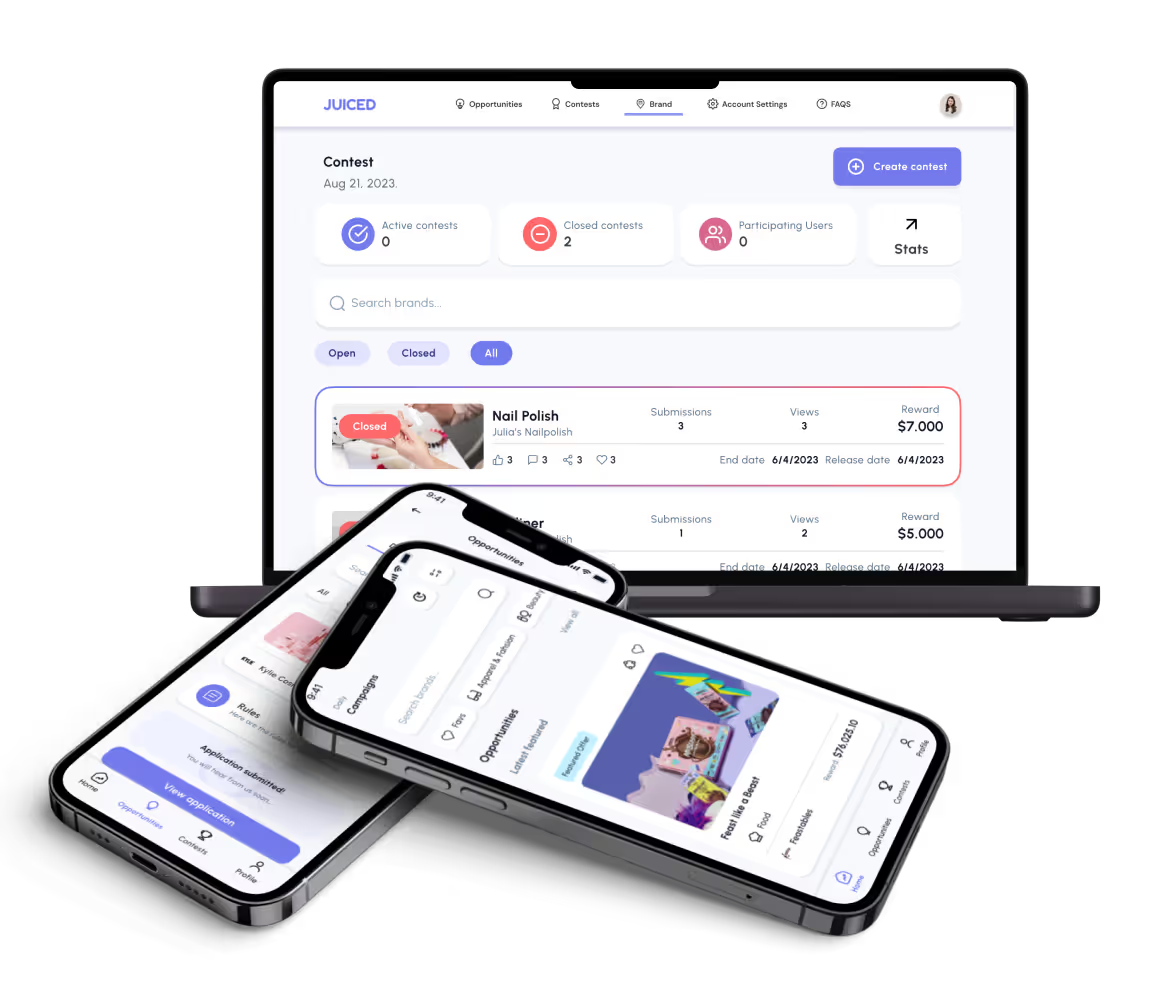

What Can FlutterFlow Build for a Gig Marketplace Platform?
FlutterFlow can build the complete buyer-to-worker transaction cycle for a gig marketplace: job posting, worker discovery, application flow, real-time notifications, in-app messaging, job completion, payment release, and ratings. Gig platforms share core architecture with two-sided SaaS products.
Reviewing whether you can build a SaaS with FlutterFlow helps frame what this tech stack delivers for two-sided gig platforms specifically.
Job Posting and Category Tagging
Buyers post gigs with title, description, location, required skills, time window, and payment amount, all tagged by category for worker filtering and discovery.
Worker Profile and Skills Verification
Gig workers build profiles with listed skills, availability hours, work history, and uploaded certifications or credentials for buyer review before hiring.
Location-Based Job Discovery
Workers see nearby jobs sorted by distance, with a map view showing available gigs relative to their current GPS location.
Application and Acceptance Flow
Workers apply to open jobs; buyers review applicants and accept one, triggering booking confirmation notifications to both parties simultaneously.
Real-Time Push Notifications for New Jobs
Workers receive instant push alerts when a job matching their category and location is posted within their configured radius.
In-App Messaging for Job Coordination
Buyer and worker communicate through a Firestore-backed thread to confirm details, share location updates, or adjust timing before the job starts.
Job Completion and Payment Release
Workers mark jobs complete via the app; payment releases from escrow through Stripe and routes directly to the worker's connected account.
Ratings and Reliability Score
Both parties rate each interaction; workers accumulate a reliability score displayed on their profile and factored into job matching priority.
The features above cover the full transactional cycle. A phased build approach launches the job-to-payment loop first, then layers in location precision and verification in phase two.
How Long Does It Take to Build a Gig Marketplace Platform with FlutterFlow?
A simple gig marketplace MVP with job posting, application flow, and Stripe payment takes 10–14 weeks. A full-featured platform with geolocation matching, real-time messaging, completion flow, ratings, and an admin panel takes 18–28 weeks.
The timeline is driven by architectural complexity, not feature count. Geolocation design and Stripe Connect configuration are the longest phases.
- Geolocation architecture: Deciding between static location matching and real-time GPS tracking early determines the entire backend data model.
- Notification design: Real-time push notifications for new jobs require Firebase Functions, not client-side FlutterFlow actions alone.
- Phased approach advantage: Launching the core job-to-payment loop first gets you market validation before committing budget to geolocation complexity.
Teams that scope geolocation requirements in weeks one and two, then build the payment layer before adding location features, consistently reach production faster than those attempting all layers simultaneously.
What Does It Cost to Build a FlutterFlow Gig Marketplace Platform?
A FlutterFlow gig marketplace platform built by an experienced agency runs $35,000–$110,000. FlutterFlow pricing plans are predictable, the variable costs are geolocation services and per-worker background check fees, which scale with platform activity.
Platform and developer costs are only part of the budget. Geolocation services and Stripe Connect processing fees add recurring variable costs that should be modelled before launch.
- Developer rates: FlutterFlow developers typically charge $50–$150/hour; gig marketplace complexity sits at the higher end of that range.
- Background check costs: Per-worker API fees add up quickly as the platform scales, budget these as a variable cost from the start.
- Custom development comparison: An equivalent gig platform built with custom code costs $150,000–$400,000 and takes significantly longer to launch.
The cost advantage over custom development is largest at the MVP stage. As the platform matures and adds algorithmic matching, the gap narrows.
How Does FlutterFlow Compare to Custom Development for a Gig Marketplace Platform?
FlutterFlow delivers a gig marketplace in 18–28 weeks at $35,000–$110,000. Custom development for an equivalent platform takes 24–48 months at $150,000–$400,000 or more. The trade-off is capability ceiling, not build quality.
The comparison is not about which approach is better in absolute terms. It is about which one matches your current stage and workflow requirements.
- FlutterFlow wins for: Niche gig verticals, local on-demand service platforms, and MVPs built to validate supply and demand before full investment.
- Custom wins for: High-volume platforms requiring ML-powered matching, dynamic surge pricing, and real-time GPS tracking at Uber-level scale.
- Maintenance reality: FlutterFlow reduces category and job management costs; Stripe and geolocation layers require developer expertise on either path.
Reviewing the FlutterFlow pros and cons for real-time, location-based apps is worth doing before committing this platform for a gig marketplace build.
What Are the Limitations of FlutterFlow for a Gig Marketplace Platform?
Real-time GPS tracking of worker location during active jobs, algorithmic job-to-worker matching, and surge pricing are not native FlutterFlow capabilities. These require custom engineering beyond the visual builder.
These limitations are not deal-breakers for most niche gig platforms. They become relevant as the platform scales toward high-volume, dynamic pricing, and ML-powered matching.
- Real-time GPS tracking: Background geolocation during active jobs requires a Flutter geolocation plugin and significant custom Dart code, not a visual builder feature.
- Algorithmic matching: Matching workers to jobs based on skills, distance, reliability score, and availability simultaneously exceeds FlutterFlow's visual logic builder.
- Surge pricing engine: Dynamic rate adjustment based on real-time demand is not a native FlutterFlow capability and requires custom backend logic.
- Background check APIs: KYC and screening integration requires Cloud Functions and vendor-specific API work per background check provider used.
- Scale considerations: High-volume platforms with thousands of concurrent job posts and applications need careful Firestore indexing design from the start.
Understanding FlutterFlow at scale is a legitimate planning factor for gig platforms that expect rapid worker and buyer growth after launch.
How Do You Find the Right Team for a FlutterFlow Gig Marketplace Platform?
When you hire FlutterFlow developers for a gig marketplace, geolocation architecture and Stripe Connect payout experience are essential screening criteria. General FlutterFlow experience is not enough for this platform type.
Gig marketplace complexity warrants an agency with two-sided platform and payments experience over a generalist freelancer. The geolocation and payments layers require specialist knowledge that cannot be learned mid-project.
- Firestore geolocation expertise: Your team must demonstrate working knowledge of geolocation queries in Firestore or Algolia Geo from a live project.
- Stripe Connect payout experience: Marketplace payouts to multiple workers with commission deduction require Stripe Connect configuration expertise, not just standard Stripe payments.
- Real-time notification architecture: Push notification fan-out to workers matching job criteria requires Firebase Functions experience beyond client-side FlutterFlow actions.
- Red flag: no two-sided platform portfolio: Developers without a gig, marketplace, or on-demand platform in their portfolio are not the right fit for this build.
- Questions to ask: How do you handle geolocation job matching in Firestore? Can you show a Stripe Connect worker payout example from a live deployment?
Expect a good team to spend weeks one and two on geolocation architecture decisions, weeks two through four on scoping and data modelling, and weeks five through twenty-eight on the full build.
Conclusion
FlutterFlow can power a gig marketplace platform. Job posting, worker matching, push notifications, payment, and ratings are all achievable within the platform's native and Firebase-extended capabilities.
The ceiling is real-time GPS tracking during active jobs, algorithmic matching, and surge pricing. Define whether your gig model needs live GPS or static location matching before engaging a team.
Scope the geolocation and Stripe Connect requirements in the first two weeks. Those two decisions shape the entire architecture and determine your realistic timeline.
Building a Gig Marketplace Platform with FlutterFlow? Here Is How LOW/CODE Agency Approaches It.
Most gig marketplace builds stall at the geolocation layer or the Stripe Connect payout configuration. These are not FlutterFlow problems, they are architecture and integration problems that require the right expertise from day one.
At LOW/CODE Agency, we help SMBs compete with AI-powered software built for them — custom web and mobile apps, RAG systems, chatbots, and intelligent agents delivered by a senior development team. We have built two-sided marketplace platforms and on-demand service apps with geolocation matching, Stripe Connect payouts, and real-time notification systems. We scope the architecture before writing a line of code.
- Geolocation architecture decision: We evaluate static location matching versus real-time GPS tracking against your use case before any Firestore data modelling begins.
- Stripe Connect configuration: We build the full worker payout flow with platform commission deduction and escrow release, tested against Stripe's live environment.
- Job-to-payment loop: We deliver the core buyer-to-worker transaction cycle first, so you have a testable product before adding advanced features.
- Real-time notification design: We implement Firebase Functions-based push notification fan-out so workers receive job alerts instantly, not after a polling delay.
- Worker verification flow: We integrate background check and KYC APIs via Cloud Functions, with admin review queues for credentialing decisions.
- Phased delivery: We structure the build so phase one goes live with a working product, and phase two adds geolocation precision and advanced matching.
- Full product team: Strategy, UX, development, and QA from a single team that has built marketplace products at every complexity level.
We have built 350+ products for clients including Coca-Cola, American Express, and Sotheby's. We know exactly where gig marketplace builds go wrong and address those risks before they surface.
Related Articles
- How to Build a Healthcare Workflow System with FlutterFlow
- How to Build a Healthcare Marketplace with FlutterFlow
- How to Build a Healthcare App with FlutterFlow
- How to Build a Fundraising Platform with FlutterFlow
- How to Build a Fuel Expense Tracker with FlutterFlow
- How to Build a Freight Booking App with FlutterFlow
Last updated on
September 24, 2026
.

Jesus is a visionary entrepreneur and tech expert. After nearly a decade working in web development, he founded LOW/CODE Agency to help businesses optimize their operations through custom software solutions.


FAQs
What are the key features needed for a gig marketplace platform?
Can FlutterFlow handle complex backend functions for a gig marketplace?
How do I integrate payment gateways in a FlutterFlow gig marketplace?
Is FlutterFlow suitable for building scalable gig marketplace apps?
What are common challenges when building gig marketplaces with FlutterFlow?
How can I test and deploy my gig marketplace app built with FlutterFlow?
Related Articles

FlutterFlow
How to Build a Table Reservation App with FlutterFlow
Learn how to create a table reservation app using FlutterFlow with step-by-step guidance and best practices for smooth development.

FlutterFlow
How to Build a Cross-Platform App with FlutterFlow
Learn how to build a cross-platform app with FlutterFlow for web, iOS, and Android. Step-by-step guidance, tools, and best practices.

Comparison
FlutterFlow
FlutterFlow vs BuildFire: 10 Factors Compared (2026)
Compare FlutterFlow vs BuildFire across 10 key factors including pricing, scalability, customization, backend control, and code export to choose the right app builder in 2026.

FlutterFlow
How to Build Insurance Tech Apps with FlutterFlow
Learn how to create insurance tech apps using FlutterFlow with ease. Discover key steps, benefits, and common challenges.


Why customers trust us for no-code development


