

How to Build an Ecommerce App with FlutterFlow
10 min
read
Learn how to create a functional ecommerce app using FlutterFlow with step-by-step guidance and best practices.


FlutterFlow ecommerce app development lets product founders launch a fully functional mobile store in weeks, not months. Most ecommerce app projects stall not because of budget, but because teams assume they need a custom build for what FlutterFlow already handles well.
The platform covers the full commerce loop from product display through Stripe payment. The gaps show up in complex inventory sync and multi-variant pricing logic, and knowing where those limits are saves significant rework.
Key Takeaways
- Full ecommerce stack: FlutterFlow handles product listings, cart, checkout, Stripe payments, and order tracking in one build.
- Timeline advantage: A functional ecommerce MVP takes 6–10 weeks in FlutterFlow versus 6–12 months for a custom build.
- Cost range: Expect $15,000–$60,000 for a professionally built FlutterFlow ecommerce app.
- Real limitations: Complex inventory sync and multi-variant product logic push against FlutterFlow's visual builder ceiling.
- Web matters: Ecommerce needs a web storefront, and FlutterFlow's web output works but carries SEO constraints worth knowing.
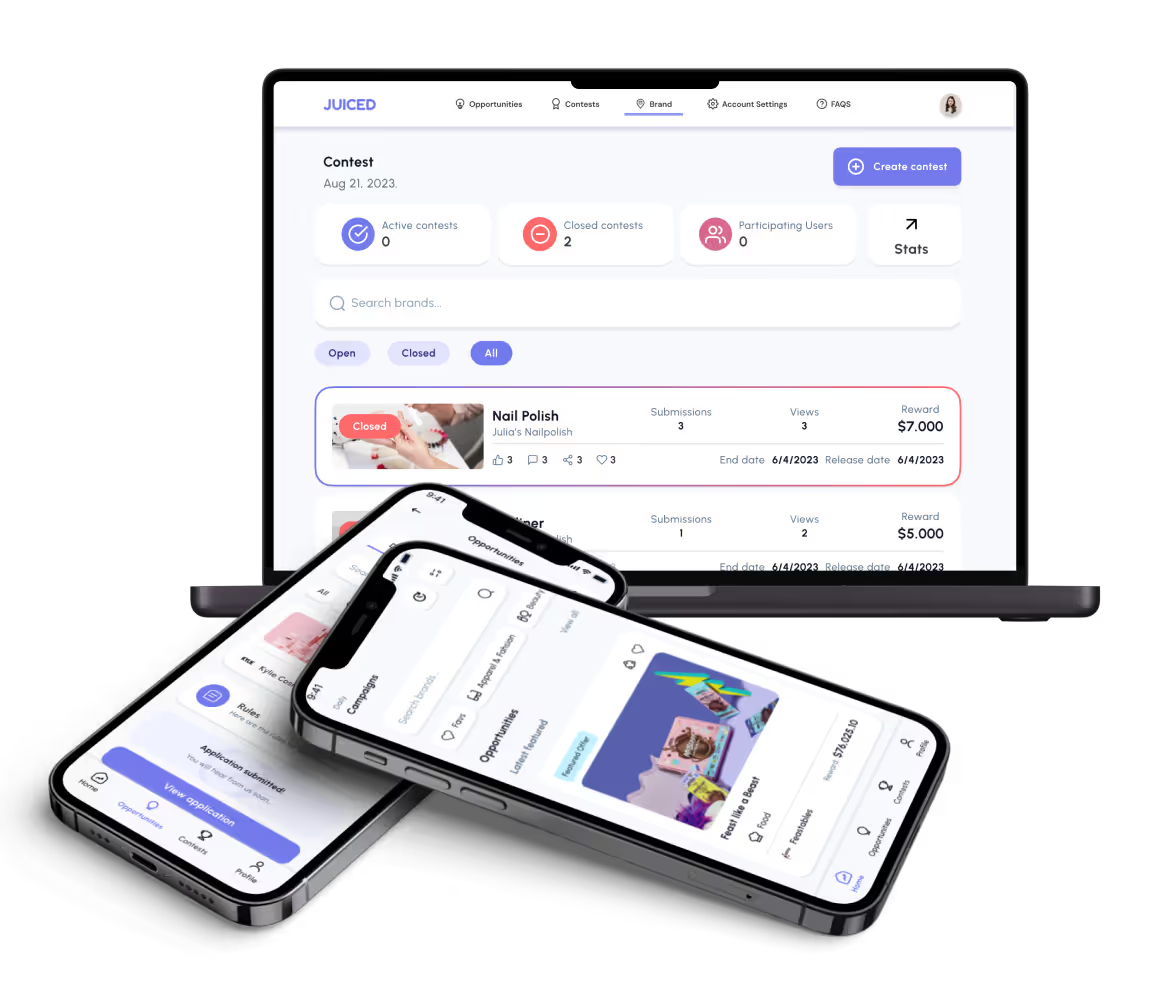

What Can FlutterFlow Build for an Ecommerce App?
FlutterFlow can build a complete ecommerce app including product catalog, cart, Stripe checkout, order tracking, push notifications, user authentication, search, and promo code logic. Ecommerce also demands a web presence, so understanding FlutterFlow web app capabilities is critical before committing to this stack.
The visual builder handles the customer-facing commerce loop well. The data architecture and payment integration require deliberate planning before a single screen is built.
Product Catalog with Variants
Products with size, colour, and SKU variants pull dynamically from Firestore or Supabase, displaying in a filterable grid or list layout.
Shopping Cart and Wishlist
Persistent cart state and wishlist functionality use local state management and user-linked Firestore collections to survive app restarts.
Stripe Checkout Integration
Stripe payment processing connects via FlutterFlow's API calls or Firebase Extensions, supporting one-time purchases and saved card payments.
Order Tracking and History
Customers view real-time order status driven by Firestore document listeners linked to order state fields updated by backend logic.
Push Notifications for Order Updates
Firebase Cloud Messaging triggers push alerts when order status changes or shipping updates arrive from fulfilment systems.
User Authentication and Profiles
Email, Google, and Apple sign-in are available out of the box, with profile pages and saved address management included.
Search and Filter
Product search with category filtering and price range sliders uses Firestore queries and custom widget logic for responsive results.
Promo Codes and Discount Engine
Coupon code validation logic runs through Cloud Functions that check code eligibility and apply discounts at checkout before payment processes.
A well-designed Firestore schema determines how cleanly all these features perform under real usage. Data architecture is the decision that matters most before build begins.
How Long Does It Take to Build an Ecommerce App with FlutterFlow?
A simple ecommerce MVP with catalog, cart, and Stripe checkout takes 4–6 weeks in FlutterFlow. A full-featured ecommerce app with reviews, promo codes, order management, and admin panel takes 10–16 weeks.
Timeline is driven by payment integration complexity, the number of product variants, and admin panel scope.
- MVP scope is achievable fast: Catalog, cart, and Stripe checkout are well-supported in FlutterFlow and ship in 4–6 weeks with an experienced team.
- Admin panel adds significant scope: A back-office order management and inventory panel can double the build timeline if not scoped upfront.
- Phased approach reduces risk: Launch with the core commerce loop first, then add loyalty programs and reviews in phase two.
- FlutterFlow versus custom timeline: FlutterFlow delivers in weeks what Rails or Node custom builds take quarters to ship.
- Payment integration complexity: Saved cards, subscription billing, and multi-currency support each add days, not hours, to build time.
The phased launch approach also generates real customer data before you invest in advanced features like promo codes and loyalty programmes.
What Does It Cost to Build a FlutterFlow Ecommerce App?
Before scoping your ecommerce build, review the FlutterFlow pricing breakdown to understand platform costs alongside development fees. The subscription is a minor line item; development and ongoing infrastructure are the real budget drivers.
Platform costs run $0–$70 per month. The developer investment is where budgets are set.
- Platform cost is low: The FlutterFlow subscription runs $0–$70 per month, a negligible share of the total project investment.
- Freelancer versus agency: Simple product catalogs work with a strong freelancer; multi-phase commerce builds with admin panels warrant an agency.
- Hidden cost: Cloud Functions: Discount engine validation, order routing logic, and notification triggers each require Cloud Function development time.
- Hidden cost: inventory APIs: Third-party inventory or warehouse management integrations add both development cost and ongoing API subscription fees.
- Custom comparison: An equivalent ecommerce app in custom code costs $80,000–$200,000, making FlutterFlow 3–5x more cost-effective.
App store fees are a fixed annual cost. Budget them alongside ongoing Firebase and Stripe costs in your operating model from day one.
How Does FlutterFlow Compare to Custom Development for Ecommerce?
FlutterFlow delivers a full ecommerce app in 6–16 weeks versus 6–18 months for a custom build at equivalent feature scope. It costs 3–5x less for the same customer-facing commerce experience. The comparison shifts for enterprise SKU catalogs and ERP-synced inventory.
For DTC brands, niche product stores, and MVP validation, FlutterFlow wins clearly. Custom development wins when the business depends on complex inventory integration or multi-merchant platform logic.
- FlutterFlow wins: DTC brands, niche product stores, mobile-first commerce, and MVP validation where speed and cost matter most.
- Custom wins: Enterprise SKU catalogs, complex ERP integrations, and platform-level multi-merchant architecture.
- Maintenance advantage: FlutterFlow reduces ongoing developer dependency for storefront updates, promotions, and product additions.
- Capability ceiling: B2B pricing tiers, headless Shopify integrations, and ERP-synced inventory exceed what the visual builder handles natively.
If you are weighing no-code options, the Bubble vs FlutterFlow for ecommerce comparison covers trade-offs in data handling and deployment that matter for commerce apps.
What Are the Limitations of FlutterFlow for Ecommerce App Development?
The primary limitations for ecommerce in FlutterFlow are real-time inventory sync with external warehouses and multi-variant product logic at scale. For ecommerce, payment data security is non-negotiable, so review FlutterFlow security considerations before finalising your architecture.
Most limitations are manageable with the right architectural decisions. A few are genuine constraints that affect whether FlutterFlow is the right fit.
- Real-time inventory sync: Live inventory updates from external warehouses are not native and require custom API middleware between FlutterFlow and your warehouse system.
- Multi-variant complexity: Size-by-colour-by-quantity product matrices become difficult to manage cleanly in the visual builder as SKU count grows.
- Nested discount logic: Tiered discount stacks and nested conditional pricing rules are hard to maintain and debug in the visual editor over time.
- Flash sale scale risk: High-traffic events can strain Firestore read limits without careful indexing and query planning before launch.
- SEO constraints: FlutterFlow's web output works for ecommerce storefronts but has limitations around server-side rendering that affect organic search performance.
- Code export quality: Exporting to Flutter/Dart is available as an exit option, but exported code requires cleanup and Flutter expertise to maintain independently.
These limitations affect platform choice most for businesses with large SKU catalogs, warehouse integrations, or heavy SEO dependence. DTC mobile-first brands rarely hit them.
How Do You Find the Right Team for a FlutterFlow Ecommerce App?
Knowing how to hire FlutterFlow developers with ecommerce-specific experience saves significant cost and rework. The team needs Stripe integration experience, Firebase architecture knowledge, and a portfolio that includes live ecommerce examples.
The right team asks about your product catalog structure, payment requirements, and admin panel scope before quoting a timeline.
- Stripe integration experience is required: Payment processing, refunds, and saved cards require proper Stripe webhook implementation, not just a basic payment form.
- Firestore data modelling skill: Product variants, cart state, order history, and discount codes each require deliberate schema design before build begins.
- App store submission history: Confirm the team has submitted Flutter apps to both the Apple App Store and Google Play successfully.
- Red flag: vague timelines: Any team that quotes a timeline without asking about admin panel scope and product variant complexity is not experienced with ecommerce builds.
- Questions to ask: How do you handle real-time inventory? What is your Stripe integration approach? Can you show an order management panel from a past project?
Expect scoping in week one, design in weeks two and three, and build from week four through week ten for a full-featured ecommerce app.
Conclusion
FlutterFlow is a genuinely capable platform for ecommerce app development. The full commerce loop from product display through payment and order tracking is achievable without custom code.
Teams that skip proper data modelling and payment architecture planning will hit walls at the inventory and checkout layers. Map your required features against FlutterFlow's capabilities before committing, and engage a team with live commerce builds in their portfolio.
Building an Ecommerce App with FlutterFlow? Here Is How LOW/CODE Agency Approaches It.
Most ecommerce app projects run over budget when the Firestore schema is not designed before the first screen is built. Changing data architecture mid-build costs weeks. Getting it right upfront is the difference between a clean launch and a rebuild.
As AI development experts, we at LOW/CODE Agency help SMBs ship real software — web and mobile applications, intelligent chatbots, RAG pipelines, and autonomous AI agents built for businesses that need results, not platforms. We design your product catalog, cart, and order data architecture before touching the visual builder. Then we build the Stripe integration, Cloud Function logic, and admin panel with the same rigour we apply to enterprise commerce builds.
- Firestore schema design: We design your product, cart, and order data model before build begins, preventing the architecture rework that derails most ecommerce projects.
- Stripe integration: We implement payment processing, refunds, and saved card flows with proper webhook handling, not a basic API call.
- Product catalog and variants: We build your catalog, variant selector, and search with Firestore queries optimised for the browse patterns your customers use.
- Admin order management: We build the back-office panel for order management, refund processing, and inventory updates alongside the customer-facing app.
- Push notifications and promos: We implement Cloud Messaging for order updates and Cloud Function validation for promo codes and discount logic.
- App store submission: We handle Apple App Store and Google Play submission, review responses, and post-launch updates.
- Full product team: Strategy, design, development, and QA from a single team that treats your ecommerce app as a product, not a project.
We have built 350+ products for clients including Coca-Cola, American Express, and Sotheby's. We know where ecommerce builds hit walls and how to design past them before they cost you.
Related Articles
- How to Build an Employee Onboarding App with FlutterFlow
- How to Build an Electricity Usage Dashboard with FlutterFlow
- How to Build an Education App with FlutterFlow
- How to Build a Dropshipping App with FlutterFlow
- How to Build a Driver Tracking Dashboard with FlutterFlow
- How to Build a Driver Onboarding Platform with FlutterFlow
Last updated on
September 24, 2026
.

Jesus is a visionary entrepreneur and tech expert. After nearly a decade working in web development, he founded LOW/CODE Agency to help businesses optimize their operations through custom software solutions.


FAQs
What are the first steps to create an ecommerce app in FlutterFlow?
Can FlutterFlow handle payment processing for ecommerce apps?
How do I manage product listings and inventory in FlutterFlow?
Is it possible to implement user authentication in a FlutterFlow ecommerce app?
What are common challenges when building ecommerce apps with FlutterFlow?
How can I test and deploy my FlutterFlow ecommerce app effectively?
Related Articles
Comparison
FlutterFlow
FlutterFlow vs Flutter | Which One Should You Use in 2026?
Compare FlutterFlow vs Flutter to see which fits your app. Learn differences in speed, scalability, control, costs, and when each makes sense in 2026.

FlutterFlow
How to Build a Fintech App with FlutterFlow
Learn step-by-step how to create a fintech app using FlutterFlow with no coding. Discover key features, security tips, and deployment advice.
FlutterFlow
How to Build a Microfinance Platform with FlutterFlow
Learn how to create a microfinance platform using FlutterFlow with step-by-step guidance and key features for success.
FlutterFlow
How to Build a Table Reservation App with FlutterFlow
Learn how to create a table reservation app using FlutterFlow with step-by-step guidance and best practices for smooth development.


Why customers trust us for no-code development


