

How to Build a Service Marketplace App with FlutterFlow
15 min
read
Learn how to create a service marketplace app using FlutterFlow with step-by-step tips and best practices for smooth development.


Service marketplaces live or die on trust. Buyers need verified providers and safe payments; providers need visibility and a reliable payout flow. Most founders underestimate how much engineering those two requirements demand.
FlutterFlow covers the provider profiles, booking calendar, Stripe Connect payments, messaging, and review layers well. This guide covers what is achievable, what is not, and what you should define before briefing a development team.
Key Takeaways
- Provider profiles are achievable: FlutterFlow renders rich profiles with photos, credentials, service listings, ratings, and portfolio images without custom code.
- Stripe Connect handles payouts: Buyer payments route through Stripe Connect with platform commission deducted at the transaction split level automatically.
- Booking needs careful design: Calendar availability with conflict prevention requires transactional Firestore writes designed correctly from day one.
- Messaging is a standard feature: Real-time provider-buyer threads are a native Firestore capability and work reliably at low-to-medium scale.
- Escrow is complex: Holding payment until service completion requires Stripe payment intent coordination beyond a standard Connect split setup.
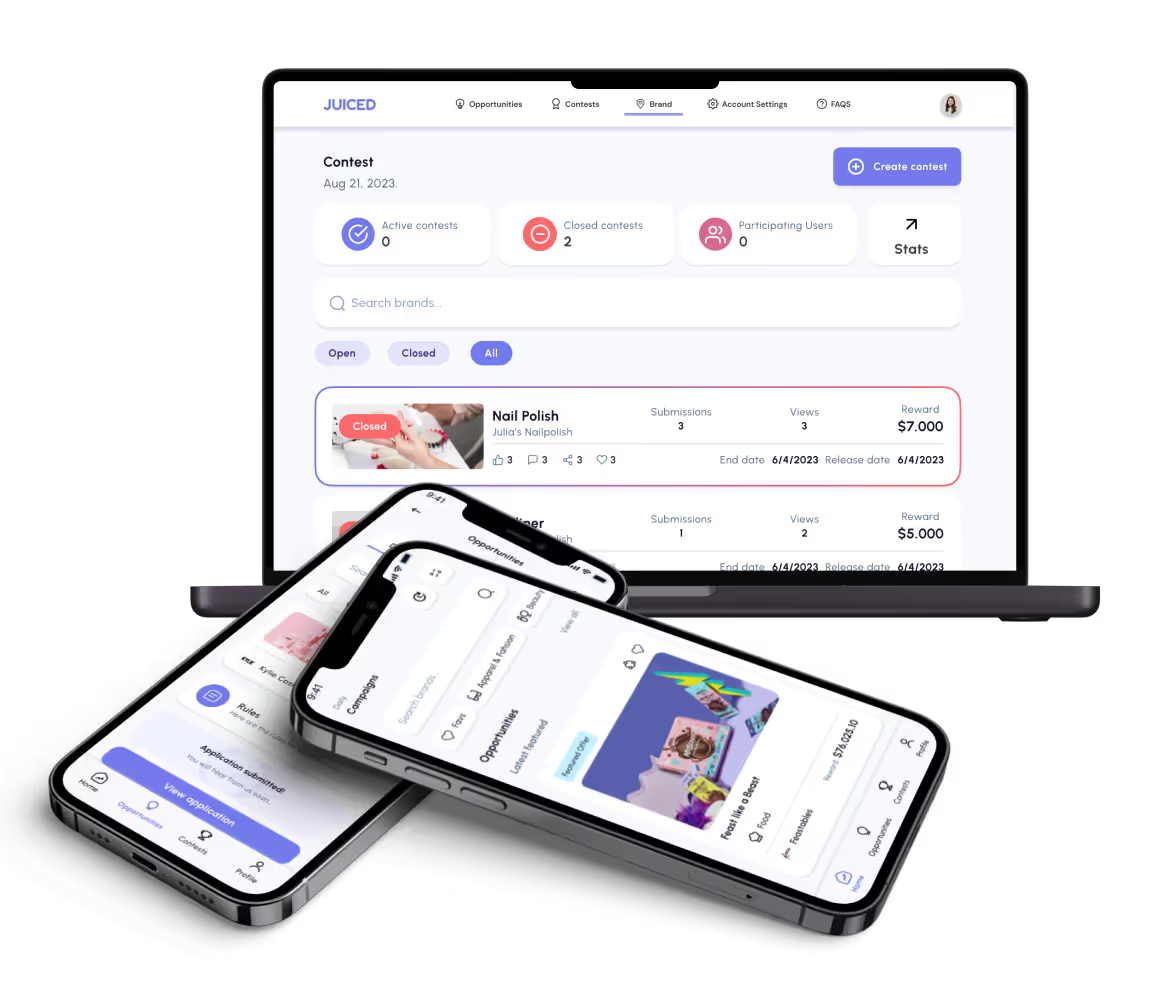

What Can FlutterFlow Build for a Service Marketplace App?
FlutterFlow can build the full provider-buyer experience for a service marketplace, including profiles, booking, Stripe Connect payments, messaging, milestone tracking, reviews, and dispute escalation. Escrow-style payment holds and AI-powered provider matching require additional backend engineering.
Service marketplaces share architecture patterns with SaaS products, and understanding whether you can build a SaaS with FlutterFlow helps frame capability expectations for this platform type.
Provider Profile and Portfolio Display
Providers build profiles with bio, service categories, portfolio images, certifications, and availability hours. Buyers browse and compare providers before making a booking decision.
Profiles pull from Firestore and display in real time, making updates visible immediately without a manual refresh.
- Rich media profiles: Photos, certifications, and portfolio images display in structured cards, giving buyers the context needed to choose a provider confidently.
- Service category filtering: Buyers filter providers by category, location, or rating to find the right match quickly across a large provider list.
- Availability hours display: Providers set their working hours, and buyers see current availability before requesting a booking slot.
Service Listing and Pricing Packages
Providers create tiered service packages with distinct deliverables, timelines, and prices for each tier. Buyers compare packages before selecting and booking.
Tiered pricing is a standard Firestore data pattern and displays cleanly in FlutterFlow without custom logic.
- Package tiers: Basic, standard, and premium packages each carry separate deliverables and pricing, giving buyers a clear choice before committing.
- Deliverable detail: Each package lists included items and expected delivery time, reducing buyer questions before the booking is confirmed.
- Price display and comparison: Package pricing displays side by side, letting buyers evaluate value before choosing and proceeding to payment.
Calendar Availability and Booking Flow
Buyers view a provider's available slots on a calendar and book a session or project start date with confirmation sent to both parties.
Booking conflict prevention requires transactional Firestore writes to lock a slot atomically. This must be designed deliberately from day one.
- Calendar slot display: Available time slots render on a calendar interface, showing only unbooked times to prevent double booking attempts.
- Booking confirmation flow: Both provider and buyer receive confirmation notifications immediately after a booking is created and slot is locked.
- Conflict prevention logic: Transactional Firestore writes lock the selected slot at the database level, blocking concurrent booking attempts for the same time.
Stripe Connect Service Payment
Buyer payment processes through Stripe Connect. The provider's share routes to their connected account after the platform commission is deducted at the split level.
Stripe Connect onboarding for providers requires identity verification handled via Stripe's hosted flow, not inside FlutterFlow directly.
- Platform commission deduction: Stripe Connect splits the payment automatically at the configured rate, routing provider earnings without manual reconciliation needed.
- Provider payout setup: Providers complete Stripe's hosted onboarding to connect their bank account before receiving any platform earnings.
- Payment confirmation tracking: Payment status updates via Stripe webhook, keeping order status current in Firestore without manual checking.
In-App Messaging Thread
A persistent messaging thread links buyer and provider from booking through delivery and review. All messages store in Firestore with real-time listener updates.
Messaging is one of FlutterFlow's strongest real-time features for marketplace use cases at low-to-medium user volumes.
- Real-time message delivery: Firestore real-time listeners push new messages to both parties instantly, without manual refresh or polling needed.
- Thread persistence: The complete message history between buyer and provider persists in Firestore and remains accessible after order completion.
- Push notification alerts: New messages trigger push notifications so neither party misses time-sensitive communication during an active order.
Order Status and Milestone Tracking
Project-based services track milestones from brief received through revision to delivery. Both buyer and provider see the current status on their respective dashboards.
Milestone state lives in Firestore and updates via button actions in the provider's interface without requiring custom code.
- Milestone visibility: Both buyer and provider see the current project stage, reducing status-check messages and keeping expectations aligned throughout delivery.
- Status update triggers: Providers advance the milestone state with a single action, triggering buyer notifications and dashboard updates automatically.
- Revision request flow: Buyers request revisions directly from the milestone view, creating a structured record that links back to the original deliverable.
Review and Rating After Completion
On order completion, buyers rate and review the provider. Providers can optionally rate buyers for platform quality control purposes.
Reviews write to Firestore and update the provider's aggregate rating displayed on their profile immediately after submission.
- Star rating capture: Buyers submit a 1-5 star rating at order completion, and the provider's average rating recalculates and displays on their profile.
- Written review display: Text reviews appear publicly on the provider profile, helping future buyers make informed decisions before booking.
- Buyer rating option: Providers can rate buyers after completion, creating a two-sided reputation system that deters problematic buyer behaviour.
Dispute and Support Escalation
Either party flags an order dispute. The platform admin receives the case, views the full message history, and mediates resolution from the admin dashboard.
Dispute records store in Firestore and link to the originating order, messaging thread, and milestone timeline for full admin context.
- Dispute flag submission: Either party submits a dispute with a category and description, creating a structured case record linked to the original order.
- Admin case dashboard: Admins see all open disputes, full message history, and milestone timeline in one place for informed mediation.
- Resolution outcome logging: The admin records the resolution decision, which updates order status and notifies both parties of the outcome.
How Long Does It Take to Build a Service Marketplace App with FlutterFlow?
A simple service marketplace MVP covering provider profiles, booking, and Stripe payment takes 8 to 14 weeks. A full platform with messaging, milestone tracking, reviews, dispute management, and admin dashboard takes 18 to 28 weeks.
Timeline depends heavily on booking conflict resolution complexity and how deeply milestone-based payments are structured.
- Simple MVP scope: Provider profiles, calendar booking, Stripe Connect payment, and basic notifications ship in 8 to 14 weeks with a focused build team.
- Full platform scope: Adding in-app messaging, milestone tracking, review system, dispute escalation, and admin dashboard extends the build to 18 to 28 weeks.
- Calendar complexity factor: Real-time conflict prevention across provider calendars at booking volume adds design time beyond a basic availability display.
- Stripe Connect onboarding: Provider identity verification via Stripe's hosted flow requires integration work that adds one to two weeks to the payment phase.
- Phased approach advantage: Launching booking and payment first generates real provider and buyer data before investing in messaging and milestone automation.
FlutterFlow delivers the provider and buyer UI significantly faster than custom development. Stripe Connect and booking conflict logic take consistent engineering time regardless of the platform used.
What Does It Cost to Build a FlutterFlow Service Marketplace App?
A FlutterFlow service marketplace costs $25,000 to $110,000 depending on scope. A provider profile, booking, and payment MVP sits at the lower end; a full two-sided platform with messaging, milestone tracking, and admin tools sits at the top.
FlutterFlow pricing plans are a fixed, modest monthly cost. The real investment is in Stripe Connect setup, booking conflict logic, and the messaging and admin systems.
- Platform cost is minimal: FlutterFlow's monthly fee is a small fraction of total project cost; Stripe Connect and booking logic drive the budget.
- Freelancer vs agency tradeoff: Freelancers suit focused provider profile and booking MVPs; agencies suit full two-sided platforms with dispute resolution and admin tooling.
- Custom comparison: Equivalent service marketplaces built from scratch typically cost $150,000 to $400,000 and take 12 to 24 months to deliver.
- Hidden cost: dispute tooling: Admin dispute resolution interfaces add development time that most initial scoping documents do not include in the first estimate.
- Hidden cost: provider verification: Third-party identity or credential verification APIs for provider onboarding add per-check costs not included in standard platform fees.
- Hidden cost: calendar sync: Google Calendar or Outlook synchronisation for provider availability adds integration scope beyond a native FlutterFlow calendar display.
Budget a 15 to 20 percent contingency for payment flow complexity discovered during build. Stripe Connect edge cases surface consistently during testing across different provider and buyer scenarios.
How Does FlutterFlow Compare to Custom Development for a Service Marketplace App?
FlutterFlow delivers a service marketplace in 18 to 28 weeks at $35,000 to $110,000. An equivalent custom-built platform takes 24 to 48 months and costs $150,000 to $400,000 or more. The trade-off is capability ceiling, not quality.
- Speed advantage is decisive: FlutterFlow delivers a working marketplace in weeks; custom builds take months to reach the same functional state.
- Cost advantage is significant: Custom service marketplace development starts at $150,000 for a basic platform; FlutterFlow full platforms run $35,000 to $110,000.
- When FlutterFlow wins: Niche service verticals, regional marketplaces, and MVPs built to validate supply and demand before larger investment.
- When custom wins: High-volume global platforms requiring AI-powered provider matching, complex dynamic pricing, and real-time booking at tens of thousands of concurrent users.
A balanced review of FlutterFlow pros and cons helps service marketplace founders make the platform decision before committing to development budgets.
What Are the Limitations of FlutterFlow for a Service Marketplace App?
FlutterFlow cannot natively hold payments in escrow until service completion, prevent booking conflicts at high volume without careful Firestore design, or power AI-driven provider matching. These requirements need custom backend engineering outside the visual builder.
FlutterFlow scalability becomes a critical planning factor as a service marketplace grows its provider network and concurrent booking volume across peak periods.
- Escrow payment complexity: Holding funds until delivery requires Stripe payment intents coordination with manual or webhook-triggered release logic beyond a basic Connect split.
- Booking conflict prevention: Preventing double bookings across provider calendars at high volume requires transactional Firestore writes designed deliberately and tested under load.
- Milestone payment releases: Splitting payments across project milestones (50% upfront, 50% on delivery) requires custom Cloud Functions logic and Stripe coordination.
- App store scrutiny: Marketplaces with user-generated content and in-app payments receive more review scrutiny from Apple and Google, adding submission timeline risk.
- Real-time messaging at scale: Firestore real-time listeners for concurrent messaging threads at high user volumes require performance planning beyond default database configuration.
- Platform dependency risk: Service marketplace apps are long-lived; FlutterFlow platform changes affect long-term maintenance costs and upgrade paths for the application.
These limitations are real but manageable. The key is identifying your payment release model and booking conflict requirements before scoping, not after development begins.
How Do You Find the Right Team for a FlutterFlow Service Marketplace App?
You need a team with Stripe Connect experience, real-time Firestore messaging knowledge, and calendar availability modeling skills. Two-sided platform experience is more important than general FlutterFlow proficiency alone.
When you hire FlutterFlow developers for a service marketplace, Stripe Connect and booking conflict resolution experience are the primary screening criteria, not just FlutterFlow hours logged.
- Stripe Connect requirement: Any candidate without a live Stripe Connect implementation in their portfolio is not ready for a service marketplace build.
- Booking conflict approach: Ask specifically how they prevent double bookings at the database level; vague answers indicate missing real-world scheduling experience.
- Messaging implementation: Request a working example of a Firestore real-time messaging thread; this separates experienced FlutterFlow developers from beginners quickly.
- Red flag: no live reference: A team without a live service marketplace reference cannot demonstrate they understand the edge cases that only appear in production.
- Agency for full platforms: Multi-feature marketplaces with dispute resolution, admin dashboards, and provider verification need a team, not a solo developer.
- Expected timeline from a good team: Architecture review in weeks one and two, scoping in weeks two to four, build beginning in week five with clear milestone delivery.
Interview at least two teams and ask for a specific booking conflict resolution approach and a Stripe Connect escrow or split implementation example before signing a contract.
Conclusion
FlutterFlow is a strong platform for building service marketplace apps. Provider profiles, calendar booking, Stripe Connect payments, in-app messaging, and reviews are all achievable within a realistic budget and timeline. The platform delivers the provider-buyer experience faster than any custom alternative at this price point.
Escrow payment logic, booking conflict prevention at scale, and milestone payment releases require experienced backend engineering. Define your payment release model and booking conflict requirements before briefing a team. Then engage a developer with a live service marketplace in their portfolio.
Building a Service Marketplace App with FlutterFlow? Here Is How LOW/CODE Agency Approaches It.
Service marketplace apps are not standard app builds. Stripe Connect architecture, booking conflict prevention, real-time messaging, and dispute resolution each require engineering decisions that affect every other part of the platform.
As AI development experts, we at LOW/CODE Agency help SMBs ship real software — web and mobile applications, intelligent chatbots, RAG pipelines, and autonomous AI agents built for businesses that need results, not platforms. We build FlutterFlow service marketplaces with the full stack behind them: Stripe Connect integration, transactional booking conflict logic, real-time Firestore messaging, provider onboarding flows, and admin dispute tooling from a team that understands two-sided platform requirements.
- Stripe Connect architecture: We set up provider onboarding, platform commission splits, and payment status webhook handling correctly before any booking flow goes live.
- Booking conflict prevention: We design transactional Firestore writes that lock availability slots atomically, preventing double bookings under concurrent user conditions.
- Real-time messaging build: We implement persistent provider-buyer threads with push notification alerts and full message history accessible after order completion.
- Milestone and payment logic: We build milestone tracking with configurable payment release rules, including partial upfront and completion-triggered payout flows.
- Dispute resolution tooling: We build admin case dashboards with full order context, message history, and resolution logging so your team can mediate efficiently.
- Phased delivery: We scope and ship provider profiles, booking, and Stripe Connect first, then layer in messaging, milestone tracking, and dispute tools in subsequent phases.
- Full product team: Strategy, UX, development, and QA from a single team so your marketplace is production-ready, not just technically functional.
We have built 350+ products for clients including Coca-Cola, American Express, and Sotheby's. We know where service marketplace builds stall, and we design the architecture to avoid those failures before a line of code is written.
Related Articles
- How to Build a Smart Home Control App with FlutterFlow
- How to Build a Site Inspection App with FlutterFlow
- How to Build a Shift Scheduling App with FlutterFlow
- How to Build a Savings Tracker App with FlutterFlow
- How to Build a Salon Booking App with FlutterFlow
- How to Build a Sales CRM App with FlutterFlow
Looking to go low-code? Our low-code development services reduce build time without sacrificing quality.
Last updated on
September 24, 2026
.

Jesus is a visionary entrepreneur and tech expert. After nearly a decade working in web development, he founded LOW/CODE Agency to help businesses optimize their operations through custom software solutions.


FAQs
What are the first steps to create a service marketplace app in FlutterFlow?
How can I manage user authentication in a FlutterFlow marketplace app?
What backend options work best with FlutterFlow for marketplace apps?
How do I handle payments in a service marketplace app built with FlutterFlow?
Can I customize the UI of my marketplace app beyond FlutterFlow’s templates?
What are common challenges when building a marketplace app with FlutterFlow?
Related Articles

FlutterFlow
How to Build a Client Intake System with FlutterFlow
Learn how to create a client intake system using FlutterFlow with step-by-step guidance and best practices for smooth data collection.

FlutterFlow
How to Build Legal Tech Apps with FlutterFlow
Learn how to create legal tech apps using FlutterFlow with step-by-step tips and best practices for efficient development.

FlutterFlow
How to Build a Creator Marketplace App with FlutterFlow
Learn how to create a creator marketplace app using FlutterFlow with step-by-step tips and best practices for success.

FlutterFlow
How to Build a Multi-Vendor Marketplace with FlutterFlow
Learn how to create a multi-vendor marketplace using FlutterFlow with step-by-step tips and best practices for success.


Why customers trust us for no-code development


