

How to Build an AI Recommendation App with FlutterFlow
13 min
read
Learn how to create an AI recommendation app using FlutterFlow with step-by-step guidance and best practices for seamless integration.


What makes a FlutterFlow AI recommendation app different from a generic list view? The recommendation quality, and that quality is entirely determined by the back-end model, not FlutterFlow itself.
FlutterFlow renders the feed, captures the behavior signals, and displays why an item was recommended. The intelligence layer, whether LLM-based or ML-based, lives outside the platform. This guide explains what FlutterFlow delivers, what stays external, and what the build realistically costs.
Key Takeaways
- FlutterFlow renders, it does not generate: AI model inference runs externally, FlutterFlow displays what the recommendation API returns.
- Two architectures exist: LLM-based recommendations use prompts; ML-based uses collaborative filtering and requires training data.
- User behavior data is the fuel: Without sufficient historical interaction data, any recommendation engine produces low-quality suggestions regardless of model sophistication.
- Cold start is a real product problem: New users with no history need a fallback recommendation strategy, popularity-based or a preference quiz, to avoid empty feeds.
- Token costs scale with personalization depth: LLM recommendations that include full user history in the prompt generate significant per-call costs at scale.

What Can FlutterFlow Build for an AI Recommendation App?
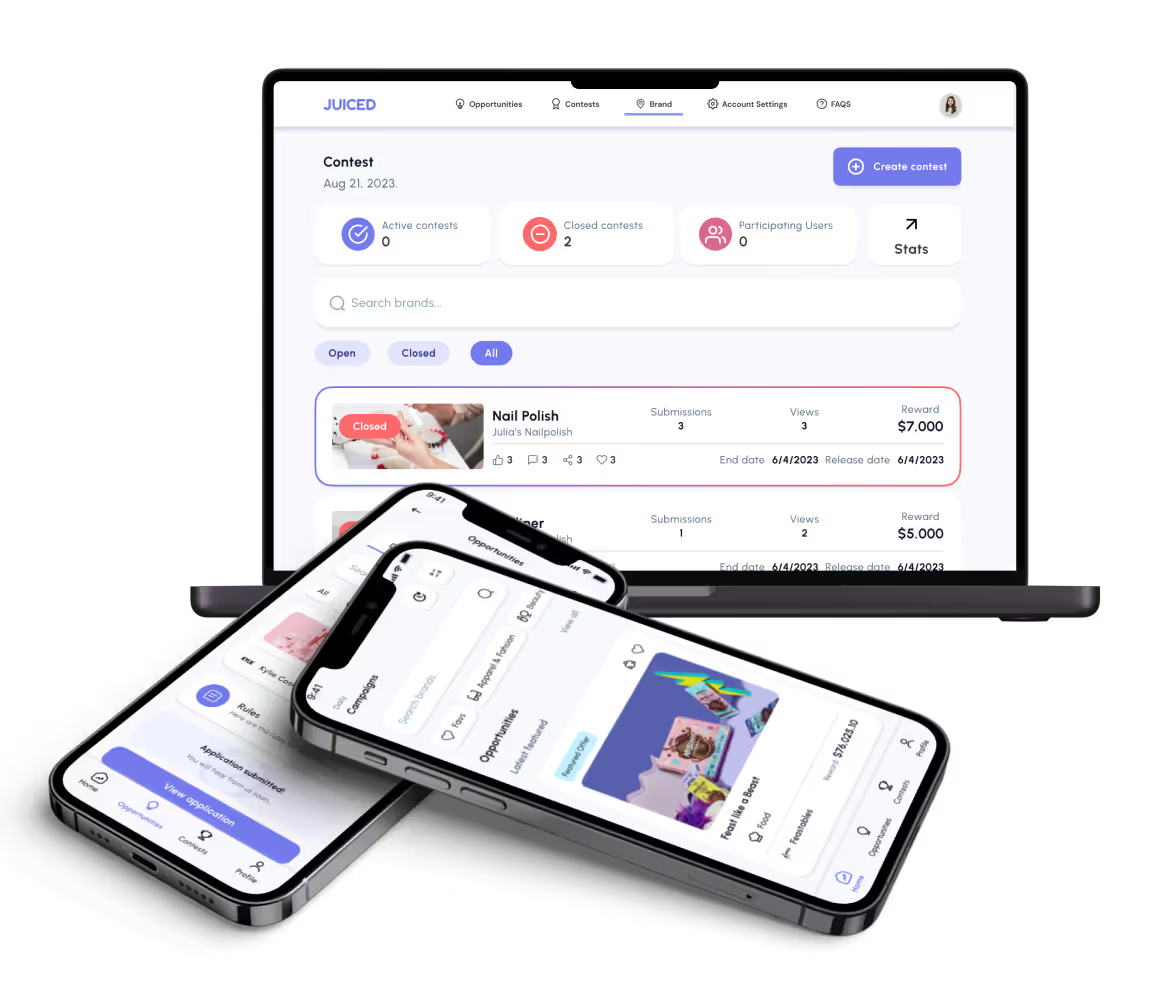
FlutterFlow handles the full recommendation UI layer, personalized feeds, detail screens, preference capture, behavior logging, and filter controls, via API calls to an external recommendation model. Every recommendation fetch is an API call that returns a ranked list FlutterFlow displays.
Understanding how to build AI-powered recommendation apps in FlutterFlow starts with the API action architecture, each recommendation fetch is an API call to an external model that returns a ranked list FlutterFlow displays.
Personalized Recommendation Feed
A scrollable card or grid feed displays AI-generated recommendations pulled from a recommendation API, with user-specific ranking based on interaction history.
- API-driven card rendering: FlutterFlow maps the returned recommendation array to card components, rendering each item with title, image, and relevance metadata.
- Pagination and lazy loading: Infinite scroll loads the next batch of recommendations as the user reaches the end of the current feed.
- Refresh on signal capture: The feed re-queries the recommendation API after significant user interactions, surfacing updated rankings without a full app reload.
Recommendation Detail Screen
An individual item detail view includes an AI-generated explanation of why the item was recommended for this specific user, increasing transparency and trust.
- Recommendation rationale display: The explanation text returned by the API renders in a dedicated section below item details, using plain language the user understands.
- Save and share actions: Users can save an item to a favorites collection or share it, both of which generate additional behavior signals.
- Similar item trigger: A "More like this" button at the bottom fires a recommendation API call with the current item as the seed, keeping users in discovery mode.
Onboarding Preference Quiz
A multi-step preference collection screen seeds the recommendation engine with explicit interest data before behavioral data accumulates, solving the cold start problem.
- Structured preference capture: Each quiz step collects a category, style, or preference dimension stored in Firestore as the user's initial profile.
- Progressive disclosure design: The quiz presents three to five steps with visual options, not text fields, reducing abandonment and increasing completion rates.
- Immediate feed population: On quiz completion, the collected preferences trigger an immediate API call that populates the first recommendation feed without a blank state.
Implicit Feedback Capture
Silent logging of user interactions, tap, dwell time, swipe direction, add to favorites, feeds the recommendation model's behavior signal without requiring explicit ratings.
- Event logging architecture: Each interaction type writes a structured event document to Firestore with item ID, event type, timestamp, and session context.
- Dwell time measurement: A timer starts when an item detail screen opens and stops on exit, logging duration as a quality signal for the recommendation model.
- Batch signal transmission: Accumulated events are sent to the recommendation model's training pipeline on a schedule, not on every individual interaction.
Explicit Rating Interface
A star rating or thumbs up/down component on each recommendation item captures explicit preference signals stored in Firebase and sent to the recommendation model for re-ranking.
- Rating component binding: Each rating interaction writes the item ID, rating value, and user ID to Firestore immediately on selection.
- Visible feedback loop: After rating, the feed visually confirms the signal was received and optionally offers to show fewer items like the rated one.
- Model re-ranking trigger: A threshold number of new explicit ratings triggers a re-rank API call, refreshing the feed with updated recommendations.
Category and Filter Controls
User-configurable filter controls, category, price range, distance, constrain the recommendation API's output scope, blending AI personalization with user-directed filtering.
- Filter state management: Selected filters are stored in app state and appended as parameters to each recommendation API call.
- Combined personalization and filtering: The API receives both the user's behavioral profile and the active filter constraints, returning personalized results within the user's defined scope.
- Filter persistence: User filter preferences save to their Firestore profile, persisting across sessions without requiring re-selection.
"More Like This" Trigger
An action button on any item fires a recommendation API call with the selected item as the seed, returning similar items for exploration-mode browsing.
- Seed item API call: The selected item's ID and attributes are passed to the recommendation API, which returns items with similar feature vectors or semantic proximity.
- Overlay or new screen: Results display in a bottom sheet or dedicated screen without disrupting the main feed, keeping context intact.
- Interaction logging: The "More like this" action itself is logged as a high-confidence positive signal for the recommendation model.
Reviewing FlutterFlow performance app examples shows what has already shipped on the platform in production, benchmarking which features are achievable at your timeline.
How Long Does It Take to Build an AI Recommendation App with FlutterFlow?
A simple LLM-based recommendation MVP takes 5–10 weeks. A full ML recommendation platform with collaborative filtering, behavior signal pipeline, and A/B testing framework runs 16–26 weeks.
The timeline splits between the FlutterFlow UI work and the recommendation model infrastructure, they run in parallel but depend on each other.
- Phase one ships fast: Popularity-based and preference-quiz recommendations launch in weeks 1–5 before behavioral data accumulates.
- LLM-based personalization follows in phase two: Once the preference capture is live, LLM-based personalization layers on top of existing user data.
- ML collaborative filtering comes last: Phase three implements ML-based recommendations after sufficient interaction data accumulates to train a quality model.
- FlutterFlow UI is 2–3x faster: Recommendation UI components deploy much faster than a custom equivalent; model training and pipeline timelines are independent.
A/B testing framework setup and cold start strategy design extend timelines by 3–6 weeks but are non-optional for any recommendation product shipping to real users.
What Does It Cost to Build a FlutterFlow AI Recommendation App?
Building a FlutterFlow AI recommendation app costs $15,000–$80,000 depending on recommendation architecture complexity and data pipeline scope. Ongoing costs include LLM API token fees per recommendation call and ML model hosting infrastructure.
With the FlutterFlow pricing plans overview as your platform baseline, build your cost model for recommendation API calls at daily active user volume, per-call AI costs are what makes or breaks the unit economics.
- LLM recommendation costs compound quickly: Including full user history and item catalog in an LLM prompt for each recommendation call is prohibitively expensive at scale without pre-filtering.
- Training data labeling adds hidden cost: ML recommendation models require labeled interaction data, this preparation phase adds weeks and cost before model training begins.
- A/B test sample size extends launch timelines: Running statistically valid A/B tests on recommendation quality requires minimum user volumes before declaring a winner.
- Cold start UX design and testing is underestimated: Preference quiz design, testing, and iteration add 1–3 weeks to a build that is often not budgeted initially.
Model the cost per recommendation call at your expected daily active user volume before committing to an LLM-based approach at scale.
How Does FlutterFlow Compare to Custom Development for an AI Recommendation App?
FlutterFlow delivers the recommendation UI in 4–8 weeks at 50–70% lower cost than a custom front-end equivalent. ML model infrastructure, behavior data pipelines, and A/B testing framework timelines are similar regardless of which front end is used.
The platform wins at the display and interaction layer. Everything above that is the same engineering work.
- FlutterFlow wins for e-commerce and content apps: Product recommendation feeds, content discovery, and service suggestions deploy fast on FlutterFlow.
- Custom wins at social graph scale: Netflix-scale content recommendation, social graph-based collaborative filtering, and proprietary neural ranking models need dedicated ML engineering.
- Mobile performance is FlutterFlow's advantage: Native mobile rendering gives recommendation feeds a UX edge on FlutterFlow versus a web-based custom build.
- MVP validation is FlutterFlow's strongest case: Testing whether a recommendation feature improves retention is faster and cheaper with FlutterFlow than a custom build.
A Bubble versus FlutterFlow AI apps comparison for recommendation use cases shows that FlutterFlow's native mobile performance gives recommendation feeds a UX advantage for mobile-first products.
What Are the Limitations of FlutterFlow for an AI Recommendation App?
FlutterFlow cannot execute recommendation model inference. The entire intelligence layer, collaborative filtering, content-based filtering, or LLM ranking, runs outside the platform. Behavior data collection, token cost scaling, and data privacy compliance require explicit architecture decisions before build starts.
Before logging user behavior data for recommendation model training, review FlutterFlow security and data privacy requirements, behavioral data collection triggers GDPR consent obligations in most markets.
- Recommendation model is entirely external: FlutterFlow displays what an API returns, collaborative filtering, content-based filtering, and neural ranking all live outside the platform.
- Cold start requires explicit design: New users receive generic or irrelevant recommendations unless a preference quiz or popularity-based fallback is explicitly designed into onboarding.
- Behavior signal pipeline complexity: Capturing implicit signals, dwell time, scroll depth, sequential selections, requires careful Firestore event logging architecture beyond standard analytics.
- Token cost scaling for LLM recommendations: Including full user preference history in each LLM prompt is prohibitively expensive at scale, RAG or pre-filtering is required.
- Real-time personalization latency: Recommendation API call latency of 1–5 seconds is visible in a card feed, caching and pre-fetching must be designed to mask it.
- GDPR behavioral data obligations: Logging detailed user behavior for model training requires a consent flow designed before data collection begins, not retrofitted later.
None of these limitations make FlutterFlow the wrong choice. They make early architecture planning non-negotiable.
How Do You Get a FlutterFlow AI Recommendation App Built?
Agency builds are recommended for ML-based recommendation systems with behavior data pipelines. Freelancers are viable for LLM-based recommendation MVPs with simple preference capture and no ML training infrastructure.
The top FlutterFlow agencies AI projects rely on will approach recommendation apps by designing the data pipeline first and the UI second, quality recommendations require data infrastructure before a single card is displayed.
- Recommendation architecture experience: The team must be able to distinguish LLM-based from ML-based approaches and explain which is appropriate for your data volume.
- Behavior signal pipeline design: Ask specifically how they structure Firestore event logging for recommendation model training, vague answers are a red flag.
- Cold start strategy articulation: A team that cannot explain their cold start approach has not built a recommendation product before.
- GDPR behavioral data compliance: Confirm they have designed GDPR consent flows for behavioral data collection in a prior project, not just server-side privacy policies.
- A/B testing framework experience: Ask whether they have set up a statistically valid A/B test on recommendation quality, not just UI A/B tests.
Expected project timeline: recommendation architecture design in weeks 1–3, behavior pipeline infrastructure in weeks 3–7, FlutterFlow UI build in weeks 4–12, model integration and testing in weeks 10–14.
Conclusion
A FlutterFlow AI recommendation app is achievable and cost-effective for the display and interaction layer.
The recommendation quality is entirely a function of the model and data infrastructure sitting behind it. FlutterFlow delivers the UI fast; the model and pipeline work takes as long as it takes regardless of front end.
Assess your available training data and user volume before choosing between LLM-based and ML-based recommendation architectures. Data availability is the single biggest determinant of which approach is viable at launch.
Building an AI Recommendation App with FlutterFlow? Here Is How LOW/CODE Agency Approaches It.
Most recommendation apps fail not because the UI is wrong but because the data infrastructure was not designed before the build started. Cold start is never solved retroactively.
LOW/CODE Agency is an AI product development company for SMBs. We build web apps, mobile apps, RAG systems, chatbots, and AI agents — custom software engineered for businesses that are not enterprise but demand enterprise-grade AI. We design the recommendation architecture, behavior signal pipeline, and cold start strategy before a single FlutterFlow screen is opened, because the model quality is determined by decisions made in week one, not week ten.
- Architecture selection: We assess your user volume and available training data to recommend LLM-based or ML-based approaches before committing to either.
- Cold start strategy: We design the preference quiz, popularity-based fallback, and onboarding flow that prevents empty feeds on day one.
- Behavior signal pipeline: We architect the Firestore event logging schema that captures implicit and explicit signals in the structure the recommendation model needs.
- GDPR consent flow: We design and implement the behavioral data consent mechanism before data collection begins, not as an afterthought.
- FlutterFlow UI build: We build the recommendation feed, detail screen, filter controls, and rating interface against a live recommendation API with real test data.
- Token cost modeling: For LLM-based recommendations, we model per-call costs at your target daily active user volume and design prompt structure to keep unit economics viable.
- Full product team: Strategy, design, development, and QA from one team, from recommendation architecture to App Store delivery.
We have built 350+ products for clients including Coca-Cola, American Express, and Sotheby's. Personalization and recommendation features are part of our AI app practice.
Related Articles
- How to Build an Attendance Tracking System with FlutterFlow
- How to Build an Athlete Progress Tracking App with FlutterFlow
- How to Build an Analytics Dashboard SaaS with FlutterFlow
- How to Build AI-Enabled Apps with FlutterFlow
- How to Build an AI Document Processing Tool with FlutterFlow
- How to Build a FlutterFlow AI CRM Automation App
Last updated on
September 24, 2026
.

Jesus is a visionary entrepreneur and tech expert. After nearly a decade working in web development, he founded LOW/CODE Agency to help businesses optimize their operations through custom software solutions.


FAQs
What are the first steps to start an AI recommendation app in FlutterFlow?
How do I connect AI models to FlutterFlow for recommendations?
Can FlutterFlow handle real-time recommendation updates?
What are common challenges when building AI recommendation apps with FlutterFlow?
Is coding required to build AI recommendation apps in FlutterFlow?
How can I test and improve the accuracy of recommendations in my app?
Related Articles

FlutterFlow
How to Build a Client Onboarding Portal with FlutterFlow
Learn how to create a client onboarding portal using FlutterFlow with step-by-step tips and best practices for smooth user experience.
FlutterFlow
How to Build a Hiring Workflow Tool with FlutterFlow
Learn how to create a hiring workflow tool using FlutterFlow with step-by-step guidance and best practices for smooth recruitment processes.
FlutterFlow
How to Build an SOP Documentation App with FlutterFlow
Learn how to create an SOP documentation app using FlutterFlow with step-by-step guidance and best practices for smooth app development.

FlutterFlow
Are FlutterFlow Apps Scalable? (What Scales And What Not)
Yes, FlutterFlow apps can scale. Learn what actually scales, what breaks, real limits, backend choices, and when FlutterFlow works for growing apps.


Why customers trust us for no-code development


