

How to Build a Microfinance Platform with FlutterFlow
14 min
read
Learn how to create a microfinance platform using FlutterFlow with step-by-step guidance and key features for success.


A FlutterFlow microfinance platform gives underbanked borrowers fast, accessible loan workflows on the devices they already use. Most MFIs still run paper-based processes that create errors and lost records.
FlutterFlow can digitise every stage of the loan lifecycle at a fraction of custom development cost. This guide covers what it builds, how long it takes, what it costs, and where it falls short.
Key Takeaways
- Loan lifecycle management is buildable: Application, approval, disbursement, repayment scheduling, and collection workflows are all achievable in FlutterFlow.
- Mobile-first serves borrowers well: FlutterFlow's cross-platform output reaches Android-first borrower demographics without separate iOS and Android builds.
- Compliance requirements vary by region: Microfinance is regulated differently across markets, so licensing, interest rate caps, and reporting obligations affect app design.
- Builds take 10–22 weeks for a full platform: Including agent portals, borrower apps, and loan officer dashboards depending on complexity.
- Cost advantage is real: FlutterFlow microfinance platforms run $25,000–$75,000 versus $150,000 or more for custom development.

What Can FlutterFlow Build for a Microfinance Platform?
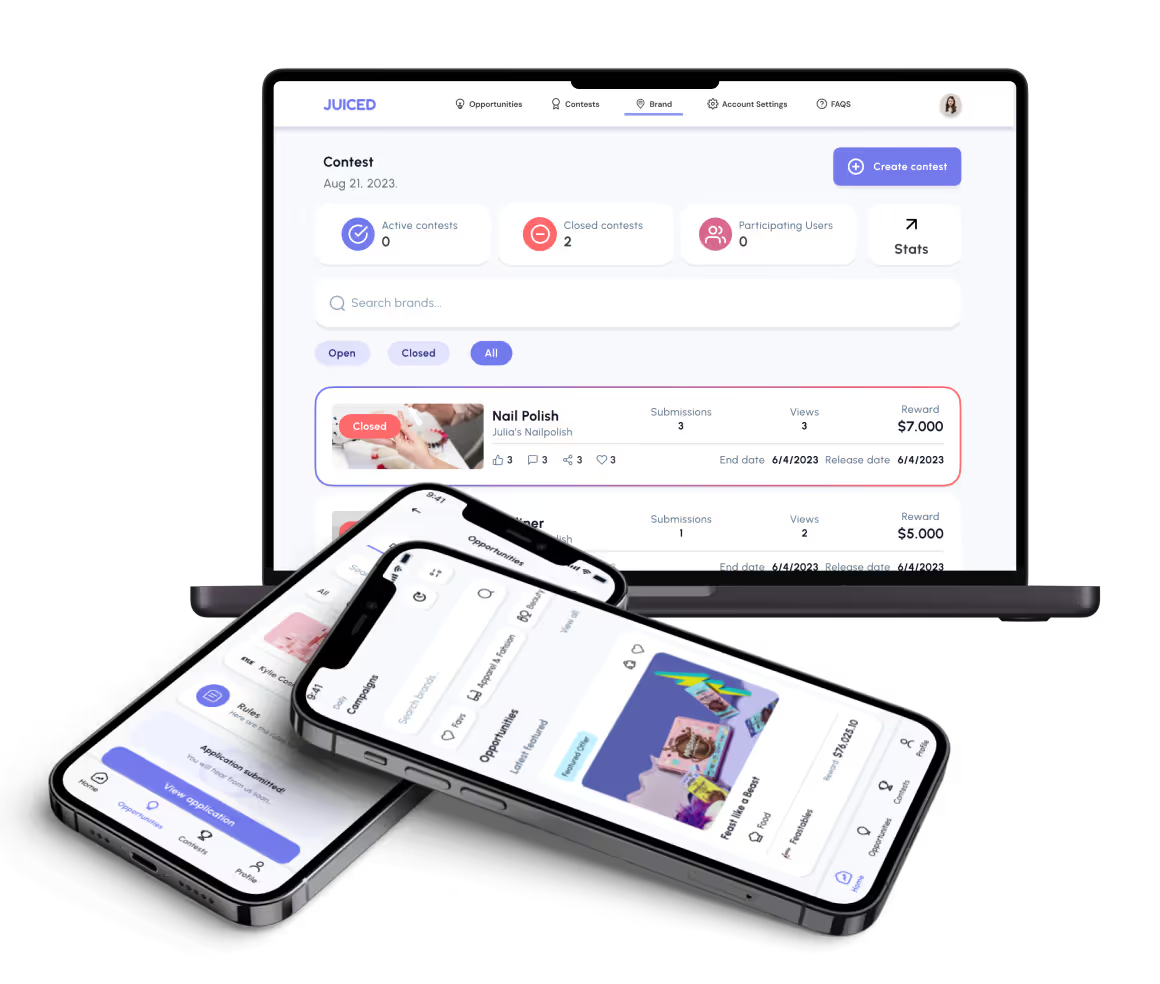
FlutterFlow can build the full loan lifecycle interface: application forms, officer dashboards, repayment tracking, group lending management, and overdue collections. All major microfinance workflows are achievable within FlutterFlow connected to a Firebase or API-based loan management backend.
Building to FlutterFlow scalability for growing platforms ensures your Firestore architecture supports loan volume growth without performance issues later.
Loan Application and Credit Assessment Form
Multi-step loan application forms with income verification, guarantor fields, and document upload connect to a loan management backend via conditional field logic and API submission.
- Conditional field logic: Application forms show or hide sections based on loan type, borrower income band, and guarantor requirements to reduce data entry errors.
- Document upload support: Borrowers upload ID documents and income proof directly through the app to Firebase Storage during the application flow.
- Backend API submission: Completed applications submit to a loan management system via API, triggering the officer review workflow automatically on receipt.
Loan applications built in FlutterFlow support the document-heavy intake processes most MFIs require without building custom form infrastructure from scratch.
Loan Approval Workflow and Officer Dashboard
A loan officer dashboard showing pending applications, borrower profiles, and approval actions can be built as a separate FlutterFlow web or tablet app on the same Firestore backend.
- Role-based access controls: Officers see only their assigned applications; supervisors see the full portfolio across their branch or region in real time.
- Application status updates: Status changes trigger push notifications to the borrower app via Firebase Cloud Messaging on every action taken.
- Approval audit trail: Every officer action is logged with a timestamp and user ID for compliance, audit, and dispute resolution purposes.
A well-structured loan officer dashboard reduces approval cycle times and removes the bottlenecks common in paper-based review processes.
Disbursement Confirmation and Payment Tracking
After loan approval, disbursement confirmation screens and real-time payment status updates render from the backend with push notifications sent via Firebase Cloud Messaging.
- Disbursement confirmation screen: Borrowers receive a confirmation view showing disbursement amount, date, and bank reference number after approval is completed.
- Real-time payment status: Live status updates from the loan management backend display within the borrower app without requiring manual page refresh.
- Push notification triggers: Firebase Cloud Messaging sends disbursement and payment alerts automatically without requiring the borrower to open the app.
Keeping borrowers informed at every payment stage reduces inbound support queries and supports better on-time repayment behaviour.
Repayment Schedule and EMI Calculator
A repayment schedule screen showing instalment amounts, due dates, and outstanding balance can be generated using FlutterFlow's custom functions for loan amortisation calculations.
- Amortisation calculation logic: Custom Dart functions calculate EMI amounts, interest breakdowns, and outstanding balances from loan principal and tenure input parameters.
- Full schedule display: Borrowers see a complete repayment calendar showing each instalment amount, due date, and cumulative interest paid to date.
- Early repayment recalculation: The schedule recalculates automatically when borrowers make partial or early payments, keeping outstanding balances accurate.
Showing borrowers their full repayment schedule upfront reduces payment disputes and supports informed lending consent before disbursement occurs.
Repayment Collection and Receipt Generation
Borrowers log repayments through the app with receipts generated in Firebase Storage and repayment records updated in the loan management backend via API.
- In-app repayment logging: Borrowers confirm payments via the app; the record updates the backend loan management system balance immediately on confirmation.
- PDF receipt generation: Firebase Functions generate PDF receipts on repayment confirmation and store them for permanent borrower access and download.
- Collection agent view: Field agents see a prioritised list of overdue accounts with borrower contact details and full payment history.
Receipt generation must be built on Firebase Functions to meet financial document standards, not FlutterFlow's native action flows.
Group Lending and Member Management
For solidarity group lending models, FlutterFlow renders group member lists, collective loan summaries, and individual contribution tracking within a group-scoped Firestore data structure.
- Group member roster: Each solidarity group has a member list showing individual loan status and contribution history within the collective group record.
- Collective loan summary: Group leaders see aggregate repayment status, meeting attendance records, and collective outstanding balance in a single group dashboard.
- Individual contribution tracking: Each member's payment contributions display separately within the group view alongside their personal repayment schedule.
Group lending data models must enforce strict group-level data isolation to prevent cross-group record contamination across the Firestore database.
Overdue Alert and Collections Workflow
Automated overdue notifications via Firebase Cloud Messaging and an in-app overdue account list for collections agents are achievable using Firestore scheduled functions and FlutterFlow list views.
- Scheduled overdue detection: Firestore scheduled functions identify missed payment dates and trigger push notifications to both the borrower and the assigned collections agent.
- Collections agent queue: A filtered list view surfaces overdue accounts sorted by days past due for prioritised field follow-up and contact attempts.
- Escalation outcome logging: Collection agents log contact attempts and outcomes against each overdue account, creating a full audit trail per case.
As your borrower base grows, understanding FlutterFlow scalability for growing platforms will determine whether your Firestore architecture needs to evolve before hitting performance ceilings.
How Long Does It Take to Build a Microfinance Platform with FlutterFlow?
A simple microfinance MVP with loan application, basic approval workflow, and repayment tracking takes 8–12 weeks with an experienced FlutterFlow developer. A full-featured platform with officer dashboard, group lending, and collections workflow takes 14–22 weeks.
A phased approach reduces risk: launch the borrower app with individual loan applications first, then add group lending, officer tools, and collections in phase two.
- Phased delivery reduces risk: Launching the borrower app first validates the loan application flow before adding officer-facing and group lending complexity to the build.
- LMS integration adds 3–5 weeks: Connecting to an existing loan management system via API adds time depending on the quality of the vendor's API documentation.
- Regulatory reporting extends scope: Central bank submission formats and portfolio-at-risk calculations require custom Firebase Functions logic outside the FlutterFlow visual editor.
- FlutterFlow saves 40–60% build time: Pre-built UI components, Firebase integration, and the visual workflow builder reduce development time versus writing Flutter from scratch.
Multi-currency and multi-language requirements for markets like Kenya, India, or the Philippines should be scoped separately since they add significant localisation work.
What Does a FlutterFlow Microfinance Platform Cost to Build?
FlutterFlow microfinance platforms typically cost $25,000–$75,000 for a developer build and $30,000–$90,000 for an agency build. Custom development of an equivalent platform runs $120,000–$300,000. The platform subscription is a minor cost relative to development and infrastructure fees.
Before scoping the full build, review the FlutterFlow plan pricing breakdown, microfinance platforms with multi-role access typically require the Teams plan.
- Teams plan required for multi-role: Most production microfinance platforms need the Teams plan at $70/month for borrower, officer, and admin role collaboration.
- Developer rate range: FlutterFlow developers charge $50–$150/hour; full microfinance platform builds at this rate typically fall in the $25,000–$75,000 range.
- Hidden costs to budget: Regulatory compliance consulting, loan management system API middleware, and multi-language localisation are common additions not in base developer quotes.
- Ongoing infrastructure costs: Firebase, SMS OTP, repayment reminders, and app store fees add $200–$800/month at typical early-stage MFI borrower volume.
The cost gap between FlutterFlow and custom development is most significant for emerging market MFIs where $150,000-plus custom build budgets are not realistic options.
How Does FlutterFlow Compare to Custom Development for Microfinance Platforms?
For most MFIs digitising paper-based processes, FlutterFlow is faster and substantially cheaper than custom development. Custom wins when proprietary credit scoring, complex provisioning calculations, or deep central bank reporting integrations are genuinely required.
The decision depends primarily on loan product complexity and the depth of regulatory reporting your market requires.
- Speed advantage is clear: FlutterFlow reaches a live borrower app in 8–12 weeks; equivalent custom Flutter development typically takes 12 months or more.
- FlutterFlow wins for first-time digitisation: Emerging market MFIs replacing paper processes and fintech startups entering micro-lending get the best cost-to-value ratio here.
- Custom wins for large MFIs: Institutions with complex loan products, proprietary risk models, or real-time central bank regulatory reporting requirements need custom development.
- Maintenance comparison: FlutterFlow apps are easier to update for UI and form changes; complex business logic updates require developer involvement on either development path.
Reviewing FlutterFlow strengths and trade-offs alongside your loan product complexity will clarify the right platform choice for your specific microfinance model.
What Are the Limitations of FlutterFlow for Microfinance Platforms?
FlutterFlow's main limitations for microfinance are offline capability for field agents, complex regulatory reporting engines, and proprietary credit scoring logic. These are plannable constraints rather than absolute blockers if addressed before architecture decisions are made.
The sensitivity of borrower financial data makes FlutterFlow security for lending apps a critical read before any architecture decisions are made.
- Offline capability is limited: Field agents in low-connectivity areas cannot reliably submit data since FlutterFlow apps rely on active data connections for core operations.
- Regulatory reporting requires custom backends: Central bank submissions and portfolio-at-risk calculations need Firebase Functions reporting engines, not FlutterFlow's visual workflow builder.
- Complex business logic is harder to maintain: Proprietary credit scoring and penalty calculation rules are more maintainable in code than in FlutterFlow's visual environment at scale.
- Firestore scale requires careful planning: Platforms managing thousands of active loans need deliberate data modelling and indexing strategy to avoid query performance degradation.
- Vendor dependency needs assessment: Confirm FlutterFlow's code export option and limitations before committing to long-term production use on any regulated financial platform.
- Market compliance varies significantly: Kenya, India, the Philippines, and Nigeria each have different MFI licensing regimes requiring market-specific legal review before finalising app design.
FlutterFlow's code export option lets experienced developers extend the platform with custom Dart code when specific functionality exceeds the visual builder's capability.
How Do You Hire the Right Team to Build a FlutterFlow Microfinance Platform?
Look for a team combining microfinance or fintech domain knowledge with FlutterFlow expertise and demonstrated experience in multi-role app architecture and loan workflow logic. A developer who understands only FlutterFlow without understanding microfinance operations will build a technically functional but operationally inadequate platform.
Understanding how to hire FlutterFlow developers fast without sacrificing the domain expertise microfinance platforms require is critical to project success.
- Domain expertise is non-negotiable: Developers should understand loan lifecycle stages, group lending models, and the difference between principal, interest, and fee repayment components.
- Multi-role architecture experience: Ask to see a FlutterFlow portfolio showing apps with borrower, officer, and admin roles operating against the same Firestore backend.
- Freelancer versus agency: Freelancers at $50–$100/hour suit smaller MVP scopes; agencies provide compliance awareness and post-launch support for full platforms.
- Red flags when hiring: No experience with multi-role applications, no workflow-heavy FlutterFlow portfolio, and vague answers about Firestore data modelling structure are warning signs.
- Key interview question: Ask candidates to explain how they would structure the Firestore data model for a solidarity group lending module with contribution tracking.
- Expect a structured delivery process: A good agency delivers a scoping call and proposal in week one, then staged delivery with phase review checkpoints throughout the build.
The most expensive microfinance app mistake is hiring a generalist FlutterFlow developer without fintech experience to build a regulated financial product.
Conclusion
FlutterFlow is a well-suited platform for MFIs digitising manual processes or entering the micro-lending market for the first time. It delivers full loan workflow functionality at a cost that aligns with the capital constraints of most MFIs and fintech startups.
Map your loan product types, regulatory reporting obligations, and field connectivity requirements before scoping the build. These three factors determine whether FlutterFlow covers your full use case or requires custom extensions.
Building a Microfinance Platform with FlutterFlow? Here Is How LOW/CODE Agency Approaches It.
Most microfinance platform builds stall because the team understands FlutterFlow but not the loan product, or understands microfinance but not the backend architecture. The gap between those two capabilities is where projects go wrong.
As AI development experts, we at LOW/CODE Agency help SMBs ship real software — web and mobile applications, intelligent chatbots, RAG pipelines, and autonomous AI agents built for businesses that need results, not platforms. We have built financial platform apps on FlutterFlow, Firebase, and Xano, and we scope every microfinance project around your loan product structure, regulatory environment, and field deployment conditions before a single screen is designed.
- Loan workflow scoping: We map your full loan lifecycle from application intake through disbursement, repayment, and collections before any architecture decisions are committed to.
- Multi-role architecture design: We structure borrower, loan officer, and admin roles with proper Firestore data isolation and permission controls from day one of the build.
- Firebase backend structure: We model your Firestore data architecture to support thousands of active loans without query performance degradation as borrower volume grows.
- Group lending implementation: We build solidarity group data structures with member contribution tracking and collective loan summaries as part of the standard platform build.
- Regulatory reporting planning: We identify your central bank and compliance reporting requirements and scope the Firebase Functions needed to meet them correctly.
- Field deployment assessment: We address offline capability limitations honestly and recommend hybrid caching or connectivity requirements based on your specific field context.
- Full product team: Strategy, UX, FlutterFlow development, Firebase backend, and QA from a single team invested in your outcome from scoping to launch.
We have built 350+ products for clients including Coca-Cola, American Express, and Sotheby's. We know exactly where microfinance platform builds go wrong and we plan for those issues before they surface in production.
Related Articles
- How to Build Nonprofit Apps with FlutterFlow
- How to Build an NGO Project Tracking App with FlutterFlow
- How to Build a Multi-Vendor Marketplace with FlutterFlow
- How to Build a Menu Management System with FlutterFlow
- How to Build a Membership Subscription Platform with FlutterFlow
- How to Build a Membership Management App with FlutterFlow
Last updated on
September 24, 2026
.

Jesus is a visionary entrepreneur and tech expert. After nearly a decade working in web development, he founded LOW/CODE Agency to help businesses optimize their operations through custom software solutions.


FAQs
What are the first steps to create a microfinance app using FlutterFlow?
Can FlutterFlow handle complex financial transactions securely?
How do I integrate loan calculation features in a FlutterFlow app?
Is FlutterFlow suitable for scaling a microfinance platform?
What are common challenges when building microfinance apps with FlutterFlow?
How can I test my microfinance app built with FlutterFlow before launch?
Related Articles
FlutterFlow
How to Build a Team Management App with FlutterFlow
Learn how to create a team management app using FlutterFlow with step-by-step guidance and best practices for efficient app development.

FlutterFlow
How to Build an AI Chatbot App with FlutterFlow
Learn how to create an AI chatbot app using FlutterFlow with step-by-step guidance and best practices for smooth development.

FlutterFlow
How to Build a Rental Agreement App with FlutterFlow
Learn how to create a rental agreement app using FlutterFlow with step-by-step guidance and key features to include.

FlutterFlow
How to Build a Vehicle Maintenance Tracker with FlutterFlow
Learn how to create a vehicle maintenance tracker app using FlutterFlow with step-by-step guidance and best practices.


Why customers trust us for no-code development


