

How to Build a Construction Progress Tracker with FlutterFlow
13 min
read
Learn how to create a construction progress tracker using FlutterFlow with step-by-step guidance and tips for effective project monitoring.


A FlutterFlow construction progress tracker solves the problem that every contractor knows well: clients call for updates, project managers chase field supervisors for status, and no one has a single source of truth.
This guide covers exactly what FlutterFlow can build for construction progress tracking, what it costs, how long it takes, and where it falls short.
Key Takeaways
- Real-time dashboards are achievable: FlutterFlow's Firestore integration enables live progress data without manual reporting cycles.
- Photo-backed milestone reporting works: Field teams upload progress photos tied to specific project phases and milestones.
- Client portals are buildable: Clients log in to a read-only view showing current progress, photos, and upcoming milestones.
- Cost is mid-range: A full progress tracking platform typically costs $20,000–$55,000 to build with a FlutterFlow agency.
- Gantt charts require workarounds: FlutterFlow has no native Gantt component; complex scheduling views need custom widgets or embedded tools.
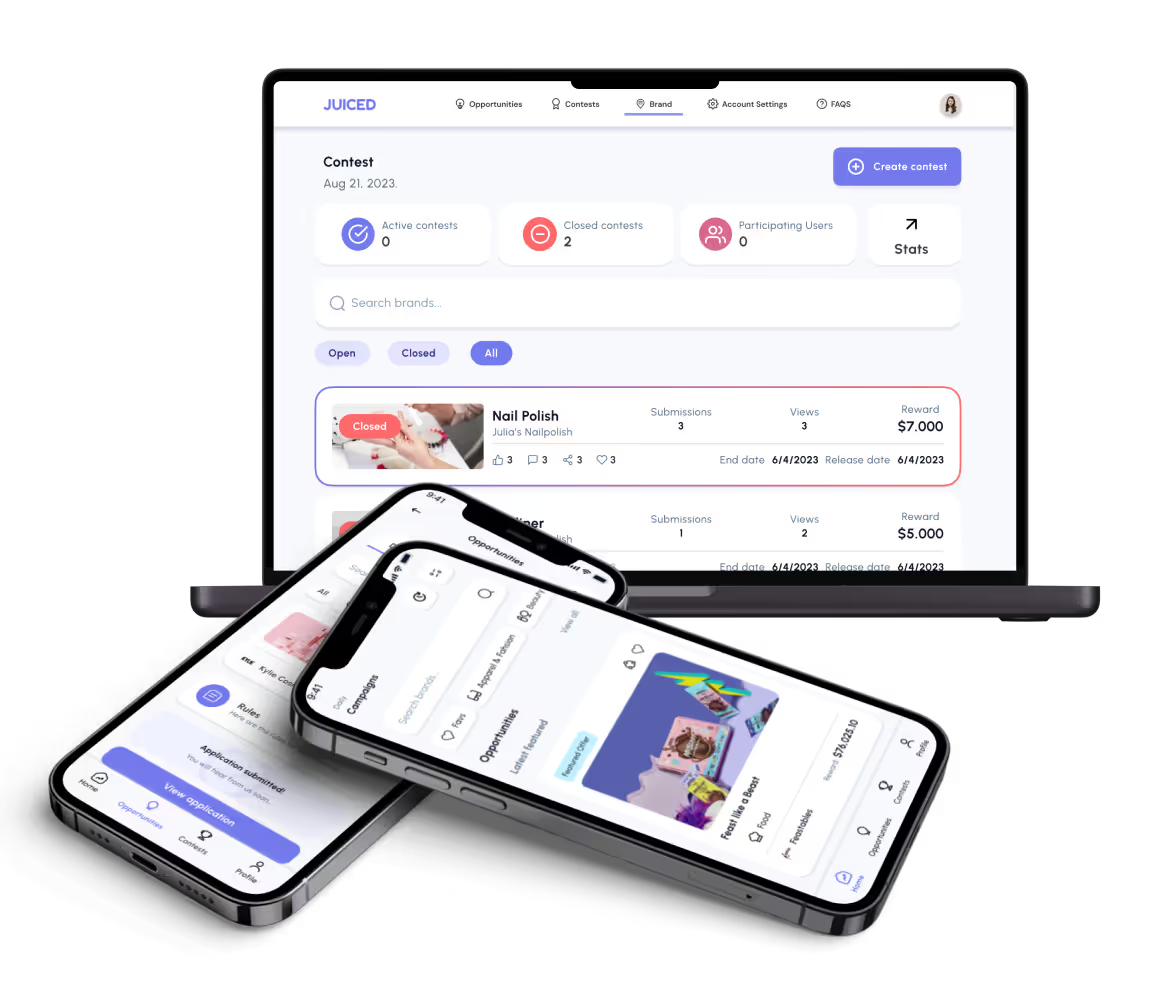

What Can FlutterFlow Build for a Construction Progress Tracker?
FlutterFlow can deliver phase-based milestone tracking, daily photo uploads, a client-facing progress portal, delay logging, push notifications, sub-trade reporting, and exportable progress reports, all from a single cross-platform codebase.
Planning a cross-platform construction tracker build means designing for both the field supervisor's phone and the project manager's desktop from the start.
Phase-Based Milestone Tracking
Projects break into phases, foundations, framing, MEP, finishes, with each milestone tracked by completion percentage and responsible supervisor. Progress updates in real time as field workers log activity.
- Phase structure: Each project phase holds its own milestones, responsible parties, and target completion dates.
- Completion percentage: Workers update progress in increments; the dashboard reflects changes immediately via Firestore.
- Supervisor accountability: Each milestone links to a named supervisor, creating a clear responsibility chain for every phase.
Phase-based tracking gives project managers an accurate status view without making phone calls or waiting for weekly reports.
Daily Progress Photo Upload with Timestamps
Field workers upload dated progress photos from the job site, linked to specific phases and viewable in a chronological feed by project managers and clients.
- Phase-linked photos: Each upload attaches to the project phase it documents, keeping the photo archive organised by construction sequence.
- Automatic timestamps: Upload date and time stamp each photo automatically, creating a verifiable visual timeline of site progress.
- Chronological feed: Project managers and clients scroll through progress photos in date order, tracking visible site changes over time.
A photo-backed progress feed gives clients the transparency they want and reduces inbound status calls for project managers significantly.
Client-Facing Progress Portal
Clients access a read-only branded portal showing project milestones, current completion percentage, photo updates, and next scheduled phases, without needing a phone call to the project manager.
- Read-only access: Clients see progress data without the ability to modify any records, protecting data integrity.
- Branded experience: The portal reflects the contractor's branding, reinforcing professionalism and client trust throughout the project.
- Milestone visibility: Clients see completed, in-progress, and upcoming phases with target dates, reducing uncertainty about project timeline.
The client portal is what differentiates a custom FlutterFlow tracker from a generic project management tool, contractors can offer branded, real-time visibility without buying Procore licences for clients.
Issue and Delay Logging
Site supervisors log delays, material shortages, or weather holds directly in the app. The system automatically updates the projected completion date and notifies relevant stakeholders.
- Structured delay logging: Supervisors select a delay category, add a note, and submit, the record timestamps and attributes automatically.
- Automatic date adjustment: Logged delays trigger recalculation of projected phase and project completion dates.
- Stakeholder notification: Delay logs trigger push notifications to project managers and, if configured, to client-facing portal updates.
Documented delays with timestamps are valuable in contract dispute resolution and insurance claims, making structured logging worth building from the start.
Push Notifications for Milestone Events
Project stakeholders receive automated push alerts when milestones are completed, delays are logged, or sign-offs are required. Firebase Cloud Messaging handles delivery reliably across iOS and Android.
- Milestone completion alerts: Stakeholders receive notification when a phase milestone is marked complete by field supervisors.
- Delay notifications: Logged site delays push to project managers immediately rather than surfacing in a weekly report.
- Sign-off requests: When a phase requires manager or client sign-off, the relevant party receives a direct push notification.
Automated notifications remove the manual status-chasing that consumes significant project manager time across multi-site construction operations.
Sub-Trade Progress Reporting
Subcontractors submit their own phase completion data through a dedicated view, feeding into the overall project progress dashboard without requiring the GC to chase updates manually.
- Dedicated sub view: Subcontractors see only their assigned phases and upload slots, keeping their workflow focused and permissions clean.
- Contribution to master dashboard: Sub-trade submissions feed directly into the GC's project progress calculation.
- Documentation uploads: Subs attach completion photos and sign-off documents through the same submission flow.
Sub-trade reporting via a dedicated portal eliminates the coordination overhead that accounts for a significant portion of GC administrative time.
Exportable Progress Reports
A one-tap PDF or CSV export of project status, milestone history, and photo evidence is available for client meetings or contract compliance.
- One-tap export: Managers generate a current-status PDF without manually compiling data from multiple sources.
- Milestone history included: Exports show completed, delayed, and in-progress phases with dates and responsible parties.
- Photo evidence embedded: Progress photos attach to their relevant milestones in the exported report for audit and client review purposes.
Exportable reports convert the live tracker data into a document suitable for client billing reviews, lender inspections, and regulatory compliance submissions.
How Long Does It Take to Build a Construction Progress Tracker with FlutterFlow?
A simple milestone tracking MVP with photo upload and a basic dashboard takes 6–9 weeks. A full platform with a client portal, sub-trade views, delay logging, and export capability takes 12–20 weeks.
Timeline extends based on the number of user roles, client portal branding requirements, and third-party integrations like Procore or MS Project.
- Phase 1 priority: Internal progress logging with photo upload and a manager dashboard, get field teams using this before adding client-facing features.
- Phase 2 additions: Client portal and sub-trade reporting once the core progress data model is validated in real project conditions.
- Phase 3 integrations: Procore, MS Project, or export connections after the core platform is stable.
- Speed advantage: FlutterFlow delivers the core progress tracker approximately 50% faster than a comparable custom build.
A phased approach means the tool adds real value to internal operations before the client portal complexity is introduced.
What Does It Cost to Build a FlutterFlow Construction Progress Tracker?
A FlutterFlow construction progress tracker costs $15,000–$50,000 for a developer build and $22,000–$70,000 for a full agency-delivered multi-role platform with client portal. Procore and Buildertrend cost $300–$1,500 per month with limited custom branding.
Before budgeting a full development project, check the FlutterFlow monthly plan costs to understand which tier supports the multi-role access and real-time data features your tracker needs.
- Platform cost: The FlutterFlow subscription is $0–$70 per month. Most production trackers need the Pro or Teams plan.
- Photo storage costs: A multi-year, multi-project tracker accumulates significant Firebase Storage volume. Plan for $100–$400 per month at scale or route to a CDN from day one.
- Hidden cost: per-project portal branding: If each client portal requires unique branding, the design and configuration overhead scales with your project volume.
- vs Procore and Buildertrend: Both tools provide broad project management capability but charge per seat and cannot be configured to your exact workflow. A custom FlutterFlow tracker breaks even within 12–24 months for most mid-size contractors.
Photo storage volume as projects accumulate is the cost most often underestimated at scoping. Design the storage architecture before the first line of FlutterFlow is written.
How Does FlutterFlow Compare to Custom Development for a Construction Progress Tracker?
FlutterFlow brings a usable construction progress tracker to market months ahead of a custom build at substantially lower cost for small-to-mid GC firms. The cost gap narrows for enterprise general contractors needing deep Procore or Primavera integration.
FlutterFlow wins clearly for specialty contractors, small-to-mid GC firms, and client-facing progress apps that need custom branding without enterprise software licensing costs.
- Speed advantage: FlutterFlow delivers a client-accessible progress tracker months ahead of a custom build for most SMB construction firms.
- Cost advantage: Substantial savings at mid-market scale. A custom equivalent starts at $80,000 before integrations.
- Gantt limitation: No native Gantt component in FlutterFlow. Building one requires a custom widget, embedded iframe, or third-party library, none trivial to implement.
- When custom wins: Enterprise GCs with existing Procore or Primavera P6 integration, complex earned value management, or BIM progress overlay requirements.
Review FlutterFlow trade-offs for projects of different complexity before deciding between a low-code and a fully custom construction platform.
What Are the Limitations of FlutterFlow for a Construction Progress Tracker?
FlutterFlow's core limitations for construction progress trackers are: no native Gantt component, no direct MS Project integration, significant photo storage costs at scale, and limited support for earned value management data models.
These are not dealbreakers for most SMB construction use cases. They are dealbreakers for enterprise GC platforms.
- No native Gantt component: Gantt scheduling views require a custom widget, embedded iframe, or third-party charting library, none of which are trivial to implement in FlutterFlow.
- MS Project and Primavera integration: Connecting FlutterFlow to enterprise scheduling software requires API middleware and custom backend logic, adding significant timeline and cost.
- Photo storage at scale: A multi-year, multi-project tracker accumulates substantial Firebase Storage costs. S3 or cloud CDN strategies are needed from day one, not added later.
- Earned value management: Baseline versus actual comparisons and variance tracking require a data model that FlutterFlow's visual editor struggles to represent cleanly.
- Vendor dependency: FlutterFlow UI updates can affect dashboard rendering on existing builds and require regression testing after platform version changes.
- Code export as escape valve: Exporting Flutter code allows developers to implement Gantt charts and enterprise scheduling integrations natively when the visual editor reaches its limit.
Understand FlutterFlow performance at scale before building a tracker that will store real-time data across dozens of active construction projects simultaneously.
How Do You Get a FlutterFlow Construction Progress Tracker Built?
Hire a FlutterFlow developer or agency with demonstrated experience in Firebase real-time data architecture, photo-heavy mobile apps, and construction project management workflows. Those three together are rarer than any one of them individually.
The top-rated FlutterFlow build agencies for construction tools combine project management domain expertise with Firebase real-time data architecture skills.
- Core expertise required: FlutterFlow and Firebase proficiency, construction project management knowledge, and experience with photo storage architecture at scale.
- Freelancer option: Freelancers can handle single-project internal trackers with a focused feature set.
- Agency advantage: Agencies are better suited for multi-client, multi-role platforms where the client portal, sub-trade views, and export requirements all need to work together.
- Red flag: no real-time dashboard portfolio: Any developer who cannot show a previous real-time dashboard app is unlikely to architect the Firestore data model correctly.
- Red flag: underestimating client portal complexity: A client-facing portal with branded views, role-separated data, and read-only access is a significant build, not an add-on.
- Key question to ask: "How do you structure data for multi-project concurrent tracking, and what is your approach to photo storage costs at scale?"
Expected project timeline is 10–18 weeks from scope sign-off to production launch for a full multi-role platform.
Conclusion
FlutterFlow is a strong choice for construction businesses that need a real-time, client-accessible progress tracking platform without the cost and complexity of enterprise project management software.
The client portal capability alone differentiates a custom FlutterFlow tracker from any off-the-shelf tool: branded, real-time project visibility for clients without buying Procore licences.
Define your project phase structure and client portal requirements before engaging a FlutterFlow developer. The data model decisions made early determine how well the platform scales as your project volume grows.
Building a Construction Progress Tracker with FlutterFlow? Here Is How LOW/CODE Agency Approaches It.
Most construction businesses do not need Procore. They need a tracker that matches their workflow, shows clients what they need to see, and does not require a $1,500 per month subscription to maintain.
At LOW/CODE Agency, we help SMBs compete with AI-powered software built for them — custom web and mobile apps, RAG systems, chatbots, and intelligent agents delivered by a senior development team. We build FlutterFlow construction trackers that work for the full project lifecycle: from field-level milestone updates to client-facing portals to PDF progress reports for lender inspections.
- Phase and milestone architecture: We design the project data model before any screens are built, ensuring the structure supports multi-project scale from day one.
- Photo storage strategy: We architect the photo storage approach upfront, whether Firebase Storage, S3, or CDN, to prevent cost surprises as project volume grows.
- Client portal design: We build the client-facing portal with appropriate role separation, branding flexibility, and read-only access controls built into the data model.
- Sub-trade reporting flows: We configure dedicated subcontractor views and submission flows that feed directly into the GC dashboard without manual data entry.
- Delay and issue logging: We build structured delay logging with automatic date recalculation and stakeholder notification built into the workflow.
- Export and reporting: We integrate PDF and CSV export capability so progress data is report-ready for client meetings, lender reviews, and compliance submissions.
- Full product team: Strategy, UX, development, and QA from one team, so nothing falls through the gap between design and development.
We have built 350+ products for clients including Coca-Cola, American Express, and Sotheby's. We understand what construction businesses need from a progress tracker and we build to that standard.
Related Articles
- How to Build a Courier Tracking App with FlutterFlow
- How to Build a Contractor Management App with FlutterFlow
- How to Build a Content Scheduling App with FlutterFlow
- How to Build a Construction Checklist Tool with FlutterFlow
- How to Build Construction Apps with FlutterFlow
- How to Build a Compliance Audit Checklist App with FlutterFlow
Last updated on
September 24, 2026
.

Jesus is a visionary entrepreneur and tech expert. After nearly a decade working in web development, he founded LOW/CODE Agency to help businesses optimize their operations through custom software solutions.


FAQs
What are the key features of a construction progress tracker in FlutterFlow?
How can I start building a construction progress tracker in FlutterFlow?
Can FlutterFlow handle real-time data updates for construction tracking?
What are common challenges when creating a progress tracker app in FlutterFlow?
How do I integrate photo documentation in a FlutterFlow construction tracker?
Is it possible to customize notifications for task updates in FlutterFlow?
Related Articles

FlutterFlow
How to Build a Courier Tracking App with FlutterFlow
Learn how to create a courier tracking app using FlutterFlow with step-by-step guidance and essential features for real-time delivery tracking.
FlutterFlow
How to Build a Student Portal with FlutterFlow
Learn how to create a student portal using FlutterFlow with step-by-step guidance and tips for beginners and developers.

FlutterFlow
How to Build a Movie Streaming Dashboard with FlutterFlow
Learn how to create a movie streaming dashboard using FlutterFlow with step-by-step guidance and best practices.

FlutterFlow
What You Can and Can’t Do with FlutterFlow (2026 Guide)
See what you can and can’t do with FlutterFlow in 2026. Learn real capabilities, limits, use cases, and when FlutterFlow is the right fit.

Why customers trust us for no-code development


