

How to Build a KPI Tracking App with FlutterFlow
13 min
read
Learn how to create a KPI tracking app using FlutterFlow with step-by-step guidance and best practices for app performance and data management.

Most teams track KPIs in a spreadsheet that nobody looks at. A FlutterFlow KPI tracking app puts goals, actuals, and trend lines in every manager's pocket, updated in real time without a manual refresh.
FlutterFlow handles the display layer well: target versus actual comparisons, trend charts, and push alerts are all achievable natively. The real technical work sits in the data ingestion pipeline that gets metrics from your business systems into Firestore. This guide covers both layers honestly.
Key Takeaways
- KPI display and goal tracking work natively: Target versus actual comparisons, trend charts, and progress indicators are all achievable in FlutterFlow without custom code.
- Data ingestion is the hardest part: Getting KPI data from CRMs, ERPs, or other business systems into Firestore requires API integration or a Cloud Function pipeline.
- Real-time Firestore updates suit operational KPIs: Metrics entered by app users in real time are a strong fit; batch-processed metrics from external systems need scheduled Cloud Functions.
- Large historical datasets need pre-aggregation: Querying a year of daily metrics for trend charts requires pre-computed Firestore documents, not raw collection scans.
- Build time range: A functional KPI tracking app takes 4 to 10 weeks depending on data source complexity and number of external integrations.

What Can FlutterFlow Build for KPI Tracking?
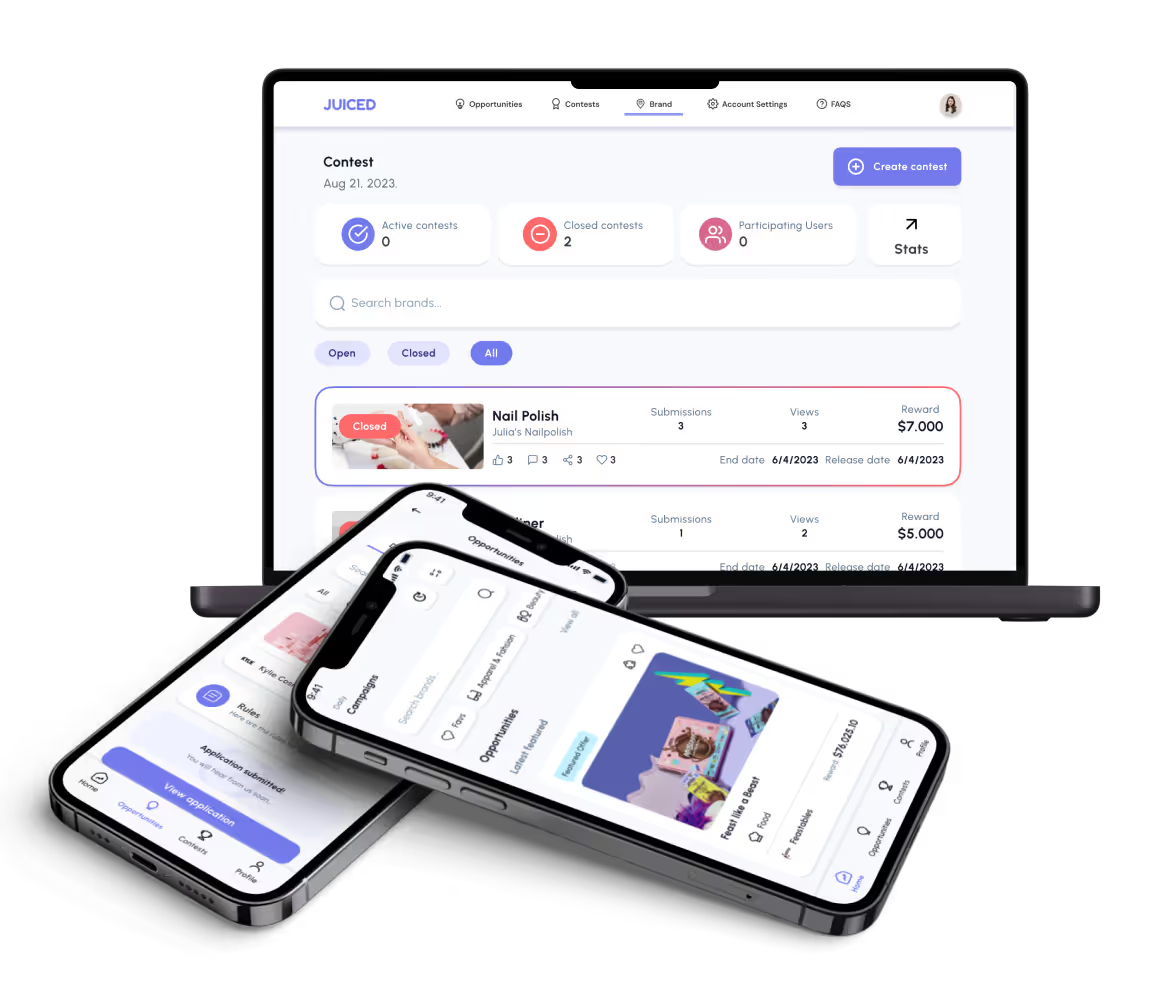
FlutterFlow delivers KPI dashboards, trend charts, goal setting, team and individual views, alert notifications, manual data entry, and report export. External data ingestion from business systems requires Cloud Function API pipelines built outside FlutterFlow's visual layer.
FlutterFlow KPI app build examples show how operations and sales teams have deployed KPI tracking in production with data ingested from multiple business systems.
KPI Dashboard with Target vs Actual
Each KPI displays as a formatted card showing current value, target, variance, and RAG status.
- RAG status logic: Red, amber, and green threshold configuration per KPI drives the colour status on each metric card.
- Variance display: The gap between current value and target is calculated and displayed alongside the metric for immediate context.
- Dashboard grouping: KPIs can be grouped by team, department, or category so different user roles see the metrics most relevant to their work.
The dashboard is the first screen users see every time they open the app, and its clarity directly determines whether the tool gets used.
Trend Charts and Historical Views
KPI performance over time visualises as line and bar charts using aggregated Firestore data.
- Time period selection: Daily, weekly, and monthly views toggle from a single chart screen using period selector buttons.
- Chart widgets: FlutterFlow's native line and bar chart widgets connect to pre-aggregated Firestore summary documents for fast load times.
- Benchmark overlays: Target lines overlaid on trend charts give users instant visual comparison against goals over the period.
Trend charts are the most data-intensive feature in any KPI app and require pre-aggregated Firestore documents to perform acceptably.
Goal Setting and Period Configuration
Managers set KPI targets by period with automatic rollover and historical goal retention.
- Period-based targets: Weekly, monthly, and quarterly targets are stored per KPI per period with a clear historical record.
- Automatic rollover: A scheduled Cloud Function creates the next period's target documents at period end, carrying forward the previous target unless manually updated.
- Target history: Previous period targets are retained in Firestore so users can compare current goal-setting against historical benchmarks.
Goal setting and period management are the administrative workflows that team leads use most; their speed and clarity drive adoption at the manager level.
Team and Individual KPI Views
A drill-down from team summary to individual contributor KPI cards gives managers visibility at both levels.
- Team summary view: An aggregated team dashboard shows combined performance against team-level targets.
- Individual drill-down: Tapping a team card navigates to individual contributor KPI cards showing personal targets and actuals.
- Role-based access: Firestore security rules ensure team members only see their own metrics, while managers see the full team view.
Role-based access is essential for KPI apps to be trusted by the teams using them; members sharing metrics they did not expect to share will stop using the tool.
KPI Alert Notifications
Push notifications fire when a KPI drops below a warning threshold or when a period target is achieved.
- Threshold triggers: A Cloud Function evaluates KPI values against configured warning thresholds when new data is written to Firestore.
- Firebase Cloud Messaging: FCM delivers push notifications to the correct user's device when their alert conditions are met.
- Alert preferences: Users can configure which KPIs trigger alerts and set their own threshold levels within manager-defined ranges.
Alert notifications are the feature that transforms a dashboard into an active management tool, prompting action rather than passive review.
Manual Data Entry and Update
A simple data entry interface lets team members log KPIs that are tracked manually rather than pulled from external systems.
- Entry forms: Clean input forms for sales calls made, visits completed, units produced, and other manually counted metrics keep data entry fast.
- Entry history: Each manual entry is time-stamped and retained in Firestore so managers can see when data was logged and by whom.
- Offline entry: Manual entry works in offline mode with local queue submission when connectivity returns, important for field-based teams.
Many operational KPIs are inherently manual; a clean entry interface is what determines whether teams log data consistently or fall back to spreadsheets.
KPI Report Export
Period KPI summary reports generate as CSV or PDF via Cloud Function, downloadable or emailed to stakeholders.
- CSV export: Raw period data exports as CSV for further analysis in Excel or BI tools.
- PDF report: A formatted PDF summary report generates via a PDF API Cloud Function for stakeholder distribution.
- Scheduled delivery: Reports can be configured to send automatically to named email addresses at period end via a scheduled Cloud Function.
Report export closes the loop from operational tracking to executive review and is often the feature that gets the KPI app adopted at leadership level.
How Long Does It Take to Build a FlutterFlow KPI Tracking App?
A simple manual-entry KPI app with target versus actual display and basic charts takes 4 to 6 weeks. A full-featured platform with external data ingestion, trend analysis, alerts, role-based views, and export runs 8 to 14 weeks.
Understanding the FlutterFlow KPI app platform cost starts with the subscription tier and extends to the Firebase and data pipeline infrastructure that supports real-time metric ingestion.
- Simple MVP scope: Manual KPI entry, target versus actual display, and basic trend charts can ship in 4 to 6 weeks.
- External data ingestion: Each external system integration, CRM, ERP, or data warehouse, adds 1 to 3 weeks depending on API complexity and data normalisation requirements.
- Alert logic timeline: Threshold-based push notification configuration via Cloud Functions and FCM adds 1 to 2 weeks to a standard build.
- Phased approach: Launching manual entry and dashboard display first, then connecting external data sources in phase two, is the fastest path to user adoption.
- Speed vs custom: FlutterFlow builds the KPI UI layer 45 to 60 percent faster than custom development; data pipeline complexity is the variable that drives timeline regardless of framework.
The number of external system integrations required is the single biggest driver of build complexity and cost; mapping every KPI to its data source before scoping is essential.
What Does It Cost to Build a FlutterFlow KPI Tracking App?
A FlutterFlow KPI tracking app costs $10,000 to $40,000 for a developer build and $18,000 to $55,000 through an agency for a full platform with external data integration and custom alerting.
- Platform subscription: FlutterFlow costs $0 to $70 per month; the Pro plan is needed for API integrations and team collaboration.
- Developer rates: Freelancers charge $50 to $150 per hour; a focused KPI app project runs $10,000 to $40,000.
- Agency cost: A full KPI platform with external data integration and custom alerting costs $18,000 to $55,000 through a FlutterFlow agency.
- vs off-the-shelf tools: Geckoboard, Klipfolio, and Databox charge per-user seat fees and do not provide a branded mobile app or custom field logic.
- Hidden cost: data normalisation: Cleaning and structuring data from external systems before it can be ingested adds engineering time that is consistently underestimated.
- Hidden cost: BigQuery: If raw Firestore queries are too slow for historical trend analysis at scale, a BigQuery layer adds both build cost and ongoing query fees.
A custom FlutterFlow KPI app avoids per-seat SaaS fees and gives teams a branded mobile experience that off-the-shelf tools cannot match.
How Does FlutterFlow Compare to Custom Development and Dedicated KPI Tools?
FlutterFlow builds a KPI tracking UI in 4 to 6 weeks at a fraction of custom development cost. Off-the-shelf KPI tools are live in days but cannot be customised. Custom development is only justified for enterprise platforms requiring statistical forecasting or complex multi-dataset joins.
FlutterFlow wins for branded mobile KPI apps; custom wins when enterprise analytics with statistical models are required.
- When FlutterFlow wins: Businesses wanting a branded mobile KPI app, operational teams needing offline-capable KPI entry, companies with existing Firestore data architecture.
- When custom wins: Enterprise analytics platforms requiring statistical forecasting, ML-driven anomaly detection, or complex multi-source data warehouse queries.
- Maintenance advantage: Operations teams can update KPI definitions, thresholds, and targets in FlutterFlow without developer involvement after launch.
- Off-the-shelf limitation: SaaS KPI tools work well for standard metrics but cannot accommodate custom business logic, industry-specific KPIs, or branded mobile distribution.
A clear view of FlutterFlow KPI tool trade-offs helps operations leaders decide whether the platform's speed advantage outweighs any analytical capability constraints for their specific use case.
What Are the Limitations of FlutterFlow for KPI Tracking Apps?
Understanding FlutterFlow KPI data performance at scale prevents the chart load time issues that surface when historical metric collections grow large without pre-aggregation. Beyond performance, the core limitations are external data ingestion, complex calculated metrics, and statistical forecasting.
These are engineering constraints, not platform deficiencies; each has a standard solution that belongs in the architecture from the start.
- External data ingestion is not native: KPIs from Salesforce, HubSpot, or ERPs require Cloud Function API pipelines; FlutterFlow cannot pull data directly from external systems through its visual builder.
- Historical Firestore query performance: Scanning a collection of daily KPI records spanning years causes slow chart loads; pre-aggregated summary documents must be maintained by scheduled Cloud Functions.
- Complex calculated metrics: Metrics derived from multi-step formulas across multiple data sources, such as gross margin calculated from revenue, COGS, and returns, require server-side calculation.
- No statistical forecasting: FlutterFlow cannot project future KPI performance from historical data; forecasting requires a backend ML service or a dedicated analytics platform.
- Real-time Firestore read costs: High-frequency dashboard refreshes across a large user base generate Firestore read costs that scale with usage and need cost management at scale.
Code export is available on paid FlutterFlow plans for teams that need full codebase control as the platform grows.
How Do You Get a FlutterFlow KPI Tracking App Built?
Knowing how to hire a FlutterFlow developer with data pipeline and Firestore optimisation experience is critical for any KPI app that ingests data from external business systems.
The right developer for a KPI app has more than FlutterFlow experience; they need data engineering background.
- Cloud Function pipeline experience: Ask for examples of scheduled Cloud Functions that pull from external APIs and normalise data into Firestore; this is the core backend skill for any data-driven KPI app.
- Pre-aggregation patterns: A developer who proposes raw Firestore collection scans for trend chart queries has not built data apps at scale; ask specifically how they approach historical query performance.
- External system API knowledge: Ask which of your specific data sources they have integrated before; CRM integrations, ERP connections, and data warehouse queries all have their own complexity profiles.
- Alert logic design: Ask how they structure threshold monitoring Cloud Functions; the answer reveals whether they understand event-driven backend architecture.
- Freelancer vs agency: Freelancers suit a simple manual-entry KPI dashboard; agencies suit multi-source KPI platforms with external data ingestion and custom alerts.
- Red flags when hiring: Proposing raw Firestore scans for trend queries, no mention of data normalisation, and no pre-aggregation strategy are all disqualifying signals.
Expected timeline from a capable team: 5 to 14 weeks depending on the number of external system integrations and historical data migration requirements.
Conclusion
FlutterFlow is a strong platform for KPI tracking apps focused on display, alerting, and manual entry. The UI layer is fast to build and intuitive to maintain without developer involvement for configuration changes.
The data ingestion and pre-aggregation pipeline is where the technical complexity lives, regardless of which framework builds the interface. Map every KPI to its data source before scoping; the number of external integrations required is the single biggest driver of build complexity and timeline.
Building a KPI Tracking App with FlutterFlow? Here Is How LOW/CODE Agency Approaches It.
Most KPI app builds underestimate the data pipeline. A FlutterFlow dashboard connected to a poorly designed Firestore schema loads slowly, shows stale data, and gets abandoned by the teams it was built for.
As AI development experts, we at LOW/CODE Agency help SMBs ship real software — web and mobile applications, intelligent chatbots, RAG pipelines, and autonomous AI agents built for businesses that need results, not platforms. We build FlutterFlow KPI tracking apps with the right backend data architecture: pre-aggregated Firestore documents for fast trend queries, Cloud Function ingestion pipelines for external system data, and alert logic that keeps managers informed without creating notification noise.
- KPI data architecture: We design the Firestore schema and pre-aggregation pattern for your specific metric types before building a single screen.
- External data ingestion: We build Cloud Function pipelines for each of your data sources, whether CRM, ERP, spreadsheet, or API, with scheduled sync and error handling.
- Dashboard and chart design: We build target versus actual dashboards, trend charts, and RAG status cards that give managers the information they need at a glance.
- Alert configuration: We implement threshold-based push notifications via Firebase Cloud Messaging so your team is notified when KPIs need attention.
- Role-based access: We configure Firestore security rules so managers see team views and individuals see only their own metrics.
- Report generation: We build PDF and CSV export via Cloud Function so period summaries reach stakeholders without manual data pulls.
- Full product team: Strategy, design, development, and QA from a single team that tests data pipeline reliability and chart performance before handoff.
We have built 350+ products for clients including Coca-Cola, American Express, and Sotheby's. We know how data apps perform in production and we build the backend to match.
Related Articles
- How to Build a Lead Tracking CRM with FlutterFlow
- How to Build a Lead Scoring AI App with FlutterFlow
- How to Build a Law Firm CRM Platform with FlutterFlow
- How to Build a Job Marketplace App with FlutterFlow
- How to Build an Itinerary Planning Tool with FlutterFlow
- How to Build an Invoice Generator App with FlutterFlow
Last updated on
September 24, 2026
.

Jesus is a visionary entrepreneur and tech expert. After nearly a decade working in web development, he founded LOW/CODE Agency to help businesses optimize their operations through custom software solutions.


FAQs
What are the first steps to create a KPI tracking app in FlutterFlow?
How can I manage data input and updates in a FlutterFlow KPI app?
What are the best practices for visualizing KPIs in FlutterFlow?
Can I integrate external data sources with my FlutterFlow KPI app?
How do I ensure my KPI tracking app performs well on different devices?
What security measures should I implement for a KPI tracking app built with FlutterFlow?
Related Articles
.avif)
Comparison
FlutterFlow
FlutterFlow vs PowerApps | 9 Factors to Decide the Best One
Compare FlutterFlow vs PowerApps across 9 key factors to choose the best low-code tool for mobile apps, business workflows, integrations, and scalability

FlutterFlow
How to Build Procurement Apps with FlutterFlow
Learn how to create efficient procurement apps using FlutterFlow with step-by-step guidance and best practices.

FlutterFlow
How to Build a Downtime Tracking App with FlutterFlow
Learn how to create a downtime tracking app using FlutterFlow with step-by-step guidance and best practices for efficient app development.

FlutterFlow
How to Build a Freight Booking App with FlutterFlow
Learn how to create a freight booking app using FlutterFlow with step-by-step guidance and key features for smooth development.


Why customers trust us for no-code development


