

How to Build an HR Analytics App with Bubble
10 min
read
Build an HR analytics app with Bubble. Track headcount, turnover, and engagement in real-time dashboards — no code, no expensive HR software.


HR analytics apps turn scattered workforce data into actionable dashboards that help leaders make faster, more confident people decisions. the Bubble platform lets HR teams build a custom analytics app without writing code, covering headcount reporting, turnover analysis, DEI metrics, performance data visualization, and predictive workforce modeling in one connected platform.
Key Takeaways
- People data becomes actionable: A Bubble HR analytics app surfaces workforce metrics in real time so HR leaders can act on trends instead of chasing spreadsheet exports.
- Data model connects all HR dimensions: Employee, Department, RoleHistory, TurnoverEvent, PerformanceRecord, and DEISnapshot types power the full analytics layer.
- Dashboards are highly configurable: Repeating groups, charts, and filtered data queries let teams build custom views for HR, finance, and executive audiences.
- Predictive modeling requires external tools: Advanced forecasting and machine learning workflows need external APIs or Python services connected via Bubble's API connector.
- Build costs start around $18,000: MVP HR analytics apps on Bubble range from $18,000 to $30,000 depending on data source complexity and visualization requirements.
- Integration quality drives data quality: The accuracy of every dashboard depends on reliable data pipelines from HRIS, payroll, and performance systems.

What Data Architecture Does a Bubble HR Analytics App Need?
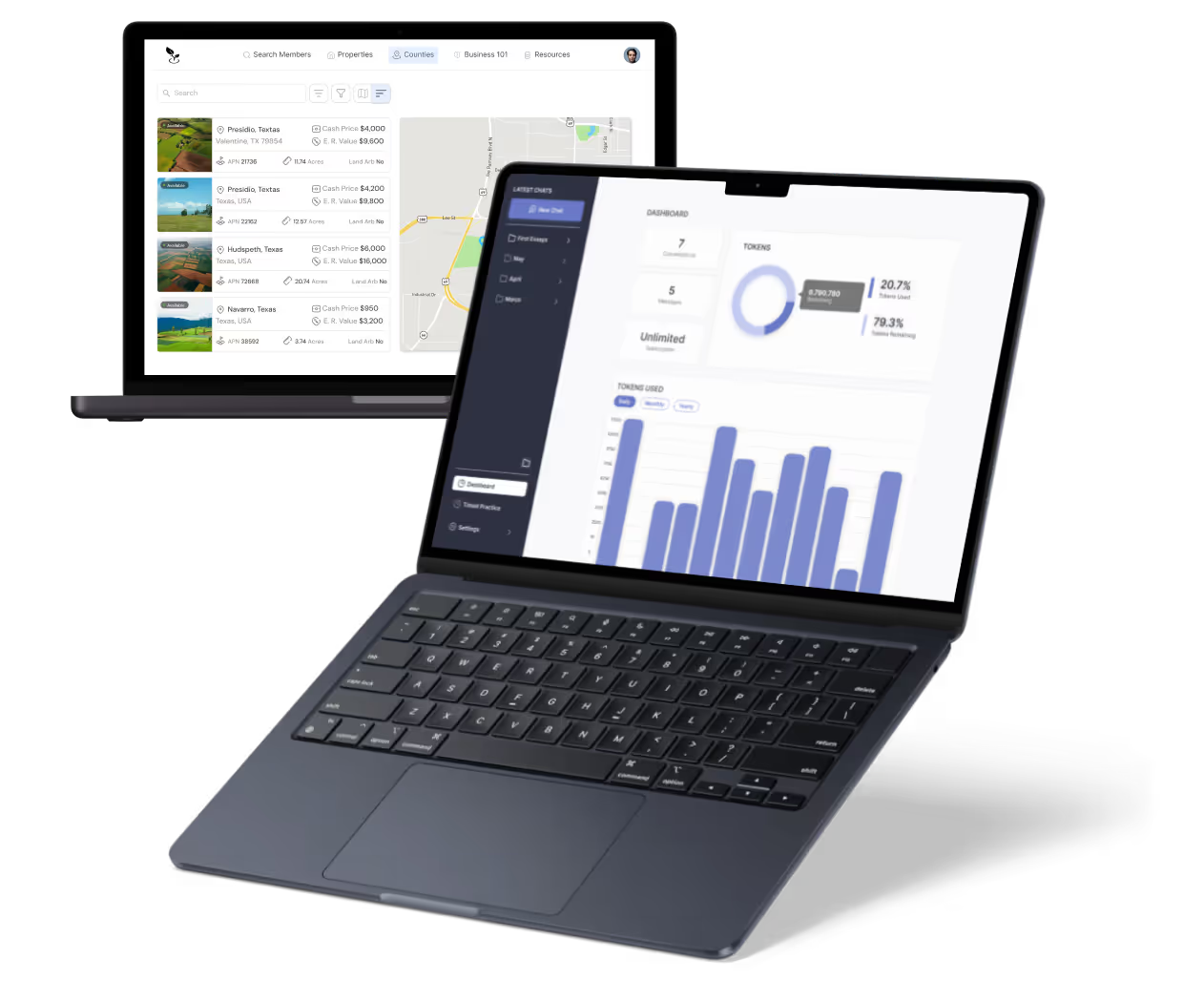
An HR analytics app needs a data model that connects employees to their role history, department, performance records, and departure events. Core types are Employee, Department, RoleHistory, TurnoverEvent, PerformanceRecord, and DEISnapshot.
These types store both current state and historical snapshots, which is what allows the app to calculate tenure, measure turnover rates, and track workforce composition over time.
- Employee type: Stores name, hire date, department link, current role, employment status, manager link, and a list of linked RoleHistory records for tenure tracking.
- Department type: Holds department name, headcount, budget owner, and aggregated metric fields updated periodically by scheduled Bubble workflows.
- RoleHistory type: Tracks each role change per employee with start date, end date, job title, grade level, and the triggering event such as promotion or transfer.
- TurnoverEvent type: Stores departure date, departure reason category, regrettable flag, tenure at departure, and a link to the departing employee's record.
- PerformanceRecord type: Holds review period, rating, reviewer, goal completion percentage, and a link to the Employee record for performance trend reporting.
- DEISnapshot type: A dated record per reporting period storing headcount breakdowns by gender, ethnicity, and age band across departments for trend reporting.
The combination of point-in-time snapshot records and live Employee data lets every dashboard query pull either current state or historical comparisons.
How Do You Build Workforce Dashboards in Bubble?
Workforce dashboards are the primary interface for HR analytics apps. Bubble builds these using filtered repeating groups, chart plugins, and dynamic data queries that respond to user-selected filters in real time.
Every dashboard section connects to the data model with a targeted search or aggregation, so the numbers on screen always reflect the current state of the workforce records stored in Bubble.
- Headcount summary: A count of Employee records with status set to active, filterable by department, location, employment type, and hire date range via dropdown inputs.
- Tenure distribution: A chart plugin visualizes Employee records grouped by tenure band, calculated from hire date to today using Bubble's date difference operator.
- Department breakdown: A repeating group lists each Department with live headcount, open role count, and turnover rate pulled from linked records via dynamic queries.
- New hire trend: A line chart plots the count of Employee records created per month over a rolling 12-month window using date-filtered searches.
- Filter controls: Dropdown and date range inputs on each dashboard section update the underlying data queries dynamically without requiring a page reload.
- Export capability: A button on each dashboard section triggers a CSV download of the filtered dataset using Bubble's built-in CSV export or a plugin connector.
See examples of Bubble apps in similar categories to understand how teams structure multi-audience dashboards with role-based views in Bubble.
How Do You Build Turnover Analysis in Bubble?
Turnover analysis tracks departure rates, identifies at-risk segments, and surfaces reasons for leaving. Bubble calculates turnover metrics by querying TurnoverEvent records against a defined headcount baseline for any selected time period.
Each TurnoverEvent record carries the departure reason, regrettable flag, tenure, and department, which lets the app slice turnover data by any combination of those dimensions.
- Turnover rate calculation: A workflow or dynamic expression divides the count of TurnoverEvents in a period by the average headcount for that period and displays it as a percentage.
- Regrettable vs. non-regrettable split: A chart segments TurnoverEvents by the regrettable flag to show what proportion of departures represent high-impact talent loss.
- Departure reason breakdown: A bar chart groups TurnoverEvents by reason category such as compensation, career growth, or management to highlight systemic drivers.
- Tenure at departure: A histogram plots TurnoverEvents by the tenure field to identify whether the company loses people early, mid-tenure, or at senior experience levels.
- Department comparison: A table ranks departments by turnover rate over a selected period using filtered counts of TurnoverEvents linked to each Department record.
- Trend line: A monthly line chart plots turnover rate over the past 24 months to distinguish seasonal patterns from genuine trend changes.
Bubble's data privacy and security rules ensure that sensitive turnover data and departure reason records are only visible to authorized HR and executive roles.
How Do You Build DEI Metrics Tracking in Bubble?
DEI metrics tracking captures workforce composition data, measures representation across levels, and tracks progress against stated goals. Bubble stores snapshot records per reporting period and visualizes changes over time through chart dashboards.
Each DEISnapshot record stores headcount breakdowns for a specific period, so the app can draw trend lines without recalculating historical data from live Employee records.
- Representation by department: A stacked bar chart reads the DEISnapshot record for the selected period and displays gender and ethnicity breakdowns per department.
- Leadership pipeline view: A filtered chart shows representation metrics for senior-grade Employee records only, highlighting gaps between overall workforce and leadership levels.
- Goal tracking: A DEIGoal type stores target representation percentages by category; a dashboard compares current DEISnapshot values against each goal with a progress indicator.
- Period-over-period comparison: A toggle lets users compare two DEISnapshot records side by side to measure progress between reporting periods.
- Cohort analysis: Filtering DEI metrics by hire cohort reveals whether representation improves at the point of hiring or erodes through promotion and retention patterns.
How Do You Build Performance Data Visualization in Bubble?
Performance data visualization connects review ratings, goal completion, and feedback trends into dashboards that support calibration, promotion decisions, and manager effectiveness reviews.
- Rating distribution: A histogram chart shows the spread of PerformanceRecord ratings across the workforce for a selected review cycle, flagging skew or grade inflation patterns.
- Goal completion tracking: A bar chart plots average goal completion percentage per department or team for the selected review period from PerformanceRecord fields.
- Manager effectiveness view: An aggregated score per manager is computed from the average rating of their direct reports' PerformanceRecords in the current cycle.
- Performance trend: A line chart per employee shows their rating trajectory across consecutive review cycles by querying all PerformanceRecords linked to their Employee record.
- Calibration dashboard: A scatter plot positions each employee on a two-axis grid of performance rating and potential score to support talent review conversations.
How Much Does It Cost to Build an HR Analytics App on Bubble?
HR analytics app builds on Bubble range from $18,000 for a focused MVP to $48,000 for a full platform with HRIS integration, DEI tracking, predictive dashboards, and role-based access across HR, finance, and executive audiences.
The main cost variables are the number of data sources requiring integration, the complexity of aggregation logic, and whether real-time HRIS sync or scheduled batch imports drive the data pipeline.
Review Bubble plan comparison and pricing to confirm the right subscription tier for your expected data volume, scheduled workflow frequency, and user seat count.
What Are the Limitations of Building an HR Analytics App on Bubble?
Bubble handles dashboards, filtered queries, and trend visualization effectively. Real-time data streaming, complex statistical modeling, and large-dataset aggregations are the areas that require the most additional architecture.
Teams expecting sub-second dashboard refresh against millions of rows or native machine learning pipelines should plan for external data services and API connectors alongside the Bubble build.
- Large dataset performance: Aggregating across tens of thousands of Employee records in real time can slow Bubble queries; scheduled pre-aggregation workflows mitigate this meaningfully.
- Predictive modeling: Advanced workforce forecasting requires external Python or R services connected via API connector; Bubble displays the outputs but does not compute them.
- HRIS sync complexity: Real-time two-way sync with Workday or SAP requires robust API connector work with field mapping, conflict resolution, and error handling logic.
- Statistical functions: Bubble does not have native standard deviation or regression operators; complex statistical calculations require external computation or pre-calculated stored fields.
- Chart library depth: Bubble's native chart options are limited; advanced visualizations like heat maps or org-level network graphs require third-party chart plugins or embedded iframes.
Review Bubble's built-in capabilities and known limitations and scaling a Bubble app to larger user volumes. For a broader view of trade-offs, the pros and cons of building on Bubble and no-code platform alternatives to Bubble are both worth reviewing before committing.
Conclusion
Bubble is a practical choice for HR teams that want custom analytics dashboards without the cost of enterprise BI tools or dedicated people analytics platforms. Headcount reporting, turnover analysis, DEI tracking, and performance visualization are all achievable within the platform.
The limitations around large-scale aggregation and predictive modeling are real but manageable with the right data architecture and external API integrations. A Bubble HR analytics app delivers meaningful workforce insight at a fraction of the cost of legacy people analytics software.
Build Your HR Analytics App with Bubble
At LOW/CODE Agency, we build HR analytics applications on Bubble that handle workforce dashboards, turnover analysis, DEI metrics, and performance visualization as one complete platform.
- Data architecture: Purpose-built analytics data model with Employee, Department, RoleHistory, TurnoverEvent, PerformanceRecord, and DEISnapshot types.
- Dashboard design: Headcount summaries, tenure distribution, department breakdowns, and filterable trend charts built for HR and executive audiences.
- Turnover analysis: Departure rate calculation, regrettable turnover tracking, reason-for-leaving breakdowns, and department comparison views.
- DEI reporting: Representation snapshots, period-over-period trend tracking, leadership pipeline visibility, and goal progress dashboards.
- Performance visualization: Rating distribution, goal completion tracking, manager effectiveness scoring, and calibration grid views.
We have delivered 450+ products for clients including Coca-Cola and American Express. Bubble development services cover HR analytics app builds from architecture through production launch; most engagements start around $18,000 USD.
Related Articles
- How to Build an Insurance CRM App with Bubble
- How to Build an HR Knowledge Base App with Bubble
- How to Build a Hospitality CRM App with Bubble
- How to Build a Home Services Marketplace App with Bubble
- How to Build a Healthcare Marketplace App with Bubble
- How to Build a Group Buying Platform App With Bubble
Last updated on
September 28, 2026
.

Jesus is a visionary entrepreneur and tech expert. After nearly a decade working in web development, he founded LOW/CODE Agency to help businesses optimize their operations through custom software solutions.


FAQs
Can you build an HR analytics app with Bubble?
How do you build a headcount dashboard in Bubble?
How do you calculate and display employee turnover in Bubble?
How do you build diversity analytics in a Bubble HR app?
How do you build a time-to-fill analytics view in Bubble?
How do you connect external HR systems data to a Bubble analytics app?
Related Articles

Bubble
How to Build a Sports Event Management App with Bubble
Launch a sports event management app with Bubble no code required. Organize registrations, teams, and results fast with this no-code step-by-step guide.

Bubble
How to Build a GDPR Compliance App with Bubble
Plan your next gala with a custom Bubble app no coding required. Manage guests, tickets, and schedules seamlessly from one no-code platform.

Bubble
How to Build a Financial Advisor CRM App with Bubble
Build a financial advisor CRM with Bubble. Track clients, AUM, and meetings in one compliant system — no code, built for your advisory workflow.
Bubble
How to Build a Marketing Agency Management App with Bubble
Run your agency smarter with a Bubble management app no coding needed. Track clients, campaigns, and results in one no-code platform. Build fast.

Why customers trust us for no-code development


