

Web Portal Development (Types, Costs, and When to Build One)
18 min
read
Web portal development explained with types, steps, costs, and when to build one. Learn how to plan, build, and scale the right portal for your business.

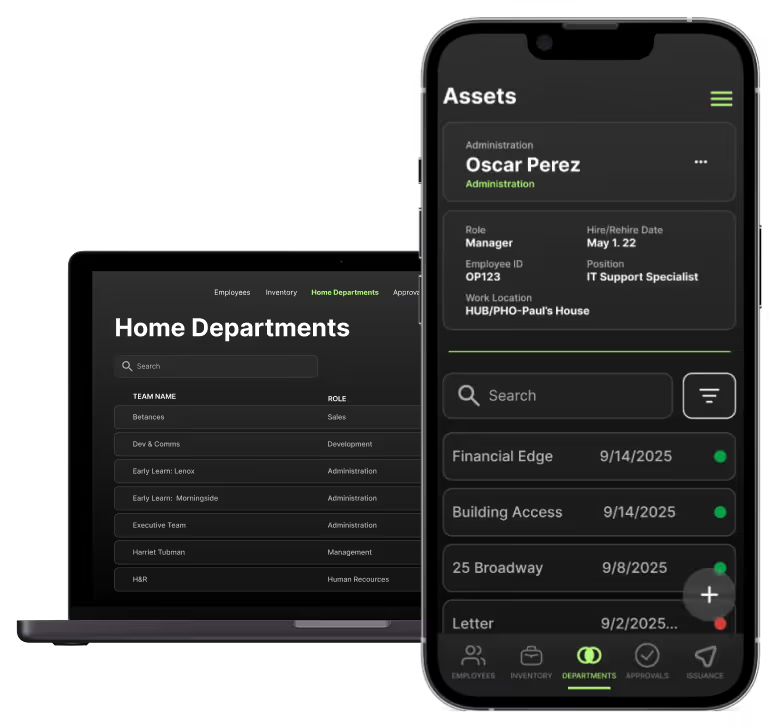
A web portal is a secure, login-based system where specific users access personalized data, tools, and workflows in one place. It is not a website.
It is not a generic web app. It is a purpose-built operational system designed around who needs access, what they need to do, and how the business runs behind it.
This guide covers what web portal development actually involves, what it costs, how long it takes, and how to decide whether you need one before committing to building it.
Key Takeaways
- A web portal is a system, not just an interface: it combines role-based access, workflow automation, data management, and integrations into one operational layer your team and users depend on daily.
- Not every problem requires a custom web portal: existing SaaS tools solve many portal-level problems faster and cheaper; clarity on workflows comes before any portal development decision.
- Low-code is the right approach for most web portals: custom development is rarely justified for portal builds where speed, cost, and scalability requirements suit low-code platforms well.
- Start with an MVP portal, not a full system: validating workflows with a minimum viable portal before investing in full-scale development reduces the most expensive category of web portal development risk.
- Integration planning determines portal success: portals that connect cleanly to existing CRM, ERP, and data systems deliver operational value; portals built in isolation create the data silos they were supposed to eliminate.

What Is Web Portal Development in Simple Terms?
Web portal development is the process of designing and building a secure, login-based system where specific users access personalized data, tools, and workflows. A portal is built for defined user groups, not the general public.
- Secure login-based access: every portal user authenticates before accessing anything; role-based permissions control exactly what each user type sees and can interact with inside the system.
- Built for specific user groups: customers, employees, partners, and vendors each have different data access needs and workflow requirements that a portal structures into separate role-defined experiences.
- Combines data, workflows, and integrations: a web portal pulls information from connected systems, automates routine workflows, and presents everything through a unified interface rather than requiring users to navigate multiple disconnected tools.
- Personalised experience per user: dashboards, notifications, documents, and tools adjust based on who is logged in rather than presenting the same generic interface to every visitor.
Web portal development is fundamentally different from website development because the goal is operational capability rather than information presentation.
Do You Actually Need a Web Portal?
Many businesses invest in web portal development before they have the workflow clarity that determines whether a portal will actually solve the problem it was built for.
- Your team uses multiple disconnected tools: if employees spend significant time switching between systems, copying data manually, or maintaining duplicate records across platforms, a portal that centralizes these workflows delivers immediate operational value.
- Users need secure role-based access to information: when different user groups, customers, partners, or internal teams need access to different data without seeing each other's information, role-based portal architecture is the right solution.
- Manual workflows are slowing operations: approval processes running through email, reporting compiled manually every week, and status updates that require someone to remember to send them are all portal-solvable problems.
- You want to give users self-service access: replacing support tickets and account management emails with a self-service portal where users access their own data, submit requests, and track status reduces operational overhead significantly.
If none of these apply, a web portal is probably not what your business needs right now.
What Problem Does Web Portal Development Solve for Your Business?
A well-built web portal solves operational fragmentation, which is the root cause behind most of the manual work, communication overhead, and data inconsistency that growing businesses accumulate.
- Centralizes data and tools into one system: instead of five tools that partially overlap, one portal gives every user type exactly what they need from a single authenticated entry point.
- Reduces manual work through automation: routine notifications, approval routing, data entry, and status updates that currently require human coordination run automatically inside a properly built portal workflow.
- Improves collaboration across teams and users: shared visibility into data, tasks, and status across internal teams and external users eliminates the information gaps that create coordination overhead.
- Creates a single source of truth: when every user type accesses the same underlying data through their role-specific view, the version control problems and inconsistency that multiple disconnected tools create disappear.
What Makes a Web Portal Different from a Website or Web App?
Understanding the distinction between a web portal, a website, and a web app prevents the most common scoping mistake in portal development projects.
Web Portal vs Website
A website is public, informational, and presents the same content to every visitor. A web portal is private, interactive, and presents different content to different authenticated users based on their role and data.
- Website serves the public: no login required, content is the same for every visitor, and the goal is information delivery rather than operational interaction or data management.
- Web portal serves defined user groups: every interaction happens behind authentication, content is personalized to the logged-in user, and the goal is operational efficiency rather than information presentation.
The practical difference is that a website tells people things while a web portal lets people do things with data and workflows specific to their relationship with your business.
Web Portal vs Web App
A web app is typically feature-focused, built around a specific function. A web portal is system-focused, built around multiple user types, workflows, and integrations operating together as one operational layer.
- Web app focuses on one core function: a project management tool, a billing system, or a booking platform each solve a specific problem for a relatively homogeneous user base with similar needs.
- Web portal serves multiple user roles: a portal combines dashboards, workflows, documents, integrations, and communication tools for different user types with different permissions and different operational needs in one system.
Web apps vs native apps covers how web-based systems compare across delivery formats for teams evaluating the right architecture for their user base.
What Types of Web Portals Exist? (And Which One Fits Your Use Case)
Web portals serve fundamentally different user groups and operational purposes. Identifying which type your business needs determines the architecture, features, and integration requirements before any development begins.
- Customer portals: self-service access to accounts, order history, support tickets, invoices, and communication; replaces the manual account management and support overhead that grows proportionally with customer volume.
- Employee portals: internal tools, HR systems, operational dashboards, and workflow management for internal teams; replaces the disconnected spreadsheets, email chains, and generic SaaS tools that create operational friction at scale.
- Partner and vendor portals: external collaboration systems for suppliers, distributors, and business partners who need structured access to shared data, documents, and workflows without full internal system access.
- Industry-specific portals: healthcare patient portals, financial client portals, and education platforms built around the specific compliance, workflow, and data requirements of regulated industries that generic tools cannot accommodate.
What Features Actually Matter in a Real Web Portal?
The features that determine whether a web portal delivers operational value are different from the features that make it look impressive in a demo.
- Role-based dashboards: different user types see different data, tools, and workflows based on their role; a customer dashboard and an admin dashboard share the same portal but present entirely different interfaces and capabilities.
- Secure authentication and access control: login systems, session management, two-factor authentication, and permission rules that control exactly what each user can see, edit, and export from the portal.
- Workflow automation and task management: approval routing, notification triggers, status updates, and task assignment that run automatically based on user actions rather than requiring manual coordination at every step.
- Document and data management: structured storage, version control, and search for the documents, records, and data assets that users need to access, upload, and manage through the portal.
- Real-time integrations with existing systems: connections to CRM, ERP, accounting software, and communication tools that ensure portal data reflects the actual state of connected systems without manual synchronization.
- Notifications and communication tools: in-portal messaging, email notifications, and alert systems that keep users informed about status changes, required actions, and relevant updates without requiring them to check back manually.
How Web Portal Development Actually Works
Step 1: Define Users and Workflows
The most valuable work in web portal development happens before any building begins. Defining exactly who uses the portal and mapping the workflows they need to complete determines every subsequent architecture decision.
The most expensive web portal development mistake is building features before the workflows behind them are clearly mapped. A portal built on undefined workflows becomes as messy as the disconnected tools it was supposed to replace, just more expensive to maintain.
Step 2: Design System Structure
System structure design translates workflow maps into data models, dashboard layouts, permission rules, and integration architecture. This is where the portal stops being a concept and starts being a buildable specification.
Data model decisions made at this stage determine how expensive every subsequent feature addition and integration becomes. Clean relational data architecture that anticipates the portal's evolution costs hours to design and saves weeks of rework when requirements grow beyond the initial scope.
Step 3: Build and Integrate Systems
Building follows architecture. The frontend dashboard and user interface build on the data model and workflow logic defined in the previous stage rather than being designed independently and retrofitted to the backend.
Integration with existing CRM, ERP, and operational systems is where most portal projects encounter unexpected complexity. Verifying that every required integration has a reliable connection method before committing to the portal architecture prevents the mid-build discovery that specific system connections require custom API work the original scope and budget did not include.
Step 4: Test, Launch, and Improve
Testing a web portal against real user workflows rather than against a feature checklist surfaces the usability gaps, permission rule errors, and integration failures that controlled testing environments never fully replicate.
Launching to a small group of real users before full organizational rollout allows the portal to be refined based on actual usage patterns before the issues it inevitably surfaces affect the entire user base simultaneously.
What Technology Is Used to Build Web Portals?
The right technology stack for a web portal depends on complexity, integration requirements, and the team building it. Low-code platforms like Bubble handle the majority of portal requirements without custom backend development, while complex enterprise portals with proprietary integrations may require custom stack decisions at each layer.
How Much Does Web Portal Development Cost?
Web portal development cost varies significantly based on complexity, user roles, and integration requirements. Understanding the cost drivers before scoping prevents the budget surprises that appear mid-build.
- Features drive cost more than portal type: each additional user role, workflow automation, and system integration adds development time and testing overhead that accumulates faster than most initial scopes anticipate.
- Integration complexity is the biggest cost variable: portals connecting to proprietary enterprise systems, legacy databases, or custom APIs consistently exceed initial estimates because integration complexity only fully reveals itself during implementation.
- Low-code development reduces cost significantly:no-code web app builders and low-code platforms reduce portal development cost by 40 to 60 percent compared to equivalent custom development at the same feature and integration scope.
How Long Does Web Portal Development Take?
Web portal development timelines depend primarily on scope clarity, integration complexity, and the development approach chosen rather than the portal type itself.
- MVP portals build faster: a well-scoped web MVP with one to two user roles, core workflows, and basic integrations builds in two to four weeks professionally; this is the right starting point for most portal projects before full-scale investment.
- Full systems take longer due to integrations: multi-role portals with complex workflow automation and multiple system integrations consistently take eight to sixteen weeks regardless of the development approach because integration testing and workflow validation cannot be significantly compressed.
- Scope clarity directly affects timeline: portals with clearly defined user workflows, data models, and integration requirements build faster and closer to estimate than portals where requirements evolve during development.
Build vs Buy vs Low-code: Which Approach Should You Choose for Web Portal Development?
- Custom development suits enterprise portals: maximum flexibility and full infrastructure control justify the higher cost and longer timeline for portals with proprietary integration requirements or compliance needs that managed platforms cannot support.
- SaaS tools suit standard workflows: if your portal requirements map closely to what tools like Notion, Softr, or existing CRM portals provide, buying is faster and cheaper than building; the customization ceiling only matters if your workflows genuinely exceed it.
- Low-code suits most business portals:rapid web app development on low-code platforms delivers the flexibility of custom development at significantly lower cost and shorter timelines for the majority of customer, employee, and partner portal use cases.
When Should You NOT Build a Web Portal?
Building a web portal before the conditions that justify one exist creates expensive systems that solve problems the business does not actually have yet.
- Your problem is solved by existing SaaS tools: if a purpose-built SaaS product already handles your core portal requirement without significant workflow compromise, building a custom portal adds cost and maintenance overhead without proportional operational benefit.
- You do not have clear workflows yet: a portal built before workflows are defined and validated produces a technically functional system that nobody uses consistently because it does not match how the business actually operates.
- You only need a simple website or landing page: if the user interaction you need is informational rather than operational, a website or landing page solves the problem at a fraction of portal development cost and complexity.
- Your use case does not require role-based access: if all users need the same interface and the same data access, a web app or SaaS tool serves the requirement more efficiently than portal architecture designed for role differentiation.
Common Mistakes to Avoid in Web Portal Development
- Building features before defining workflows: features built without mapped workflows produce capabilities that do not fit how users actually work, which creates adoption failures that rework cannot fully recover from after launch.
- Treating a portal like a website: designing a portal with a public website mindset produces interfaces that look good but lack the role-based data management, workflow automation, and integration architecture that make a portal operationally valuable.
- Ignoring user roles and permissions: building a portal with a single user experience and retrofitting role-based access later requires restructuring the data model and interface simultaneously, which is the most expensive category of portal rework.
- Overbuilding instead of starting with an MVP: investing in a full-featured portal before validating that the core workflows solve the actual problem consistently produces over-engineered systems that cost significantly more than the validated version would have.
How to Think About Web Portal Scalability from Day One
Scalability decisions made at the portal architecture stage determine how expensive every subsequent feature addition and user volume increase becomes.
- Design the data model for growth: data architecture that anticipates additional user roles, workflow complexity, and integration requirements costs hours to plan and prevents the structural rebuilds that poor initial data models consistently require at the first growth milestone.
- Plan integrations before building: identifying every external system the portal needs to connect to and verifying connection methods before building prevents the mid-project discovery that specific integrations require custom work the original scope did not include.
- Avoid rigid architecture that requires rebuilding: modular system design where features, roles, and integrations add without breaking existing functionality is worth the additional planning investment at every portal development stage.
- Continuously improve after launch: portals that improve based on real usage data consistently outperform portals built to specification without post-launch iteration; allocating improvement budget from the start rather than treating launch as completion produces better long-term operational outcomes.
How to hire web app developers covers the evaluation criteria that determine whether the team building your portal has the architecture discipline that scalable portal development requires.
Should You Build a Full Web Portal or Start with an MVP?
Starting with an MVP portal is the right decision for most businesses and almost every first-time portal development project.
- MVP validates workflows and user needs: a minimum viable portal with core user roles and primary workflows tested against real users reveals what the full system actually needs to do before the full system budget is committed.
- Reduces risk before full-scale investment:web MVP development at portal scale costs $5,000 to $15,000 professionally; full portal investment of $40,000 to $80,000 on unvalidated workflow assumptions is the most common and most expensive portal development mistake.
- Allows faster iteration and feedback: a working MVP portal in front of real users in four weeks generates more useful product direction than four months of specification refinement before any user has touched the system.
The businesses that build the most effective full-scale portals almost always started with an MVP that revealed what users actually needed rather than what the initial specification assumed they would need.
Conclusion
Web portal development is about building operational systems, not just user interfaces. A well-built portal centralizes workflows, eliminates manual coordination, and gives every user type exactly the access and tools they need from one authenticated system.
The key decision is not how to build a web portal. It is whether you actually need one, whether your workflows are defined clearly enough to build one correctly, and whether an MVP approach can validate those workflows before the full investment is committed.
Want to Build a Web Portal That Your Team Actually Uses?
At LOW/CODE Agency, we design and build web portals, customer portals, and internal operational systems for growing businesses who need systems that fit how they actually work.
- Web app development: our web app development service covers portal architecture, data modeling, workflow automation, and full production builds for customer, employee, and partner portals at every complexity level.
- PWA development: our PWA development service builds portals that install on mobile devices and work offline for field teams and mobile-first user bases that need app-like portal access without native development cost.
- Custom CMS development: our custom CMS development service adds structured content management to portals where document libraries, knowledge bases, and managed content are part of the user experience.
- B2B web development: our B2B website development service covers partner and vendor portals built for the external collaboration workflows that B2B businesses need to manage relationships at scale.
- Architecture before build: we map your user roles, workflow requirements, and integration architecture before any building begins, preventing the structural mistakes that cause portal rebuilds at the first growth milestone.
- Long-term partnership: we stay involved after launch, evolving your portal as your user base grows, your workflows mature, and your integration requirements expand beyond the initial scope.
We have shipped 350+ products across 20+ industries. Clients include Medtronic, American Express, Coca-Cola, and Zapier.
Related Articles
Last updated on
September 3, 2026
.

Jesus is a visionary entrepreneur and tech expert. After nearly a decade working in web development, he founded LOW/CODE Agency to help businesses optimize their operations through custom software solutions.


FAQs
What is web portal development in simple words?
How is a web portal different from a website?
How much does it cost to build a web portal?
How long does web portal development take?
Can you build a web portal without coding?
What are examples of web portals?

Why customers trust us for no-code development


