

No-code Use Cases (Real Examples You Can Build in 2026)
15 min
read
Explore real no-code use cases you can build in 2026. See practical examples, tools, and ideas to launch apps, automate workflows, and solve business problems fast.

No-code is not just for simple apps or quick prototypes. In 2026, real businesses run SaaS platforms, automate entire operations, and serve thousands of customers on no-code tools without a single developer on the team.
This guide covers the most practical no-code use cases across every business type so you can identify where it fits your situation and what to build first.
Key Takeaways
- No-code solves real business problems: the most valuable use cases are not app types but specific operational bottlenecks that currently consume team time or block growth.
- Internal tools are the highest ROI starting point: replacing spreadsheets and manual processes with structured systems is fast to build, cheap to run, and immediately valuable to the team using them.
- Automation delivers the fastest payback: structured repeatable workflows that currently require manual coordination are the clearest first use case for any team new to no-code.
- SaaS and marketplaces are achievable but complex: full product builds on no-code platforms require more planning and budget than most founders expect when they first explore the category.
- Start with one problem, not one platform: the right use case to start with is the one causing the most friction in your operations today, not the most impressive thing no-code can theoretically build.

What Can You Actually Build with No-code?
No-code solves real operational problems, not just app categories. The most useful frame is not what type of app you can build but what problem you are currently solving manually that could run as a system instead.
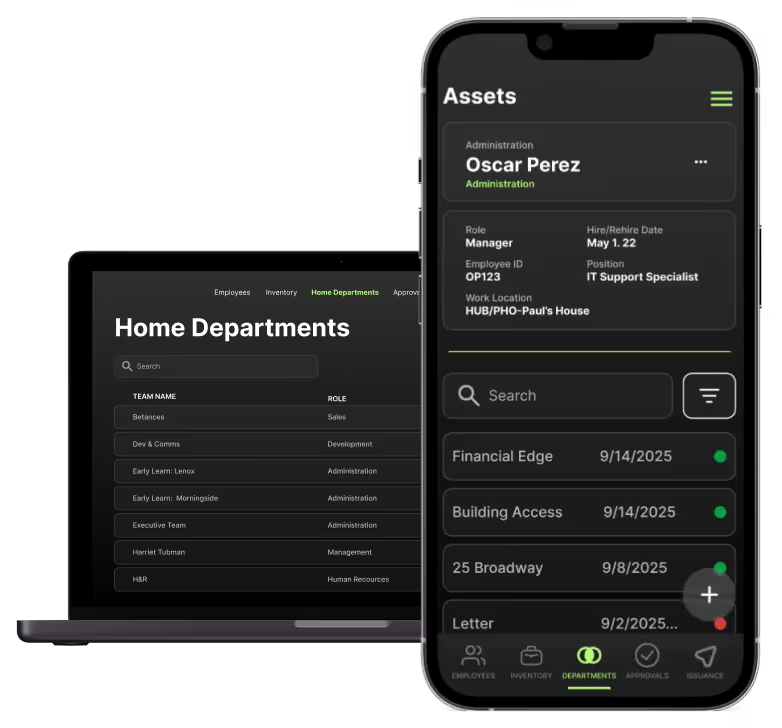
Teams replace chaotic spreadsheet tracking with structured internal tools. Founders launch products that would have required three months and a developer in two weeks and under $10,000. Operations teams automate the repetitive coordination work that consumes hours every week across their entire department.
Real no-code app examples across industries show the range of what ships in production today, from simple dashboards to multi-user SaaS platforms processing real transactions.
Most Common No-code Use Cases (By Real Business Needs)
Building Products (Startup and Founder Use Cases)
No-code is where most startup products begin in 2026. The speed and cost advantage over custom development is significant enough that building an MVP any other way is hard to justify before product-market fit is proven.
- SaaS platforms: authentication, subscription billing, dashboards, and multi-user workflows launch on Bubble without engineering teams at a fraction of custom development cost.
- Marketplaces: two-sided platforms with user roles, matching logic, and payment processing ship in weeks rather than months using no-code tools designed for complex relational data.
- Mobile and web apps: consumer-facing apps reach both app stores through FlutterFlow with native performance that responsive web cannot match for users comparing against native alternatives.
Building a no-code MVP covers how to scope a product build that validates demand without overinvesting before the idea is proven.
Internal Tools (Most Practical Use Case)
Internal tools are the highest-ROI no-code use case for most businesses. Requirements are well understood, users are internal, and the cost of a rebuild is low relative to the immediate operational value delivered.
- Replace spreadsheets with structured apps: enforce data consistency, automate calculations, and give the right people the right access without custom development timelines or cost.
- Reporting and dashboards: pull from multiple data sources into a single operational view, replacing the manual export and format process someone runs every week.
- Admin panels and operational tools: built for specific team workflows, these replace generic software that never quite fits how the team actually works day to day.
Business Process Automation
Automation delivers the fastest payback of any no-code use case. Business process automation examples across industries show how consistently the same workflow patterns appear regardless of company size.
- Repetitive workflow automation: tasks that follow the same pattern every time run automatically without anyone managing each instance, freeing team capacity for higher-value work.
- Approval systems: structured workflows with automatic routing, reminders, and escalation replace email chains that rely on people remembering to follow up.
- Data entry and task automation: information entered in one tool appears instantly in another without copying, pasting, or manual import processes that introduce errors.
The benefits of business process automation compound over time as each automated workflow frees capacity that compounds into real operational leverage.
Customer-Facing Systems
Customer-facing systems built on no-code handle real transaction volume and real user bases across industries that would have required significant custom development five years ago.
- Booking and scheduling apps: availability management, payment processing, and automated confirmations run for service businesses across hospitality, healthcare, and professional services.
- CRMs and customer portals:no-code CRM systems built around a team's actual sales process outperform generic tools that require extensive customization to fit non-standard workflows.
- Membership and community platforms: gated content, member directories, and community features serve real member bases without enterprise software costs or custom development timelines.
Operational and Industry Use Cases
Industry-specific operational tools are among the most underexplored no-code use cases despite being some of the highest-value builds for the teams that need them.
- HR onboarding systems: guide new employees through document submission, training completion, and system access requests, replacing inconsistent manual checklists with structured reliable processes.
- Finance tools: billing tracking, invoice management, and expense approval run reliably on no-code platforms for teams that do not need the complexity of enterprise finance software.
- Logistics and field operations: field workers get mobile access to job information, completion tracking, and customer communication without the cost of enterprise field service software.
- Healthcare and education platforms:healthcare automation and education workflows serve patients, students, and staff with structured systems that previously required custom development budgets most organizations in those sectors could not justify.
Data and Workflow Systems
Data management and workflow coordination are use cases where no-code replaces both expensive software and manual processes simultaneously.
- Reporting and analytics dashboards: aggregate data from multiple tools into a single operational view, replacing the manual weekly report that consumes hours of someone's time every cycle.
- Document processing and tracking: route files through review, approval, and storage automatically, replacing the email-based document management that creates version control chaos.
- Data syncing across tools:no-code automation ensures a record updated in one system appears correctly in every connected system without manual intervention or data entry duplication.
AI-Powered Use Cases
AI-powered no-code use cases are the fastest-growing category in 2026. Building an AI SaaS with no-code is increasingly practical for founders who understand where no-code AI integration works reliably.
- Customer support chatbots: handle common queries, route complex issues to the right team member, and capture interaction data without human involvement in every instance.
- AI-driven workflows and decision tools: classify incoming data, generate structured outputs, and trigger downstream actions based on AI analysis, replacing manual review processes that required human judgment for every case.
MVP and Idea Validation
Idea validation is where no-code has the clearest advantage over every alternative. Getting a working product in front of real users before significant investment changes the economics of early-stage product development fundamentally.
- Launching startup ideas quickly: two to four weeks to a working product instead of three to six months changes what is possible for founders without engineering resources or large budgets.
- Testing products without developers: validate core assumptions with real users before committing to architecture decisions that are expensive to reverse once the product is built on them.
- Iterating based on user feedback: rapid iteration on real user responses produces better products faster than any methodology that delays user contact until a more complete version is ready.
Real Examples of No-code Use Cases (Simple Workflows)
These are the automation patterns that run in production across businesses every day.
- Lead to CRM workflow: a lead fills out a form, gets added to the CRM automatically, receives a welcome email, and the sales team gets a Slack notification within seconds of submission without anyone touching the process.
- Booking and payment flow: a customer makes a booking, payment processes automatically, a confirmation email goes out, and the calendar updates, all triggered by a single user action.
- Task creation from submissions: a team member submits a request form, a task is created in the project management tool, assigned to the right person, and a confirmation sent to the requester automatically.
- Customer onboarding sequence: a new customer signs up, a series of onboarding emails triggers over the following days, their account is set up in connected tools, and the success team is alerted to follow up at the right moment.
Which No-code Use Case Fits You?
The right starting point depends entirely on where the biggest operational friction or growth constraint is in your current situation.
- If you are a founder: build an MVP or SaaS product that validates whether your core idea has demand before investing in infrastructure or engineering.
- If you run a team: build internal tools that replace the spreadsheets, manual processes, and generic software that slow your team down and create data inconsistency.
- If you handle repetitive work: automate the workflows that follow the same pattern every time and currently require someone to manually coordinate across multiple tools.
- If you manage customers: build a CRM or customer portal that gives your team structured visibility into customer data and gives customers self-service access to their own information.
Best No-code Use Cases to Start With (Beginner-Friendly)
The best starting use cases share a common profile: well-understood requirements, limited scope, and immediate visible value for the people using the result.
- Internal tools and dashboards: requirements are clear, users are internal and forgiving, and the value is immediately visible when a spreadsheet becomes a structured app with proper data validation and access control.
- Simple automation workflows: a single trigger with two or three actions is achievable in hours, delivers instant time savings, and builds the confidence to tackle more complex automation progressively.
- Basic MVPs for validation: a core workflow with authentication and the single feature that proves the product's value is enough to generate real user feedback that informs every subsequent decision.
Effort vs Impact of Different Use Cases
Automation and internal tools consistently sit in the low effort, high impact quadrant because the requirements are defined, the users are known, and the value is measurable from day one. SaaS platforms and marketplaces require significantly more planning, build time, and budget but produce proportionally higher long-term value when the product finds its market.
Cost and Complexity by Use Case
Internal tools deliver the clearest cost-to-value ratio because they are fast to build, cheap to run, and replace manual processes with measurable time savings from day one. SaaS platforms and marketplaces require more investment but generate revenue that justifies the build cost when the product finds product-market fit.
When No-code Is NOT Suitable for Your Use Case
The real capabilities and limitations of no-code make clear where the category performs well and where it creates more problems than it solves.
- Complex backend-heavy systems: products requiring precise custom data processing, complex business logic with many exception paths, and enterprise-grade compliance infrastructure push beyond what visual builders handle reliably.
- High-scale real-time platforms: applications expecting millions of concurrent users, sub-second response time requirements, and real-time data processing at volume need infrastructure control that managed platforms cannot provide.
- Deep customization requirements: products where every UI interaction, data structure, and system behavior must be precisely controlled throughout the development lifecycle belong in custom code from the start.
Common Mistakes When Choosing No-code Use Cases
- Starting with complex products too early: building a full SaaS platform before validating that users want the core feature is the most expensive no-code mistake; start with the minimum that proves demand.
- Automating unclear or broken processes: automation makes bad processes run faster; understand and fix the workflow logic before automating it or the problems compound at every execution.
- Choosing use cases without validating need: building an internal tool nobody asked for or automating a workflow that changes constantly creates wasted build time and maintenance overhead with no operational benefit.
- Ignoring scalability and future growth:business process automation challenges compound when initial builds are not designed with future volume and complexity in mind from the start.
How No-code Use Cases Fit Into Business Growth
The right no-code use case changes as the business grows. Matching the use case to the business stage prevents both premature complexity and underinvestment in systems that the business has already outgrown.
- Idea stage: MVP validation using no-code to test demand before any infrastructure investment; the goal is learning, not building.
- Growth stage: internal tools and automation that give a growing team the operational leverage to handle more volume without proportional headcount growth.
- Scale stage: full SaaS and operational systems that serve external customers reliably at meaningful volume while the team focuses on product and market rather than manual operations.
Low-code business process automation becomes increasingly relevant at the scale stage when pure no-code approaches hit their flexibility ceiling and teams need more control over workflow logic without committing to full custom development.
How to Choose the Right No-code Use Case
Choosing the right use case is more important than choosing the right platform. A well-chosen simple use case built on any capable platform outperforms an ambitious complex use case built on the best platform available.
- Identify your biggest bottleneck: the right first use case is not the most impressive thing no-code can build but the one causing the most friction or consuming the most time in your operations today.
- Focus on solving one problem first: a single well-executed automation or internal tool that works reliably is more valuable than an ambitious system that partially works across many problem areas.
- Choose based on impact, not complexity: the lowest-complexity use case with the highest operational impact is almost always the right starting point for teams new to no-code.
- Start small and expand gradually: stable simple implementations built on proven workflow logic are better foundations for expansion than complex systems built before the requirements are fully understood.
Why Teams Work with No-code Experts Instead of DIY
DIY no-code use case implementation costs less upfront and more overall for anything beyond simple single-step automation or basic internal tools.
- Faster execution with fewer mistakes: experienced no-code teams know which use cases create problems at scale before building them, which prevents the most expensive category of rework.
- Better system design and scalability:how no-code agencies structure builds from discovery through launch ensures that the data model, workflow logic, and integration architecture support the use case at the volume the business plans to reach.
- Avoid rebuilding later: wrong platform selection, poor data architecture, and underestimated integration complexity are the three most common causes of expensive no-code rebuilds; experienced teams resolve all three before the first screen is built.
- Continuous improvement and optimization:the best no-code agencies stay involved after launch, iterating and optimizing as the business use case evolves rather than delivering and disappearing.
Conclusion
No-code use cases in 2026 span from simple automation workflows saving hours per week to full SaaS platforms serving thousands of paying customers. The right use case is not the most technically impressive one available. It is the one that solves the most important problem your business faces right now with the resources available to build it properly.
Start with the bottleneck. Build the minimum that proves the value. Expand from there as the use case is validated and the operational benefit is clear.
Want to Build the Right No-code System for Your Business?
At LOW/CODE Agency, we started as builders and that has not changed. Today we build AI-powered products — web apps, mobile apps, RAG systems, chatbots, and AI agents — specifically for SMBs that want real software, not a SaaS subscription. We are not a dev shop.
- No-code development services: our no-code development service covers platform selection, data architecture, full production builds, and ongoing iteration across every no-code use case.
- Bubble development: our Bubble development service handles web SaaS, internal tools, and workflow-heavy business applications from MVP to scale.
- Automation development: our automation development service designs and builds no-code automation systems that replace manual operational work reliably at production scale.
- Architecture before build: we identify your highest-impact use case, plan the right approach, and design the system before touching any visual builder.
- Full product team on every project: strategy, UX, development, and QA working together from discovery through launch and beyond.
- Long-term partnership: we stay involved after launch, iterating as your use cases evolve and your operational requirements grow.
We have shipped 350+ products across 20+ industries. Clients include Medtronic, American Express, Coca-Cola, and Zapier.
Related Articles
Last updated on
September 3, 2026
.

Jesus is a visionary entrepreneur and tech expert. After nearly a decade working in web development, he founded LOW/CODE Agency to help businesses optimize their operations through custom software solutions.


FAQs
What are the most common no-code use cases?
Can no-code be used for real businesses?
What is the best no-code use case for beginners?
Are no-code use cases limited to simple apps?
How do I choose the right no-code use case?
How long does it take to build a no-code use case?
Related Articles
.avif)
No-code/Low-code
Agile vs Waterfall for No-code Data App Builds (2026 Guide)
Agile vs Waterfall for no-code data apps explained. Compare speed, cost, flexibility, and use cases to choose the right approach in 2026.
No-code/Low-code
No-code CRM (Build vs Buy, Benefits, Limits Explained)
Learn how no-code CRM works, when to use it, and its limits. Compare build vs buy, risks, scalability, and best use cases before choosing.
![What Is Low-code Technology? [Meaning and How It Works]](https://cdn.prod.website-files.com/61cbe22a00483909d327afc6/69deac765170e55c4b3e12ba_69b2c8bf9cd93ec79dc1155a_what-is-low-code-technology.avif)
No-code/Low-code
What Is Low-code Technology? [Meaning and How It Works]
Understand what low-code technology is, how it works, and why businesses use it to build apps faster with visual tools. A simple, complete beginner guide.

AI
No-code/Low-code
How to build an AI project manager app using no-code
Discover how to create an AI-powered project management app using no-code tools. Step-by-step guide for building smart, automated workflows.

Why customers trust us for no-code development


