

No-code CRM (Build vs Buy, Benefits, Limits Explained)
16 min
read
Learn how no-code CRM works, when to use it, and its limits. Compare build vs buy, risks, scalability, and best use cases before choosing.

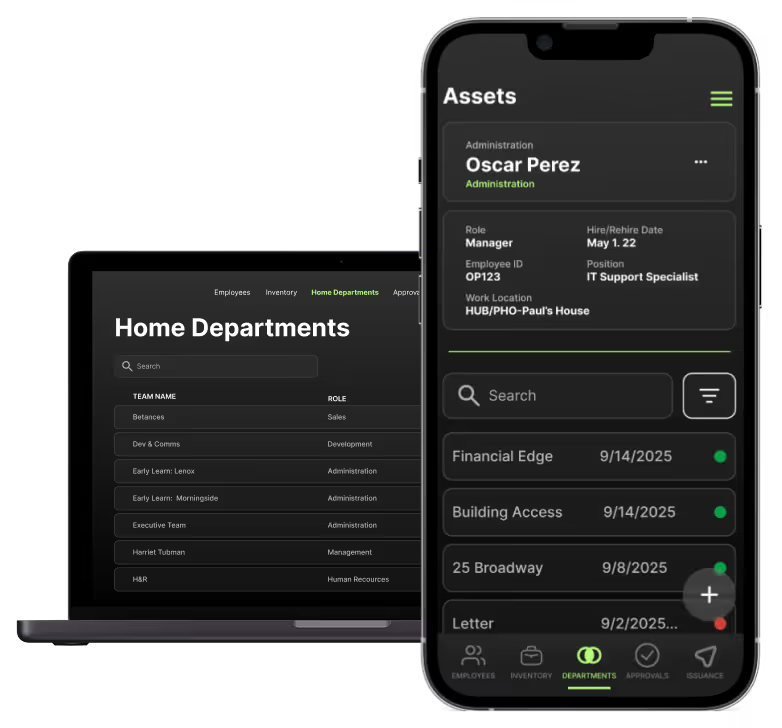
A no-code CRM gives your team a structured system built around how you actually work, not how a SaaS vendor decided you should work.
In 2026, businesses replace spreadsheets, ditch rigid off-the-shelf tools, and build custom CRM systems on no-code platforms in days rather than months.
This guide tells you exactly what a no-code CRM can do, where it breaks, and how to decide whether it is the right choice for your business before you commit.
Key Takeaways
- No-code CRMs are faster and cheaper to build than custom systems: a tailored CRM built on Bubble or Glide costs a fraction of custom development and ships in weeks rather than months.
- They work best for structured workflows at early to growth stage: lead management, sales pipelines, client portals, and operations tools all build reliably within platform capabilities.
- Vendor lock-in is the most significant long-term risk: most platforms export nothing, meaning outgrowing the platform means rebuilding rather than migrating.
- Building beats buying when your workflows are unique: off-the-shelf CRMs force your team to adapt to the tool; a no-code CRM adapts the tool to your team.
- The right choice depends on your workflows, not the tool: complexity, scale, and integration requirements determine whether no-code CRM is the right foundation for your business.

Know Before Choosing a No-code CRM
This guide answers the questions that actually matter before you commit to building or switching to a no-code CRM.
- Can you replace your current CRM or spreadsheets with it? For most structured sales and operations workflows, yes; the ceiling appears at complex enterprise processes, advanced analytics, and high-volume data requirements.
- Should you build your own CRM or use an existing tool? Build when your workflows are unique enough that standard SaaS tools require constant workarounds; buy when your workflows are standard enough that off-the-shelf tools cover them without friction.
- Will it support your workflows as you grow? To a point; no-code CRMs scale well through early and growth stages before data volume, user load, and integration complexity create platform constraints.
- What risks are you taking long term? Vendor lock-in, platform dependency, and the potential rebuild cost when the platform ceiling is reached are the three risks worth understanding explicitly before committing.
- Whether you will need to rebuild later? Possibly; planning clean data architecture and modular workflow design from day one reduces the probability and cost of that transition significantly.
What You Can Actually Do With a No-code CRM
No-code CRM platforms in 2026 handle a significantly wider range of sales and operations workflows than most teams expect when they first evaluate the category.
- Build a CRM tailored to your exact workflows: every field, pipeline stage, user role, and automation rule configures around how your team actually works rather than forcing your team to adapt to a vendor's assumptions.
- Manage leads, contacts, and deals in one place: structured databases with relational data, status tracking, and activity history replace the spreadsheet chaos that most growing teams inherit from their earliest sales processes.
- Automate follow-ups, task assignments, and updates:no-code automation handles the repetitive coordination work that currently consumes sales and operations time, from follow-up reminders to deal stage updates triggered by customer actions.
- Create dashboards and reports for your team: operational visibility into pipeline health, team performance, and customer status builds in visual builders without custom reporting development or expensive BI tools.
- Connect CRM with email, forms, and other tools: pre-built connectors link your CRM to Gmail, Outlook, Typeform, Stripe, and hundreds of other tools without custom API code or developer involvement at any stage.
- Let non-technical teams manage and update the system: operations managers, sales leads, and founders configure and maintain the CRM without involving IT or engineering when workflows change.
- Launch quickly without waiting for developers: a well-scoped no-code CRM builds in one to three weeks professionally rather than the three to six months a custom-built equivalent would require.
Where No-code CRM Works Best (Use Case Fit)
Strong Fit Scenarios
These are the situations where a no-code CRM consistently delivers value without requiring workarounds that undermine the speed and flexibility advantage it provides.
- Replacing spreadsheets or messy tools: teams tracking leads, clients, and deals across disconnected spreadsheets get immediate structured visibility when those workflows move into a purpose-built no-code CRM.
- Building a custom CRM for a startup or small team: early-stage teams whose workflows do not fit standard SaaS CRM assumptions build systems that match their actual process in days rather than spending months configuring tools that never quite fit.
- Managing sales pipelines with simple to moderate workflows: deal stage tracking, contact management, activity logging, and follow-up automation all build cleanly within platform capabilities for teams whose sales process follows consistent patterns.
- Creating internal tools for operations or client management: client portals, account management dashboards, and operations tracking systems built on the same platform as the CRM create integrated systems that share data cleanly without complex integrations.
Weak Fit Scenarios
These are the situations where no-code CRM limitations become business constraints before the system reaches its potential.
- Complex enterprise sales processes with deep logic: multi-stage approval workflows, territory management, complex commission calculations, and enterprise-grade forecasting push beyond what visual builders handle reliably without significant workarounds.
- Systems requiring advanced analytics or forecasting: predictive analytics, revenue forecasting models, and complex multi-dimensional reporting require data processing capabilities that no-code platforms cannot provide without expensive external BI tool integrations.
- High-scale CRM with large data volume and users: query performance degrades at high data volume in most no-code platforms; a CRM handling millions of contact records and hundreds of concurrent users hits platform ceilings that tier upgrades address only partially.
- Heavy integrations with legacy or custom systems: proprietary enterprise systems, custom ERP platforms, and legacy databases that lack pre-built connectors require developer involvement that removes the no-code speed and cost advantage entirely.
The Big Decision: Build Your Own CRM or Use Existing Tools
Most teams approach this decision backwards. They evaluate tools before defining workflows clearly enough to know which tool actually fits.
- Build with no-code when your workflows are unique: standard SaaS CRM tools that require constant field hacks, workarounds, and process compromises create operational friction that compounds every time your team fights the tool to do what your process requires.
- Use HubSpot or Zoho when your workflows are standard: off-the-shelf tools ship faster than anything you build and carry years of product investment in features your team will eventually need without custom development.
- Building gives flexibility but requires planning: a no-code CRM built without clear data architecture and workflow logic becomes as messy as the spreadsheets it replaced, which eliminates the core reason for building it.
- Buying is faster but creates rigidity over time: standard tools force your process to adapt to the vendor's assumptions, which creates friction as your business evolves away from those assumptions.
The right decision is not which approach is better in isolation. It is whether your workflows are specific enough to your business to justify the structure and planning that a purpose-built system requires.
No-code CRM vs Traditional CRM vs Custom CRM
No-code CRM is the right choice for teams whose workflows are unique enough to need customization but whose scale and complexity do not yet justify custom development investment. Traditional CRM tools suit teams whose sales processes match standard SaaS assumptions closely enough that configuration covers the gaps. Custom CRM development becomes necessary when complexity, compliance, and scale requirements exceed what both no-code and traditional tools handle reliably.
Where No-code CRM Starts Breaking (Real Limitations)
Understanding exactly where no-code CRM breaks before you hit the ceiling is what separates teams that plan well from teams that discover the problem under operational pressure.
- Limited customization for complex workflows: multi-step conditional logic, exception handling paths, and unique process rules create compounding workarounds that become difficult to maintain as the CRM grows in scope.
- Performance issues as data and users grow: contact database queries, pipeline filtering, and dashboard loading all degrade at predictable points as data volume and concurrent user load increase beyond what managed infrastructure handles optimally.
- Limited control over backend and infrastructure: you cannot optimize database queries, configure caching, or adjust execution logic in the ways that a high-volume CRM at production scale requires for consistent performance.
- Integration challenges with complex systems: niche industry tools, legacy enterprise platforms, and custom internal systems that lack pre-built connectors require developer involvement that removes the no-code advantage entirely.
- Restricted flexibility for advanced reporting: complex multi-dimensional analytics, custom attribution models, and predictive reporting require data processing capabilities that no-code platforms cannot provide natively without expensive external tool integrations.
The Real Risks You Need to Understand
Vendor Lock-in
Most no-code platforms export data as CSV and export no workflow logic at all. Your CRM structure, automation rules, and interface design are entirely proprietary to the platform. If you outgrow the platform or pricing changes significantly, rebuilding is the only path forward.
- Hard to migrate your CRM later: recreating every workflow, field configuration, automation rule, and dashboard in a new environment requires significant time and cost that teams consistently underestimate when they first make the platform choice.
- Your system depends on platform decisions: feature deprecations, pricing changes, and platform updates all affect your CRM without your involvement or consent.
Scalability Limits
No-code CRM scales well through early and growth stages and degrades at predictable points beyond that.
- Works well early but struggles at scale: contact volumes in the hundreds of thousands, complex relational queries across large datasets, and high concurrent user loads push beyond what managed infrastructure handles reliably.
- May require rebuilding as business grows: teams that build on no-code CRM at 50 contacts sometimes discover the platform ceiling at 50,000 contacts when the rebuild cost is significantly higher than it would have been at the start.
Cost Over Time
- Starts affordable but grows with usage: platform tier upgrades at higher data volumes, additional automation tool subscriptions, and plugin costs for missing native features compound into total cost of ownership numbers that differ significantly from the initial subscription price.
- Add-ons and integrations increase cost: connecting your CRM to email tools, forms, payment systems, and communication platforms adds subscription costs that accumulate as the system grows in scope.
Integration Constraints
- Works well with common tools: Stripe, Gmail, Slack, Typeform, and other widely used tools connect through pre-built connectors without custom development.
- Struggles with complex or legacy systems: proprietary enterprise platforms, industry-specific software, and custom internal databases that lack pre-built connectors require developer work that adds cost and timeline to every integration.
When a No-code CRM Is the Right Choice
- You need a system quickly without hiring developers: a professionally built no-code CRM ships in one to three weeks versus three to six months for custom development at 60 to 80 percent lower cost.
- Your workflows are clear but not overly complex: sales pipelines, lead management, contact tracking, and follow-up automation that follow consistent patterns build cleanly within platform capabilities without constant workarounds.
- You want flexibility that SaaS CRMs do not provide: custom fields, unique pipeline stages, and workflow logic specific to your business configure in a no-code CRM without the vendor constraints that make standard tools frustrating for non-standard processes.
- You are in early-stage or growth phase:the benefits of no-code compound most clearly at the stage when speed and cost matter more than architectural perfection and the rebuild risk is acceptable relative to the validation value.
- You want to test and iterate your CRM setup: no-code platforms allow workflow changes, field additions, and process modifications in hours rather than the development cycles that custom CRM changes require.
When You Should Avoid No-code CRM
- You need deep customization and full control: proprietary sales logic, custom data processing, and unique system behaviors that consistently require workarounds signal the wrong platform choice from the start.
- Your CRM must handle large-scale operations: contact volumes in the hundreds of thousands, complex multi-dimensional reporting, and high concurrent user loads belong on purpose-built infrastructure rather than managed platform environments.
- You rely on complex integrations or legacy systems: enterprise ERP platforms, industry-specific software, and custom internal databases that lack pre-built connectors require developer involvement at every integration point.
- You need advanced analytics and performance tuning: predictive forecasting, complex attribution modeling, and revenue analytics at enterprise scale require data infrastructure that no-code platforms cannot provide natively.
- Your product depends heavily on backend logic: CRM systems where the competitive advantage is in proprietary data processing, custom algorithms, or unique execution patterns belong in custom CRM development from the start.
What Happens When You Outgrow a No-code CRM
Outgrowing a no-code CRM is a rebuild, not an upgrade. Teams consistently discover this later than they should.
- You may need to rebuild instead of upgrading: platform tier upgrades address moderate scaling needs but cannot resolve the architectural constraints that require custom infrastructure to solve correctly.
- Migration can be complex and time-consuming: data exports as CSV and workflow logic exports as nothing; every automation rule, dashboard, and integration must be recreated in the new environment from scratch.
- Data structure may not transfer cleanly: no-code platform database formats use proprietary structures that do not map cleanly to standard relational database schemas; the transformation requires significant technical effort and data cleaning.
- Teams often underestimate transition effort: a no-code CRM that cost $8,000 to build frequently requires $50,000 to $120,000 to rebuild in custom code when the business has grown to depend on it operationally.
The Smarter Approach Most Teams Use
The most successful no-code CRM implementations are built with the transition in mind from day one rather than discovering the need for it under growth pressure.
- Start with no-code CRM to replace spreadsheets: the immediate structured visibility over contacts, deals, and workflows justifies the build cost before any automation or advanced feature is added.
- Use it to understand real workflows and needs: operating a real CRM with real data teaches process lessons that specifications and planning never reveal, which makes the eventual custom build significantly better.
- Improve structure and automation over time:no-code automation tools connected to your CRM compound its operational value as the team identifies high-frequency manual tasks that automation handles reliably.
- Move to custom or hybrid systems when needed: the transition decision belongs at the point when platform limitations create genuine business constraints, not before demand is proven or after the limitations have caused operational damage.
- Combine no-code with APIs and automation tools: using no-code CRM frontends with custom backend logic creates hybrid architectures that extend the useful life of the no-code investment significantly beyond what the platform alone supports.
How to Decide If a No-code CRM Is Right for You
- Define how complex your workflows are: map your sales and operations processes against the platform's documented capabilities; if more than 30 percent require workarounds, the platform is wrong for the workflow.
- Estimate your future scale and data volume: model contact volume, user load, and query complexity at your target scale, not just your current scale; the performance implications look different at 50,000 contacts than they do at 500.
- List integrations you will need: verify pre-built connectors exist for every critical external system before committing to a platform that may require custom development for integrations your CRM depends on from day one.
- Evaluate flexibility vs long-term control: assess whether your CRM roadmap will consistently push against platform boundaries and whether the rebuild cost at that point is acceptable given the speed and cost advantage you gain now.
- Balance speed vs long-term risk: the core decision is whether the speed and cost advantage of no-code CRM today is worth the vendor lock-in and rebuild risk later; for most early to growth stage businesses the answer is yes.
Why Teams Work With a Product Team Instead of Guessing
Wrong data architecture, poor workflow design, and platform selection based on surface features rather than long-term fit are the three most common causes of no-code CRM rebuilds. Experienced teams resolve all three before the first field is configured.
At LOW/CODE Agency, we do not just build CRMs. We design systems that match how your business actually runs, so your team uses them daily and they evolve as you grow.
- Avoid building a CRM that breaks later: the most expensive outcome is a well-used CRM on the wrong foundation; architecture review before build prevents this at a fraction of the rebuild cost.
- Design workflows that actually scale: experienced teams build data models and automation logic for the contact volume and process complexity you plan to reach, not just the minimum viable version.
- Structure your data and processes correctly from day one: clean relational data architecture, logical field naming, and modular workflow design reduce the migration cost and transition disruption when the business outgrows the platform.
- Reduce risk of lock-in and poor decisions:how no-code agencies structure builds from discovery through launch ensures platform selection, data architecture, and workflow design decisions are made for long-term fit rather than immediate convenience.
Conclusion
No-code CRM is powerful for speed and flexibility at the stage when getting a structured system in place matters more than architectural perfection.
It works best for structured workflows at early to growth stage where the platform capabilities match the business requirements without consistent workarounds.
It struggles with complexity, scale, and deep customization where the platform ceiling becomes an operational constraint rather than an acceptable tradeoff.
Want to Build a CRM That Actually Fits How Your Business Works?
At LOW/CODE Agency, we started as builders and that has not changed. Today we build AI-powered products — web apps, mobile apps, RAG systems, chatbots, and AI agents — specifically for SMBs that want real software, not a SaaS subscription. We are not a dev shop.
- Custom CRM development: our custom CRM development service designs and builds CRM systems around your actual workflows, not vendor assumptions about how your sales process should work.
- No-code development: our no-code development service covers platform selection, data architecture, and full production builds for CRM and operational systems where speed and cost are the priority.
- Architecture before build: we define data models, workflow logic, and integration approach before any visual building begins, preventing the data architecture mistakes that cause expensive CRM rebuilds.
- Full product team on every project: strategy, UX, development, and QA working together from discovery through launch and beyond.
- Long-term partnership: we stay involved after launch, evolving your CRM as your sales process, team structure, and operational requirements change over time.
We have shipped 350+ products across 20+ industries. Clients include Medtronic, American Express, Coca-Cola, and Zapier.
Related Articles
- No-code MVP Development (How to Build, Validate, and Scale)
- How to Build an AI SaaS with No-code (From Idea to Launch Guide)
- Best 12 No-code Automation Tools (How to choose the best one)
- Capabilities and Limitations of No-code (2026 Guide)
- When to Use No-code (And When You Should Avoid It)
- Traditional Development vs No-code (2026 Comparison)
Last updated on
September 3, 2026
.

Jesus is a visionary entrepreneur and tech expert. After nearly a decade working in web development, he founded LOW/CODE Agency to help businesses optimize their operations through custom software solutions.


FAQs
What is a no-code CRM and how does it work?
Is a no-code CRM better than traditional CRM tools?
Can a no-code CRM scale with my business?
Will I need to rebuild my CRM later?
Is no-code CRM suitable for large businesses?
What is the best no-code platform for building a CRM?
Related Articles

No-code/Low-code
How to Publish a Low-code Mobile App on the App Store
Learn how to publish a low-code mobile app on the App Store. Covers Apple review rules, certificates, testing, common rejections, and launch tips.

AI
No-code/Low-code
How to Build an AI SaaS with No-code (From Idea to Launch Guide)
Learn how to build an AI SaaS with no-code. Tools, steps, costs, risks, and how to launch and scale your AI product successfully.

MVP
No-code/Low-code
Low-code MVP Development for Startups (2026 Guide)
A 2026 guide to low-code MVP development for startups. Learn how to validate ideas faster, cut build costs, and launch without overengineering.
![What Are Low-code Applications? [Detailed Guide]](https://cdn.prod.website-files.com/61cbe22a00483909d327afc6/69de878d902970291a8e40e7_69b2c801e7ca826265eea676_what-are-low-code-applications.avif)
No-code/Low-code
What Are Low-code Applications? [Detailed Guide]
Understand what low-code applications are, how they work, and where they’re used. A simple guide with examples, benefits, and common use cases.

Why customers trust us for no-code development


