

How to Build a Task Management Platform with FlutterFlow
12 min
read
Learn how to create a task management platform using FlutterFlow with step-by-step tips and best practices for efficient app development.


Can a FlutterFlow task management platform compete with tools like ClickUp or Todoist? The answer depends on how you architect the data model and real-time sync logic, not on the visual builder's limits.
FlutterFlow handles the core use case well. This guide maps the features it delivers, where it slows down, how long it takes to build, and what to look for in a developer.
Key Takeaways
- Task CRUD is native: Creating, updating, filtering, and archiving tasks requires no custom code in FlutterFlow.
- Real-time sync is built in: Firestore powers live multi-user task updates without manual polling or WebSocket setup.
- Recurring tasks need Cloud Functions: FlutterFlow has no native recurrence engine, so daily and weekly schedules require backend logic.
- Cross-platform from one codebase: iOS, Android, and web all deploy from a single FlutterFlow project.
- Billing integration is straightforward: Stripe handles subscription plans and feature gating via custom API actions.
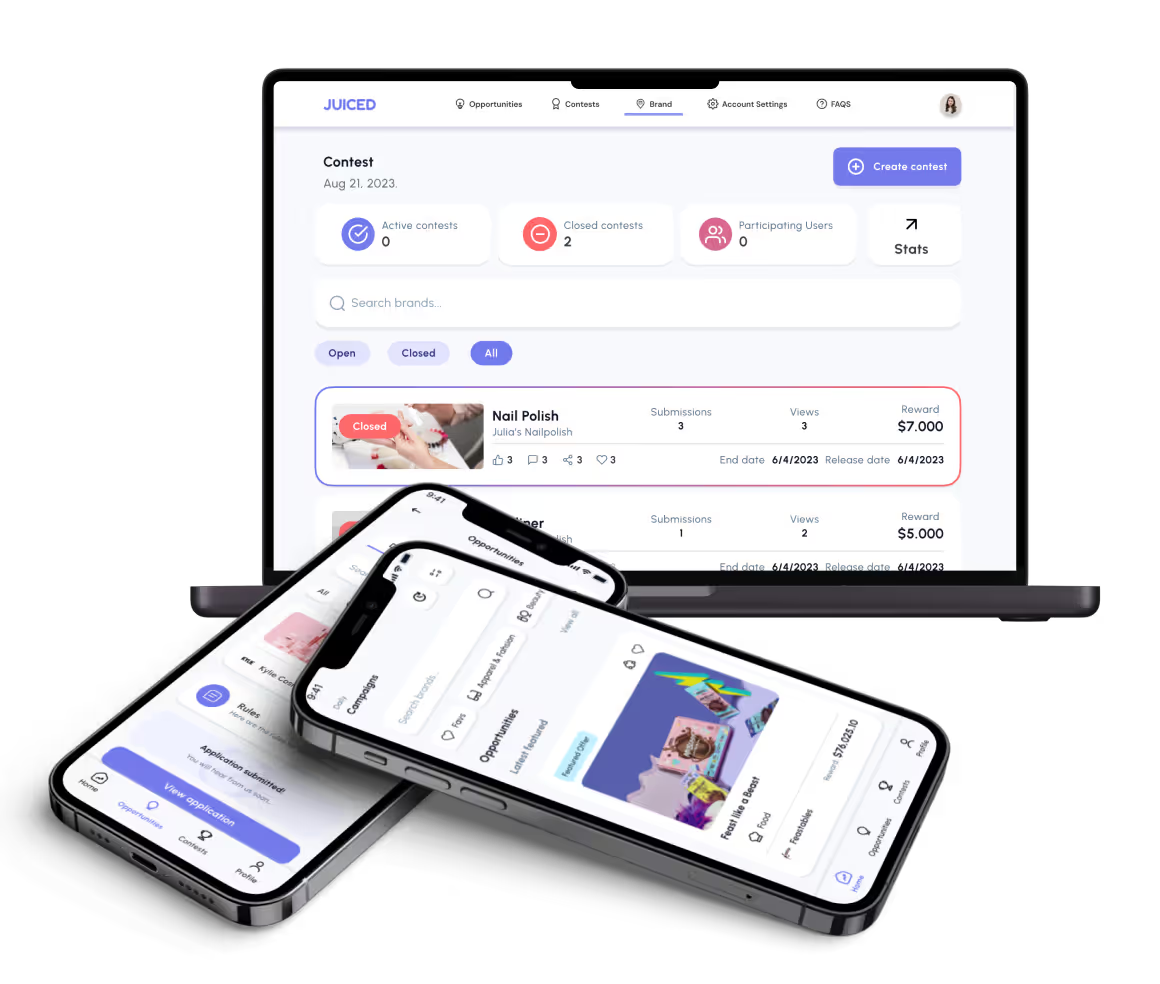

What Can FlutterFlow Build for a Task Management Platform?
FlutterFlow can build a full-featured task management platform including task creation, status workflows, team assignment, notifications, and reporting. Recurring task logic and full-text search require custom backend work beyond the visual builder.
If you plan to monetise this product, understanding what it takes to build a SaaS with FlutterFlow is worth doing before locking in your feature list.
Task Creation and Editing Interfaces
Full CRUD task forms with title, description, assignee, priority, labels, and due date fields are built visually with FlutterFlow's form components. No custom code is required for any of these fields.
Tasks are stored as Firestore documents, keeping all field changes in sync across every logged-in user in real time.
- Form components: Title, description, assignee, priority, labels, and due date all build without writing a single line of code.
- Firestore sync: Every task update reflects instantly for all team members through FlutterFlow's real-time Firestore listener.
- Attachment support: File uploads connect to Firebase Storage and link to the task record with a single action block.
Status Workflows and Progress Tracking
Custom status columns such as To Do, In Progress, Blocked, and Done are managed through enum fields in Firestore. Drag-and-drop Kanban rendering uses FlutterFlow's reorderable list components.
Status changes trigger Firestore writes that update all open views of the board in real time.
- Enum-based statuses: Custom status values map cleanly to Firestore enum fields and display in any list or board view.
- Kanban drag-and-drop: Reorderable list components render Kanban columns without custom widget code.
- Status history logging: Each status transition writes a timestamped log entry, giving the team a clear change history.
Assignee and Team Management
Tasks link to user records through Firestore reference fields. This allows filtered views by assignee, team, or department without changing backend logic.
Role-based visibility ensures managers see all tasks while individual contributors see only their assigned work.
- Reference field linking: Tasks connect to user documents, enabling team and assignee filters across every view.
- Role-based filtering: Firebase Auth custom claims gate which tasks each user role can view or edit.
- Workload display: Aggregate queries surface per-user task counts, giving managers a quick workload overview.
Notifications and Reminders
Push notifications via Firebase Cloud Messaging trigger on assignment, deadline approach, or status change. These are configured through Cloud Functions called by Firestore triggers.
Notification delivery works on iOS and Android from the same FlutterFlow project without platform-specific code.
- Assignment alerts: A Cloud Function triggers a push notification to the assignee whenever a task is assigned or reassigned.
- Deadline reminders: Scheduled Cloud Functions check due dates and send reminders 24 hours before each task deadline.
- Status change pings: Firestore triggers fire notification logic when task status changes, keeping all stakeholders informed.
Subtask and Checklist Support
Nested subcollections in Firestore model subtask hierarchies. Checklist items render as interactive checkbox lists within task detail screens.
Checklist completion percentage surfaces in the parent task card, giving the team a quick progress signal without opening the full task.
- Subcollection modelling: Subtasks store as a Firestore subcollection under the parent task, keeping data organised cleanly.
- Checkbox rendering: Interactive checkbox lists render natively in FlutterFlow without custom widget development.
- Progress indicators: Checklist completion percentage calculates client-side and displays on the parent task card.
Search and Filter Capabilities
FlutterFlow's query filtering supports multi-field search across task name, status, assignee, and due date. Full-text search across task content requires Algolia or Typesense integration.
Multi-field filters cover most team use cases without the added cost of a search service.
- Multi-field filtering: Status, assignee, due date, and priority filters combine to narrow task lists precisely.
- Label-based filtering: Custom labels create flexible grouping without requiring additional Firestore collections.
- Full-text search gap: Fuzzy search across task titles and descriptions requires Algolia or Typesense, adding cost and setup time.
Reporting and Productivity Views
Completed task counts, overdue summaries, and per-user workload widgets build using aggregate Firestore queries and chart components. Dashboards show team velocity and individual output.
These views are configurable per role, so managers and contributors see different reporting scopes.
- Velocity charts: Aggregate Firestore queries feed chart components showing tasks completed per day or week.
- Overdue summaries: A filtered query surfaces all past-due tasks across the team in a single dashboard card.
- Per-user workload: Individual task count displays give managers a fast view of who is over- or under-loaded.
How Long Does It Take to Build a Task Management Platform with FlutterFlow?
A simple task management MVP covering task creation, assignment, and basic status tracking takes 4 to 6 weeks. A full platform with team workspaces, notifications, reporting, and billing takes 10 to 18 weeks.
FlutterFlow saves 45 to 60 percent of build time versus a custom Flutter project by eliminating boilerplate UI and Firestore wiring.
- Simple MVP timeline: Task CRUD, assignment, status columns, and basic filtering ship in 4 to 6 weeks with a focused scope.
- Full platform timeline: Team workspaces, push notifications, reporting dashboards, and Stripe billing extend the build to 10 to 18 weeks.
- Recurring task complexity: Implementing daily, weekly, and custom recurrence rules via Cloud Functions adds 2 to 3 weeks to any phase.
- Third-party integration time: Slack notifications and Google Calendar sync each add 1 to 2 weeks depending on API complexity.
- Phased approach advantage: Shipping task CRUD and auth first generates usable value while team features and billing build in later phases.
A phased delivery model reduces risk for SaaS products. Launching phase one with paying early users funds the phase two feature build.
What Does It Cost to Build a FlutterFlow Task Management Platform?
A FlutterFlow task management platform costs $12,000 to $70,000 depending on feature scope and whether you hire a freelancer or an agency. Platform fees are a small fraction of total project spend.
Understanding FlutterFlow pricing plans is the right starting point before separating platform fees from development and backend costs.
- Platform cost is minimal: FlutterFlow's monthly fee is under 5 percent of total project cost for most builds.
- Freelancer vs agency: Freelancers suit focused MVPs with a single user role; agencies suit SaaS products with billing and a growth roadmap.
- Off-the-shelf comparison: ClickUp Business costs $12 per user per month; a custom build makes economic sense above 50 to 100 users needing white-label control.
- Hidden cost: full-text search: Algolia or Typesense integration adds both monthly fees and 1 to 2 weeks of development time.
- Hidden cost: audit logging: Storing immutable task change logs for compliance or enterprise features requires deliberate backend design.
- Hidden cost: calendar sync: Google Calendar API licensing and quota management add cost that many initial scopes omit.
Budget a contingency of 15 to 20 percent for integration complexity discovered during build. Task management SaaS products regularly surface edge cases in notification and billing logic.
How Does FlutterFlow Compare to Bubble, Glide, and Adalo for Task Management Platforms?
FlutterFlow produces the highest-quality native mobile output of any visual builder for task management apps. Bubble handles more complex web-based relational logic; Glide is faster for simple list tools; Adalo hits feature ceilings quickly on complex workflows.
- Mobile quality advantage: FlutterFlow produces true native iOS and Android apps; Glide and Bubble output web-wrapped experiences with lower performance.
- Bubble for web complexity: Bubble's relational data model handles more complex task logic and automations for web-only platforms.
- Glide for simple use cases: Glide ships faster for basic list-based task tools but hits feature ceilings quickly when filtering and roles are added.
- Code export advantage: FlutterFlow's code export option reduces long-term lock-in versus Bubble, which offers no equivalent exit path.
- When FlutterFlow wins: Field team task tools, mobile-first workflows, and white-label SaaS products for niche markets.
- When alternatives win: Web-only task platforms with complex database automations and no iOS or Android requirement.
The Bubble vs FlutterFlow for SaaS comparison is the best place to pressure-test this decision if you are still weighing platforms.
What Are the Limitations of FlutterFlow for Task Management Platforms?
FlutterFlow has no native recurring task engine, limited full-text search, partial offline support, and Firestore cost scaling challenges at high query volumes. These are solvable with deliberate backend design, but each adds time and cost.
Getting ahead of FlutterFlow scalability at scale means designing Firestore indexes and pagination before you hit 10,000 active tasks in the system.
- No recurring task engine: Daily, weekly, and custom recurrence rules require Cloud Functions and are non-trivial to maintain as logic grows.
- Full-text search gap: Firestore does not support fuzzy search, so searching across task titles and descriptions requires Algolia or Typesense integration.
- Offline write limitations: FlutterFlow's offline mode relies on Firestore's cache, which does not cover all write operations reliably in poor network conditions.
- Firestore cost at scale: High-volume task queries with complex multi-field filtering compound Firestore read costs without careful index and pagination design.
- Vendor dependency risk: Major FlutterFlow releases have broken custom widget libraries; a maintenance plan and version pinning strategy are necessary.
- Code export caveats: Exported Flutter code is functional but requires a Flutter developer to clean up before it is maintainable as a standalone project.
Recurring task logic is the most underestimated limitation in this category. Scoping it properly before development begins saves significant rework in phase two.
How Do You Get a FlutterFlow Task Management Platform Built?
You need a developer or agency with real-time Firestore experience, Cloud Functions knowledge for recurring logic, and Stripe integration background. FlutterFlow UI skill alone is not enough for a production task platform.
Knowing how to hire FlutterFlow developers with real-time data experience means your task sync architecture will be solid from the first sprint.
- Required expertise: Firestore data modelling for nested tasks, Cloud Functions for recurring logic, push notification pipelines, and Stripe SaaS billing are baseline requirements.
- Freelancer fit: Freelancers suit focused MVPs with a single task view, basic assignment, and no SaaS billing requirements.
- Agency fit: Agencies suit products on a SaaS roadmap where recurring features, multi-workspace, and billing growth need a long-term partner.
- Red flag: no live multi-user reference: A developer without a live multi-user task app in their portfolio has not solved real-time sync edge cases in production.
- Key question: recurring tasks: Ask specifically how they implement recurrence rules and whether they have Cloud Function examples to show.
- Expected scoping time: Allow 1 to 2 weeks for a proper scoping session before development phases begin.
Interview at least two developers and ask to see a live task platform before committing to a project.
Conclusion
FlutterFlow handles core task management well. Task CRUD, real-time sync, team assignment, and mobile delivery are all within its native capability.
Recurring logic, full-text search, and offline reliability require deliberate backend work that must be scoped upfront, not added later. List your non-negotiable features, identify which require Cloud Functions, and get a scoping estimate from a developer with a live platform in their portfolio.
Building a Task Management Platform with FlutterFlow? Here Is How LOW/CODE Agency Approaches It.
Most task management builds stall not on the UI, but on real-time sync architecture, recurring task logic, and SaaS billing. These are the parts that need to be right from day one.
At LOW/CODE Agency, we help SMBs compete with AI-powered software built for them — custom web and mobile apps, RAG systems, chatbots, and intelligent agents delivered by a senior development team. We build FlutterFlow task management platforms with the full stack behind them: Firestore data modelling, Cloud Functions for recurring logic, Stripe subscription billing, and push notification pipelines from a team that has shipped multi-user products before.
- Firestore architecture: We design your task data model with indexes, pagination, and real-time listener strategy before any UI work begins.
- Recurring task logic: We implement Cloud Function-based recurrence engines that handle daily, weekly, and custom schedules reliably.
- Push notification pipelines: We configure Firebase Cloud Messaging triggers for assignment, deadline, and status change events across iOS and Android.
- Stripe SaaS billing: We integrate subscription plans, trial periods, and feature gating so your task platform monetises cleanly from launch.
- Full-text search integration: We connect Algolia or Typesense when your task volume and search requirements exceed Firestore's native query limits.
- Phased delivery: We scope and ship task CRUD and auth first, then layer in team features, reporting, and billing so you get value at each stage.
- Full product team: Strategy, UX, development, and QA from a single team so your task platform is production-ready, not just technically functional.
We have built 350+ products for clients including Coca-Cola, American Express, and Sotheby's. We know exactly where task management platform builds go wrong, and we scope to avoid those problems before they cost you time.
Related Articles
- How to Build a Telehealth App with FlutterFlow
- How to Build a Team Management App with FlutterFlow
- How to Build a Taxi Booking App with FlutterFlow
- How to Build a Table Reservation App with FlutterFlow
- How to Build a Customer Support Dashboard with FlutterFlow
- How to Build a Supply Chain Dashboard with FlutterFlow
Last updated on
September 24, 2026
.

Jesus is a visionary entrepreneur and tech expert. After nearly a decade working in web development, he founded LOW/CODE Agency to help businesses optimize their operations through custom software solutions.


FAQs
What are the first steps to start building a task management app in FlutterFlow?
How can I implement task assignment and notifications in FlutterFlow?
What database options work best with FlutterFlow for task management?
Can I customize the task status and priority features in FlutterFlow?
How do I ensure data security and user authentication in my FlutterFlow app?
What are common challenges when building a task management platform with FlutterFlow?
Related Articles

FlutterFlow
How to Build a Utility Billing Platform with FlutterFlow
Learn how to create a utility billing platform using FlutterFlow with step-by-step tips and best practices for efficient app development.

FlutterFlow
How to Build a Supplier Onboarding Tool with FlutterFlow
Learn how to create a supplier onboarding tool using FlutterFlow with step-by-step guidance and best practices for smooth integration.
FlutterFlow
How to Build a Trucking Dispatch App with FlutterFlow
Learn how to create a trucking dispatch app using FlutterFlow with step-by-step guidance and key features to include.

Comparison
Glide
FlutterFlow
FlutterFlow vs Glide | 10 Factors Compared (2026)
Compare FlutterFlow vs Glide across 10 key factors including flexibility, database control, scalability, pricing, and app performance to choose the right builder in 2026.


Why customers trust us for no-code development


