

How to Build a Lead Scoring AI App with FlutterFlow
10 min
read
Learn how to create a lead scoring AI app using FlutterFlow with step-by-step guidance and best practices for effective lead management.


A FlutterFlow lead scoring AI app gives sales reps a ranked list of who to call next. But the scores themselves come from a back-end model, not from FlutterFlow.
Understanding that separation before you build saves weeks of misdirected effort. This guide covers what the app layer delivers, realistic timelines, real costs, and where the platform has hard limits.
Key Takeaways
- FlutterFlow displays scores: The lead scoring model runs in an external back-end service; FlutterFlow reads the result and surfaces it for reps.
- Training data is the ceiling: A model trained on incomplete win/loss data produces unreliable scores that reps stop trusting quickly.
- Two scoring architectures exist: LLM-based scoring is fast to build; ML-based scoring requires more data but delivers higher accuracy at scale.
- Explainability drives adoption: Reps act on scores when they understand why, scores without explanation face consistent resistance.
- CRM sync is non-negotiable: Lead score data without CRM integration is operationally useless for any real sales team.

What Can FlutterFlow Build for a Lead Scoring AI App?
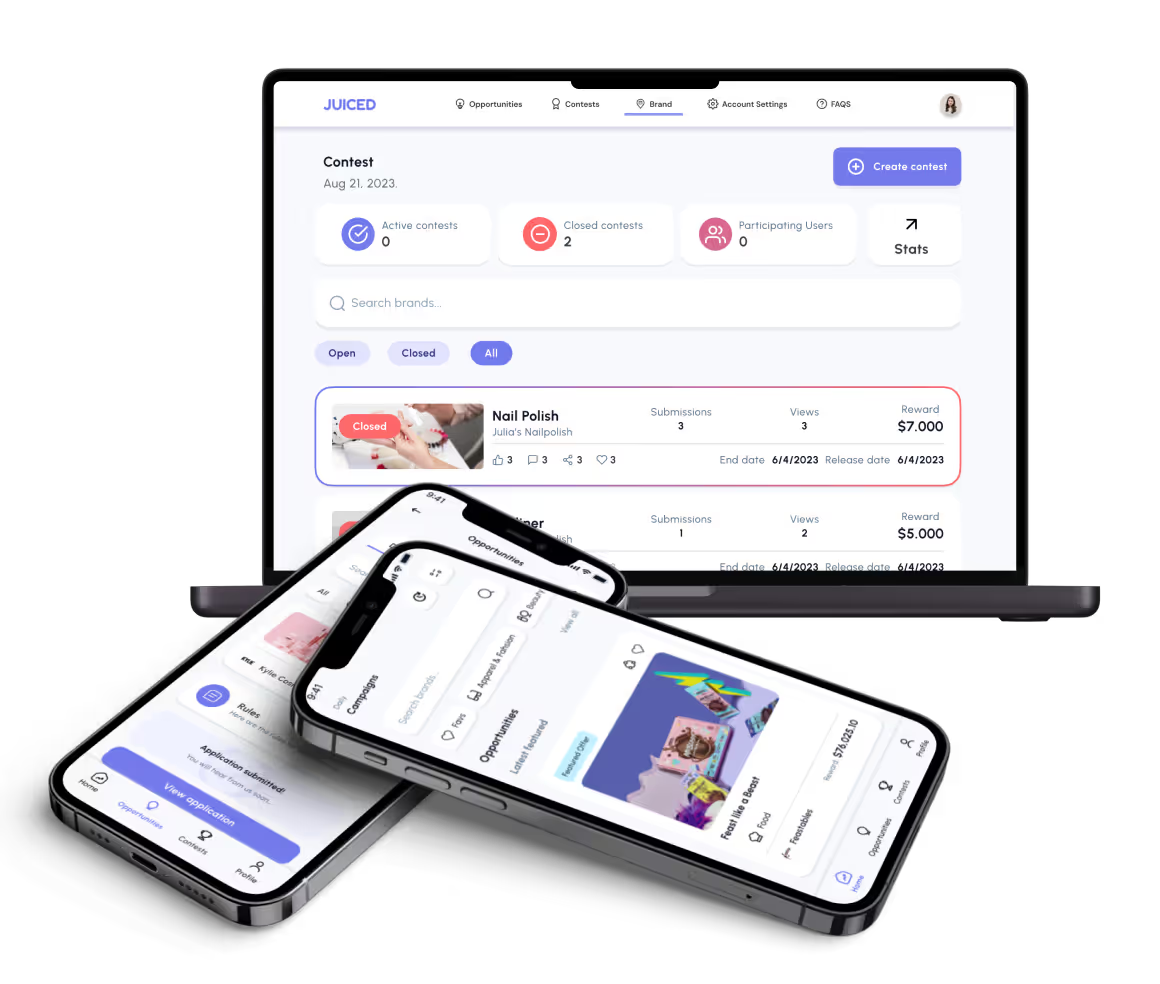
FlutterFlow builds the rep-facing interface for a lead scoring AI app: ranked dashboards, score detail views, trend charts, filter controls, and CRM activity logging. The scoring model runs externally; FlutterFlow surfaces the result and enables rep actions.
The technical framework for how to build AI scoring apps FlutterFlow centers on a clear separation: the model runs externally and FlutterFlow displays the output.
Lead Priority List Dashboard
A ranked list sorted by AI-generated score showing contact name, company, score value, change since last update, and recommended next action.
Individual Lead Score Detail View
A per-lead screen showing which factors contributed positively or negatively to the score, sourced from the scoring model's explainability output.
Score Trend Chart
A line chart showing a lead's score progression over 30 or 90 days, helping reps time outreach based on whether engagement is rising or falling.
Lead Filter and Segment Controls
Filter controls for score range, industry, deal size, score tier (Hot/Warm/Cold), and days-in-stage to focus reps on quota-relevant segments.
Score Refresh Trigger
A manual refresh button that triggers a back-end API call to recalculate a lead's score against the latest CRM and behavioral data before an important call.
CRM Activity Logger
One-tap buttons (Log Call, Log Email, Advance Stage) that write activity records directly to Salesforce or HubSpot via API, keeping data fresh for the scoring model.
Score Model Accuracy Dashboard
An admin-only view showing precision, recall, and conversion rate by score tier to monitor model health and identify when recalibration is needed.
Each of these features is achievable within FlutterFlow's visual builder using Firestore for data storage and custom API actions for back-end scoring calls.
How Long Does It Take to Build a Lead Scoring AI App with FlutterFlow?
A simple LLM-based scoring MVP takes 6–10 weeks. A full ML lead scoring platform with trained classifiers, CRM integration, explainability, and admin monitoring takes 14–24 weeks. Timeline is driven primarily by CRM data quality and model training requirements.
The front-end UI builds faster than the scoring infrastructure. Plan your timeline around the model, not the app layer.
- CRM data quality extends timelines: Cleaning and structuring historical win/loss data for model training typically adds 2–4 weeks before development starts.
- Phased builds reach production faster: Launch rule-based scoring and a priority list first; add the ML model, CRM sync, and explainability in phase two.
- Front-end builds 2–3x faster: FlutterFlow delivers lead list and detail UI significantly faster than custom code; scoring model timelines are similar regardless of front-end.
Validate the scoring model's accuracy on real leads before committing to the explainability and admin monitoring layers. Those are phase-two investments.
What Does It Cost to Build a FlutterFlow Lead Scoring AI App?
A FlutterFlow lead scoring AI app costs $15,000–$80,000 depending on whether you use LLM-based or ML-based scoring and how complex your CRM integration is. Ongoing costs include model hosting and CRM API fees.
FlutterFlow pricing plans sales tools run $0–$70/month at the platform level. Model hosting and CRM licensing are the operational expenses that scale with volume.
- Custom ML scoring is far more expensive: A bespoke ML lead scoring system built without FlutterFlow costs $200,000–$500,000 at minimum.
- Enterprise alternatives carry mandatory plans: Salesforce Einstein Lead Scoring requires Sales Cloud Enterprise; HubSpot predictive scoring requires Marketing Hub Professional.
- Data cleaning is a hidden pre-cost: Preparing historical CRM data for model training adds 20–40 hours of data work before a developer writes a line of code.
Budget for model retraining as a recurring cost. Sales patterns shift and a model calibrated on 12-month-old data will degrade in accuracy.
How Does FlutterFlow Compare to Custom Development for a Lead Scoring AI App?
FlutterFlow delivers the rep-facing scoring UI 2–3x faster and at 50–65% lower cost than custom development. ML model development and CRM pipeline costs are similar on either path. Custom development wins only at enterprise scale with proprietary signal sources.
The platform choice affects the app layer, not the scoring model. Both paths require equivalent investment in the model itself.
- FlutterFlow wins for SMB sales teams: Rapid validation, field sales enablement apps, and early-stage scoring tools with manageable CRM data volumes.
- Custom wins at enterprise scale: Multi-signal real-time scoring using intent data, technographics, and predictive firmographic enrichment requires dedicated ML infrastructure.
- Maintenance split: FlutterFlow enables fast score display and UX updates; custom code provides deeper control over feature engineering and model architecture.
A FlutterFlow pros cons sales apps assessment confirms the platform is strong for rep-facing score dashboards. The scoring model and CRM pipeline determine revenue impact.
What Are the Limitations of FlutterFlow for a Lead Scoring AI App?
FlutterFlow cannot compute lead scores. Every score displayed is the result of an API call to an external service. Training data quality, score explainability, CRM freshness, GDPR compliance, and model drift are the real operational constraints.
FlutterFlow security for sales data must be reviewed before designing your CRM integration. Prospect contact data synced for scoring is subject to GDPR obligations and requires a data processing legal basis.
- Scoring computation is entirely external: FlutterFlow cannot execute logistic regression, gradient boosting, or LLM inference. All scores arrive via API from an external service.
- Training data quality is the model's ceiling: Incomplete, inconsistent, or biased CRM data produces scores that damage rep trust within weeks of launch.
- Explainability requires a dedicated layer: Converting SHAP or LIME values into human-readable explanations needs a back-end layer; FlutterFlow displays the result but cannot compute it.
- CRM freshness determines score reliability: Stale CRM activity data produces stale scores. Real-time sync between your CRM and the scoring service is a required design decision.
- GDPR Article 22 applies to EU prospects: AI-based scoring of EU data subjects triggers automated decision-making obligations, including the right to explanation and the right to object.
- Model drift is a maintenance cost: Sales patterns change. A model calibrated on historical data degrades in accuracy over 6–12 months without scheduled retraining.
Plan the retraining cadence and compliance review into the project budget before you start. Both are recurring costs, not one-time investments.
How Do You Get a FlutterFlow Lead Scoring AI App Built?
Hire a team with ML model development experience, CRM API integration track record, and GDPR automated decision-making knowledge. The FlutterFlow UI work is proportionally smaller than the scoring infrastructure. Agency delivery is recommended for ML-based scoring builds.
When you hire FlutterFlow developers sales tools experience matters, but the critical hire is the ML engineer who builds the scoring model. The FlutterFlow work is a smaller proportion of the project.
- ML model experience is non-negotiable: Ask for prior classification model training and validation examples, not just FlutterFlow portfolio work.
- CRM integration depth matters: Salesforce and HubSpot API experience at the write-back level, not just read access, is required for score-driven activity logging.
- Red flag to watch for: Any developer who proposes running scoring logic inside FlutterFlow actions does not understand the architecture.
- GDPR compliance expertise: Confirm the team understands Article 22 automated decision-making obligations before they design the scoring data flow.
- Ask about model retraining: How do they handle accuracy degradation over time? What is the retraining cadence they recommend for your data volume?
Agencies are preferred over solo freelancers for ML-based scoring builds. The model development, CRM integration, and compliance requirements consistently require a structured team with overlapping specialisms.
Conclusion
A FlutterFlow lead scoring AI app is a strong front-end delivery vehicle for AI-generated scores. But score quality, rep adoption, and revenue impact are determined by the scoring model, the training data, and the explainability layer.
Audit your CRM data quality and win/loss record completeness before engaging any developer. If the training data is not ready, the scoring model cannot be built regardless of how good the app looks.
Building a Lead Scoring AI App with FlutterFlow? Here Is How LOW/CODE Agency Approaches It.
Most lead scoring projects stall not because the app is hard to build, but because the scoring model is underpowered and reps stop trusting it. Getting the architecture right from the start is what separates a tool that gets used from one that gets shelved.
We are LOW/CODE Agency — an AI product development company for SMBs. We build across the full stack: web apps, mobile apps, AI chatbots, RAG pipelines, and autonomous agents. Custom software, built by experts. We scope the scoring infrastructure and the app layer together, so the model, the CRM integration, and the rep-facing UI are designed as a single system, not assembled in stages by different people.
- Scoring architecture scoping: We assess your CRM data quality and win/loss volume before recommending LLM-based or ML-based scoring for your use case.
- ML model development: We build and validate classification models trained on your historical CRM data, with precision and recall benchmarked before launch.
- Score explainability layer: We design the explainability output so reps see why a lead is scored high or low, driving adoption rather than skepticism.
- CRM integration: We connect the scoring service to your Salesforce or HubSpot instance with real-time write-back for activity logging and score freshness.
- FlutterFlow UI build: We build the ranked dashboard, score detail views, trend charts, filter controls, and admin monitoring screen in FlutterFlow.
- GDPR compliance design: We design the data flow and processing basis for GDPR Article 22 obligations before any scoring of EU data subjects begins.
- Post-launch model monitoring: We set up accuracy tracking and a retraining cadence so the scoring model does not degrade as your sales patterns evolve.
We have built 350+ products for clients including Coca-Cola, American Express, and Sotheby's. We know where lead scoring projects go wrong and we address those failure points before they cost you months.
Related Articles
Last updated on
September 24, 2026
.

Jesus is a visionary entrepreneur and tech expert. After nearly a decade working in web development, he founded LOW/CODE Agency to help businesses optimize their operations through custom software solutions.


FAQs
What is lead scoring and why use AI for it?
Can FlutterFlow handle AI integration for lead scoring?
What are the key steps to build a lead scoring app in FlutterFlow?
How do I train the AI model for accurate lead scoring?
What are common challenges when building AI lead scoring apps?
Is it possible to update the lead scoring model after app deployment?
Related Articles

FlutterFlow
How to Build a Vendor Management App with FlutterFlow
Learn how to create a vendor management app using FlutterFlow with step-by-step guidance and best practices for smooth development.

FlutterFlow
How to Build a Freight Booking App with FlutterFlow
Learn how to create a freight booking app using FlutterFlow with step-by-step guidance and key features for smooth development.
FlutterFlow
How to Build an NGO Project Tracking App with FlutterFlow
Learn how to create an NGO project tracking app using FlutterFlow with step-by-step tips and best practices for efficient development.
FlutterFlow
How to Build a Farmer Marketplace App with FlutterFlow
Learn how to create a farmer marketplace app using FlutterFlow with step-by-step guidance and essential features for success.

Why customers trust us for no-code development


