

How to Build a Staffing Marketplace Platform with FlutterFlow
15 min
read
Learn how to create a staffing marketplace platform using FlutterFlow with step-by-step tips and best practices for success.


A FlutterFlow staffing marketplace platform can handle shift posting, worker matching, GPS clock-in, and client dashboards with far less development time than custom code. The front end looks simple: post a shift, fill a shift. The compliance, payroll, and verification layers underneath are where most builds stall.
This guide covers what FlutterFlow realistically delivers for a staffing platform, how long and how much the build takes, where the platform hits its limits, and how to find a team equipped for compliance-sensitive staffing tech.
Key Takeaways
- Shift management is achievable: Posting, accepting, and tracking shifts is well within FlutterFlow's visual builder capabilities without custom code.
- Payroll compliance is not visual: IR35 classification, W-2 vs 1099 determination, and tax withholding logic require backend systems outside FlutterFlow's scope.
- Identity verification needs an API: Background checks and right-to-work verification require third-party services like Onfido or Checkr integrated via custom API actions.
- Cost range is $25,000 to $70,000: Agency-built staffing platforms in FlutterFlow typically fall within this range for full-featured builds.
- Real-time availability at scale: Managing worker availability slots across many clients requires database indexing that must be planned from the project start.
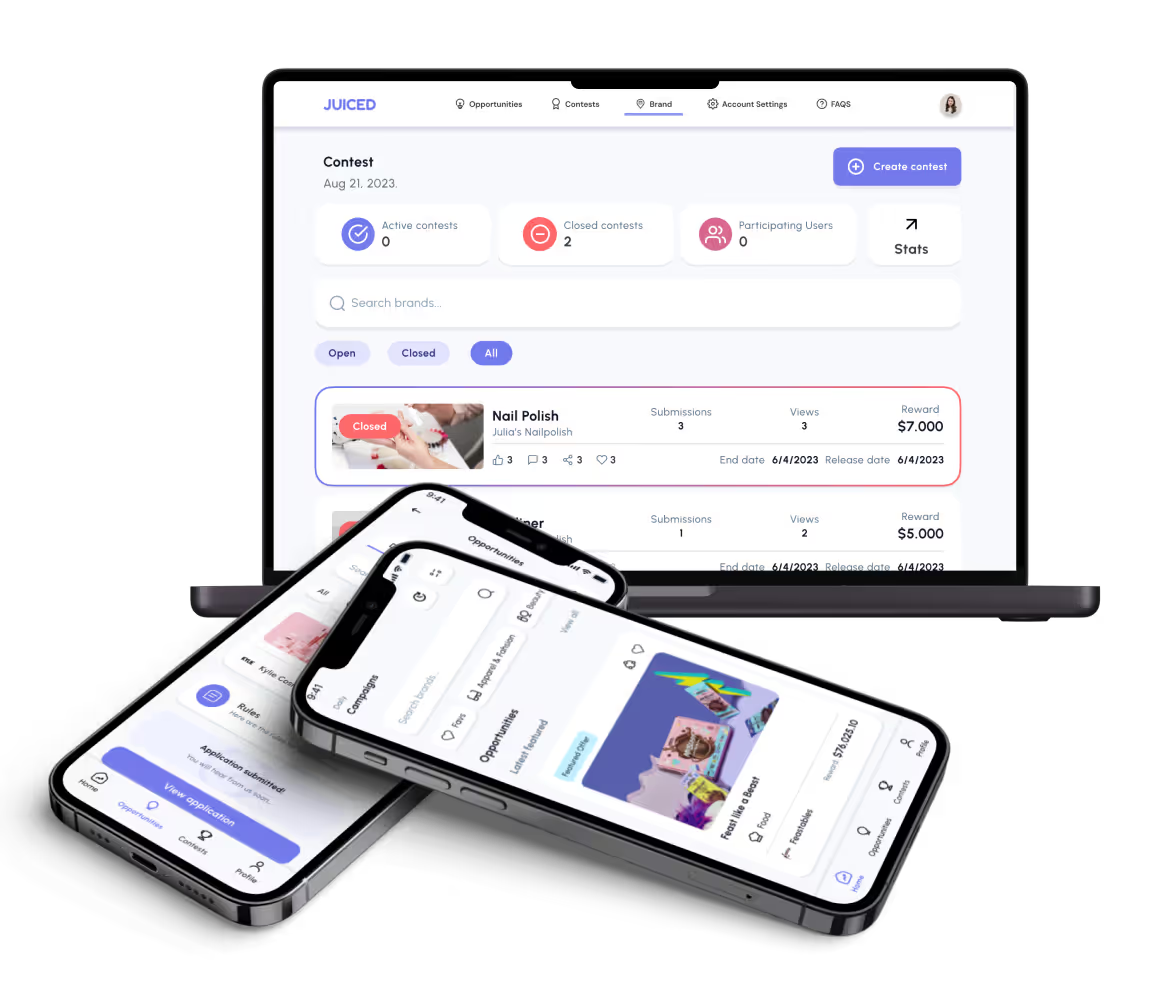

What Can FlutterFlow Build for a Staffing Marketplace Platform?
FlutterFlow delivers the shift management, worker profile, and client dashboard layer of a staffing marketplace. Shift posting, worker onboarding, GPS clock-in, timesheet approval, and Stripe payouts are all achievable within FlutterFlow's visual builder.
Reviewing FlutterFlow marketplace app examples with transactional and workforce management features helps you benchmark what is realistic in production.
Worker Onboarding and Compliance Document Upload
FlutterFlow supports multi-step worker registration including skills, certifications input, and right-to-work document upload to Firebase Storage. An admin review queue holds worker profiles until approved.
Workers only appear in the active pool after an administrator confirms their compliance documents are valid and complete.
- Document upload to Firebase: Workers upload right-to-work documents, certifications, and ID directly from their phone to Firebase Storage.
- Admin approval queue: New worker profiles enter a review queue before becoming visible to clients, enforcing compliance without manual communication.
- Skills and certification input: Workers tag their role types and certifications during registration, enabling automated matching against shift requirements.
Shift Posting and Job Description Management
Client businesses create shift postings with role requirements, location via Google Maps autocomplete, hourly rate, start and end times, and required certifications. Postings store in Firestore and match against worker profiles.
Clients can save shift templates for recurring roles, reducing the time to post repeated shift types across multiple weeks.
- Google Maps location input: Shift locations use Maps autocomplete so workers see precise addresses and travel distances before accepting.
- Certification matching: Shifts requiring specific certifications only surface to workers whose profiles include those credentials.
- Shift template saving: Clients save recurring shift formats as templates, reducing posting time for repeat roles at the same location.
Worker Availability and Shift Acceptance Flow
Workers set recurring availability or mark individual available dates. When a matching shift posts, they receive a push notification and can accept or decline with one tap from the mobile app.
Availability data indexes in Firestore against shift requirements, surfacing the right workers for each posting automatically.
- Recurring availability setting: Workers define weekly patterns or mark specific available dates from a calendar view in their profile.
- Push notification on match: Workers receive a notification the moment a shift matching their skills and availability is posted by a client.
- One-tap acceptance: Shift acceptance requires a single confirmation tap, with immediate status update to both the worker and the client.
Time Tracking and Clock-In/Clock-Out
A GPS-verified clock-in feature confirms workers are on-site at shift start using device location. Actual worked hours record against the scheduled shift for timesheet generation.
Geofencing radius is configurable per shift location to account for different site types. Indoor GPS limitations should be tested before deployment.
- GPS-verified clock-in: Device location confirms the worker is within the defined geofence radius before allowing shift start registration.
- Actual hours recording: Clock-out captures the precise end time and calculates worked hours against the scheduled shift for comparison.
- Location dispute logging: GPS coordinates log at clock-in and clock-out, providing a verifiable record if a client disputes attendance.
Automated Timesheet and Hours Approval
After each shift, a timesheet auto-generates from clock-in and clock-out data and goes to the client for approval. Disputes flag for admin review before payment releases.
The approval window is configurable per client, with automatic escalation to admin if the client does not respond within the defined period.
- Auto-generated timesheets: Each completed shift produces a timesheet pre-populated with GPS-verified hours for client review.
- Client approval flow: Clients approve or dispute individual timesheets before the payment cycle processes worker compensation.
- Dispute escalation: Flagged timesheets route to admin review automatically, preventing payment delays while disputes are resolved.
Platform Commission and Worker Payment Processing
Stripe handles client invoicing. Stripe Connect manages worker payment distribution after the platform deducts its margin. Payroll tax withholding for W-2 workers requires a dedicated payroll API such as Gusto or Rippling.
Stripe Connect supports worker payouts to bank accounts in most markets, but tax filing and withholding logic must live in a separate payroll system.
- Stripe client invoicing: Clients receive automated invoices for confirmed shifts, reducing manual billing work for platform operators.
- Stripe Connect payouts: Worker payments distribute automatically after timesheet approval, with the platform margin deducted before transfer.
- Payroll API integration: Tax withholding and W-2 processing require Gusto or Rippling integration via API, not a FlutterFlow-native feature.
Client Dashboard for Workforce Management
A client-facing dashboard shows active workers, upcoming shifts, attendance rates, and spend against budget. Clients manage their workforce without separate spreadsheet tracking.
Dashboard data pulls from Firestore in real time, giving clients accurate operational visibility as shifts complete and workers clock out.
- Active worker overview: Clients see which workers are currently on shift, their clock-in time, and their assigned role from one screen.
- Spend tracking: Total hours and cost by worker, role, and date period display against the client's budget allocation.
- Attendance rate display: Per-worker and per-role attendance rates surface trends that help clients make rehire decisions.
Performance Rating and Rehire Flags
Post-shift ratings allow clients to flag high performers for automatic re-invitation to future matching shifts. Problematic workers route to admin review, creating a quality feedback loop inside the platform.
Rating history aggregates on each worker profile, giving the matching algorithm a quality signal beyond availability and certifications alone.
- Post-shift client rating: Clients rate workers after each shift on a defined scale, with the score adding to the worker's platform profile.
- High-performer auto-invite: Top-rated workers receive priority notification for future shifts from clients who have rated them highly before.
- Admin review routing: Workers flagged as problematic route to admin review before appearing in future shift matching pools.
How Long Does It Take to Build a Staffing Marketplace Platform with FlutterFlow?
A staffing MVP covering shift posting, worker profiles, availability management, and basic payment takes 10 to 14 weeks. A full platform with GPS clock-in, timesheet approval, client dashboard, and compliance document flows takes 18 to 28 weeks.
The phased approach is especially important for staffing platforms. Launch with shift posting and manual approval first, then automate GPS tracking and payroll API integration in phase two.
- Simple MVP timeline: Shift posting, worker profiles, availability management, and basic Stripe payment ship in 10 to 14 weeks.
- Full platform timeline: GPS clock-in, auto-generated timesheets, client dashboard, compliance document flows, and ratings extend the build to 18 to 28 weeks.
- Stripe Connect complexity: Worker payout flows with split payment logic and dispute handling add 2 to 3 weeks beyond basic Stripe integration.
- Identity verification timeline: Onfido or Checkr API integration for right-to-work and background checks adds 1 to 2 weeks to the compliance document phase.
- Speed versus custom: FlutterFlow delivers the UI layer four times faster than custom development; compliance and payroll logic requires backend investment either way.
What Does It Cost to Build a FlutterFlow Staffing Marketplace Platform?
FlutterFlow staffing platforms cost $20,000 to $70,000 depending on scope. A focused shift management MVP sits at the lower end; a full platform with GPS clock-in, payroll API integration, and identity verification sits at the top.
Confirming FlutterFlow subscription plan costs early helps clarify the platform's share of total build and operating expenses before committing to a budget.
- Payroll API is a significant ongoing cost: Gusto charges $40 or more per active worker per month, which scales materially as your worker pool grows.
- Background check costs accumulate: At $20 per check and 500 new workers per month, identity verification adds $10,000 per month to operating costs.
- Compared to custom builds: Equivalent custom staffing platforms cost $120,000 to $300,000 for the same feature scope with compliance layers.
- Hidden cost: legal review: Worker classification compliance review for IR35 or W-2 vs 1099 determination requires legal counsel outside the development budget.
- Hidden cost: insurance verification: Insurance certificate verification APIs for contractor-based staffing platforms add per-check costs not covered by standard background check services.
Build a 15 to 20 percent contingency into your budget. GPS clock-in accuracy issues and payroll API edge cases surface during QA and add time to the final phase.
How Does FlutterFlow Compare to Custom Development for a Staffing Marketplace?
FlutterFlow delivers a staffing marketplace in 14 to 22 weeks versus 8 to 14 months for a custom build, at $25,000 to $70,000 versus $150,000 to $350,000. The trade-off is at the compliance ceiling: multi-state payroll, enterprise ATS integration, and platforms managing 10,000 or more workers require custom development.
FlutterFlow wins for regional staffing platforms, single-industry verticals in hospitality or events, and MVP validation before investing in the compliance layer.
- Speed advantage is clear: FlutterFlow delivers a shift management platform in under six months; equivalent custom builds take over a year to reach the same state.
- Cost advantage at MVP stage: FlutterFlow platforms cost 60 to 75 percent less than custom builds for the same shift management and worker profile scope.
- When custom wins: Multi-state or multi-country payroll compliance at launch, enterprise ATS integration requirements, or platforms managing 10,000 or more workers.
- When FlutterFlow wins: Regional staffing, single-industry verticals, and MVP validation where proving the business model matters more than compliance coverage.
Understanding Bubble versus FlutterFlow trade-offs helps staffing platform founders choose the right base tool before committing to a technology direction.
What Are the Limitations of FlutterFlow for a Staffing Marketplace Platform?
FlutterFlow cannot calculate payroll taxes, determine worker classification status, or provide continuous GPS location tracking during shifts. These functions require dedicated backend systems integrated with FlutterFlow via API.
Understanding FlutterFlow security architecture matters when your platform stores worker tax documents, right-to-work files, and payment records in Firestore.
- Payroll tax compliance: Calculating and withholding federal, state, and local taxes for W-2 workers requires a dedicated payroll system; FlutterFlow cannot handle this natively.
- Worker classification logic: Determining IR35 or W-2 vs 1099 status based on engagement patterns requires legal logic that cannot be expressed in visual action chains.
- Continuous GPS tracking: Real-time location streaming during shifts for lone worker safety requires a custom location implementation beyond the standard Maps widget.
- Scale at high volume: Platforms with tens of thousands of worker profiles need composite Firestore indexes and potentially an external search service not configurable in FlutterFlow.
- Vendor dependency risk: Custom GPS and compliance API integrations tied to FlutterFlow's custom action system are vulnerable to platform updates breaking the connection.
- Code export as escape valve: Exporting Flutter code preserves the UI layer, but payroll and compliance Cloud Functions are maintained separately regardless.
How Do You Find the Right Team for a FlutterFlow Staffing Marketplace Platform?
You need a team with GPS clock-in implementation experience, Stripe Connect payout architecture knowledge, Firebase Storage for compliance documents, and payroll API integration capability. Agencies are strongly preferred over freelancers for staffing platforms.
Working with top-rated FlutterFlow agencies experienced in workforce management platforms avoids the compliance and payment pitfalls that derail less experienced teams.
- Required expertise: GPS clock-in, Stripe Connect worker payouts, Firebase Storage security rules for multi-tenant data isolation, and payroll API integration are all baseline requirements.
- Freelancer limitation: Solo developers may handle simple shift posting tools, but compliance document flows and GPS features require a team covering UI and backend Cloud Functions.
- Red flag: treating payroll as Stripe: A developer who describes payroll as a simple Stripe payment does not understand the tax withholding and classification obligations of staffing platforms.
- Red flag: no multi-tenant security: Firebase security rules for isolating worker documents from client access are non-negotiable; skip this and worker data becomes accessible across clients.
- Key GPS question: Ask how they have handled GPS clock-in accuracy disputes in previous builds, specifically for indoor venues and locations with weak signal.
- Expected project structure: Discovery takes 2 weeks, design takes 2 to 3 weeks, build takes 12 to 16 weeks, compliance review and QA take 3 weeks, and store submission takes 1 week.
Brief at least two agencies and ask for verifiable portfolio examples of workforce management or marketplace apps with payment and compliance components before committing.
Conclusion
FlutterFlow delivers the shift management, worker profile, and client dashboard layer of a staffing platform efficiently. Payroll compliance, worker classification, and real-time GPS tracking require backend systems and legal review that sit entirely outside the visual builder.
Define which compliance requirements are in scope for launch versus phase two before approaching any development team. Brief a team with both FlutterFlow marketplace experience and payroll API integration capability.
Building a Staffing Marketplace Platform with FlutterFlow? Here Is How LOW/CODE Agency Approaches It.
Staffing platforms fail most often at two points: payroll compliance and worker data isolation. Getting the architecture right before the first line of code is built prevents expensive rebuilds six months in.
As AI development experts, we at LOW/CODE Agency help SMBs ship real software — web and mobile applications, intelligent chatbots, RAG pipelines, and autonomous AI agents built for businesses that need results, not platforms. We build FlutterFlow staffing platforms with the full compliance and payment stack behind them: Stripe Connect payout architecture, GPS clock-in implementation, Firebase Storage security rules for multi-tenant data isolation, and payroll API integration from a team that understands workforce management requirements.
- Shift management build: We design and build the full shift posting, worker matching, availability management, and acceptance flow with production-grade Firestore indexing.
- GPS clock-in implementation: We implement geofenced clock-in with dispute logging, configurable radius per location, and indoor GPS fallback options tested before deployment.
- Stripe Connect architecture: We design the platform commission structure, worker payout flows, and timesheet-triggered payment release with proper dispute handling.
- Payroll API integration: We connect Gusto or Rippling for tax withholding and W-2 processing, scoping the integration correctly from the start rather than treating it as a Stripe afterthought.
- Compliance document flows: We build Firebase Storage upload, admin review queues, and document expiry tracking for right-to-work and certification management.
- Multi-tenant security: We configure Firebase security rules to ensure strict isolation between worker documents and client access across all data in the platform.
- Full product team: Strategy, UX, development, and QA from a single team so your staffing platform is production-ready for real compliance and payment requirements.
We have built 350+ products for clients including Coca-Cola, American Express, and Sotheby's. We know where staffing platform builds go wrong and how to scope them correctly before the build starts.
Related Articles
- How to Build a Student Portal with FlutterFlow
- How to Build a Movie Streaming Dashboard with FlutterFlow
- How to Build a Stock Trading Dashboard with FlutterFlow
- How to Build a Sports Event Registration App with FlutterFlow
- How to Build Sports Apps with FlutterFlow
- How to Build a Spending Analytics Dashboard with FlutterFlow
Partner with our low-code development experts to bring your app idea to life faster.
Last updated on
September 24, 2026
.

Jesus is a visionary entrepreneur and tech expert. After nearly a decade working in web development, he founded LOW/CODE Agency to help businesses optimize their operations through custom software solutions.


FAQs
What are the key features needed for a staffing marketplace platform?
Can FlutterFlow handle complex backend logic for staffing platforms?
How do I integrate payment processing in a FlutterFlow staffing app?
What are the common challenges when building a staffing marketplace with FlutterFlow?
Is FlutterFlow suitable for launching an MVP of a staffing marketplace?
How can I ensure data security in a FlutterFlow staffing platform?
Related Articles

FlutterFlow
How to Build a Downtime Tracking App with FlutterFlow
Learn how to create a downtime tracking app using FlutterFlow with step-by-step guidance and best practices for efficient app development.

FlutterFlow
How to Build a Project Management SaaS with FlutterFlow
Learn how to create a project management SaaS using FlutterFlow with step-by-step tips and best practices for no-code app development.

FlutterFlow
How to Build Food and Restaurant Apps with FlutterFlow
Learn how to create food and restaurant apps using FlutterFlow with step-by-step guidance and best practices for seamless app development.

FlutterFlow
How to Build a Logistics App with FlutterFlow
Learn how to create a logistics app using FlutterFlow with easy steps, key features, and common challenges explained for beginners.


Why customers trust us for no-code development


