

How to Build a Solar Monitoring App with FlutterFlow
15 min
read
Learn how to create a solar monitoring app using FlutterFlow with step-by-step tips and best practices for real-time data tracking.


Solar installers and energy retailers are paying white-labelling fees to platforms that offer no customisation. A FlutterFlow solar monitoring app delivers a branded customer experience at a fraction of the cost.
This article covers what FlutterFlow can display, which inverter APIs it reads from, what the build costs, and where the platform reaches its limits before you commit to a scope.
Key Takeaways
- Display strength: A FlutterFlow solar monitoring app shows generation, consumption, grid export, and battery state from inverter cloud APIs in real time.
- Inverter API dependency: FlutterFlow reads from manufacturer cloud APIs like Fronius, SolarEdge, or Enphase, it does not connect directly to hardware.
- Branded SaaS potential: Solar installers can wrap FlutterFlow into a white-labelled monitoring app for their entire customer base.
- Build cost: A focused solar monitoring app typically costs $15,000 to $45,000 depending on inverter integrations and analytics depth.
- Hard limitation: Sub-second live monitoring and direct inverter control require hardware-level integration beyond FlutterFlow's scope.
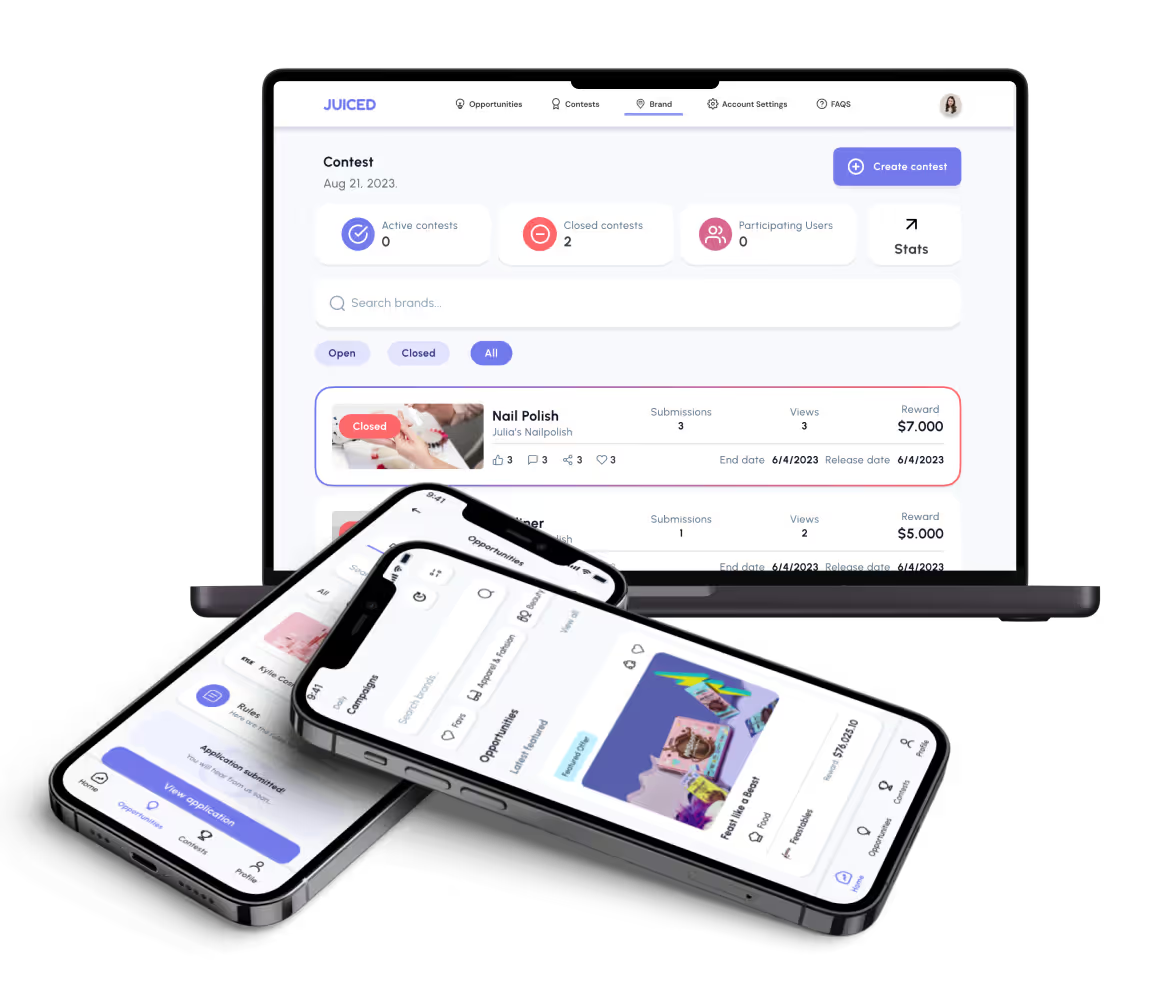

What Can FlutterFlow Build for a Solar Monitoring App?
FlutterFlow builds the data display and customer experience layer of a solar monitoring app. It reads generation, consumption, battery, and grid data from inverter cloud APIs and presents it in a branded, mobile-first interface. It cannot control hardware or stream sub-second telemetry without additional backend engineering.
Building SaaS solar apps with FlutterFlow is a viable route for solar installers who want to offer branded monitoring experiences to hundreds of customers without enterprise platform fees.
Real-Time Generation and Consumption Display
FlutterFlow displays live solar generation, home consumption, grid import/export, and battery charge level from inverter cloud API data. The dashboard updates on a polling interval configured in the backend.
All live data originates from the manufacturer's cloud API, not directly from the inverter or meter hardware.
- Generation display: Live solar output in kilowatts pulled from inverter API data and rendered on the home dashboard screen.
- Consumption overlay: Home energy draw displayed alongside generation so customers see self-consumption versus grid draw at a glance.
- Grid import/export status: Net grid flow direction and rate displayed clearly, helping customers track feed-in tariff earnings in real time.
- Battery charge level: State of charge percentage and current charge rate displayed for systems with battery storage installed.
FlutterFlow renders this data using standard widgets, the polling frequency and data freshness depend on your backend and inverter API tier.
Historical Energy Charts
FlutterFlow's native chart widgets display daily, weekly, monthly, and annual energy production and consumption histories. Data comes from your backend, which stores API-sourced readings over time.
Chart granularity depends on what the inverter API returns and how your backend aggregates readings.
- Daily production chart: Bar chart showing hourly generation output for the current day, giving customers a clear pattern view.
- Weekly and monthly summaries: Aggregated energy charts showing production and consumption totals across user-selected date ranges.
- Annual comparison view: Year-over-year production charts help customers track system performance degradation or seasonal variation accurately.
Customers use historical charts more than live dashboards for understanding system health, design these screens with equal care.
Savings and Earnings Calculator
FlutterFlow displays estimated savings, feed-in tariff earnings, and payback progress calculated from energy data and configurable tariff rates. The calculation logic sits in your backend and returns a result the app displays.
Tariff rates are stored in Firestore and updated by administrators without a new app release.
- Daily savings estimate: Dollar value of self-consumed solar generation displayed based on configurable retail electricity tariff rate.
- Feed-in earnings display: Total earnings from grid-exported energy calculated against the current feed-in tariff rate for the customer's region.
- Payback progress tracker: Cumulative savings displayed against system cost, giving customers a visible payback milestone to track over time.
This feature drives customer engagement more than any other, it converts an energy number into a financial outcome customers care about.
Multi-Site Portfolio View
Solar installers and fleet managers view a portfolio of customer sites with generation status, daily output, and alert flags on a single screen. Each site tile links to the full monitoring dashboard for that installation.
Portfolio views are structured in Firestore with site documents linked to customer accounts and queried by installer role.
- Site status overview: Each customer site shows current generation status and today's total output on the installer's portfolio screen.
- Underperforming site flags: Sites generating below expected output for the date and weather conditions surface with a visible alert indicator.
- Alert count display: Outstanding unresolved alerts per site are shown as a count badge, helping installers prioritise their response queue.
Multi-site architecture must be designed into the Firestore data model from day one, retrofitting it after a single-site build adds significant rework.
System Health and Alert Notifications
FlutterFlow surfaces inverter error codes, production anomalies, and communication faults as push notifications via Firebase Cloud Messaging. Alert rules are evaluated in backend Cloud Functions, not in the FlutterFlow layer.
Notifications route to customers, installers, or both depending on alert severity and role configuration.
- Inverter fault alerts: Error codes from the inverter API trigger push notifications to the system owner and assigned installer automatically.
- Production anomaly detection: Generation falling below expected thresholds for the time of day triggers a health alert for investigation.
- Communication fault notification: Loss of contact between the inverter and its cloud API triggers an alert before the customer notices data has stopped updating.
Alerts are the highest-value feature for installers, they reduce truck rolls by flagging issues before customers call.
Battery State of Charge Display
FlutterFlow shows battery storage charge level, current charge/discharge rate, and estimated time to full or empty for customers with battery storage. This data comes from the inverter API battery endpoint.
Not all inverter APIs return battery data through the same endpoint structure, backend normalisation handles the differences.
- Charge level display: Battery percentage shown as a visual indicator with current charge or discharge rate in kilowatts alongside it.
- Time to full or empty: Estimated duration until full charge or full discharge calculated from current rate and displayed for customer awareness.
- Charge mode status: Whether the battery is charging from solar, discharging to home, or idle displayed clearly on the battery card.
Self-Consumption and Export Rate Metrics
FlutterFlow calculates and displays self-consumption percentage, grid export rate, and autarky rate as KPIs for environmentally aware customers. These metrics are calculated in the backend and returned as display values.
Self-consumption and autarky rates are the metrics customers in premium markets care most about alongside financial savings.
- Self-consumption percentage: Proportion of solar generation consumed directly by the home rather than exported to the grid.
- Autarky rate display: Percentage of total home energy demand met by solar generation, a key metric for energy independence tracking.
- Export rate metric: Proportion of generated solar energy sent to the grid, helping customers understand their grid dependency profile.
How Long Does It Take to Build a Solar Monitoring App with FlutterFlow?
A simple solar monitoring MVP covering a single inverter API, generation display, and basic charts takes 4 to 6 weeks. A full platform with multi-inverter support, multi-site portfolio view, battery display, alerts, and a savings calculator takes 10 to 16 weeks.
Timeline depends heavily on the inverter manufacturers your customers use and whether those manufacturers provide cloud APIs with consistent data schemas.
- Simple MVP timeline: Single inverter API integration, generation and consumption display, and basic daily charts ship in 4 to 6 weeks.
- Full platform timeline: Multi-inverter support, multi-site portfolio, battery display, alert notifications, and savings calculator extend the build to 10 to 16 weeks total.
- API complexity factor: Fronius and SolarEdge have well-documented APIs; less common or budget inverter brands add 2 to 4 weeks for API research and normalisation.
- White-labelling requirements: Adding branded onboarding, custom colour schemes, and app store submission under the installer's developer account adds 1 to 2 weeks.
- Phased approach advantage: Launching single-inverter monitoring first generates value immediately while multi-site portfolio and battery display build in phase two.
FlutterFlow delivers solar monitoring interfaces 2 to 3 times faster than custom React Native or Flutter builds with equivalent charting features. The speed advantage comes from the UI layer, not the backend API integration work.
What Does It Cost to Build a FlutterFlow Solar Monitoring App?
A FlutterFlow solar monitoring app costs $15,000 to $55,000. A single-inverter monitoring MVP with basic charts sits at the lower end. A full multi-inverter platform with white-labelling, battery display, multi-site portfolio, and savings calculator sits at the top.
Understanding the FlutterFlow pricing structure helps solar businesses budget correctly, the platform subscription cost is minor compared to backend API and hosting costs for a multi-site product.
- Platform cost is minimal: FlutterFlow's monthly fee is a small fraction of total project cost; inverter API integration drives the budget.
- Freelancer vs agency tradeoff: Freelancers suit single-inverter monitoring apps; agencies suit multi-inverter white-labelled installer platforms requiring security and QA.
- vs White-labelling existing platforms: SolarEdge and Enphase white-labelling costs $5 to $20 per site per month with no customisation; a FlutterFlow app eliminates per-site fees.
- vs Custom development: Custom solar monitoring apps start at $100,000; FlutterFlow delivers equivalent display functionality at $15,000 to $55,000.
- Hidden cost: multi-inverter normalisation: Supporting Fronius, SolarEdge, and Enphase simultaneously requires a normalisation layer that adds backend engineering time to any scope.
- Hidden cost: app store submission: iOS and Android app store submission under the installer's account adds 2 to 4 weeks and requires Apple and Google developer accounts.
Budget a contingency of 15 to 20 percent for inverter API edge cases discovered during integration. Each manufacturer's API returns slightly different data structures.
How Does FlutterFlow Compare to Custom Development for Solar Monitoring?
FlutterFlow is 3 to 5 times cheaper than a custom-built solar monitoring app for installers with 50 to 500 customer sites, and deploys in 8 to 16 weeks versus 6 to 14 months for a custom React Native or Flutter build with equivalent charting features.
- Speed advantage is clear: FlutterFlow delivers a working monitoring interface in weeks; equivalent custom builds take months to reach the same display state.
- Cost advantage is significant: Custom solar monitoring development starts at $100,000; FlutterFlow full platforms run $15,000 to $55,000 for equivalent display functionality.
- When FlutterFlow wins: Branded monitoring apps for solar installers, customer-facing energy dashboards, and savings and payback calculators for residential systems.
- When custom wins: Direct device control, sub-second telemetry, SCADA integration, and grid management systems are beyond FlutterFlow's scope entirely.
Mapping FlutterFlow benefits and drawbacks against your inverter ecosystem and customer requirements is the clearest path to a build-or-buy decision for a solar monitoring app.
What Are the Limitations of FlutterFlow for a Solar Monitoring App?
FlutterFlow cannot communicate directly with inverters, smart meters, or energy gateways. It reads from manufacturer cloud APIs. It also cannot deliver sub-second live data streams or execute direct device control commands.
FlutterFlow scalability limits become relevant when a solar monitoring platform grows to thousands of customer sites with concurrent data polling against multiple inverter APIs.
- No direct hardware communication: FlutterFlow requires a cloud API intermediary from the inverter manufacturer, inverters without cloud APIs cannot feed data into the app.
- Sub-second data refresh: Live energy dashboards updating every second require WebSocket architecture outside FlutterFlow's polling-based default configuration.
- Inverter API dependency: Not all inverter manufacturers offer cloud APIs, budget and older inverter brands often have no API access available.
- Complex energy analytics: Time-of-use optimisation, predictive export limiting, and grid frequency response require backend logic well beyond FlutterFlow's visual condition builder.
- Multi-inverter data normalisation: Different inverter APIs return different data schemas, requiring a normalisation service before FlutterFlow can display data consistently across brands.
- Vendor dependency: Dashboard logic and site configuration live in FlutterFlow, code export on paid plans provides a migration path if needed.
Knowing these limits before scoping prevents expensive redesigns when your backend architect identifies requirements the FlutterFlow display layer cannot satisfy.
How Do You Get a FlutterFlow Solar Monitoring App Built?
You need a developer or agency with specific inverter API integration experience alongside FlutterFlow expertise. Energy sector knowledge matters as much as platform skill for this use case.
Engaging top FlutterFlow development agencies with energy sector experience means your inverter API integration and multi-site architecture will be designed correctly from day one.
- Required expertise: Inverter API integration with Fronius, SolarEdge, or Enphase, plus Firebase real-time data management and push notification setup are baseline requirements.
- Freelancer scope: A skilled freelancer handles a single-inverter monitoring app with basic charts and a savings calculator for a focused installer deployment.
- Agency scope: Multi-inverter support, white-labelled installer platforms, multi-site portfolio, battery display, and alert systems need a team, not a solo developer.
- Red flag: no energy API experience: A developer unfamiliar with inverter API polling patterns and data schema differences will create technical debt that costs more to fix later.
- Key interview question: Ask which inverter APIs they have integrated, how they handle different data refresh rates, and whether they can show a live data dashboard they have built.
- Expected prototype timeline: A working dashboard displaying live or mocked inverter data is a reasonable expectation within 3 to 4 weeks of starting.
Interview at least two developers or agencies and ask for verifiable examples of energy or IoT API integrations before committing to a project.
Conclusion
FlutterFlow is a practical platform for solar monitoring apps that display inverter API data, calculate savings, and surface alerts to customers and installers. The display and workflow layers are well within its capability.
It cannot replace the hardware layer or deliver sub-second live telemetry without additional backend engineering. Confirm which inverter brands your customers use, verify cloud API availability, and scope a four-week MVP displaying generation and savings data for a single inverter family first.
Building a Solar Monitoring App with FlutterFlow? Here Is How LOW/CODE Agency Approaches It.
Most solar monitoring apps fail at the inverter API layer, not the display layer. Getting multi-inverter normalisation, multi-site architecture, and alert routing right from day one is what separates a reliable platform from one that frustrates customers with stale data.
At LOW/CODE Agency, we help SMBs compete with AI-powered software built for them — custom web and mobile apps, RAG systems, chatbots, and intelligent agents delivered by a senior development team. We build FlutterFlow solar monitoring applications with the full backend behind them: inverter API integration, data normalisation, white-labelled installer platforms, push alert systems, and savings calculators from a team that understands how energy data needs to behave at scale.
- Inverter API integration: We connect FlutterFlow apps to Fronius, SolarEdge, Enphase, and Huawei cloud APIs with proper data normalisation across different manufacturer schemas.
- Multi-site architecture: We design Firestore data models that support installer portfolio views across hundreds of customer sites from day one.
- Alert system build: We implement Cloud Functions that evaluate production anomalies and inverter faults, routing push notifications to customers and installers correctly.
- Savings calculator design: We build configurable tariff-rate calculators that display financial savings and feed-in earnings in formats customers engage with daily.
- White-labelling delivery: We configure branded onboarding, custom colour schemes, and app store submissions under your installer brand for a fully owned product.
- Phased delivery: We scope and ship single-inverter monitoring first, then layer in multi-site portfolio, battery display, and analytics so you get value at each stage.
- Full product team: Strategy, UX, development, and QA from a single team so your solar monitoring app is production-ready, not just technically functional.
We have built 350+ products for clients including Coca-Cola, American Express, and Sotheby's. We know how to scope and deliver FlutterFlow energy applications that stand up to real inverter API behaviour at scale.
Related Articles
- How to Build a Spa Appointment App with FlutterFlow
- How to Build an SOP Documentation App with FlutterFlow
- How to Build Onboarding and SOP Apps with FlutterFlow
- How to Build Social Apps with FlutterFlow
- How to Build a Smart Home Control App with FlutterFlow
- How to Build a Site Inspection App with FlutterFlow
Our low-code development team ships production apps faster using the best visual platforms.
Last updated on
September 24, 2026
.

Jesus is a visionary entrepreneur and tech expert. After nearly a decade working in web development, he founded LOW/CODE Agency to help businesses optimize their operations through custom software solutions.


FAQs
What are the first steps to create a solar monitoring app in FlutterFlow?
How can I connect solar panel data to my FlutterFlow app?
What are the best practices for real-time updates in a solar monitoring app?
Can FlutterFlow handle complex data visualizations for solar energy stats?
How do I ensure data security in a solar monitoring app built with FlutterFlow?
What are common challenges when building a solar monitoring app with FlutterFlow?
Related Articles

FlutterFlow
How to Build a Bill Payments App with FlutterFlow
Learn how to create a bill payments app using FlutterFlow with step-by-step guidance and best practices for smooth development.

FlutterFlow
How to Build Insurance Tech Apps with FlutterFlow
Learn how to create insurance tech apps using FlutterFlow with ease. Discover key steps, benefits, and common challenges.
FlutterFlow
How to Build Nonprofit Apps with FlutterFlow
Learn how to create nonprofit apps using FlutterFlow with step-by-step guidance and best practices for effective app development.

FlutterFlow
How to Build a Hiring Workflow Tool with FlutterFlow
Learn how to create a hiring workflow tool using FlutterFlow with step-by-step guidance and best practices for smooth recruitment processes.

Why customers trust us for no-code development


