

How to Build AI-Enabled Apps with FlutterFlow
13 min
read
Learn how to create AI-powered apps using FlutterFlow with step-by-step guidance and best practices for seamless integration.


FlutterFlow AI enabled apps connect to OpenAI, Anthropic Claude, and Google Gemini through the platform's API action blocks. That makes it possible to ship chatbots, recommendation engines, and document processors without a dedicated AI engineering team.
The AI model layer, prompt engineering, and token cost management are the genuine challenges. Understanding where FlutterFlow ends and where the AI infrastructure begins is what separates a production app from an expensive prototype.
Key Takeaways
- API action blocks connect everything: OpenAI, Anthropic, Google Gemini, and custom AI endpoints are all reachable through FlutterFlow's API call actions.
- AI logic runs externally: FlutterFlow sends prompts and displays responses, LLM computation happens in the provider's infrastructure.
- Token costs are a production constraint: GPT-4 API calls at scale generate significant per-token costs; model this before launch.
- Hallucination risk requires UI guardrails: LLM outputs need appropriate disclaimers and human review mechanisms designed into the UX.
- RAG needs vector databases: Retrieval-augmented generation requires Pinecone, Weaviate, or equivalent, not Firebase Firestore alone.
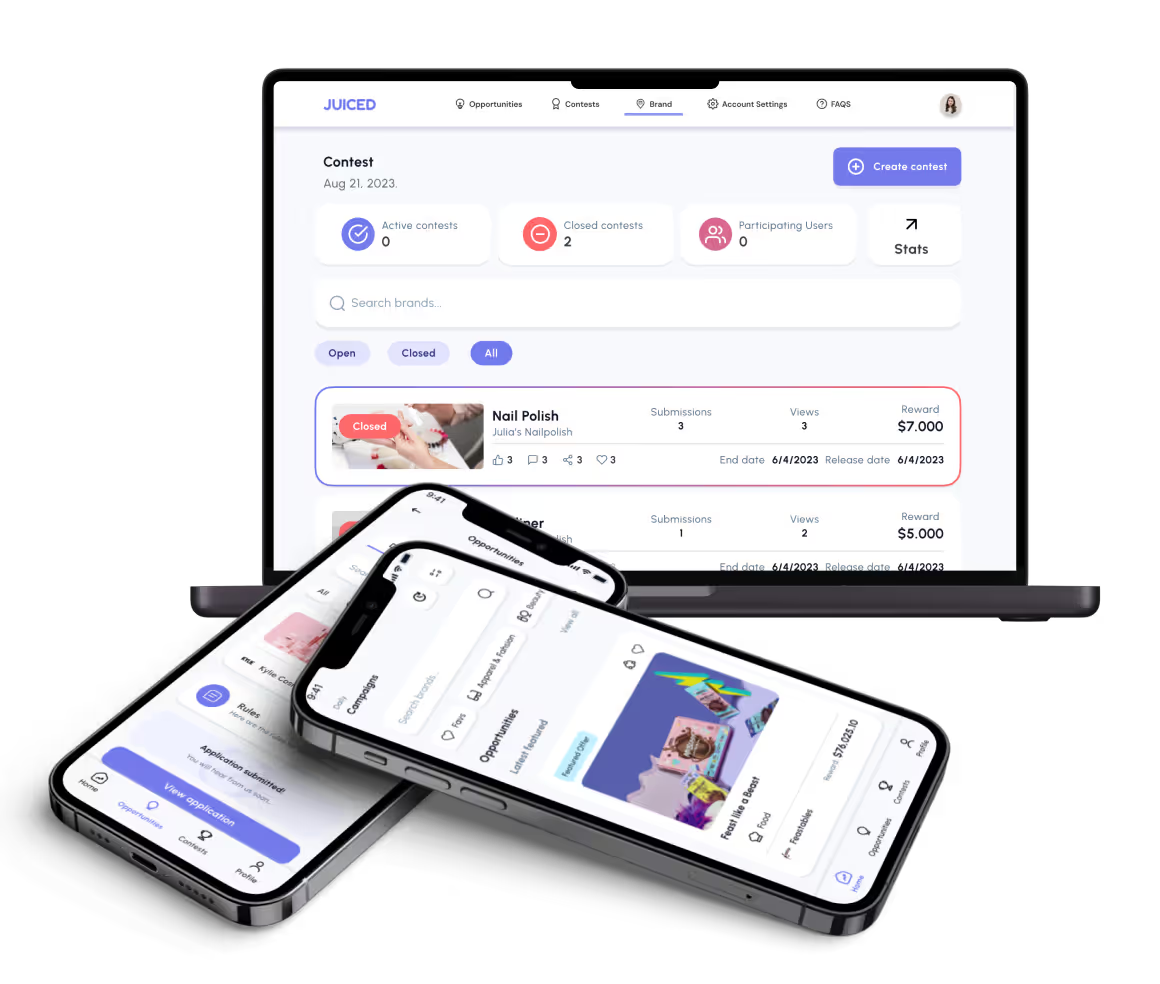

What Can FlutterFlow Build for AI Enabled Apps?
FlutterFlow delivers the UI layer for AI enabled apps, chatbot interfaces, content generation screens, recommendation feeds, and document analysis views, connected to external AI models via API action blocks. Every AI feature follows the same pattern: FlutterFlow sends a request and displays what the model returns.
Understanding how to build AI-powered apps FlutterFlow is worth covering before exploring specific features, API action blocks are the connection point between FlutterFlow's UI and any AI model.
AI Chatbot Interface
FlutterFlow delivers a conversational UI with message thread display, streaming text response rendering, and conversation history storage, connected to OpenAI or Anthropic via API action blocks.
- Message thread rendering: A scrollable chat UI with user and AI message bubbles stores and displays conversation history in Firestore.
- API action integration: Each user message triggers a FlutterFlow API call action that sends the prompt and conversation context to the LLM endpoint.
- Conversation history storage: Firestore documents hold the full message thread per user, passed as context on each subsequent API call.
AI-Powered Content Generation Screen
An input form lets users provide parameters, tone, topic, format, and trigger an LLM API call that returns generated content in a formatted output field.
- Structured prompt construction: FlutterFlow combines user inputs into a prompt string before passing it to the AI API action.
- Output field rendering: Generated text appears in a formatted text widget, with copy and save actions available post-generation.
- Parameter controls: Dropdowns and sliders let users adjust generation settings without needing to write prompts manually.
AI Recommendation Display
A card or list UI shows AI-generated recommendations returned from a back-end recommendation service or direct LLM API call with structured JSON output.
- JSON parsing from API responses: FlutterFlow parses structured JSON returned by the recommendation API into individual card components.
- Dynamic list rendering: A ListView widget maps over the returned recommendation array, rendering each item as a tappable card.
- Fallback state handling: Empty states and loading indicators are configurable in FlutterFlow when the API call is pending or returns no results.
Document Upload and AI Analysis Interface
A file upload screen connects to a document processing API that extracts, summarises, or classifies content, with structured results displayed in FlutterFlow components.
- File picker integration: FlutterFlow's file upload component passes document bytes or a storage URL to the processing API via an API action.
- Result display structure: Extracted entities, summaries, or classifications render in labelled text fields and structured cards.
- Firebase Storage integration: Uploaded documents are stored in Firebase Storage before the processing API is called, keeping the file accessible for reprocessing.
AI Form Auto-Fill
Form fields pre-populate based on an AI API call analysing user history, uploaded documents, or contextual inputs, reducing manual data entry in complex applications.
- Context-driven pre-fill: The API call receives available user context and returns field values as a structured JSON object that FlutterFlow maps to form inputs.
- Editable outputs: Pre-filled fields remain editable, so users review and correct AI suggestions before submission.
- Trigger configuration: Auto-fill fires on a button tap or when a key input field is completed, not continuously on every keystroke.
AI Output Feedback and Rating
A thumbs up/down or star rating component attaches to each AI response, logging feedback to Firebase for model improvement and quality monitoring.
- Rating component binding: Each feedback interaction writes a structured document to Firestore with the AI response ID, rating value, and timestamp.
- Feedback loop data: Logged ratings feed downstream model fine-tuning or prompt refinement workflows outside FlutterFlow.
- Display confirmation: A brief visual confirmation appears after rating submission to close the interaction loop for the user.
AI Status and Token Usage Display
An admin dashboard shows recent AI API calls, token consumption, cost accumulation, and error rates pulled from logging infrastructure.
- API call logging: Each AI action writes metadata, tokens used, model called, response latency, to a Firestore audit collection.
- Cost accumulation view: A KPI card totals daily and monthly token spend, giving operators visibility before costs spike unexpectedly.
- Error rate tracking: Failed API calls are flagged in a filterable log table for prompt debugging and infrastructure monitoring.
These seven feature patterns cover the core of what FlutterFlow delivers for AI-powered applications in production today.
How Long Does It Take to Build a FlutterFlow AI Enabled App?
A simple AI-enabled MVP with a single LLM API call and basic chat UI takes 4–8 weeks. A full AI-powered application with multiple features, a RAG pipeline, feedback loop, and token cost management runs 12–22 weeks.
Build timelines split into two distinct layers: the FlutterFlow UI work and the AI back-end infrastructure.
- Phase one ships faster: Start with a single AI feature, chatbot or summarisation, before adding recommendation or document processing in phase two.
- Prompt engineering takes real time: Iterating prompts to reduce hallucination and improve output quality adds 2–4 weeks to any AI app build.
- FlutterFlow UI is 2–3x faster: The front-end layer deploys much faster than a custom equivalent; AI back-end timelines are similar regardless of front end.
- RAG adds significant scope: Vector database setup, embedding generation, and semantic search infrastructure are distinct workstreams from the FlutterFlow build.
A phased approach, single AI feature first, then recommendation or document processing, then RAG and feedback loops, consistently reaches production 30–40% faster than building all features simultaneously.
What Does It Cost to Build a FlutterFlow AI Enabled App?
Building a FlutterFlow AI enabled app costs $15,000–$80,000 depending on AI feature complexity and back-end services required. Ongoing AI API token costs and vector database hosting add to the operational budget at every user volume.
FlutterFlow pricing plans for AI projects cover the platform cost, but the AI API token budget is often the dominant ongoing operational expense, model it per user session before launch.
- Token costs are the hidden budget risk: A conversational AI app with 10,000 daily users using GPT-4 can generate $5,000–$50,000/month depending on conversation length.
- Prompt engineering adds 20–40 hours: Testing and iterating prompts to achieve production-quality output is a real line item, not an assumed capability.
- RAG infrastructure adds ongoing cost: Embedding generation, vector storage, and semantic query costs accumulate separately from LLM token costs.
- FlutterFlow saves 50–70% on the UI layer: The cost advantage is real, but the AI model layer costs the same regardless of which front end is used.
Model token cost per user session at three volume scenarios, 1,000, 10,000, and 50,000 daily active users, before finalising which features are viable at launch.
How Does FlutterFlow Compare to Custom Development for AI Enabled Apps?
FlutterFlow delivers the AI app UI layer 2–3x faster and at 50–70% lower cost than a custom equivalent. The AI model integration, prompt engineering, and back-end pipeline timelines are similar regardless of which front end is chosen.
The comparison is real for the UI layer. For the AI infrastructure, the tools and timelines are the same.
- FlutterFlow wins for standard LLM apps: Consumer AI apps with chatbots, content generation, and summarisation deploy faster and cheaper with FlutterFlow.
- Custom wins for real-time inference: Sub-100ms latency requirements, streaming token-by-token responses, and multi-agent orchestration need custom AI engineering.
- Mobile-first is FlutterFlow's advantage: Cross-platform iOS and Android delivery from one codebase is a concrete speed benefit for consumer AI products.
- Capability ceiling is the AI pipeline: Proprietary model fine-tuning, custom embedding pipelines, and complex multi-agent workflows require custom development regardless.
Reviewing FlutterFlow pros cons AI development shows that the platform is competitive for AI-powered UI delivery but not for the AI model layer itself.
What Are the Limitations of FlutterFlow for AI Enabled Apps?
FlutterFlow does not natively support streaming AI responses, context window management for long conversations, or vector database operations. These require back-end middleware. Data privacy obligations may restrict which user inputs can be sent to third-party AI providers.
Review FlutterFlow security for AI apps before designing your data flow, user inputs sent to OpenAI or Anthropic must be assessed against your privacy obligations and data residency requirements.
- Streaming response rendering: True token-by-token streaming requires WebSocket or Server-Sent Event handling not natively supported in FlutterFlow's API actions, middleware is required.
- Context window management: Managing conversation history within LLM token limits requires back-end context trimming logic; FlutterFlow actions alone cannot reliably handle growing conversation state.
- RAG requires external infrastructure: Embedding generation, vector storage, and semantic search across Pinecone or Weaviate are outside what Firebase Firestore can do natively.
- Hallucination risk is a product design problem: Any application where factual accuracy matters requires output validation, source citation, or human review mechanisms designed explicitly into the UX.
- Token cost spikes need active monitoring: Without usage controls, a spike in user activity or a prompt misconfiguration can generate unexpected API costs within hours.
- GDPR and HIPAA data restrictions: Text entered by users into AI interfaces is sent to third-party LLM infrastructure, regulated industries must audit what data can legally leave the platform.
These limitations do not disqualify FlutterFlow for AI apps. They require deliberate architecture decisions before a single screen is designed.
How Do You Get a FlutterFlow AI Enabled App Built?
Agency builds are recommended for multi-feature AI apps with RAG infrastructure and token cost management requirements. Freelancers are viable for single-feature AI additions to an existing FlutterFlow app where back-end AI infrastructure is already in place.
The top FlutterFlow AI development agencies will distinguish between prompt engineering skill and general development skill, both are required for a production AI app.
- LLM API integration experience: The team must have shipped production apps using OpenAI or Anthropic APIs, not just run demos or sandbox prototypes.
- Prompt engineering capability: Ask for examples of how they handle hallucination reduction and context management in a live product.
- RAG architecture knowledge: Vector database setup, embedding generation, and semantic search are distinct skills from FlutterFlow proficiency.
- Token cost modeling: Ask specifically how they model per-session token costs at your expected user volume before the build starts.
- Red flag to avoid: Developers who cannot explain how they will manage context window limits in a chatbot do not have production AI app experience.
Expected project structure: AI integration design and prompt engineering in weeks 1–4, back-end AI middleware in weeks 3–6, FlutterFlow UI build in weeks 4–12, testing and quality assessment in weeks 11–14.
Conclusion
FlutterFlow is a capable delivery platform for AI enabled apps. The API action blocks make LLM integration accessible, and the mobile-first output is competitive for consumer AI products.
The AI model layer, prompt engineering, and production token cost management are the genuine challenges regardless of which front-end tool is used.
Select your AI model provider and run a token cost projection at your expected user volume before designing the first FlutterFlow screen. The economics determine which features are viable at launch.
Building an AI Enabled App with FlutterFlow? Here Is How LOW/CODE Agency Approaches It.
Most AI app projects underestimate the back-end infrastructure work and overspend on token costs within the first three months of production. The FlutterFlow layer is the fast part. The AI layer is where scoping matters.
We are LOW/CODE Agency — an AI product development company for SMBs. We build across the full stack: web apps, mobile apps, AI chatbots, RAG pipelines, and autonomous agents. Custom software, built by experts. We design the AI architecture, model the token economics, and build the FlutterFlow UI as one integrated workstream, not three separate deliveries handed off between teams.
- AI architecture design: We scope the LLM provider selection, prompt structure, context management strategy, and RAG requirements before any UI work begins.
- Token cost modeling: We run per-session cost projections at your expected user volume across scenarios before the build starts, so there are no surprises post-launch.
- Prompt engineering: We iterate prompts in a controlled testing environment to establish hallucination rate benchmarks before connecting them to the UI.
- RAG infrastructure: When document-grounded AI answers are required, we design and build the vector database, embedding pipeline, and semantic search layer.
- FlutterFlow UI build: We build the chatbot, content generation, recommendation, and document analysis screens against a tested AI back end.
- Post-launch monitoring: We set up token usage dashboards and error rate tracking so cost spikes and AI failures surface before users notice them.
- Full product team: Strategy, design, development, and QA from one team that owns the outcome from architecture to App Store submission.
We have built 350+ products for clients including Coca-Cola, American Express, and Sotheby's. AI-powered apps are a core part of our FlutterFlow practice.
Related Articles
- How to Build an Athlete Progress Tracking App with FlutterFlow
- How to Build an Analytics Dashboard SaaS with FlutterFlow
- How to Build an AI Recommendation App with FlutterFlow
- How to Build an AI Document Processing Tool with FlutterFlow
- How to Build a FlutterFlow AI CRM Automation App
- How to Build an AI Chatbot App with FlutterFlow
Our low-code development team ships production apps faster using the best visual platforms.
Last updated on
September 24, 2026
.

Jesus is a visionary entrepreneur and tech expert. After nearly a decade working in web development, he founded LOW/CODE Agency to help businesses optimize their operations through custom software solutions.


FAQs
What is the first step to integrate AI in FlutterFlow apps?
Can FlutterFlow handle complex AI models directly?
How do I connect AI APIs to a FlutterFlow project?
Are there limitations when using AI with FlutterFlow?
What are best practices for testing AI features in FlutterFlow apps?
Is coding required to build AI-enabled apps in FlutterFlow?
Related Articles
FlutterFlow
How to Build a Training Management System with FlutterFlow
Learn how to create a training management system using FlutterFlow with step-by-step guidance and best practices.

FlutterFlow
How to Build a Real Estate Agent Marketplace with FlutterFlow
Learn how to create a real estate agent marketplace using FlutterFlow with step-by-step guidance and key features explained.

FlutterFlow
How to Build an Analytics Dashboard SaaS with FlutterFlow
Learn how to create an analytics dashboard SaaS using FlutterFlow with step-by-step tips and best practices for developers.

FlutterFlow
How to Build a Coaching App with FlutterFlow
Learn how to create a coaching app using FlutterFlow with step-by-step guidance and best practices for a smooth development process.

Why customers trust us for no-code development


