

How to Build a Content Scheduling App with FlutterFlow
14 min
read
Learn how to create a content scheduling app using FlutterFlow with step-by-step tips and best practices for smooth app development.


A FlutterFlow content scheduling app can manage calendars, queues, and team approvals, but can it actually publish posts to Instagram or TikTok on a schedule? The answer matters enormously, and most developers get the architecture wrong until it is too late to redesign.
This guide covers what FlutterFlow can build, what requires Firebase Functions, and what to confirm before starting development.
Key Takeaways
- Calendar and queue UI is a FlutterFlow strength: Visual scheduling interfaces with drag-and-drop grids and post queues are well within FlutterFlow's capability.
- Direct publishing is API-gated: Posting directly to Instagram, TikTok, and LinkedIn requires official API access that platforms control and do not always grant to third parties.
- Push notification scheduling works well: Firebase Cloud Messaging handles scheduled reminder notifications reliably across iOS and Android.
- Team collaboration features are buildable: Multi-user content calendars with role-based approval flows work well in FlutterFlow's multi-role data model.
- AI copy assistance adds real value: AI-generated caption suggestions and hashtag recommendations via API integration enhance creator productivity meaningfully.

What Can FlutterFlow Build for a Content Scheduling App?
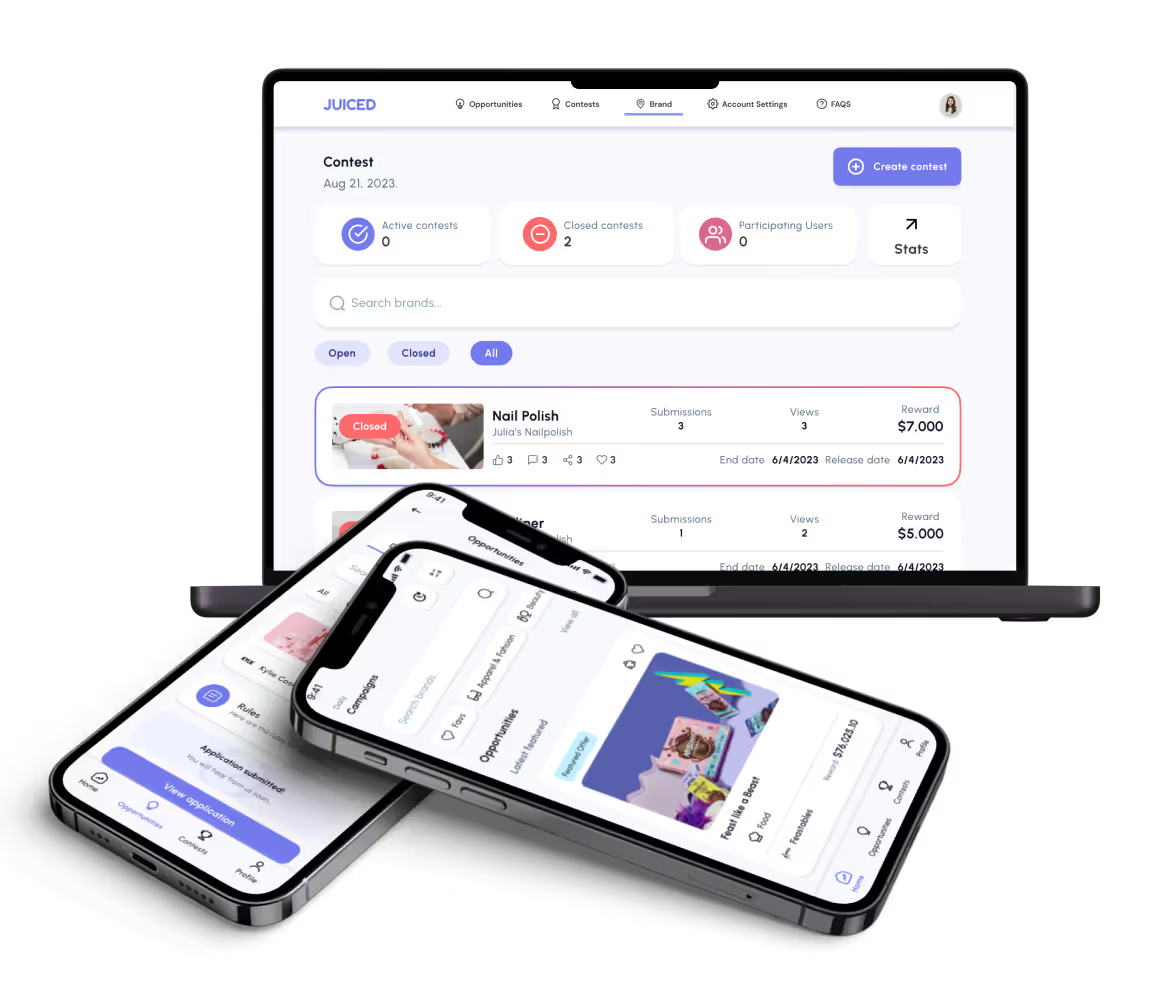
FlutterFlow can build the full scheduling interface: visual calendar, post queue, team approval workflow, push reminders, analytics feed, and content library. The publishing engine itself runs in Firebase Functions, not in FlutterFlow's visual editor.
This distinction, between the scheduling UI and the publishing engine, is the architectural decision that defines the entire build.
Visual Content Calendar
A drag-and-drop monthly and weekly calendar interface lets creators place, move, and reschedule content across multiple platforms from a single screen.
- Drag-and-drop scheduling: Posts move between dates by dragging, updating scheduled time in Firestore without manual data entry.
- Multi-platform view: Colour-coded platform indicators show where each post is scheduled to publish on a given day.
- Quick edit access: Tapping any calendar item opens the post editor directly without leaving the calendar view.
A well-designed visual calendar is the primary reason creators choose a custom tool over a generic shared spreadsheet.
Post Queue and Draft Management
A list-based queue of scheduled and draft posts displays status tags, publish times, and one-tap edit access for last-minute changes before a post goes live.
- Status tags: Posts display as Draft, Scheduled, Published, or Failed, giving creators an instant read on queue health.
- Publish time display: Each queue item shows its scheduled publish time in the creator's local timezone.
- One-tap edit: Last-minute copy or image changes open directly from the queue without navigating through a menu structure.
A clean queue view reduces the anxiety that content managers feel when managing high-volume publishing across multiple accounts simultaneously.
AI-Generated Caption and Hashtag Suggestions
AI-generated caption suggestions surfaced via API call to GPT or Claude help creators draft platform-appropriate copy directly within the scheduling flow, reducing blank-page friction significantly.
- On-demand generation: Creators tap a button to generate caption options based on the post image, platform, and tone settings they select.
- Hashtag recommendations: The AI returns relevant hashtags with estimated reach data pulled from the platform's topic model.
- Platform tone adjustment: Captions adapt to the platform context, LinkedIn professional tone versus Instagram conversational, based on the scheduling target.
AI copy assistance is increasingly a baseline expectation for creator tools rather than a premium feature, and FlutterFlow makes it straightforward to integrate via API call.
Multi-Platform Content Preview
Side-by-side preview panels show how a post will appear on different social platforms before scheduling, reducing formatting errors from copy-pasting between platforms.
- Platform-accurate rendering: Preview panels replicate each platform's post layout, including character limits, image crop ratios, and link formatting.
- Pre-schedule review: Creators catch formatting issues before a post enters the queue, not after it publishes incorrectly.
- Caption truncation alerts: The preview flags captions that exceed platform character limits before the post is scheduled.
Multi-platform preview is the feature that agencies and marketing teams most consistently cite as justification for a custom tool over a generic scheduler.
Team Collaboration and Approval Workflow
Multi-role calendar access lets content managers submit posts, editors review copy, and approvers sign off before content enters the publish queue.
- Role-separated access: Content managers, editors, and approvers each see and action only the steps relevant to their role.
- Sequential approval steps: Posts move through a defined approval chain before entering the scheduled queue, preventing unapproved content from publishing.
- Comment and revision threads: Reviewers leave inline notes on specific posts; writers respond and resubmit without leaving the app.
A structured approval workflow is what separates a creator tool from an enterprise marketing team platform, and FlutterFlow's multi-role data model handles this well.
Push Notification Reminders
Scheduled push notifications via Firebase Cloud Messaging alert creators when a post is due for publishing, an approval is pending, or a scheduled post has failed.
- Publish reminders: Creators receive a notification when a manually-published post is scheduled to go live, prompting action if the platform does not support direct API posting.
- Approval request alerts: Approvers are notified immediately when a post enters their review queue.
- Failure alerts: If a scheduled post fails to publish via API, a failure notification fires so the creator can investigate and republish manually.
Push notifications are the reliability layer for any content scheduling tool where missed publish times have real consequences for brand consistency.
Analytics Summary Feed
Post-performance summary cards pull engagement data from connected social accounts after content publishes, giving creators in-app visibility into what is working.
- Engagement metrics: Likes, comments, shares, and reach display on each published post card within the app.
- Platform-specific data: Metrics pull from each platform's API and display in a unified feed without requiring creators to log into each platform separately.
- Performance trends: Week-over-week and post-type comparisons help creators identify which content formats drive the most engagement.
Content Library and Asset Management
A centralised media library stores images, videos, and captions with tags and search, allowing creators to reuse assets across future scheduling workflows without digging through device galleries.
- Centralised storage: All approved brand assets live in one searchable library accessible to all team members with appropriate permissions.
- Tag and search: Assets are tagged by campaign, platform, or content type for fast retrieval when building new scheduled posts.
- Reuse workflow: Creators pull existing assets into new posts directly from the library, maintaining brand consistency across scheduling cycles.
How Long Does It Take to Build a Content Scheduling App with FlutterFlow?
A simple scheduling MVP with calendar, queue, and push reminders takes 4–6 weeks. A full-featured scheduler with multi-platform publishing, team approval workflow, analytics, and AI copy assistance takes 10–14 weeks.
Timeline extends based on the number of social platform API integrations, approval role complexity, and AI integration scope.
- Phase 1 priority: Calendar and queue management first, get the core scheduling interface working before adding publishing integrations.
- Phase 2 additions: Team approval workflow and AI caption assistance once the scheduling data model is validated.
- Phase 3 integrations: Social platform API publishing connections and analytics pulls last, as these have the most external dependencies.
- Speed advantage: FlutterFlow delivers a scheduling app UI and workflow in roughly one third of the time of a custom-coded equivalent.
Social platform API access applications can take weeks to approve, start those applications before development begins, not after.
What Does It Cost to Build a FlutterFlow Content Scheduling App?
A FlutterFlow content scheduling app costs $15,000–$45,000 for developer builds and $20,000–$65,000 for a full agency-delivered platform with team collaboration and analytics. Custom scheduling SaaS tools typically cost $50,000–$150,000 for equivalent functionality.
Understanding FlutterFlow platform pricing tiers before scoping prevents surprises when the platform subscription is added to the total project budget.
- Platform cost: The FlutterFlow subscription is $0–$70 per month. Most production scheduling apps need the Pro or Teams plan for multi-user access.
- AI API costs: GPT and Claude per-call pricing scales with usage. Estimate based on caption generation volume before committing to a specific model.
- Hidden cost: social API application process: Platform API developer applications for Instagram, TikTok, and LinkedIn can take several weeks to approve and are not guaranteed.
- Hidden cost: content moderation: Multi-user scheduling tools where content enters a publish queue before human review may require moderation logic to prevent policy violations.
The social platform API application process is the single most common cause of scheduling app launch delays, it cannot be rushed and must start before development begins.
How Does FlutterFlow Compare to Custom Development for a Content Scheduling App?
FlutterFlow delivers a scheduling app MVP in 4–6 weeks at $20,000–$45,000. A custom-coded equivalent takes 3–5 months at $50,000–$150,000. The capability ceiling is background job scheduling and multi-workspace tenancy for enterprise-grade tools.
FlutterFlow wins clearly for creator tools, internal marketing team schedulers, and MVP validation of scheduling SaaS ideas.
- Speed and cost advantage: FlutterFlow delivers a production scheduling UI in weeks at a fraction of custom development cost.
- Background scheduling limitation: FlutterFlow apps do not run background processes natively. All time-based publishing logic must run in Firebase Cloud Functions.
- Social API deprecation risk: API policy changes from Instagram, TikTok, and LinkedIn affect any scheduling tool regardless of whether it was built in FlutterFlow or custom code.
- When custom wins: Enterprise-grade scheduling with multi-workspace tenancy, complex approval chains requiring audit logs, and proprietary analytics pipelines.
Teams evaluating their full options should also consider alternative platforms for scheduling app development before committing to FlutterFlow.
What Are the Limitations of FlutterFlow for a Content Scheduling App?
The core limitation is that FlutterFlow cannot post to social platforms autonomously. All publishing logic runs in Firebase Cloud Functions triggered by scheduled jobs. FlutterFlow builds the interface; Firebase executes the publishing.
Understanding this architecture before scoping prevents the most common expensive mistake in scheduling app development.
- Direct publishing constraint: FlutterFlow cannot autonomously post to Instagram, TikTok, or LinkedIn. Publishing requires Firebase Cloud Functions triggered at scheduled times, outside the visual editor entirely.
- Social API gating: Instagram, TikTok, and LinkedIn control third-party posting API access. Access can be revoked or rate-limited without warning, breaking publishing integrations overnight.
- Background job execution: FlutterFlow apps do not run background processes natively. All scheduling logic must live in Cloud Functions, which requires Firebase Functions expertise separate from FlutterFlow skills.
- Scale and cost at volume: High-volume teams scheduling hundreds of posts daily generate significant Firebase Function invocations with associated costs that scale non-linearly.
- Vendor dependency on social platforms: Twitter/X and Instagram API policy changes in recent years have broken third-party scheduling tools. This risk applies regardless of the build platform.
- Code export option: Useful for teams needing to add custom background scheduling logic beyond what Firebase Functions can cleanly support in a maintainable way.
Teams expecting high scheduling volume should understand FlutterFlow under heavy load before designing their Firebase Functions architecture.
How Do You Build a FlutterFlow Content Scheduling App with the Right Team?
Hire a developer or agency with FlutterFlow calendar UI experience, Firebase Cloud Functions expertise for cron jobs, and demonstrated knowledge of social platform OAuth authentication flows. All three are required; none is sufficient alone.
Finding experienced FlutterFlow developers who understand backend scheduling logic prevents the most common architecture mistakes in this type of build.
- Core expertise required: FlutterFlow calendar UI, Firebase Cloud Functions for scheduled jobs, social API OAuth authentication flows, and push notification configuration.
- Freelancer option: A strong senior freelancer can handle MVP scope, calendar, queue, reminders, and basic publishing integration for one or two platforms.
- Agency advantage: Agencies bring the project management and multi-discipline expertise needed for multi-platform, multi-role team scheduling tools at production quality.
- Red flag: assumes FlutterFlow publishes directly: Any developer who does not immediately clarify that publishing requires Firebase Functions does not understand the architecture.
- Red flag: no OAuth experience: Social platform API authentication requires OAuth token management for long-lived posting permissions, not a beginner skill.
- Key question to ask: "How do you implement time-zone-aware scheduling, and how do you handle OAuth token refresh for long-lived social platform posting permissions?"
Allow 2–3 weeks of discovery to map every platform integration and confirm API access availability before development begins. That time prevents mid-build pivots.
Conclusion
FlutterFlow is excellent for building the calendar interface, queue management, and team approval workflow of a content scheduling app. The publishing engine, background scheduling logic, and social API connections all live in Firebase Functions outside the visual editor.
That architecture is not a limitation, it is the correct design. FlutterFlow handles the UI; Firebase handles the execution.
Before starting development, confirm which social platforms you need to publish to and verify your API access eligibility. That single step prevents the most expensive discovery of the entire project.
Building a Content Scheduling App with FlutterFlow? Here Is How LOW/CODE Agency Approaches It.
Most content scheduling app builds stall at the social API integration stage because the team did not confirm API access before writing the first screen. By then, the budget is half-spent and the architecture may need rethinking.
As AI development experts, we at LOW/CODE Agency help SMBs ship real software — web and mobile applications, intelligent chatbots, RAG pipelines, and autonomous AI agents built for businesses that need results, not platforms. We validate API access, design the Firebase Functions architecture, and build the FlutterFlow scheduling interface as a system, not as separate components handed off between developers.
- API access validation: We confirm social platform API access eligibility before any development begins, so integration complexity is scoped accurately from day one.
- Firebase Functions architecture: We design the background publishing job structure before the UI is built, ensuring the publishing logic is reliable and scalable.
- Calendar and queue UI: We build the visual scheduling interface, post queue, and drag-and-drop calendar in FlutterFlow with platform-appropriate UX patterns.
- Team approval workflow: We implement role-separated approval flows, content manager, editor, approver, with comment threads and revision history built into the data model.
- AI caption integration: We connect GPT or Claude via API to the post creation flow, with platform-tone awareness and hashtag generation built into the UX.
- Push notification configuration: We configure Firebase Cloud Messaging for publish reminders, approval requests, and failure alerts across iOS and Android.
- Full product team: Strategy, UX, development, and QA from one team so the handoff between FlutterFlow UI and Firebase backend is never a gap.
We have built 350+ products for clients including Coca-Cola, American Express, and Sotheby's. We know how to build scheduling tools that actually publish reliably at production volume.
Related Articles
- How to Build a Course Marketplace App with FlutterFlow
- How to Build a Courier Tracking App with FlutterFlow
- How to Build a Contractor Management App with FlutterFlow
- How to Build a Construction Progress Tracker with FlutterFlow
- How to Build a Construction Checklist Tool with FlutterFlow
- How to Build Construction Apps with FlutterFlow
Last updated on
September 24, 2026
.

Jesus is a visionary entrepreneur and tech expert. After nearly a decade working in web development, he founded LOW/CODE Agency to help businesses optimize their operations through custom software solutions.


FAQs
What are the first steps to create a content scheduling app in FlutterFlow?
How can I integrate calendar functionality in a FlutterFlow app?
What are common challenges when building scheduling apps with FlutterFlow?
Can I add notifications for scheduled content in FlutterFlow?
How do I manage user authentication in a content scheduling app?
Is FlutterFlow suitable for building complex content scheduling apps?
Related Articles

FlutterFlow
How to Build a Fuel Expense Tracker with FlutterFlow
Learn how to create a fuel expense tracker app using FlutterFlow with step-by-step guidance and best practices for accurate tracking.

FlutterFlow
How to Build a Coaching Marketplace Platform with FlutterFlow
Learn how to create a coaching marketplace platform using FlutterFlow with step-by-step guidance and best practices.
FlutterFlow
How to Build an NGO Project Tracking App with FlutterFlow
Learn how to create an NGO project tracking app using FlutterFlow with step-by-step tips and best practices for efficient development.
FlutterFlow
How to Build a Taxi Booking App with FlutterFlow
Learn how to create a taxi booking app using FlutterFlow with step-by-step guidance and tips for a smooth development process.


Why customers trust us for no-code development


