

How to Build a Policy Management Dashboard with FlutterFlow
15 min
read
Learn how to create a policy management dashboard using FlutterFlow with step-by-step guidance and best practices.


A FlutterFlow policy management dashboard connects to your existing core systems and gives agents and policyholders a real-time view without a full custom rebuild. Insurance teams managing hundreds of policies through disconnected spreadsheets and legacy portals lose hours daily to manual status checks.
FlutterFlow surfaces policy data through APIs without replacing the policy administration system behind it. This article covers what the dashboard can do, what it costs, and where the limits are.
Key Takeaways
- Policy data lives in your core system: FlutterFlow surfaces policy information through APIs, not as a replacement for the policy administration system behind it.
- Role-based access is essential: Agent, underwriter, and policyholder views each require distinct data permissions built into the dashboard architecture from the start.
- Document management is a common requirement: Policy documents, endorsements, and renewal notices need a structured storage and retrieval layer alongside the dashboard.
- Integration complexity drives timeline: The harder part is connecting to legacy core systems; the FlutterFlow UI layer builds relatively quickly once the API is accessible.
- Regulatory data handling adds scope: PII handling, state data residency requirements, and audit logging must be designed in before any screen is built.
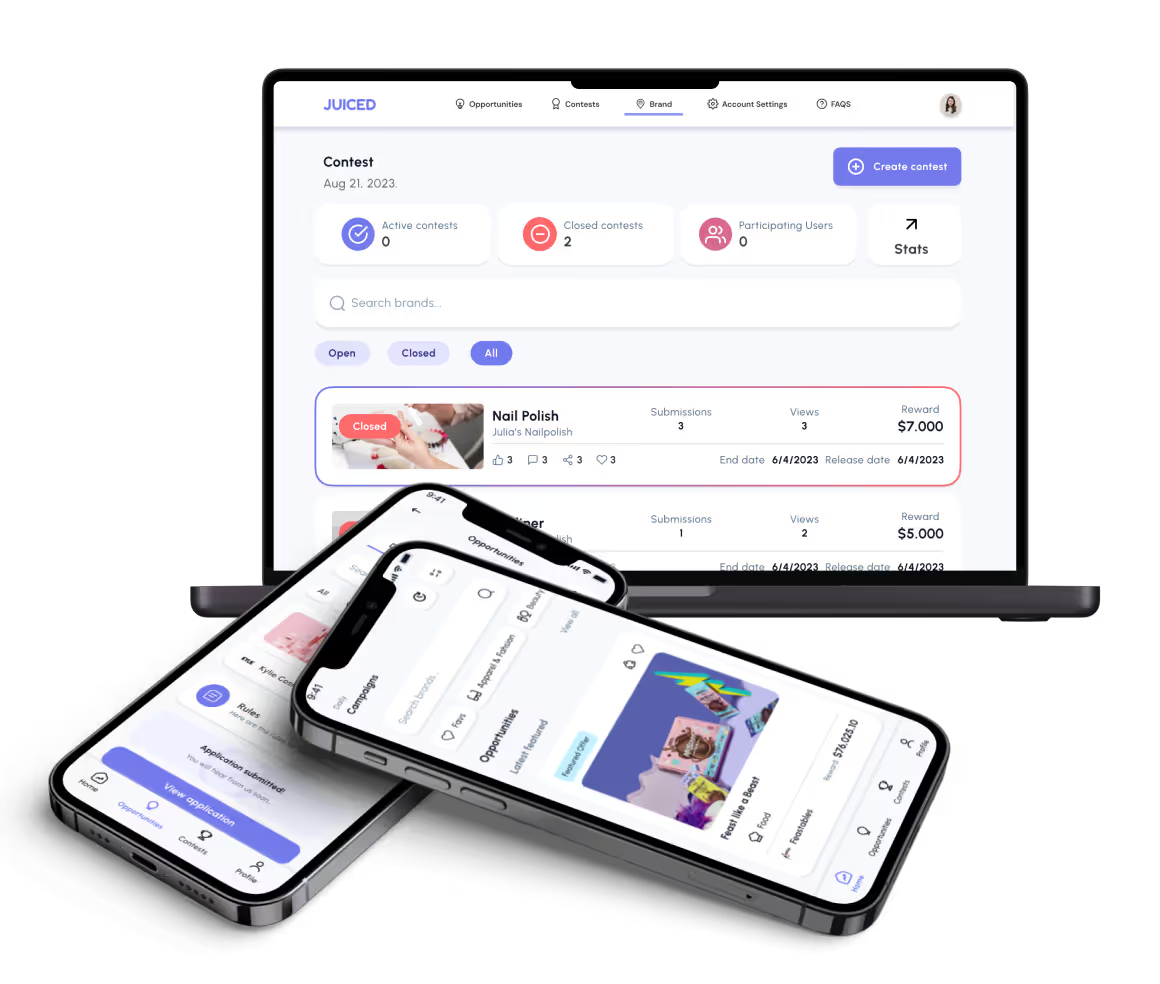

What Can FlutterFlow Build for a Policy Management Dashboard?
FlutterFlow builds the client-facing and agent-facing layers of a policy management dashboard: policy summary views, endorsement request flows, document access, renewal pipelines, payment screens, and notifications. It does not replace the policy administration system that holds the authoritative data.
See FlutterFlow app examples live across industries to understand the visual complexity that is achievable in production builds.
Policy Summary Views
Policyholders and agents see active policies, coverage details, effective dates, and premium amounts pulled in real time from the core policy administration system via REST API. Data refreshes on each screen load.
Role-based access rules determine which policies each user can view. Agents see their assigned book of business; policyholders see only their own policies.
- Real-time policy data: Coverage details, effective dates, premium amounts, and policy status read from the core system API on each screen load for accuracy.
- Role-scoped visibility: Firestore security rules and API parameters restrict each user to their permitted policy records, preventing cross-account data exposure.
- Policy status indicators: Active, lapsed, pending renewal, and cancelled status labels display clearly on each policy card, helping agents prioritise their workflow.
Endorsement and Change Requests
Structured request forms for adding drivers, updating addresses, or changing coverage limits route to underwriters with notification triggers. Request status updates display in the policyholder's dashboard.
Form validation ensures required fields are complete before submission. The submitted request writes to Firestore and triggers a notification to the assigned underwriter's queue.
- Structured request forms: Endorsement request types have dedicated forms with field validation, ensuring submissions are complete before they reach the underwriting team.
- Automated routing: Submitted requests trigger Firebase Cloud Messaging notifications to the assigned underwriter or review queue based on request type and policy class.
- Status tracking: Policyholders see their request status, whether submitted, under review, approved, or declined, updated in real time as the underwriter progresses it.
Document Library
Searchable access to policy documents, declarations pages, endorsements, and renewal notices stored in Firebase Storage or connected document management services is achievable with FlutterFlow's file display widgets.
Documents are linked to policy records in Firestore by policy number and document type, making retrieval fast and predictable for both agents and policyholders.
- Searchable document access: Policyholders and agents search or browse documents by type, date, or policy number using FlutterFlow's filter and search components.
- Secure file retrieval: Documents stored in Firebase Storage use signed URL access so only authenticated users with the correct policy permissions can download them.
- Upload capability: Agents can upload endorsement documents or correspondence to a policy record in the dashboard, creating a centralised document trail.
Renewal Pipeline Dashboard
An agent-facing view of policies approaching renewal with days-to-expiry sorting, renewal status indicators, and bulk outreach triggers gives agents a structured way to manage their renewal pipeline without a separate CRM.
Renewal data pulls from the core system API. Days-to-expiry calculations run in a Cloud Function and write to Firestore for efficient dashboard querying.
- Days-to-expiry sorting: Policies approaching renewal display in ascending expiry order, putting the most urgent renewals at the top of the agent's workflow.
- Renewal status indicators: Each policy shows its renewal status, from not started through to quoted and accepted, so agents can see pipeline health at a glance.
- Bulk outreach triggers: Agents select multiple policies and trigger email or SMS renewal reminders in a single action, connected to your outreach platform via API.
Payment History and Billing
Stripe-connected billing screens showing payment history, upcoming instalments, autopay enrolment, and one-click payment options give policyholders self-service control over their premium payments.
Payment processing runs through Stripe; FlutterFlow displays Stripe data and handles payment initiation actions. No payment card data passes through the FlutterFlow layer.
- Payment history display: Stripe transaction records display in a clean list view showing payment date, amount, and method for each historical premium payment.
- Upcoming instalment schedule: Policyholders see their upcoming payment dates and amounts, reducing inbound calls about billing to the service team.
- One-click payment: Saved payment methods stored in Stripe enable one-click premium payment from the dashboard without re-entering card details.
Agent Book of Business View
An aggregate dashboard showing total policies, premium volume, lapse rate, and recent activity for agents managing large portfolios gives agency managers a consolidated performance view.
Summary metrics are calculated server-side and cached in Firestore for fast dashboard loads. Individual policy drill-down is available from the summary view.
- Portfolio summary metrics: Total active policies, gross premium volume, policies lapsing this month, and recent endorsement activity display in a summary card layout.
- Lapse rate tracking: Policies that have lapsed in the current period surface as a metric with drill-down access to the individual records for follow-up.
- Recent activity feed: New endorsements, payments, and customer-initiated requests appear in a chronological activity feed on the agent dashboard for same-day awareness.
Notifications and Alerts
Push and in-app notifications for renewal reminders, payment confirmations, endorsement approvals, and policy change acknowledgments are delivered via Firebase Cloud Messaging to both agents and policyholders.
Notification triggers are configured as Cloud Function listeners tied to Firestore document changes and API event webhooks from the core system.
- Renewal reminder notifications: Automated push notifications alert policyholders and agents at 60, 30, and 7 days before policy expiry to prompt renewal action.
- Endorsement status updates: Push notifications fire when an endorsement request status changes, keeping policyholders informed without requiring them to check the dashboard manually.
- Payment confirmation delivery: Payment success and failure notifications are delivered immediately after Stripe webhook receipt, giving policyholders real-time billing visibility.
How Long Does It Take to Build a Policy Management Dashboard with FlutterFlow?
A simple policyholder self-service portal covering policy view, payment, and document download takes 6-10 weeks. A full agent and policyholder dashboard with multi-role access, endorsement workflows, and a renewal pipeline takes 14-22 weeks.
Timeline depends heavily on core system API readiness. Legacy policy administration systems often lack documented APIs and require middleware development before any FlutterFlow screen is built.
- Simple portal timeline: Policyholder self-service covering policy view, document download, and Stripe-connected payment ships in 6-10 weeks with a clean REST API available.
- Full dashboard timeline: Multi-role access, endorsement workflows, renewal pipeline, and agent book of business view extend the build to 14-22 weeks depending on integration complexity.
- Legacy API factor: Policy administration systems without documented APIs require custom middleware development, adding 3-6 weeks before the FlutterFlow build begins.
- Role-based architecture time: Designing and testing Firestore security rules for agent, underwriter, and policyholder access levels adds 1-2 weeks to the architecture phase.
- Phased approach advantage: Policyholder self-service view first, agent tools in phase two, and analytics in phase three delivers value at each milestone while keeping scope manageable.
FlutterFlow builds the dashboard UI 2-3 times faster than custom development. Core system integration effort is similar across approaches and is always the critical path.
What Does It Cost to Build a FlutterFlow Policy Management Dashboard?
FlutterFlow policy management dashboard builds cost $15,000-$75,000 depending on the number of user roles, integrations, and compliance requirements. A single-role policyholder portal sits at the lower end; a full multi-role agent and policyholder platform sits at the top.
The FlutterFlow pricing plans overview covers platform costs, but the real budget variable for a policy dashboard is the core system integration layer.
- Platform cost is minimal: FlutterFlow's monthly fee is a small fraction of total project cost; core system integration and compliance architecture drive the budget.
- API middleware is a real cost: Legacy core systems without REST APIs require custom middleware development that adds $5,000-$20,000 to the total project budget.
- Freelancer scope: Freelancers suit single-role policyholder portals with a clean REST API and no compliance-driven audit logging requirements.
- Agency scope: Multi-role dashboards with legacy integration, endorsement workflows, and state data residency requirements need a team with insurance domain expertise.
- Custom comparison: Custom policy dashboards cost $100,000-$300,000 and take months to build; off-the-shelf portals from Applied or Guidewire require their full platform stack.
- Hidden cost: UAT with licensed agents: User acceptance testing with real insurance agents adds time and coordination overhead that many initial project quotes do not include.
Budget a 15-20% contingency for legacy API discovery and compliance review findings identified during the build.
How Does FlutterFlow Compare to Custom Development for a Policy Management Dashboard?
FlutterFlow is 50-65% cheaper for a front-end policy dashboard built over an existing core system and deploys in 6-22 weeks versus 4-8 months for custom development. Deep workflow automation, batch policy processing, and complex underwriting rule engines cannot live inside FlutterFlow.
- Speed advantage is meaningful: FlutterFlow delivers a working policy dashboard interface in weeks; equivalent custom builds take months to reach the same functional state.
- Non-engineer UI updates: Product and operations teams update dashboard layouts and notification copy in FlutterFlow without developer involvement, reducing ongoing maintenance costs.
- When FlutterFlow wins: Self-service portals layered over existing core systems, agent tools for established carriers, and MVP policyholder apps that need to ship quickly.
- When custom wins: Greenfield policy administration system replacement, deep workflow automation with complex underwriting rules, and proprietary data model requirements.
Review FlutterFlow alternatives worth considering if you need a platform with deeper workflow automation than FlutterFlow's current action editor supports.
What Are the Limitations of FlutterFlow for a Policy Management Dashboard?
FlutterFlow cannot support deep underwriting workflow automation, multi-step approval chains with complex business rule exceptions, or batch policy processing. These functions belong in the core system or a dedicated workflow engine, not in the FlutterFlow layer.
Read the guide to FlutterFlow security for regulated apps before designing your role-based access model, as insurance data requires strict PII controls at the API layer.
- Legacy core system integration: Most policy administration systems require API middleware or custom connectors that add significant project cost and time before the dashboard build begins.
- Complex endorsement workflow automation: Multi-step underwriting approval chains with business rule exceptions and manual override handling exceed FlutterFlow's native automation capabilities.
- Audit logging requirements: State regulators often require immutable audit logs of policy changes; FlutterFlow does not produce compliant audit trails without custom backend configuration.
- Scale performance considerations: Dashboards serving thousands of concurrent agents need careful Firebase read and write optimisation to avoid performance degradation at load.
- Vendor dependency risk: Core dashboard screens depend on FlutterFlow component availability; breaking changes to the platform require rebuild cycles in production insurance tools.
- Code export limitations: Code export is available, but complex API integration logic built in FlutterFlow's action editor does not translate cleanly to hand-maintained Flutter code.
These limits matter most for carriers building dashboards on top of Guidewire, Duck Creek, or legacy AS400 policy administration systems without modern REST APIs.
How Do You Get a FlutterFlow Policy Management Dashboard Built?
You need a developer or agency with insurance backend API experience, FlutterFlow role-based access architecture knowledge, and regulatory data handling familiarity. Core system integration experience matters more than raw FlutterFlow hours for this use case.
When you hire qualified FlutterFlow developers for an insurance dashboard, ask specifically for core system API integration experience before reviewing portfolio work.
- Required expertise: Insurance backend API integration, Firestore role-based access architecture, regulatory data handling knowledge, and document management system experience.
- Freelancer scope: Freelancers suit single-role policyholder portals with a clean, documented REST API and limited compliance or audit logging requirements.
- Agency scope: Multi-role dashboards with legacy integration, endorsement workflows, and state data residency requirements need a team with both insurance domain and FlutterFlow depth.
- Red flag when hiring: Any developer who scopes the project without first auditing the core system API documentation or who does not ask about state data residency requirements.
- Key interview question: Ask specifically whether they have built dashboards on insurance core systems and how they handle legacy API authentication, rate limiting, and error states.
- Expected project timeline: API audit 2-3 weeks; architecture 2 weeks; FlutterFlow build 8-14 weeks; testing and compliance review 4 weeks before production release.
Interview at least two agencies and ask for verifiable examples of insurance API integrations or regulated industry dashboard builds before committing.
Conclusion
A FlutterFlow policy management dashboard is a practical overlay for insurance carriers that already have a core system. It surfaces data and handles self-service without requiring a platform replacement, at a fraction of the cost and time of a custom rebuild.
Audit your core system's API documentation before scoping the dashboard build. Integration readiness is the single biggest timeline variable in any policy management project, and discovering it late is expensive.
Building a Policy Management Dashboard with FlutterFlow? Here Is How LOW/CODE Agency Approaches It.
Policy management dashboards are not standard web apps. The legacy core system integration, role-based data architecture, and regulatory compliance requirements are where most insurance dashboard builds succeed or stall. Getting the API and access layer right from day one determines whether the dashboard ships on time.
At LOW/CODE Agency, we help SMBs compete with AI-powered software built for them — custom web and mobile apps, RAG systems, chatbots, and intelligent agents delivered by a senior development team. We build FlutterFlow policy management dashboards with the full integration stack behind them: core system API connectivity, role-based Firestore architecture, compliance-aware audit logging, and document management from a team that understands how insurance data needs to be handled.
- Core system API integration: We connect FlutterFlow dashboards to Guidewire, Duck Creek, and legacy policy administration systems with proper authentication and error handling built in.
- Role-based access architecture: We design and implement agent, underwriter, and policyholder access layers with Firestore security rules that enforce data boundaries at the API level.
- Endorsement workflow design: We build structured request forms, approval routing, and status tracking for endorsement workflows that match your underwriting team's actual process.
- Compliance and audit logging: We engineer immutable audit logs for policy data changes and configure PII handling to meet state data residency requirements from the start.
- Document management integration: We connect Firebase Storage or your existing document management system to the dashboard with role-appropriate access control for policy documents.
- Phased delivery: We scope and ship the policyholder self-service portal first, then layer in agent tools and analytics so your team gets value at each stage of the build.
- Full product team: Strategy, UX, development, and QA from a single team so your policy dashboard is production-ready and not just technically functional.
We have built 350+ products for clients including Coca-Cola, American Express, and Sotheby's. We know how to scope and deliver FlutterFlow dashboards that stand up to regulated industry requirements.
Related Articles
- How to Build Procurement Apps with FlutterFlow
- How to Build a Prescription Management App with FlutterFlow
- How to Build a POS App with FlutterFlow
- How to Build a Physiotherapy App with FlutterFlow
- How to Build Personal Finance Apps with FlutterFlow
- How to Build a Performance Review System with FlutterFlow
Last updated on
September 24, 2026
.

Jesus is a visionary entrepreneur and tech expert. After nearly a decade working in web development, he founded LOW/CODE Agency to help businesses optimize their operations through custom software solutions.


FAQs
What are the first steps to create a policy dashboard in FlutterFlow?
How can I connect my policy data to the FlutterFlow dashboard?
What widgets are best for displaying policy information in FlutterFlow?
Can I add user roles and permissions to the dashboard in FlutterFlow?
How do I ensure the dashboard updates automatically with new policy changes?
What are common challenges when building a policy dashboard in FlutterFlow?
Related Articles

FlutterFlow
How to Build Nonprofit Apps with FlutterFlow
Learn how to create nonprofit apps using FlutterFlow with step-by-step guidance and best practices for effective app development.

FlutterFlow
How to Build a Vehicle Maintenance Tracker with FlutterFlow
Learn how to create a vehicle maintenance tracker app using FlutterFlow with step-by-step guidance and best practices.

FlutterFlow
How to Build a Creator Subscription Marketplace with FlutterFlow
Learn how to create a creator subscription marketplace using FlutterFlow with step-by-step guidance and best practices.

FlutterFlow
How to Build a Taxi Booking App with FlutterFlow
Learn how to create a taxi booking app using FlutterFlow with step-by-step guidance and tips for a smooth development process.


Why customers trust us for no-code development


