

Build a SaaS Platform App with Bubble
10 min
read
Learn how to build a SaaS platform app with Bubble. Launch a fully featured software product with auth, billing, and dashboards — no coding experience needed.

Most SaaS founders spend months on infrastructure before writing a single line of product logic. Building your SaaS platform on Bubble cuts that timeline to weeks without sacrificing the core features your users need.
This guide covers how to build a SaaS platform app with Bubble: the architecture decisions, feature set, billing setup, authentication, and where the platform holds up or runs into its limits.
Key Takeaways
- Bubble is a proven SaaS platform: subscription billing, user authentication, multi-tier pricing, and workflow automation are all achievable without custom code.
- Architecture decisions made early, data types, user roles, and workspace structure, determine how well the platform scales as you add customers.
- Stripe integration handles billing: plan management, trial periods, upgrades, and payment failures are all manageable through Bubble's Stripe plugin.
- A production-ready SaaS MVP on Bubble takes 8-14 weeks and costs between $15,000 and $40,000 depending on feature depth.
- Vendor lock-in is a real trade-off: all business logic lives inside Bubble, so plan your growth runway knowing migration means a full rebuild.
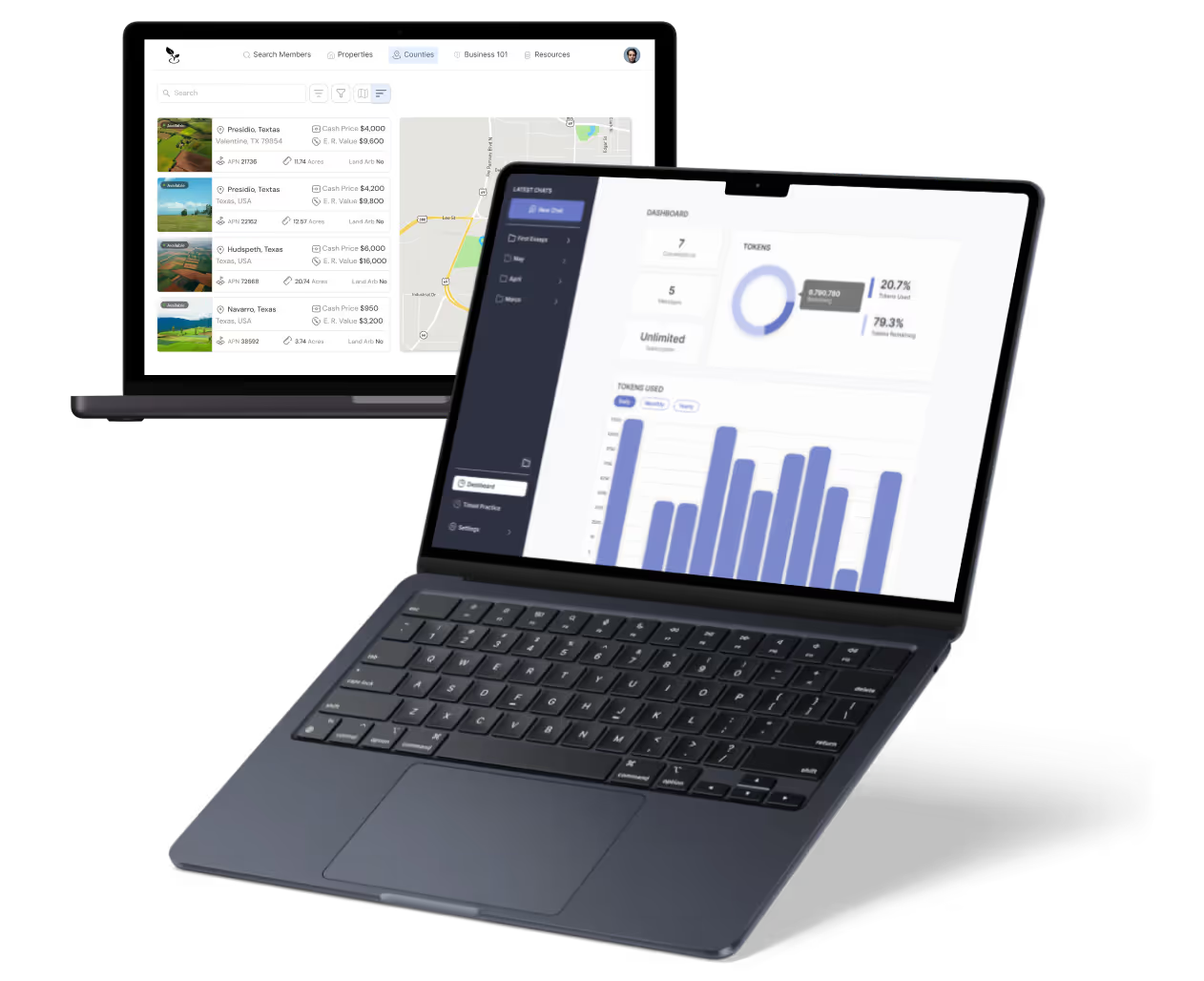

What Features Does a Bubble SaaS Platform App Need?
A Bubble SaaS platform needs user authentication, subscription billing, a core product workflow, a user dashboard, account settings, and an admin panel.
The exact feature set depends on what the SaaS does, but the platform layer, auth, billing, settings, and admin, is consistent across almost every SaaS product. Build this layer first before touching product-specific features.
- User authentication covers registration, login, password reset, and optionally social login via OAuth. Bubble handles this natively.
- Subscription billing connects to Stripe for plan selection, trial activation, payment capture, and recurring charge management.
- Core product workflow is whatever your SaaS actually does, project management, reporting, communication, or data processing.
- User dashboard gives each subscriber a personalized view of their data, activity, and account status.
- Account settings lets users manage profile, password, notifications, and billing details without contacting support.
- Admin panel gives your team visibility into all customers, usage, plan status, and the ability to manage accounts.
Bubble SaaS app examples across different product categories show how the platform layer and core product combine in real, shipped products.
How Do You Structure the Architecture of a Bubble SaaS App?
Structure the architecture around a User data type, a Subscription data type, and a workspace or account entity that links users to their plan and data.
The data model is the most critical architecture decision in a SaaS build. Getting it wrong forces expensive rework later. Spend more time here than on UI design.
- User data type: stores profile information, role, subscription status, and links to the account or workspace they belong to.
- Account or workspace data type: the organizational unit that owns data, holds the Stripe customer ID, and defines the plan the user is on.
- Subscription data type: records plan name, billing cycle, trial end date, Stripe subscription ID, and status.
- Privacy rules per data type: configure Bubble's privacy rules so users only see data that belongs to their account. Test before building any UI.
- Role field on users: at minimum, separate admin and member roles. Add more granularity only if your product genuinely requires it.
Define the full data model before building any workflows. Every feature built on a poorly structured database requires rework when you add the next feature.
How Do You Set Up Authentication for a Bubble SaaS App?
Set up authentication using Bubble's built-in auth system for email and password login, then extend with OAuth plugins for Google or GitHub login if your target users expect it.
Authentication is a solved problem in Bubble. Use the native system rather than building custom auth logic. Add social login only if it meaningfully reduces sign-up friction for your specific user base.
- Email and password: Bubble's native sign-up and login workflows handle this out of the box with minimal configuration.
- Google OAuth: the Google OAuth plugin handles token exchange and user creation. Configure the redirect URI in Google Cloud Console before testing.
- Magic link login: useful for B2B tools where users expect frictionless re-entry. Requires a custom email workflow and token validation.
- Session management: set session expiry appropriately for your use case. SaaS tools used daily can stay logged in longer than financial tools.
- Email verification: require email verification before activating a paid plan. This reduces fraudulent sign-ups and invalid Stripe charges.
Bubble's security model covers authentication configuration, session handling, and data access rules that every SaaS application needs to get right before launch.
How Do You Build Subscription Billing in a Bubble SaaS App?
Build subscription billing by connecting Bubble to Stripe using the Stripe.js plugin, creating workflows for plan selection, checkout, and webhook handling for subscription lifecycle events.
Stripe handles the payment infrastructure. Bubble handles the logic that responds to subscription events, activating accounts, restricting access on cancellation, and managing trial periods.
- Stripe checkout: use Stripe's hosted checkout page for plan selection and payment capture. It handles card validation, 3D Secure, and tax compliance.
- Webhook handling: configure Bubble server-side workflows to respond to Stripe events, payment succeeded, subscription cancelled, trial ended, invoice failed.
- Plan access control: gate features behind plan checks. A user on a Free plan should not access features reserved for Pro subscribers.
- Trial period: set a trial duration in Stripe, then check trial end date in Bubble workflows to prompt upgrade before access expires.
- Upgrade and downgrade: handle plan changes via the Stripe customer portal or a custom in-app flow that updates the Stripe subscription and syncs the change to your Subscription data type.
Review Bubble pricing plans alongside your Stripe costs to understand the full monthly operating overhead before setting your own pricing tiers.
What Does the Development Process Look Like for a Bubble SaaS App?
The development process runs six phases: product scoping, data model design, authentication and billing, core product build, admin tooling, and pre-launch QA.
The product scoping phase is where most SaaS founders underinvest. Shipping the wrong feature set fast is still shipping the wrong product. Define the minimum feature set that a paying customer would use before writing any workflows.
- Phase 1: Product scoping: define the core job to be done, the minimum feature set, and the pricing tiers before touching Bubble.
- Phase 2: Data model design: build all data types, privacy rules, and relationships. Test access control with dummy data.
- Phase 3: Auth and billing: implement registration, login, Stripe checkout, and webhook handling before any product features.
- Phase 4: Core product build: build the main product workflow in structured sprints. Ship usable versions of each feature before moving to the next.
- Phase 5: Admin tooling: build your internal admin panel to manage customers, view subscriptions, and handle support cases.
- Phase 6: QA and launch prep: test all user flows, billing edge cases, and plan access gates. Set up error logging and customer support tooling.
A focused SaaS MVP on Bubble takes 8-14 weeks. Adding a mobile-responsive experience, complex reporting, or third-party integrations extends this by 2-6 weeks depending on scope.
How Much Does It Cost to Build a SaaS Platform on Bubble?
Building a SaaS platform on Bubble costs between $15,000 and $50,000 depending on product complexity, the number of pricing tiers, and integration requirements.
Bubble's per-plan cost is a fixed overhead your SaaS needs to carry from day one. Factor it into your unit economics before validating your pricing model.
- Lean MVP with auth, billing, one core workflow, and basic admin: $15,000 to $25,000.
- Full SaaS platform with multi-tier plans, team features, advanced workflows, and integrations: $30,000 to $50,000.
- Bubble production plan: $32 to $349 per month depending on capacity and features required.
- Stripe processing fees: 2.9% plus $0.30 per transaction, plus Stripe's platform fee if using Connect for marketplace features.
- Ongoing development: budget 15-20% of initial build cost per year for feature additions, performance improvements, and platform updates.
Custom SaaS development starts at $80,000 and typically takes 12-18 months. Bubble delivers a production-ready SaaS product in 2-4 months at a fraction of that investment.
What Are the Limitations of Building a SaaS Platform on Bubble?
Key limitations include vendor lock-in, database query performance at scale, no native mobile app output, and the complexity ceiling on highly custom product logic.
Bubble's capabilities and limitations matter most when you are evaluating whether the platform can support your product vision, not just your MVP requirements.
- Vendor lock-in: all product logic, data, and workflows live in Bubble's environment. There is no code export, migration means rebuilding from scratch.
- Database performance: complex filtered searches across large datasets slow down. High-growth SaaS products with millions of records hit this ceiling faster than expected.
- No native mobile: Bubble outputs web apps that can be wrapped for mobile distribution. Not a true native app experience.
- Logic complexity ceiling: highly custom workflows, advanced graph algorithms, real-time multiplayer, complex document editing, require workarounds or external APIs.
- Plugin dependency: many advanced features depend on community or third-party plugins that may have reliability or maintenance risks.
Bubble's scalability ceiling is the most important constraint to understand before committing. Plan your customer growth trajectory and evaluate whether Bubble's infrastructure can support it at your 18-month horizon.
When Does Bubble Make Sense for a SaaS Build?
Bubble makes sense for a SaaS build when you are validating product-market fit, building a niche product with a defined customer set, or need to get to revenue before investing in custom infrastructure.
Bubble pros and cons give you the honest trade-off framework before committing. The speed and cost advantages are real. So are the scale constraints.
- Pre-revenue founders validating willingness to pay should use Bubble to build a chargeable product in weeks rather than months.
- Niche B2B tools with a defined user base under 10,000 active subscribers are well-served by Bubble's performance range.
- Agencies building SaaS for clients can deliver production-grade products faster and cheaper, improving margins without sacrificing quality.
- Funded teams at Seed stage should plan Bubble as the platform through product-market fit, then evaluate a migration at Series A based on actual scale requirements.
When scale, performance, or custom logic requirements exceed what Bubble supports, Bubble alternatives give you a clear set of platforms and architectures to evaluate for your next stage.
Want to Build a SaaS Platform on Bubble?
Building a SaaS product is not just a development problem. It is an architecture problem, a billing problem, and a user experience problem running in parallel from day one.
SMBs do not need a no-code tool. They need an AI product team. At LOW/CODE Agency, we build custom web apps, mobile apps, chatbots, and AI agents — software that actually scales with your business. We handle product scoping, data architecture, billing integration, and full feature development as one coordinated process.
- Product architecture first: we design the data model, user roles, and workspace structure before writing a single workflow.
- Billing and auth from day one: Stripe checkout, webhook handling, plan access gates, and trial logic built in sprint one.
- Core product build: your main SaaS workflow built in structured sprints with customer-testable output at each stage.
- Admin and operations tooling: internal dashboards for customer management, subscription visibility, and support workflows.
- Scalable from MVP to growth stage: architecture decisions that support your first 1,000 customers without forcing a rebuild.
- Long-term product partnership: we stay involved post-launch to add features, improve performance, and evolve the product with your roadmap.
We have delivered 450+ products for clients including American Express and Coca-Cola. Bubble development services cover the full journey from product scoping to live SaaS; most SaaS engagements start around $20,000 USD.
Related Articles
Last updated on
September 28, 2026
.

Jesus is a visionary entrepreneur and tech expert. After nearly a decade working in web development, he founded LOW/CODE Agency to help businesses optimize their operations through custom software solutions.


FAQs
What is a SaaS platform app and can Bubble build one?
How do you build extensibility into a Bubble SaaS platform?
How do you build a developer portal for a Bubble SaaS platform?
Can Bubble support a marketplace of third-party integrations for a platform?
How do you handle platform-wide updates without disrupting customer workflows?
What Bubble features are most important for building a SaaS platform?
Related Articles

Bubble
How to Build a Hybrid Event Platform App with Bubble
Launch a hybrid event platform with Bubble without writing code. Engage in-person and virtual attendees seamlessly step-by-step no-code guide.
Bubble
How to Build a Lab Management App with Bubble
Build a lab management app with Bubble without coding. Streamline sample tracking, workflows, and compliance step-by-step launch faster today.

Bubble
How to Build a Financial Reporting App with Bubble
Create a financial dashboard app with Bubble without coding. Visualize KPIs, track budgets, and monitor cash flow step-by-step fast.

Bubble
How to Build a Field Reporting App with Bubble
Build a field operations app with Bubble no coding required. Coordinate teams, track tasks, and manage workflows step-by-step easily.


Why customers trust us for no-code development


