

How to Build a Real Estate Marketplace App with Bubble
8 min
read
Build a real estate marketplace with Bubble. List properties, connect buyers and agents, and handle inquiries — no custom backend development needed.


A real estate marketplace connects buyers, renters, and agents through one searchable listing platform. Zillow and Rightmove have proven the model. Bubble lets you build your own version without a full custom engineering team.
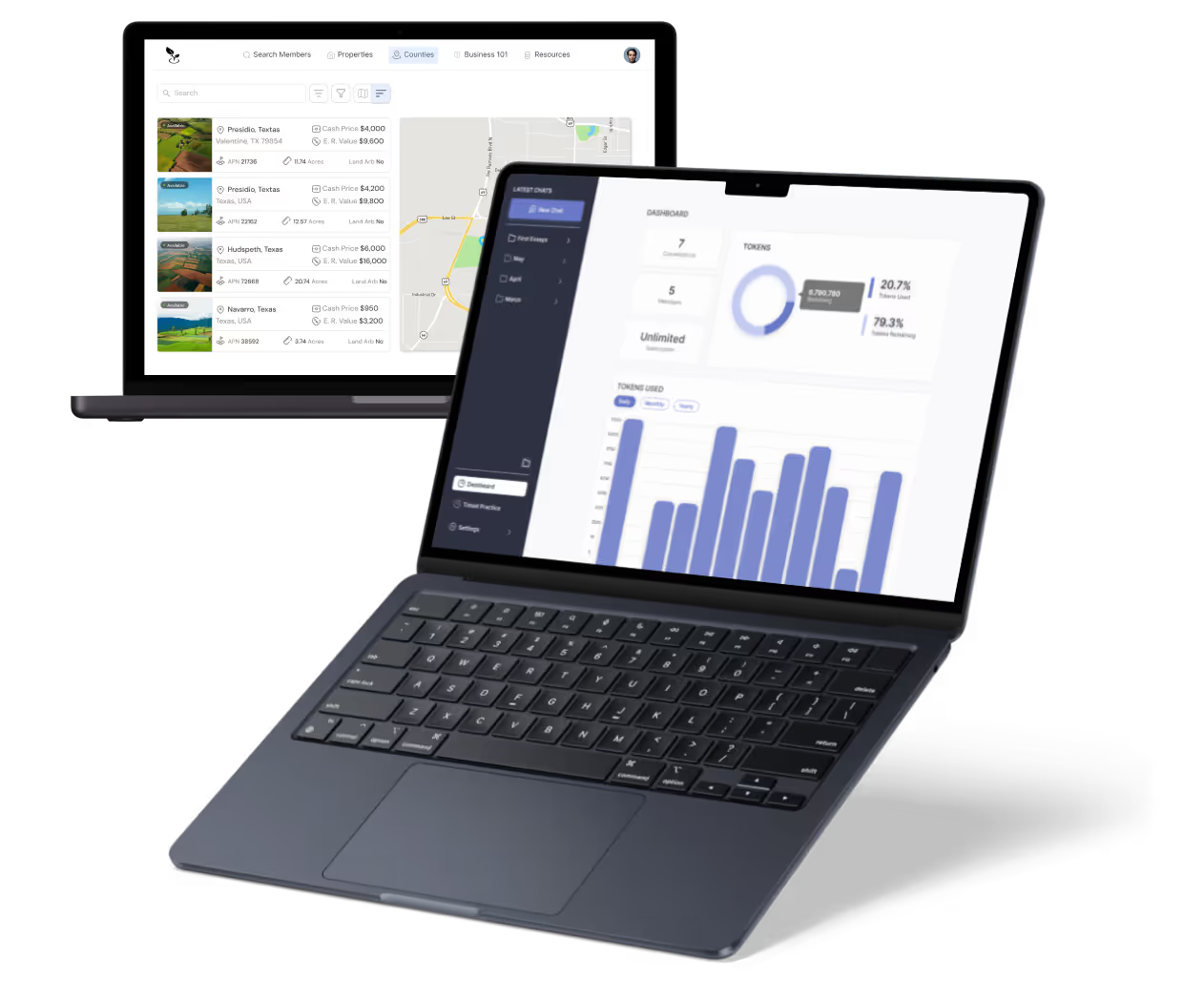
You can launch a real estate marketplace on Bubble with property listings, map-based search, inquiry workflows, and tenant applications built in from day one.
Key Takeaways
- Relational data model: Bubble handles Agents, Properties, Listings, Inquiries, and Applications as cleanly linked data types.
- Map-based search: Google Maps API integration gives you filterable, location-aware property search out of the box.
- Inquiry workflows: Contact forms per listing with automated agent notification are straightforward to build in Bubble.
- Tenant applications: Document upload, application forms, and background check API connections are all achievable on Bubble.
- Cost range: A real estate marketplace MVP on Bubble typically runs $20,000 to $30,000 depending on feature scope.
- Known limits: MLS/IDX feed integration, real-time market data, and complex mortgage calculators expose Bubble's ceiling.

What Data Architecture Does a Real Estate Marketplace Need?
Bubble's visual database connects data types through relational fields. A real estate marketplace needs six core data types to support listings, inquiries, and applications cleanly and without duplication.
Getting your data types defined before any UI work prevents the structural rework that derails most marketplace builds mid-project.
- Agent/Landlord: Stores name, contact details, agency affiliation, license number, and linked active listings.
- Property: Stores physical address, coordinates, property type, number of beds and baths, and square footage.
- Listing: Linked to Property and Agent, stores price, status, listing date, photos, description, and tenure type.
- Inquiry: Linked to Listing and prospective buyer or renter, stores message, timestamp, and response status.
- ViewingRequest: Linked to Listing and Inquiry, stores requested date, time, confirmation status, and agent notes.
- Application: Linked to Listing and Applicant, stores form responses, uploaded documents, status, and decision notes.
See how other teams have structured similar builds in these Bubble app examples for reference.
How Do You Build Property Listings and Search?
Agents and landlords need a structured form to create listings and upload photos without technical help. Buyers and renters need fast, filterable search with map view to find relevant properties quickly.
Bubble handles both through a combination of repeating groups, the Google Maps plugin, and multi-condition search filters built into the search workflow.
- Listing creation: A multi-step form creates the Property and Listing records together, with photo upload handled by Bubble's file uploader.
- Map-based search: The Google Maps plugin plots Listing coordinates on an interactive map that updates as filters change.
- Filter by type: Dropdowns and checkboxes filter search results by property type, tenure, price range, and bedroom count.
- Saved searches: Users can save filter combinations as a SavedSearch record and receive email alerts for new matches.
- Listing status: Active, under offer, and sold statuses update in real time on both the map and repeating group views.
Strong search and filter UX is the most visited part of any real estate marketplace and worth investing proper design time on.
How Do You Build Inquiry and Viewing Workflows?
Every listing needs a way for interested parties to contact the agent or landlord directly. Bubble handles inquiry forms, automated notifications, and viewing scheduling through its workflow and email systems.
Inquiry and viewing logic should be scoped as separate but linked workflows so each can be managed and reported on independently.
- Contact form: Each listing page has an inquiry form that creates an Inquiry record linked to the Listing and the User.
- Agent notification: A workflow sends an email to the linked Agent immediately when a new Inquiry record is created.
- Viewing request: Interested users can submit a preferred date and time, creating a ViewingRequest linked to their Inquiry.
- Confirmation workflow: The agent confirms or reschedules the viewing from their dashboard, triggering a notification to the requester.
- Response tracking: Inquiry records store agent response status so agents can manage their pipeline from one dashboard view.
Review Bubble's security model to ensure inquiry data and user contact details are protected with correct privacy rules.
How Do You Build Tenant Application and Vetting?
For rental marketplaces, the application and vetting stage is where deals are made or lost. Bubble supports structured application forms, document uploads, and third-party background check API integrations without custom code.
Tenant applications should be locked to authenticated users only, with privacy rules preventing applicants from seeing each other's submissions.
- Application form: A multi-step form collects employment status, income, references, and rental history into the Application record.
- Document upload: Bubble's file uploader handles ID scans, pay stubs, and reference letters stored against the Application record.
- Background check API: Services like Checkr or Stripe Identity connect via API Connector to trigger checks from within Bubble workflows.
- Application status: Agents update status (received, reviewing, approved, declined) from their dashboard, triggering applicant notifications.
- Landlord decision notes: A private notes field on the Application record lets landlords log internal comments not visible to applicants.
Keeping application data locked to the relevant Agent or Landlord via privacy rules is essential before any tenant data is collected.
How Much Does It Cost to Build a Real Estate Marketplace on Bubble?
A real estate marketplace MVP on Bubble runs between $20,000 and $30,000. A full production build with advanced vetting and admin features lands between $38,000 and $55,000 depending on integrations and scope.
Map search complexity, application vetting logic, and third-party API integrations are the biggest scope drivers in any real estate build.
| Build Tier | Features Included | Estimated Cost |
|---|---|---|
| MVP | Agent onboarding, property listing creation, map-based search, inquiry form, viewing request scheduling | $20,000 – $30,000 |
| Full Build | Everything in MVP plus tenant applications, document upload, background check API, saved searches, admin dashboard, analytics | $38,000 – $55,000 |
Review Bubble pricing plans to understand ongoing platform costs on top of your development investment.
What Are the Limitations of Building a Real Estate Marketplace on Bubble?
Bubble covers core real estate marketplace features well, but a few specific requirements expose real platform limits. Understanding them before committing prevents costly scope changes mid-build.
MLS feed integration, real-time market data, and complex mortgage logic are the three areas where Bubble shows the most constraint.
- MLS/IDX feed integration: Ingesting live MLS feeds requires a middleware layer or third-party service, since Bubble cannot parse IDX formats natively.
- Complex mortgage calculators: Multi-variable mortgage tools with live rate feeds require external data sources that add API complexity.
- Real-time market data: Live price trend overlays and comparable sales data feeds need dedicated data providers outside Bubble.
- Bubble's scalability ceiling: Map search with thousands of concurrent listings and filters can produce slow query times without careful data architecture.
- Bulk listing imports: Agents or agencies migrating large listing databases need CSV import tooling or API ingestion built separately.
Review Bubble pros and cons and Bubble's capabilities and limitations before finalizing your platform choice. If Bubble does not fit, Bubble alternatives are worth evaluating.
Conclusion
Bubble is a practical choice for building a real estate marketplace when your goal is a fast, cost-effective launch with property listings, map-based search, inquiry workflows, and tenant applications in one platform. The data model, workflow engine, and API Connector cover what most real estate marketplace MVPs need at launch. For early-stage and mid-market builds, Bubble gets you to production without the cost and timeline of a fully custom engineering team.
Want to Build a Real Estate Marketplace on Bubble?
At LowCode Agency, we build real estate marketplaces on Bubble that handle agent onboarding, property listings, map search, inquiry workflows, and tenant applications as one complete platform.
- Data architecture: Agent, Property, Listing, Inquiry, ViewingRequest, and Application data types structured for clean relational queries.
- Listings and search: Multi-step listing creation, Google Maps integration, and multi-condition filtering by type, price, and beds.
- Inquiry and viewing: Per-listing contact forms, automated agent notifications, viewing scheduling, and confirmation workflows.
- Tenant applications: Structured application forms, document upload, background check API integration, and status management.
- Admin tooling: Full admin dashboard with listing oversight, agent management, application review, and reporting built in.
We have delivered 350+ products for clients including Coca-Cola and American Express. Bubble development services cover real estate marketplace builds from architecture through production launch; most engagements start around $20,000 USD.
If you are serious about building a real estate marketplace on Bubble, let's build your platform properly.
Last updated on
May 29, 2026
.

Jesus is a visionary entrepreneur and tech expert. After nearly a decade working in web development, he founded LowCode Agency to help businesses optimize their operations through custom software solutions.


FAQs
Can you build a real estate marketplace with Bubble?
How do you build property listings in a Bubble real estate marketplace?
How do you build map-based property search in Bubble?
How do you build agent profiles in a Bubble real estate marketplace?
How do you build saved searches and listing alerts in Bubble?
How do you capture and manage leads in a Bubble real estate marketplace?
Related Articles

Bubble
How to Build a Bug Tracker App with Bubble
Build a bug tracker with Bubble. Log issues, assign fixes, and track resolution status — a lightweight, custom alternative to expensive dev tools.

Bubble
How to Build a Digital Products Marketplace App with Bubble
Build a digital products marketplace with Bubble. Let creators sell and buyers discover digital goods — a full platform, no backend code needed.

Bubble
How to Build a Real Estate CRM App with Bubble
Build a real estate CRM with Bubble. Manage listings, track buyers, and automate follow-ups — a custom system built for agents and brokers.

Bubble
How to Build a Trade Show Management App with Bubble
Manage trade shows effortlessly with Bubble. Build a no-code app to handle exhibitors, schedules & registrations step-by-step, without coding.


Why customers trust us for no-code development


