

Build a SaaS Feedback Portal with Bubble
11 min
read
Learn how to build a SaaS feedback portal with Bubble. Collect feature requests, manage votes, and close the loop with users — all without writing code.

Product teams that systematically collect and act on user feedback build better products faster than teams that rely on intuition. A dedicated feedback portal changes the relationship between your SaaS product and its users by giving them a structured channel to submit ideas, vote on requests, and track what gets built. Building a SaaS feedback portal on Bubble lets you own the feedback loop entirely within your product.
This guide covers how to build a SaaS feedback portal with Bubble: submission workflows, voting mechanics, status tracking, admin triage, and integration with your product roadmap process.
Key Takeaways
- Bubble is well-suited to feedback portals because the core mechanics, submission, voting, commenting, and status updates, map directly to Bubble's data and workflow capabilities.
- Voting systems require deduplication logic to prevent users from voting multiple times on the same item. This is a manual implementation in Bubble, not a native feature.
- Admin triage and status workflows are as important as the user-facing submission experience. Without a structured triage process, feedback portals become noise rather than signal.
- A feedback portal MVP on Bubble takes 4-8 weeks and costs between $8,000 and $20,000 depending on voting mechanics, admin tooling, and integration with external planning tools.
- The key success metric is closed-loop communication: users who see their feedback acknowledged and actioned return and submit more. Build the status update workflow before the submission form.

What Features Does a SaaS Feedback Portal on Bubble Need?
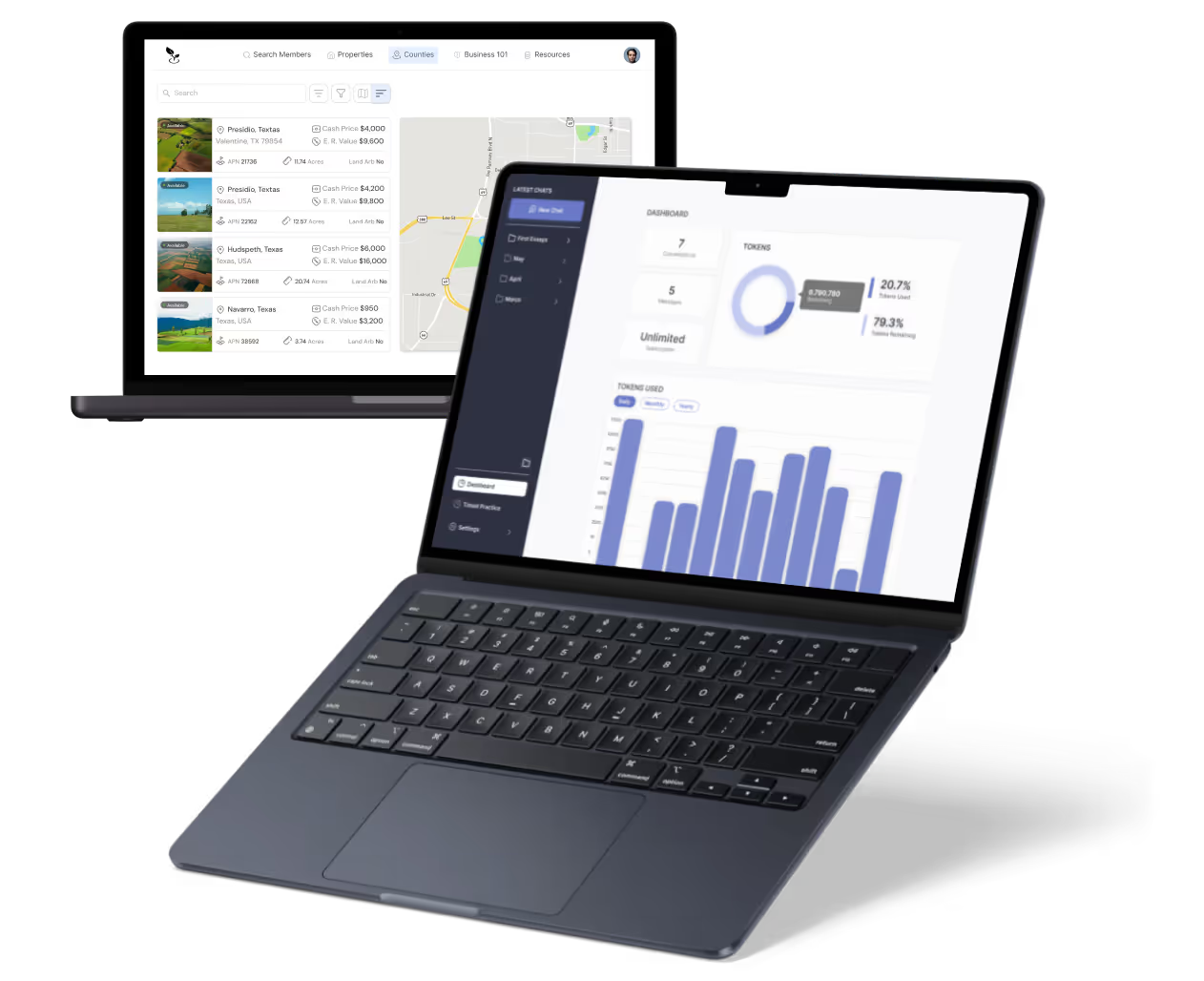
A SaaS feedback portal needs a submission form, a public or team-visible list of submitted feedback, an upvoting system, status labels, an admin triage panel, and a notification system that closes the loop with submitters.
Feedback portals fail when they become one-way channels. Users submit ideas and never hear what happened to them. The features that matter most are the ones that communicate back to users, not just the ones that collect from them.
- Submission form: a structured form where users describe their request with a title, description, category tag, and optional screenshot or attachment.
- Feedback list view: a browsable, searchable list of submitted items that users can filter by category, status, and vote count.
- Upvoting system: allows users to vote on existing feedback items so popular requests surface naturally, reducing duplicate submissions.
- Status labels: Admin-assigned labels such as Under Review, Planned, In Progress, and Shipped communicate the lifecycle of each feedback item.
- Admin triage panel: a dedicated view for product managers to review new submissions, merge duplicates, assign status, and add internal notes.
- Submitter notifications: automated emails or in-app notifications sent to submitters when the status of their feedback item changes.
Bubble app examples include product feedback tools and community voting platforms where Bubble's data model and workflow system handle the full submission-to-resolution cycle.
How Do You Build the Submission and Voting System?
Build submissions using a Feedback data type with fields for title, description, category, status, vote count, and submitter reference, then implement voting as a separate Vote data type that links users to specific feedback items to enforce one vote per user per item.
The submission form is straightforward. Voting deduplication is the technical challenge. Bubble does not natively prevent duplicate votes, so you must check for an existing vote record before creating a new one.
- Feedback data type: title, description, category, status, vote count integer, submitter user reference, created date, and last updated date.
- Vote data type: feedback item reference and voter user reference, with a unique constraint enforced by a pre-creation check in the workflow.
- Vote creation workflow: before creating a Vote record, search for an existing Vote record matching the current user and feedback item. Only create the new vote if no match is found.
- Vote count update: after creating a Vote record, increment the vote count field on the associated Feedback record using a backend workflow to maintain an accurate tally.
- Unvote logic: allow users to remove their vote by deleting their Vote record and decrementing the feedback item's vote count, then updating the UI to reflect the change.
Bubble's security model applies to vote integrity. Configure privacy rules so users can only create Vote records for themselves and can only delete their own vote records, preventing vote manipulation.
How Do You Build the Admin Triage Panel?
Build the admin triage panel as a dedicated page accessible only to users with an Admin or Product Manager role, displaying new submissions in priority order with actions to change status, merge duplicates, add internal notes, and trigger submitter notifications.
The triage panel is where feedback becomes product decisions. A poorly designed triage view creates friction for the people who most need to use the portal, reducing its value for everyone.
- Admin role gate: restrict the triage page to users with admin or product manager roles using Bubble's privacy rules and conditional page redirects.
- New submissions queue: a filtered view showing only items with a status of New, sorted by submission date so the team processes the oldest items first.
- Status change workflow: a dropdown on each item that allows the admin to change the status, triggering a backend workflow that updates the record and optionally notifies the submitter.
- Duplicate merge: a workflow that merges vote counts from one feedback item into another and marks the original as a duplicate, consolidating related requests.
- Internal notes field: a private notes field visible only to admin users, allowing the product team to annotate items with context, links, and decisions without surfacing them to submitters.
Review Bubble pricing plans when planning notification workflows. Email notifications triggered by status changes count against Bubble's workflow action limits at lower plan tiers, which matters for active feedback portals.
How Do You Structure Status Tracking and Closed-Loop Communication?
Structure status tracking by defining a fixed set of status values that represent your product team's actual workflow stages, then automating submitter notifications at each status transition so users know their feedback is being acted on without manual follow-up.
The status system is the feedback portal's trust mechanism. Users submit feedback because they believe it might influence the product. Status updates are the evidence that their belief was correct.
- Status vocabulary: define 4-6 status values that match your team's actual process, such as New, Under Review, Planned, In Development, Shipped, and Not Planned.
- Status transition workflows: backend workflows triggered by status changes that send email notifications to the original submitter and anyone who upvoted the item.
- Status changelog: a log of status changes on each feedback item so admins can see the history of how an item progressed through the pipeline.
- Shipped announcements: when a feedback item reaches Shipped status, consider a broader notification to all users who voted on it rather than just the submitter.
- Not Planned rationale: when declining feedback, include an optional rationale field that admins can fill in to explain the decision, which reduces repeat submissions for the same request.
How Do You Integrate a Feedback Portal with External Planning Tools?
Integrate the feedback portal with external tools by using Bubble's API connector to push high-priority or status-changed feedback items to project management platforms such as Jira, Linear, or Notion when specific workflow conditions are met.
Most product teams track actual development work in a separate planning tool. The feedback portal does not need to replace it. A targeted integration that pushes selected feedback into your planning tool closes the gap between user input and delivery.
- Jira or Linear integration: use Bubble's API connector to create a task or issue in your project management tool when an admin marks a feedback item as Planned or In Development.
- Webhook trigger: set up a backend workflow that fires a webhook to an external automation tool such as Zapier when a feedback item reaches a defined status threshold.
- Bidirectional status sync: for teams that want development status reflected back in the feedback portal, configure a Bubble API endpoint that external tools can call to update the feedback item's status when a related task is resolved.
- Slack notifications for the product team: send a Slack message to a product channel when a new submission exceeds a vote threshold, surfacing high-demand requests without the team needing to check the portal manually.
Bubble's capabilities and limitations are relevant for integrations because bidirectional syncs, real-time webhooks, and complex API response handling require careful API connector configuration that goes beyond Bubble's standard plugin interactions.
How Much Does It Cost to Build a SaaS Feedback Portal on Bubble?
Building a SaaS feedback portal on Bubble costs between $8,000 and $22,000 depending on voting mechanics, admin triage complexity, notification workflows, and whether external planning tool integration is required.
Feedback portals are operationally simple to build but require careful UX design to be genuinely used. The product team's engagement with the triage panel determines whether the portal generates value or becomes another ignored inbox.
- Simple feedback board with submission form, public voting, basic status labels, and submitter email notifications: $8,000 to $12,000.
- Full feedback platform with duplicate merging, admin triage panel, multi-channel notifications, external tool integration, and analytics on feedback trends: $16,000 to $22,000.
- Bubble starter plan: adequate for small internal feedback portals; public-facing portals with active user bases should evaluate the growth plan for workflow capacity.
- Maintenance and iteration: feedback portals typically require one sprint per quarter to add new categories, adjust status workflows, and update notification templates.
What Are the Limitations of Building a Feedback Portal on Bubble?
Key limitations include the manual implementation required for vote deduplication, the absence of native duplicate detection for similar submissions, performance constraints with very large feedback volumes, and limited rich text formatting in submission forms.
Bubble's scalability ceiling matters for feedback portals at consumer SaaS scale where thousands of users are actively submitting and voting. The vote count update workflow on heavily trafficked items can create database write contention.
- Vote deduplication is manual: Bubble does not natively prevent duplicate votes. The pre-creation check workflow approach works reliably at moderate volumes but adds latency to the vote action.
- No AI duplicate detection: identifying when two feedback submissions describe the same request requires manual admin review. Automated semantic similarity detection is not a native Bubble feature.
- Rich text in submissions: Bubble's standard input fields do not support formatted text. Users who want to submit detailed feedback with formatted lists or code snippets need a rich text plugin.
- Large feedback volume performance: portals with tens of thousands of submissions require pagination and optimized search constraints to maintain responsive load times.
Bubble pros and cons favor feedback portals for growing SaaS products with engaged user bases where the core mechanics of submission, voting, and status tracking cover the full required scope. For enterprise feedback management with AI-powered categorization or deep analytics, Bubble alternatives with purpose-built feedback infrastructure are worth evaluating.
Want to Build a SaaS Feedback Portal on Bubble?
A feedback portal that closes the loop between user input and product decisions is a competitive advantage. Most SaaS products either ignore feedback or collect it without acting on it. Building the right system turns both problems into trust.
LOW/CODE Agency is the AI product development partner built for SMBs. We build and ship web apps, mobile apps, chatbots, RAG systems, and AI agents — end to end, without the enterprise overhead. We handle submission architecture, voting deduplication, admin triage workflows, and external tool integrations as one complete engagement.
- Submission and data architecture: Feedback and Vote data types, deduplication logic, category taxonomy, and status value definition.
- Voting system build: vote creation with deduplication check, vote count maintenance, unvote workflow, and UI state management.
- Admin triage panel: new submissions queue, status change workflows, duplicate merge, internal notes, and notification triggers.
- Closed-loop notifications: email and in-app notifications for status changes, vote threshold alerts for the product team, and Shipped announcements to voters.
- External tool integration: Jira, Linear, or Notion connection via API connector for pushing planned items into your development workflow.
- Feedback analytics: trend views showing submission volume, category distribution, and vote activity over time for product planning context.
We have delivered 450+ products for clients including Zapier and Sotheby's. Bubble development services cover feedback portal builds from data architecture to production deployment; most feedback portal engagements start around $10,000 USD.
Related Articles
Last updated on
September 28, 2026
.

Jesus is a visionary entrepreneur and tech expert. After nearly a decade working in web development, he founded LOW/CODE Agency to help businesses optimize their operations through custom software solutions.


FAQs
Can you build a SaaS feedback portal with Bubble?
How do you build a feature request submission system in Bubble?
How do you implement upvoting for feature requests in Bubble?
How do you build a public product roadmap in Bubble?
How do you manage feedback internally in a Bubble feedback portal?
What notifications should a Bubble feedback portal send to users?
Related Articles

Comparison
Glide
Bubble
Bubble vs Glide | 10 Factors to Decide the Best One
Compare Bubble vs Glide across 10 key factors, including use cases, backend needs, scalability, pricing, limitations, and which platform fits your app goals.
Bubble
How to Build a Donor Management App with Bubble
Create a donation platform with Bubble no coding required. Accept donations, manage campaigns, and engage donors step-by-step fast.

Bubble
How to Build a Vendor Management App with Bubble
Streamline vendor relationships with Bubble. Build a no-code vendor management app step-by-step track contracts, payments & performance fast.

Bubble
Best Bubble Agency for MVP Development in 2026 (7 Top Picks)
Looking for the best Bubble agency for MVP development? Here are 7 vetted agencies that ship fast, scalable Bubble MVPs in 2026.

Why customers trust us for no-code development


