

Build a SaaS Admin Dashboard with Bubble
10 min
read
Learn how to build a SaaS admin dashboard with Bubble. Manage users, view metrics, and control your app's backend — all built visually without code.

Every SaaS product needs two products: the customer-facing application and the internal admin dashboard your team uses to manage it. The admin dashboard is often built last and under-resourced. Bubble makes building a production-grade admin dashboard fast enough that there is no reason to skip it.
This guide covers how to build a SaaS admin dashboard with Bubble: the features your team needs, the data architecture, access control, reporting views, and how to build an admin layer that scales with your customer base.
Key Takeaways
- A Bubble admin dashboard gives your team real-time visibility into customers, subscriptions, usage, and support cases without building a separate internal tool.
- Admin dashboards require their own access control: only specific internal users should access the admin layer, configure this with a separate admin role and privacy rules.
- Real-time data views, search, and filtering are Bubble's strength in admin tooling, list views with dynamic filters and bulk actions are achievable without custom code.
- An admin dashboard MVP on Bubble takes 3-6 weeks and costs between $8,000 and $20,000 as a standalone build or as part of a full SaaS product.
- Internal tools on Bubble carry the same vendor lock-in as customer-facing products, all admin workflows and reporting logic live inside the platform.

What Features Does a SaaS Admin Dashboard on Bubble Need?
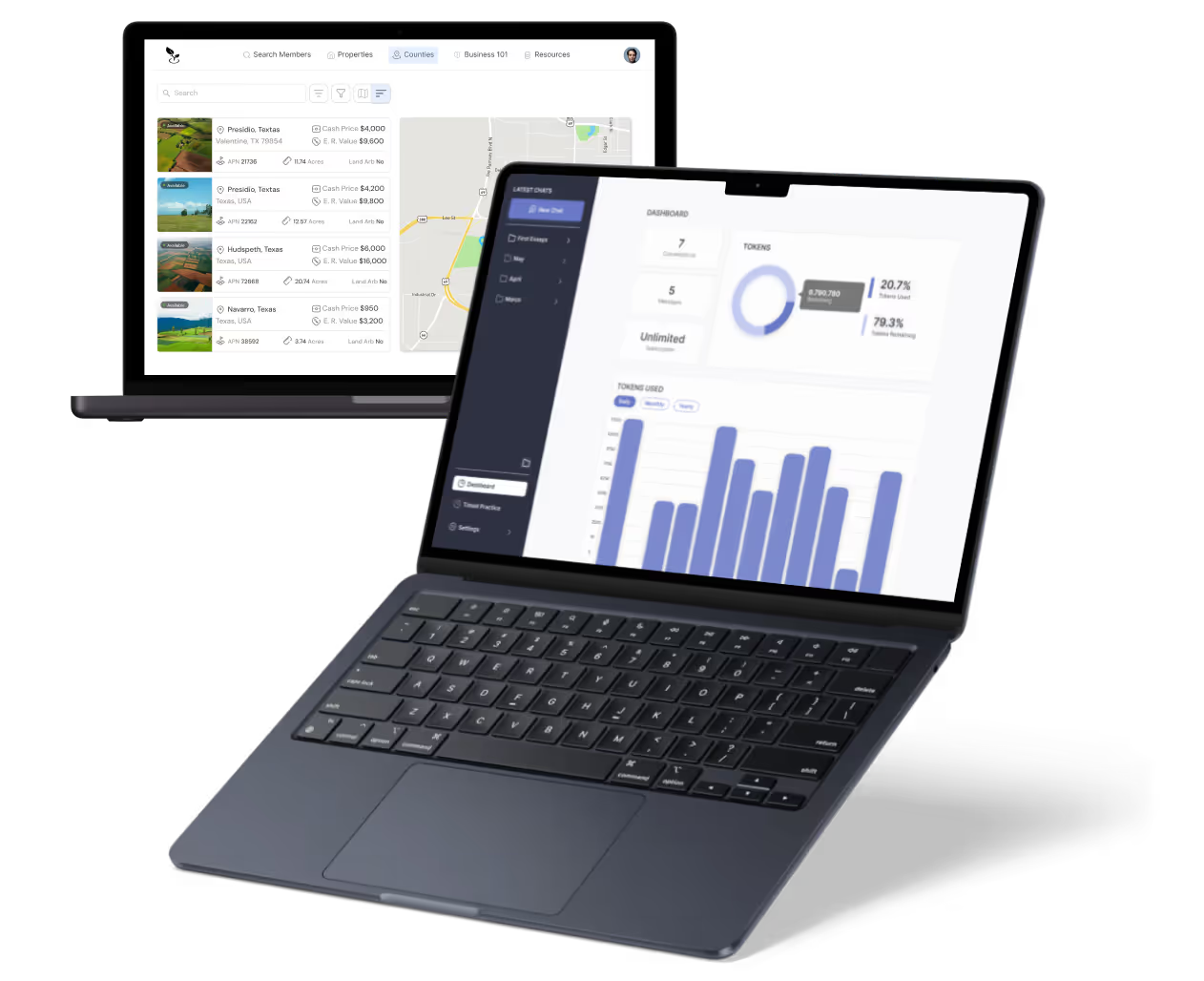
A SaaS admin dashboard needs customer management, subscription and plan visibility, usage reporting, account actions, support tooling, and system health monitoring.
The exact features depend on your SaaS product, but the admin layer always serves the same jobs: understand what customers are doing, manage their accounts, and resolve their problems without writing manual database queries.
- Customer list and search lets your team find any account by name, email, plan, signup date, or usage status within seconds.
- Account detail views show everything about a specific customer, profile, subscription, usage, activity log, and support history in one screen.
- Subscription management lets admins upgrade, downgrade, extend trials, apply credits, or cancel subscriptions on behalf of customers.
- Usage reporting shows current usage against plan limits for each customer, with filters to identify accounts near their limit or in violation.
- Bulk actions allow your team to send emails, apply plan changes, or flag accounts across a filtered set of customers at once.
- System metrics show total active users, MRR, churn, new signups, and trial conversion rates for business health monitoring.
- Support action log records every admin action taken on a customer account with the team member who took it and a timestamp.
Bubble app examples of internal admin tools show how customer management, reporting, and bulk operations are built in production admin dashboards.
How Do You Control Admin Access in a Bubble SaaS Dashboard?
Control admin access by creating a separate Admin role on the User data type, then restricting all admin pages and workflows to users where this role is confirmed via server-side conditions.
Admin dashboards contain every customer's data. A configuration error that exposes admin pages to regular users is a serious data incident. Access control for the admin layer must be enforced at the workflow level, not just the UI level.
- Admin role field: add an is_admin boolean or an admin role value to the User data type. Never rely on URL structure or navigation to restrict admin access.
- Page-level redirect: add a workflow on every admin page load that redirects non-admin users immediately if
Current User's is_admin is not true. - Server-side condition on all admin actions: wrap every admin workflow trigger with a condition that checks admin role before executing. A non-admin user must not be able to trigger admin actions via workarounds.
- Separate admin login or environment: consider using a separate Bubble page or subdomain prefix for admin access to reduce accidental exposure risk.
- Audit log of admin actions: every action taken on a customer account by an admin should be logged with the admin's user ID, action type, target record, and timestamp.
Bubble's security model covers the privacy rule and server-side condition patterns that protect admin-only data from unauthorized access.
How Do You Build Customer Search and Filtering in a Bubble Admin Dashboard?
Build customer search and filtering using Bubble's search and filter operators on a repeating group, with input elements that update the search constraints dynamically as the admin types.
The most-used feature in any admin dashboard is the customer search. An admin who has to scroll through a list of 1,000 customers to find one account will quickly lose trust in the tool. Dynamic filtering is not optional.
- Text search input: a single search input that filters customer records by name, email, or company using Bubble's "contains keyword" operator.
- Plan filter dropdown: a dropdown to filter customers by subscription plan, Free, Trial, Pro, Enterprise. Updates the repeating group in real time.
- Status filter: filter by account status, active, trial, suspended, cancelled. Essential for identifying accounts requiring attention.
- Signup date range: date picker inputs that filter customers who signed up within a specified range for cohort analysis.
- Usage filter: filter customers by usage level, near limit, over limit, or low usage. Helps identify upgrade opportunities and at-risk accounts.
- Column sorting: allow admins to sort the customer list by signup date, MRR, usage, or last active date to surface actionable patterns.
Design the filtering system around the jobs your team actually does, not every possible combination. Five well-designed filters outperform twenty options that are rarely used.
How Do You Build a Reporting View in a Bubble Admin Dashboard?
Build reporting views using Bubble's aggregation capabilities on data types, displayed through charts, metric cards, and dynamic lists that update in real time as the underlying data changes.
Admin reporting does not need to be a full business intelligence tool. It needs to answer the specific questions your team asks every day, how many active subscribers, what is the trial conversion rate, who is at risk of churning.
- Metric cards: display key numbers, total active subscribers, MRR, active trials, new signups this month, as prominent numeric displays at the top of the admin home screen.
- Subscription breakdown: a chart or list showing the distribution of customers across plan tiers, updated live as plan changes occur.
- Signup trend: a line or bar chart showing daily or weekly new registrations over a rolling time period.
- Trial conversion tracker: a list or metric showing trials started, trials converted, and trials expired within a selected time range.
- Usage heat map or list: a ranked list of customers by usage, showing who is getting the most and least value from the product.
Review Bubble pricing plans when planning your reporting requirements, some Bubble plans have API call limits that affect how frequently you can fetch aggregated reporting data.
What Does the Development Process Look Like for a Bubble Admin Dashboard?
The development process runs four phases: requirements mapping, access control and foundation, core admin views, and reporting with bulk actions.
Admin dashboards are best built alongside the customer-facing product, not after it. Building the admin layer after the customer product means retrofitting visibility into data structures that were not designed for it.
- Phase 1: Requirements mapping: define what your team needs to see and do in the admin dashboard. List every question the admin needs to answer and every action they need to take.
- Phase 2: Access control and foundation: admin role setup, page-level access restrictions, server-side guards, and audit log data type configuration.
- Phase 3: Core admin views: customer list with search and filtering, account detail pages, and subscription management actions.
- Phase 4: Reporting and bulk actions: metric cards, charts, trend views, and multi-select bulk operations for common team workflows.
An admin dashboard built as a standalone project takes 3-6 weeks. Built as part of a full SaaS product build, the admin layer adds 2-4 weeks to the total timeline.
How Much Does It Cost to Build a SaaS Admin Dashboard on Bubble?
Building a SaaS admin dashboard on Bubble costs between $8,000 and $20,000 as a standalone build, or $10,000 to $25,000 additional when added to a full SaaS product engagement.
Admin dashboards are not glamorous, but they save engineering time, reduce support costs, and give founders visibility into business health. The ROI is typically immediate.
- Basic admin dashboard with customer list, account detail, and plan management: $8,000 to $12,000.
- Full admin platform with search, filtering, reporting charts, bulk actions, and audit logs: $15,000 to $20,000.
- As part of a full SaaS build: admin tooling adds $10,000 to $25,000 to a full SaaS engagement depending on reporting depth.
- Ongoing maintenance: admin dashboards evolve with the product. Budget 2-4 days per quarter for adding new views as the SaaS grows.
The alternative, writing ad-hoc database queries or using a separate tool like Retool, typically costs more in aggregate developer time than a well-built Bubble admin dashboard.
What Are the Limitations of Building an Admin Dashboard on Bubble?
Key limitations include performance on large datasets, limited charting capabilities natively, the complexity of building truly real-time dashboards, and the challenge of supporting multiple admin roles with granular permissions.
Bubble's capabilities and limitations are particularly relevant for admin dashboards because they often need to query across large datasets, display aggregated metrics, and update frequently, all areas where Bubble has constraints.
- Large dataset performance: filtering and sorting across thousands of customer records slows down. Pagination and pre-aggregated summary fields help, but they require deliberate design.
- Native charting limitations: Bubble's built-in chart element is limited. Complex visualizations require ApexCharts or Chart.js plugins.
- Real-time data refresh: Bubble does not push database changes to open pages automatically. Admin dashboards that need live updates require polling or workarounds.
- Multi-admin role complexity: if different admin team members need different levels of access, support agents vs. billing admins vs. engineering admins, the role logic adds significant complexity.
Bubble's scalability ceiling affects admin dashboards earlier than customer-facing apps because admins regularly query unfiltered large datasets rather than scoped user-specific data.
When Does Bubble Make Sense for an Admin Dashboard?
Bubble makes sense for a SaaS admin dashboard when your customer base is under 50,000 accounts, your reporting needs are standard rather than deeply custom, and you want to avoid building a separate internal tool stack.
Bubble pros and cons favor internal tooling strongly, the speed and flexibility advantages matter more for admin dashboards than the scale limitations do for most SaaS products at early and growth stages.
- Early-stage SaaS products need admin visibility from day one. Building it in Bubble alongside the product is the most cost-effective approach.
- Teams without dedicated engineering resources for internal tooling benefit from Bubble's no-code speed to maintain and update the admin layer.
- SaaS products with Bubble frontends should always build their admin dashboard in Bubble too, it shares the data model and avoids API integration overhead.
- Products with moderate customer volumes up to tens of thousands of accounts will find Bubble's admin performance acceptable without optimization.
When customer volumes, reporting complexity, or multi-team admin requirements exceed what Bubble handles well, Bubble alternatives like Retool, Forest Admin, or a custom-built admin interface are worth evaluating.
Want to Build a SaaS Admin Dashboard on Bubble?
An admin dashboard is not optional infrastructure, it is the tool your team uses to manage customers, resolve problems, and understand business health. Building it late or building it poorly creates operational debt that slows growth.
LOW/CODE Agency is the AI product development partner built for SMBs. We build and ship web apps, mobile apps, chatbots, RAG systems, and AI agents — end to end, without the enterprise overhead. We design admin experiences that match how your team actually works, not generic CRUD interfaces.
- Requirements mapping: we work with your team to define every question you need to answer and every action you need to take from the admin layer.
- Access control architecture: admin role setup, page guards, server-side conditions, and audit logging built before any admin features.
- Customer management views: search, filtering, account detail, and subscription management actions your team will use every day.
- Reporting and metrics: metric cards, trend charts, subscription breakdowns, and usage views built around your specific business questions.
- Bulk operations: multi-select actions for common team workflows, mass emails, plan changes, trial extensions, and account flags.
- Long-term admin evolution: we add views and reports as your SaaS grows and your team's operational needs change.
We have delivered 450+ products including internal tools for Medtronic and American Express. Bubble development services include full admin dashboard builds as standalone or combined SaaS engagements; most start around $10,000 USD.
Related Articles
Last updated on
September 28, 2026
.

Jesus is a visionary entrepreneur and tech expert. After nearly a decade working in web development, he founded LOW/CODE Agency to help businesses optimize their operations through custom software solutions.


FAQs
Can you build a SaaS admin dashboard with Bubble?
How do you restrict admin dashboard access in Bubble?
What metrics should a SaaS admin dashboard include?
How do you build a user management table in a Bubble admin dashboard?
How do you display real-time data in a Bubble admin dashboard?
Can you build a multi-section admin dashboard in Bubble?
Related Articles

Bubble
How to Build a Partner Portal App with Bubble
Build a partner portal with Bubble. Give resellers and partners a branded hub for deals, resources, and support — no code, fast to launch.

Bubble
How to Build a Wealth Management Platform with Bubble
Launch a wealth management platform with Bubble without coding. Track portfolios, manage clients & visualize assets step-by-step using no-code.

Bubble
How to Build a Short-Term Rental Management App with Bubble
Build a short-term rental management app in Bubble without coding. Sync bookings, manage guests, and automate pricing with this no-code guide.

Bubble
How to Build a D2C Brand Store App with Bubble
Build a D2C brand store with Bubble. Sell direct, own your customer data, and control the experience — without Shopify's limitations or fees.


Why customers trust us for no-code development


