

How to Build a Commercial Real Estate Management App with Bubble
15 min
read
Create a cold chain management app with Bubble without coding. Monitor temperature, track shipments, and ensure compliance step-by-step.


Building a commercial real estate management app with Bubble gives property managers and owners a single platform to track leases, automate rent billing, reconcile CAM charges, and monitor portfolio performance. The alternative is six-figure enterprise CRE software.
Commercial leases carry escalation clauses, CAM reconciliation obligations, renewal option windows, and co-tenancy requirements. Managing those in spreadsheets is not a workflow problem. It is a liability. Bubble handles the data relationships and automation that make CRE management defensible at scale.
Key Takeaways
- Core purpose: A commercial real estate management app tracks leases, tenants, rent schedules, CAM charges, maintenance, and portfolio performance in one system.
- Key features: Lease management, rent roll reporting, CAM reconciliation, tenant portal, and maintenance routing are the five MVP pillars.
- Data model: Property, Lease, Tenant, Rent Schedule, and CAM Expense are the five primary data types.
- Build time: 8-12 weeks solo; 5-7 weeks with an agency.
- Cost: Agency builds run $15,000-$40,000 depending on lease complexity and reporting requirements.
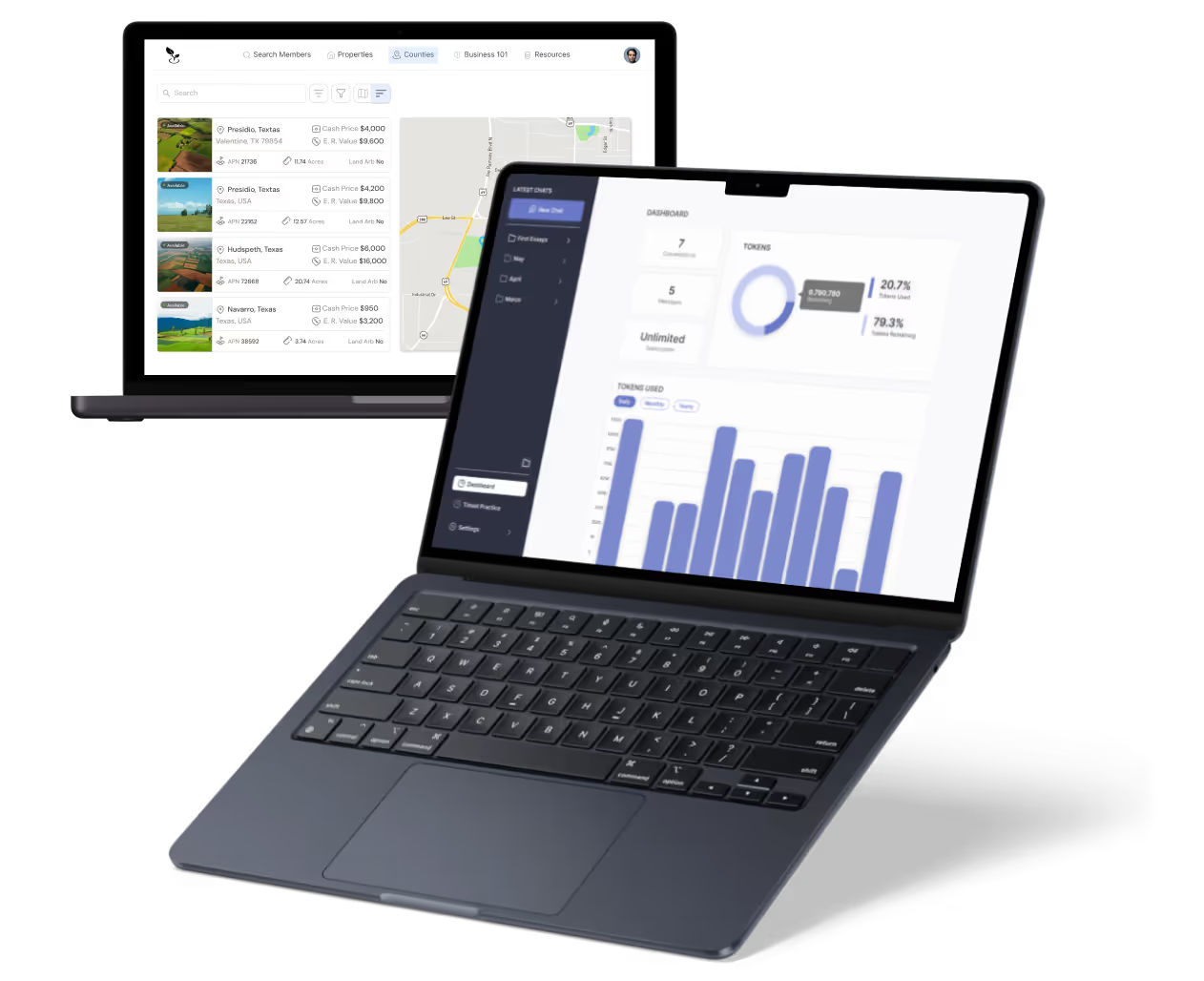

What Is a Commercial Real Estate Management App — and Why Build It with Bubble?
A commercial real estate management app centralizes lease administration, rent collection, CAM tracking, tenant communications, and portfolio reporting for office, retail, industrial, and mixed-use properties.
The problem with spreadsheets is not that they cannot store lease data. They cannot enforce escalation logic, trigger renewal alerts, or automate CAM reconciliation statements without someone manually running the calculations.
- Relational lease data: Bubble's database handles the multi-level relationships between Properties, Units, Leases, Tenants, and Rent Schedules that commercial portfolios require.
- Automated billing cycles: Scheduled backend workflows run rent invoicing on a fixed schedule, apply escalation clauses automatically, and flag overdue payments without manual intervention.
- Role-based access: Tenants, property managers, asset managers, and owners each see the data relevant to their role. Privacy rules enforce this at the database level.
- CAM reconciliation: Bubble can store actual operating expense data and run annual CAM reconciliation calculations that generate statements for each tenant based on their proportionate share.
Before committing to Bubble for a complex CRE management platform, it is worth understanding Bubble's pros and cons, particularly around complex calculation workflows and the performance considerations for data-heavy reporting pages.
Bubble handles the CRE management use case well for portfolios up to several hundred units. At institutional scale with thousands of leases and complex financial integrations, evaluate whether the platform's query performance meets the reporting requirements.
What Features Should a Commercial Real Estate Management App Include?
The MVP needs to cover the lease administration cycle from lease execution through annual reconciliation. Every feature outside that core cycle is a candidate for version two.
Start with lease management and rent collection. Those two features deliver immediate operational value before any reporting or portal feature is built.
- Lease management: Store full lease terms including start and end dates, base rent, escalation type (fixed percentage, CPI, fixed dollar), escalation schedule, CAM inclusion terms, security deposit, and renewal option windows. Generate alerts at 90, 60, and 30 days before each renewal deadline.
- Rent roll reporting: A real-time rent roll display shows all units, current tenants, lease term, current base rent, CAM estimate, and lease expiration date. Export to CSV for owner and lender reporting.
- CAM charge tracking: Record actual operating expenses by category (insurance, taxes, maintenance, management) for each property. The annual reconciliation workflow calculates each tenant's proportionate share based on their leased square footage divided by total leasable area.
- Tenant portal: Tenants log in to view their current lease summary, payment history, pending invoices, and submitted maintenance requests. The portal also stores their lease document, amendments, and certificate of insurance on file.
- Rent collection: Stripe processes ACH and card payments directly from the tenant portal. Invoices are generated automatically by the monthly billing workflow and delivered via email. Payment records update the Rent Schedule in real time.
- Maintenance request routing: Tenants submit maintenance requests through their portal. Requests route to the property manager's maintenance queue and follow the standard triage-to-work-order workflow. Commercial tenants often need faster response SLAs than residential. Track response time in the request record.
- Document management: Leases, amendments, insurance certificates, operating expense reports, and estoppel certificates are stored in a categorized document library linked to the relevant Lease or Tenant record.
- Portfolio dashboard: Asset managers and owners see a summary view of all properties: occupancy rate, current NOI, upcoming lease expirations, and open maintenance issues. Designed for weekly review, not day-to-day management.
Defer the portfolio dashboard to version two. Property managers need the lease and billing features immediately. Asset managers can wait four weeks for a reporting dashboard.
How Do You Structure the Database for a Commercial Real Estate Management App in Bubble?
Seven data types cover the full commercial lease management workflow. The most critical relationship to design correctly is between Lease, Rent Schedule, and Payment. These three types drive the entire financial management layer.
Before building any UI, create all option sets: Property Type, Lease Type, Escalation Type, Payment Status, CAM Category, and User Role.
- Property: Fields include Name (text), Address (text), Total Square Footage (number), Property Type (option set: Office/Retail/Industrial/Mixed-Use), Owner (User), and Units (list of Unit).
- Unit: Fields include Property (Property), Suite Number (text), Square Footage (number), Unit Type (option set: Office/Retail/Storage), and Current Lease (Lease).
- Lease: Fields include Unit (Unit), Tenant (Tenant), Start Date (date), End Date (date), Base Rent (number - monthly), Escalation Type (option set: Fixed Percent/CPI/Fixed Dollar/None), Escalation Rate (number), Escalation Anniversary (date), CAM Included (yes/no), CAM Estimate (number - monthly), Security Deposit (number), Renewal Options (text), and Status (option set: Active/Expired/Terminated/Pending).
- Rent Schedule: Fields include Lease (Lease), Period Start (date), Period End (date), Base Rent Amount (number), CAM Estimate (number), Total Amount (number), and Status (option set: Pending/Invoiced/Paid/Overdue). One Rent Schedule record per billing period per lease.
- CAM Expense: Fields include Property (Property), Category (option set: Insurance/Taxes/Maintenance/Management/Utilities/Other), Amount (number), Expense Date (date), Vendor (text), and Notes (text).
- Tenant: Fields include Company Name (text), Primary Contact (text), Email (text), Phone (text), Current Leases (list of Lease), and Active (yes/no). Tenant is separate from the User data type to allow for multiple contacts per tenant company.
- Payment: Fields include Rent Schedule (Rent Schedule), Amount (number), Payment Date (date), Stripe Charge ID (text), and Status (option set: Pending/Completed/Failed/Refunded).
For large portfolios where CAM reconciliation queries will run across hundreds of expense records, reviewing the best backends for Bubble helps determine whether Bubble's native database handles the query load or whether an external data source improves performance.
How Do You Build the Core Workflows for a Commercial Real Estate Management App in Bubble?
CRE management workflows split between scheduled automation (billing cycles, escalation, alerts) and event-driven transactions (payments, document uploads, maintenance requests). The scheduled workflows are the highest-value features in the entire app.
Build and test each scheduled workflow independently in Bubble's Backend Workflows tab before enabling them on any live lease data.
- Lease setup and rent schedule generation: When a property manager creates a new Lease record and sets it to Active, a workflow iterates through all billing periods from the start date to the end date and creates one Rent Schedule record per period. This generates the complete billing calendar for the lease's full term.
- Monthly rent invoicing: A scheduled backend workflow runs on the first day of each month. It searches for all Rent Schedule records with Period Start equal to today and Status equal to Pending. For each, it creates a Stripe invoice, sends an invoice email to the tenant via SendGrid, and updates the Rent Schedule Status to Invoiced.
- CAM annual reconciliation: At the end of each fiscal year, a workflow aggregates all CAM Expense records for the property, calculates each tenant's proportionate share (tenant SF divided by total leasable SF multiplied by total CAM expenses), compares this to the CAM estimates already billed, and generates a reconciliation statement PDF via Documint showing the balance due or credit owed.
- Lease expiration alerts: A daily scheduled workflow searches for all Active Leases where End Date is within 90 days of today. It sends an alert email to the property manager and creates an alert record in the system. The same workflow fires again at 60 and 30 days.
- Annual rent escalation: On each Lease's Escalation Anniversary date, a scheduled workflow checks the Escalation Type and calculates the new base rent (for fixed percent: current rent multiplied by 1 plus escalation rate; for CPI: current rent multiplied by current CPI index). It creates new Rent Schedule records from the anniversary date forward with the updated base rent.
- Tenant portal access: When a tenant logs in, their dashboard queries Rent Schedule records where Lease's Tenant = Current User, filtered to the current period and the past 12 months. Their lease document displays from a File field on the Lease record.
- Document upload and linking: A property manager uploads a document through the document management section. A workflow creates a Document record with the file, category, and metadata. If the document type is a lease amendment, the workflow also updates the linked Lease record's amendment history.
The rent escalation workflow is the most error-prone automated workflow in a CRE app. Test it with a lease that has a known escalation event. Calculate the expected result manually and verify the workflow output matches.
What Security and Data Requirements Apply to a Commercial Real Estate Management App?
Commercial lease data is confidential business information. Tenant rent amounts, CAM charges, and lease terms are sensitive data that tenants do not want disclosed to other tenants or the general public.
Privacy rules must enforce strict data separation between tenants who occupy units in the same building.
- Tenant access: Privacy rules on Lease, Rent Schedule, and Payment records restrict tenants to records linked to their own company. Tenants in the same building cannot see each other's rent or lease terms.
- Asset manager access: Owners and asset managers see portfolio-level data including rent roll, occupancy, and NOI. They access this through a dedicated dashboard that aggregates data without exposing individual tenant financial details in a per-record view.
- Property manager access: Property managers see all records for properties they manage. Add a Managed Properties (list of Property) field to the manager's User record and use it as a filter condition in all privacy rules for that role.
- Lease document security: Lease PDFs and amendment documents are stored as private files. They are never publicly accessible by URL. File retrieval requires an authenticated session and a privacy rule that confirms the requesting user is the relevant tenant, property manager, or owner.
- Financial audit trail: Payment records are never deleted. If a payment is reversed or credited, create a new record with the adjustment rather than modifying the original payment record.
- Certificate of insurance tracking: COI documents have expiration dates and must be renewed annually. Store COI files with an Expiration Date field and run a scheduled workflow that alerts property managers when a tenant's COI is within 30 days of expiring.
What Plugins and Integrations Does a Commercial Real Estate Management App Need?
The CRE management plugin stack requires more financial integration depth than residential management apps, specifically around invoice generation, electronic lease execution, and accounting sync.
Prioritize Stripe and DocuSign or SignWell above all other integrations. Without them, the core billing and lease execution workflows do not function.
- Stripe plugin (official): Handles ACH and card payment collection from the tenant portal. For commercial tenants, ACH is preferred due to lower transaction fees on large rent amounts. Configure Stripe for both payment method types from day one.
- SendGrid (API Connector): Delivers rent invoices, CAM reconciliation statements, lease expiration alerts, and maintenance request notifications. Use dynamic templates for each email type. Rent invoices and CAM statements have different formats.
- DocuSign or SignWell (API Connector): Electronic lease execution and amendment signing. Commercial leases require legally binding signatures from both parties. SignWell is lower cost for lower-volume use cases; DocuSign is preferred for institutional landlords.
- Documint (API Connector): Generates formatted rent statement PDFs and CAM reconciliation statements. The CAM reconciliation output needs to show the calculation clearly. Template design matters here.
- QuickBooks (via Zapier or direct API): Syncs rent payment records and operating expense entries to the accounting system the landlord or asset manager uses for financial reporting. Zapier covers the integration without direct API development.
- Google Maps plugin: Property location display on the portfolio dashboard and in the tenant portal for new tenants finding the building. Also useful for service area visualization when filtering vendors for maintenance work orders.
- Bubble API Connector - CoStar/LoopNet: Market comparable data integration for asset managers who need rent comp analysis within the platform. Optional advanced feature, typically deferred to version two unless the client is an active broker or asset manager.
How Long Does It Take and What Does It Cost to Build a Commercial Real Estate Management App with Bubble?
Commercial real estate management apps are the most complex property management builds in the Bubble ecosystem. The lease administration logic, CAM reconciliation calculations, and multi-role reporting requirements add meaningful depth to what appears to be a straightforward CRUD application.
Scope the CAM reconciliation feature explicitly before estimating. It is the single biggest complexity driver and the most frequently underestimated feature in CRE management builds.
- Solo builder - MVP: 8-12 weeks at 25+ hours per week. Core scope: lease management, rent schedule generation, monthly invoicing with Stripe, tenant portal, and document management. CAM reconciliation adds 2-3 weeks.
- Agency build - MVP: 5-7 weeks for a production-ready version with full QA, privacy rule audit, and tested billing automation. CAM reconciliation included in this estimate.
- Reporting and analytics complexity: A full portfolio dashboard with NOI calculations, occupancy trends, and lease expiration forecasting adds 2-3 weeks regardless of builder. Plan it explicitly and separate it from lease administration.
- Bubble plan: The Growth plan ($119/month) is the minimum for scheduled backend workflows. For multi-developer teams building a CRE platform, the Team plan ($349/month) is required.
- Agency cost range: $15,000-$40,000. The lower end delivers lease administration, Stripe billing, and tenant portal. The upper end includes CAM reconciliation, DocuSign integration, QuickBooks sync, and portfolio analytics.
- Ongoing costs: Bubble hosting ($119-$349/month) plus Stripe fees (ACH at 0.8% capped at $5, card at 2.9% + 30 cents) plus DocuSign or SignWell subscription ($10-$40/month per user) plus SendGrid.
Review Bubble's pricing plans and map each plan's capabilities against your specific workflow requirements before finalizing the technical scope. Scheduled backend workflows, which the billing and alert system depends on entirely, are plan-gated.
The fastest path to a deployable CRE management tool is to build lease management and rent invoicing first, validate the billing accuracy with live leases, and add CAM reconciliation and portfolio analytics in a planned second phase.
Conclusion
Bubble handles commercial real estate management well because its workflow engine maps directly to the scheduled billing, escalation, and alert logic that makes CRE administration defensible at scale.
The CAM reconciliation feature is where most builds encounter unexpected complexity. Scope it explicitly, build it last, and test it against real operating expense data before declaring the MVP complete.
Need Help Building Your Commercial Real Estate App on Bubble?
CRE management apps combine financial automation, complex lease logic, and multi-role access. Poor architecture decisions are quickly exposed once real lease data enters the system.
An escalation workflow that calculates incorrectly, or a tenant with access to another tenant's rent schedule, creates both financial and legal exposure.
At LOW/CODE Agency, we started as builders and that has not changed. Today we build AI-powered products — web apps, mobile apps, RAG systems, chatbots, and AI agents — specifically for SMBs that want real software, not a SaaS subscription. We scope the architecture, engineer the workflows, and stay involved through launch and beyond.
- Data architecture: We design your data types, option sets, and privacy rules before writing a single element on the canvas.
- Workflow engineering: We build backend workflows, scheduled jobs, and API integrations with proper logic and error handling.
- Plugin configuration: We select and configure the right Bubble plugins for your feature set without unnecessary bloat.
- Role-based access: We implement privacy rules at the database level, not just conditional UI visibility.
- Integration setup: We connect your Bubble app to Stripe, SendGrid, Twilio, and other services correctly from day one.
- Pre-launch testing: We test against real data before deployment so every workflow performs correctly under live conditions.
- Post-launch support: We stay involved after go-live to optimize as real usage data shapes the app.
We have built 350+ products for clients including Coca-Cola, American Express, Sotheby's, and Medtronic. We know exactly where Bubble builds fail and we address those problems before they surface.
Related Articles
- How to Build a Compliance Management App with Bubble
- How to Build a Community Management App with Bubble
- How to Build a Community Forum App with Bubble
- How to Build a Cold Chain Management App with Bubble
- How to Build a Coaching Platform App with Bubble
- How to Build a Co-living Management App with Bubble
Last updated on
September 24, 2026
.

Jesus is a visionary entrepreneur and tech expert. After nearly a decade working in web development, he founded LOW/CODE Agency to help businesses optimize their operations through custom software solutions.


FAQs
Can you build a cold chain management app without coding using Bubble?
How do you monitor temperature logs in a Bubble cold chain management app?
How do you set up temperature excursion alerts in Bubble?
How do you track cold chain shipments in Bubble?
How do you manage cold storage facility inventory in Bubble?
How do you generate cold chain compliance reports in Bubble?
Related Articles
Bubble
How to Build a Cold Chain Management App with Bubble
Build a coaching platform app with Bubble no coding needed. Onboard clients, schedule sessions, and track progress fast with no-code.

Bubble
How to Build a Quality Inspection App with Bubble
Build a quality inspection app in Bubble without coding. Log defects, track standards, and generate reports fast with this no-code step-by-step guide.

Bubble
How to Build a Consulting Management App with Bubble
Create a construction project management app with Bubble no coding. Track tasks, budgets, and teams step-by-step using no-code tools.

Bubble
How to Build a Microlearning Platform App with Bubble
Build a microlearning platform with Bubble no coding required. Deliver bite-sized lessons, track progress, and engage learners step-by-step.


Why customers trust us for no-code development


