

Build a Peer-to-Peer Marketplace App with Bubble
12 min
read
Learn how to build a peer-to-peer marketplace with Bubble. Enable user listings, messaging, and secure payments between buyers and sellers — no code needed.

Peer-to-peer marketplaces are built on a simple economic insight: most people have more of something than they need, and someone nearby needs exactly that. The model powers everything from car sharing to neighborhood lending to secondhand fashion. What makes P2P platforms distinct from business-to-consumer marketplaces is that both sides of every transaction are individuals, which creates unique trust, identity, and payment challenges. Building a P2P marketplace on Bubble lets you validate the asset or service category and community mechanics before committing to engineering at scale.
This guide covers how to build a peer-to-peer marketplace with Bubble: individual seller and buyer architecture, listing and discovery, trust and identity verification, peer payment flows, community features, and the safety and trust mechanics that make P2P platforms work between strangers.
Key Takeaways
- Bubble supports P2P marketplace architecture through individual user dual-role design (users can be both buyers and sellers), listing management, in-platform messaging, Stripe Connect for peer payments, and community trust features like ratings and profiles.
- Trust between individuals is harder than trust in a business: buyers purchasing from a verified company have institutional guarantees. Buyers purchasing from an individual need social and reputational signals. Building those signals in is the platform's primary job.
- Dual-role user architecture allows every user to be both a buyer and a seller simultaneously, which is essential for P2P platform network effects and inventory growth.
- A P2P marketplace MVP on Bubble takes 8-14 weeks and costs between $18,000 and $48,000 depending on asset category, identity verification requirements, and community feature depth.
- Community features drive retention: P2P platforms where users have identities, histories, and reputations retain more active members than those that treat every transaction as anonymous.

What Data Architecture Does a P2P Marketplace Need?
A P2P marketplace needs a unified User data type where each person can act as both buyer and seller, a Listing data type for supply-side content, a Transaction data type for peer payments, a Message data type for in-platform communication, and a Trust data type combining ratings, verifications, and review history.
The dual-role user model is the fundamental architectural difference between P2P and other marketplace types. Unlike two-sided marketplaces with discrete buyer and seller populations, P2P platforms treat every user as a potential participant on both sides simultaneously.
- User data type: profile photo, display name, bio, location (city or neighborhood level, not precise), member since date, verification badges, average rating as seller, average rating as buyer, and total completed transactions.
- Listing data type: seller reference, category, title, description, price or price type (fixed, negotiable, free), images, condition (for physical goods), location, status, and view count.
- Transaction data type: buyer reference, seller reference, listing reference, agreed price, payment intent ID, transaction status, and any escrow or hold period details.
- Message data type: sender reference, recipient reference, listing reference (optional), content, timestamp, and read status, supporting both listing-specific and general conversations.
- Review data type: reviewer reference, reviewed reference, transaction reference, role reviewed (as seller or buyer), rating, and review text.
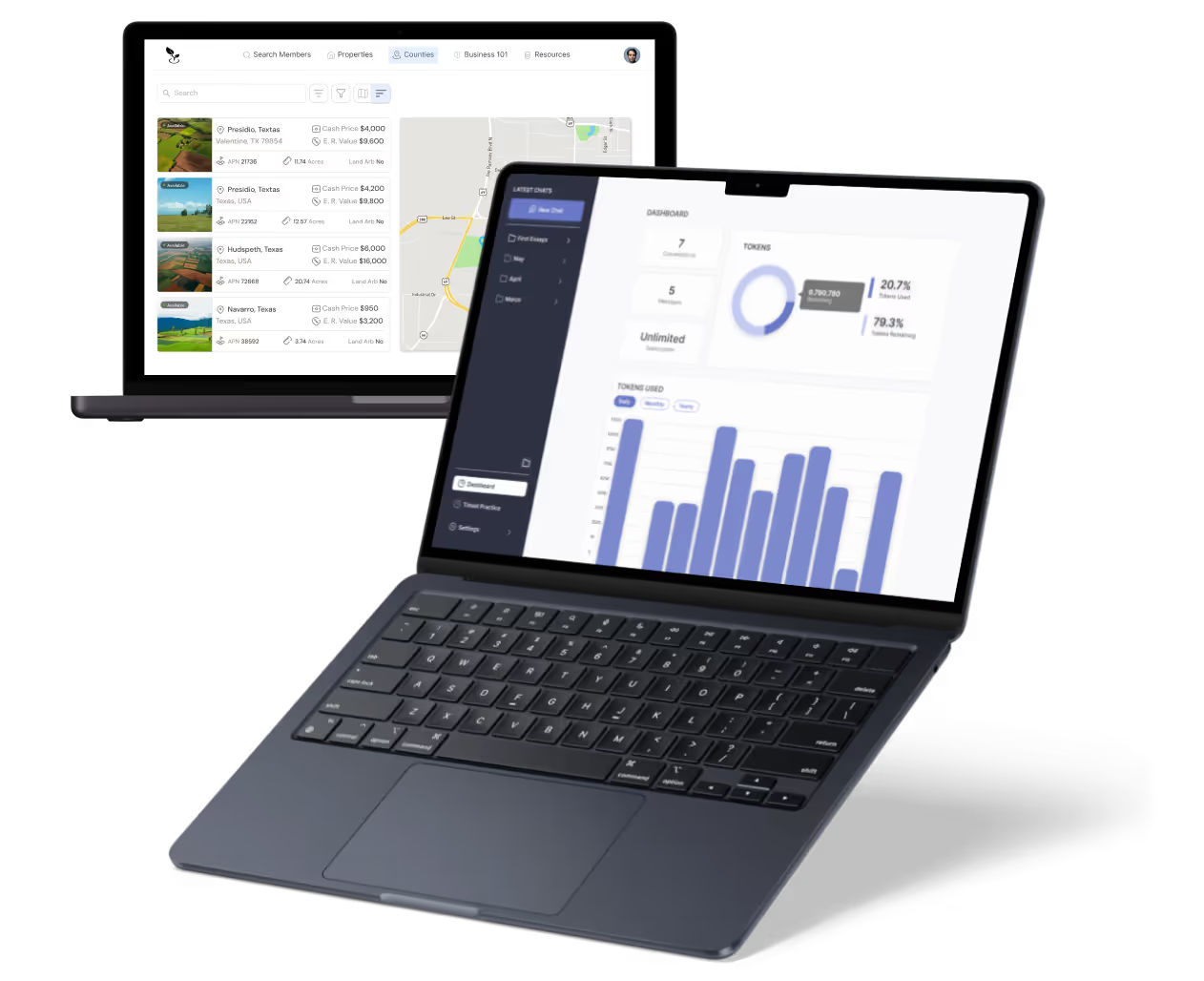
Bubble app examples include neighborhood lending platforms, secondhand goods networks, and peer service exchanges where Bubble's data model supports individual-to-individual transactions with community trust features.
How Do You Build Dual-Role User Profiles?
Build dual-role user profiles by storing all user information on a single User data type with separate fields for seller reputation and buyer reputation, and building profile views that adapt to display the relevant context based on whether the viewer is evaluating them as a potential seller or buyer.
The dual-role profile is the community identity layer of a P2P marketplace. A user's profile is their reputation, and a strong reputation is the currency that enables trust between strangers. Profile completeness and verification signal quality drive conversion at every stage of the transaction.
- Profile completeness indicators: a score or checklist that shows users what profile elements they are missing (photo, bio, verified email, verified phone, linked identity document) and why each matters.
- Seller view of profile: listing inventory, seller reviews and rating, total sales, and verification badges, displayed when someone views the profile in a selling context.
- Buyer view of profile: purchase history summary, buyer reviews and rating, and any relevant trust signals, displayed when a seller evaluates a potential buyer before confirming a transaction.
- Verification badges: visual indicators for verified email, verified phone, identity document verified, and social account linked, each earned by completing the relevant verification step.
- Member tenure display: the date the user joined the platform, shown on all profile views as a trust signal (longer tenure implies more established community history).
Bubble's security model is critical for P2P user data. Privacy rules must restrict access to sensitive profile fields (email, phone, precise location) so they are only visible to other users in specific contexts such as after a confirmed transaction, not to all platform members.
How Do You Build Identity Verification for P2P Transactions?
Build identity verification by integrating an identity document verification service such as Stripe Identity, Jumio, or Veriff via Bubble's API connector, requiring verification for sellers above a defined transaction value threshold and displaying verification status as a trust badge on their profile.
Identity verification in P2P marketplaces is where platform safety becomes tangible. A platform where anyone can list and sell with no identity signal attracts fraud. A platform where verification is mandatory but friction-heavy loses supply. The design must balance trust creation with onboarding conversion.
- Verification tier system: define which categories or transaction values require identity verification (for example, all transactions above $100 or all vehicle and property listings) versus which allow unverified participation.
- Stripe Identity integration: use the Stripe Identity API via Bubble's API connector to send users through a hosted document and selfie verification flow, receiving a verified status and ID token on completion.
- Verification status storage: store the verification status and provider reference on the User data type, updating automatically when the verification webhook is received.
- Profile badge display: show a verified identity badge on listings and profiles for users who have completed verification, prominently enough that unverified sellers are visibly differentiated.
- Category-based verification gates: configure specific listing categories to require verified status before a listing can be published, enforced as a workflow check on listing creation rather than just a UI advisory.
Review Bubble pricing plans when planning verification workflows. Each verification API call to Stripe Identity or a comparable service has a per-verification cost that must be factored into the platform's unit economics, and the webhook processing for verification status updates requires workflow execution capacity.
How Do You Handle Peer Payments Safely?
Handle peer payments using Stripe Connect with the platform acting as a payment intermediary, collecting funds from the buyer, holding them until the transaction is confirmed, and releasing the net amount (after platform fee) to the seller's Connected Account rather than processing direct peer transfers.
Running all P2P payments through the platform rather than facilitating direct peer transfers is the structural decision that makes chargebacks manageable, enables platform fee collection, and gives the platform standing to mediate disputes. Direct peer transfers (Venmo, cash) eliminate all three of these capabilities.
- Seller Stripe Connect onboarding: require sellers above a defined listing value or transaction frequency to complete Stripe Connected Account onboarding before their listings go live or payments can be accepted.
- Escrow hold period: after the buyer pays, hold the funds for a defined confirmation period (typically the time it takes for the physical item to arrive or the service to be completed) before releasing to the seller.
- Platform fee deduction: deduct the platform's transaction fee from the seller's payout, configuring it as the application_fee_amount on the Stripe charge.
- Buyer protection policy: communicate a clear buyer protection guarantee that entitles buyers to a refund if the item does not arrive, is significantly not as described, or the seller does not fulfill the transaction.
- Dispute and refund workflow: an admin-mediated dispute process where buyers and sellers submit evidence, and admin resolves the dispute by releasing the escrow to the seller or issuing a refund to the buyer.
How Do You Build Community Features for a P2P Platform?
Build community features by adding social trust elements such as public reviews, follower connections, listing saves, and neighborhood or interest group affiliation that give users reasons to return to the platform beyond individual transactions.
Community is the retention mechanism of P2P platforms. Transaction-only P2P apps see users complete a purchase and leave. P2P platforms with identity, reputation, and community affiliation create members who return, browse, and eventually list their own items.
- Public review profiles: all reviews (as buyer and as seller) are visible on public profiles, creating a permanent reputation record that incentivizes good behavior on both sides.
- Follow and favorites: allow users to follow active sellers they like and save listings they are interested in, with notifications when saved listings are modified or favorited sellers list new items.
- Neighborhood or group affiliation: group users by location, interest, or category affiliation, enabling local or community-specific browsing that reduces geographic friction for in-person P2P transactions.
- Activity feed: a platform activity stream showing recent listings, completed transactions (with seller permission), and member milestones that creates visible evidence of platform activity.
- Top member recognition: a platform highlight system that surfaces high-rated, verified, long-tenured members as trusted community anchors, creating aspirational identity for new members.
Bubble's capabilities and limitations are relevant to community features because real-time activity feeds, sophisticated social graph recommendations, and notification push at scale require third-party infrastructure rather than native Bubble functionality.
How Much Does It Cost to Build a P2P Marketplace on Bubble?
Building a P2P marketplace on Bubble costs between $18,000 and $50,000 depending on asset category, identity verification integration depth, escrow payment complexity, and the sophistication of community and trust features.
P2P marketplaces require more trust infrastructure investment than equivalent B2C marketplaces because both sides of each transaction are individuals without institutional accountability. The identity, review, and community systems are not optional features; they are the product.
- Simple P2P marketplace with dual-role profiles, listing catalog, in-platform messaging, basic Stripe Connect, and post-transaction reviews: $18,000 to $28,000.
- Full P2P platform with identity verification, escrow payments, buyer protection policy, dispute resolution, community features, and neighborhood or group affiliation: $36,000 to $50,000.
- Bubble production plan: recommended for P2P platforms with active community volumes where messaging, listing activity, and transaction workflows run concurrently.
- Category expansion: adding asset or service categories with category-specific listing fields and verification requirements typically requires 4-6 days per category after the initial build.
What Are the Limitations of Building a P2P Marketplace on Bubble?
Key limitations include the complexity of Stripe Connect onboarding for casual individual sellers, the manual nature of dispute mediation, performance constraints for community activity feeds at scale, and the absence of native machine learning for trust scoring.
Bubble's scalability ceiling matters for P2P platforms that grow to large active communities. Community activity feeds, geo-based listing discovery, and concurrent messaging across many individual user pairs create database query patterns that require careful optimization as the platform scales.
- Stripe Connect for casual sellers: requiring casual individual sellers to complete full Stripe Connected Account onboarding (including ID and tax information) creates friction that reduces seller activation rates compared to platforms using simpler peer payment methods.
- Dispute mediation at scale: as transaction volume grows, the manual effort of mediating disputes between individual buyers and sellers scales linearly. Building efficient admin tooling for dispute resolution becomes a significant operational investment.
- Community feed performance: a real-time activity feed showing all platform activity for a user's network requires complex query logic that slows significantly as the community grows without pre-computation strategies.
- Trust score computation: calculating nuanced trust scores based on transaction history, review quality, and verification depth requires logic that must be computed in Bubble workflows rather than a dedicated scoring system.
Bubble pros and cons favor P2P marketplaces in focused communities with moderate transaction volumes, manageable verification requirements, and standard escrow payment mechanics. For large-scale P2P platforms with real-time community features and high fraud risk, Bubble alternatives with dedicated trust and safety infrastructure are worth evaluating.
Want to Build a P2P Marketplace on Bubble?
P2P marketplaces that invest in trust infrastructure from the start attract better sellers, retain more buyers, and scale more reliably than those that treat trust as a feature to add later. The identity, escrow, and community systems built at launch determine the quality of the peer relationships the platform is built on.
At LOW/CODE Agency, we build AI-powered products for SMBs — custom web apps, mobile apps, chatbots, RAG systems, and AI agents, delivered with the depth and standards of a specialist software team. We handle dual-role user architecture, identity verification, escrow payments, community features, and dispute resolution as one complete engagement.
- Data architecture: dual-role User, Listing, Transaction, Message, and Review data type design with privacy rule configuration for appropriate peer data isolation.
- Dual-role profiles: seller and buyer reputation views, completeness scoring, verification badge display, and public review history.
- Identity verification: Stripe Identity or comparable service integration, tier-based verification requirements, status badge display, and category verification gates.
- Peer payments: Stripe Connect onboarding for sellers, escrow hold workflow, platform fee deduction, buyer protection policy, and dispute mediation admin tools.
- Community features: public review profiles, follow and favorites, neighborhood or group affiliation, activity feed, and top member recognition.
- Admin tooling: transaction management, dispute resolution queue, identity verification review, listing moderation, and community health analytics.
We have delivered 450+ products for clients including Sotheby's and Zapier. Bubble development services cover P2P marketplace builds from architecture to production launch; most P2P marketplace engagements start around $20,000 USD.
Related Articles
Last updated on
September 28, 2026
.

Jesus is a visionary entrepreneur and tech expert. After nearly a decade working in web development, he founded LOW/CODE Agency to help businesses optimize their operations through custom software solutions.


FAQs
Can you build a peer-to-peer marketplace with Bubble?
How do you handle peer-to-peer payments in a Bubble marketplace?
How do you build a trust and safety system for a Bubble P2P marketplace?
How do you build search and discovery for a peer-to-peer Bubble marketplace?
Can you build a messaging system for a P2P Bubble marketplace?
How do you handle listing moderation in a Bubble P2P marketplace?
Related Articles
Bubble
How to Build a Transport Scheduling App with Bubble
Create a transport scheduling app with Bubble no coding needed. Plan routes, assign drivers & track trips step-by-step using no-code tools.

Bubble
Best Bubble Agency for Web Development in 2026 (7 Top Picks)
Looking for the best Bubble agency for web app development? Here are 7 vetted agencies that build custom, scalable web apps on Bubble.io in 2026.

Bubble
How to Build a Home Care Management App with Bubble
Launch a HIPAA compliance platform on Bubble without coding. Manage policies, training, and risk assessments step-by-step no developer needed.

Bubble
How to Build a Consulting Management App with Bubble
Create a construction project management app with Bubble no coding. Track tasks, budgets, and teams step-by-step using no-code tools.


Why customers trust us for no-code development


