

How to Build a Learning Management System App with Bubble
12 min
read
Create a powerful LMS with Bubble without writing code. Deliver courses, track progress, and engage learners step-by-step no developer needed.


Off-the-shelf LMS platforms like Moodle and TalentLMS lock you into rigid course structures and charge per-seat fees that scale painfully. You end up bending your curriculum to fit their system.
Building a learning management system app with Bubble flips that dynamic. You design the course structure, the enrollment logic, and the learner experience from scratch, at a flat monthly cost.
Key Takeaways
- Core function: A Bubble LMS manages course content, learner enrollment, progress tracking, assessments, and completion certificates in one app.
- Data model: Six data types - User, Course, Lesson, Enrollment, LessonProgress, and Assessment - form the LMS foundation.
- Workflows: Progress updates, quiz scoring, completion detection, and certificate generation are all automated in Bubble's workflow editor.
- Integrations: Video hosting, payment processing, and email delivery require external plugins; Bubble handles all the LMS logic natively.
- Build time: A solo MVP takes 60–80 hours; an agency-built platform with payments and certificates runs 120–160 hours.
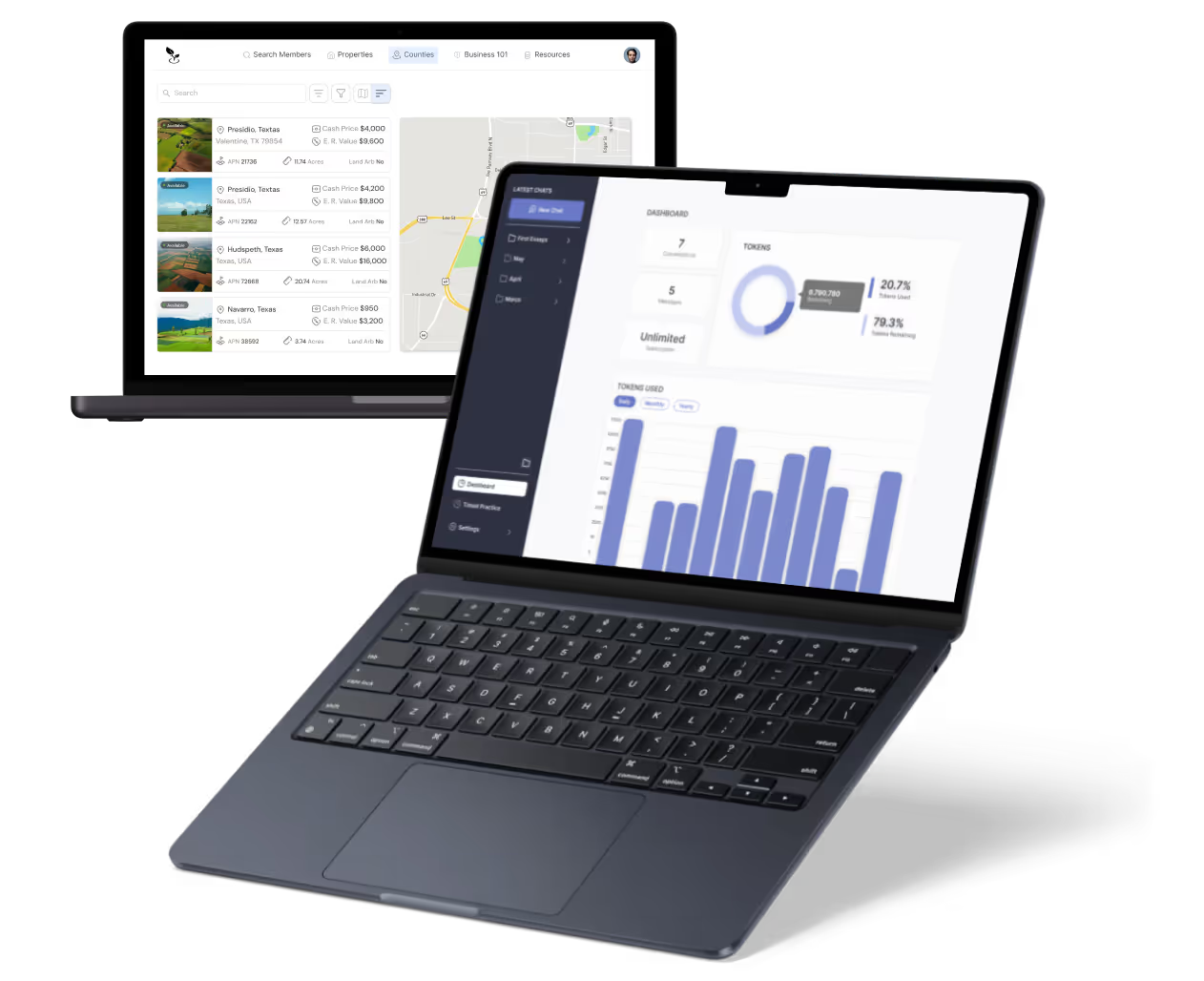

What Is a Learning Management System App - and Why Build It with Bubble?
An LMS delivers structured learning content, tracks learner progress through it, administers assessments, and issues credentials on completion. The core value is connecting content delivery to measurable outcomes in one system.
Training companies, corporate L&D teams, bootcamps, certification bodies, and coaches with structured programs all need custom LMS logic. SaaS platforms handle generic cases; Bubble handles the specific ones.
- Relational hierarchy: Bubble's database handles the course-lesson-enrollment-progress hierarchy natively, which is the core data structure an LMS requires.
- Custom enrollment logic: Set free enrollment, paid enrollment with Stripe, invite-only access, or cohort-based enrollment. The rule is a workflow condition, not a plan upgrade.
- No per-seat pricing: You pay a flat Bubble subscription. Adding 1,000 new learners does not increase your platform cost the way Teachable or TalentLMS pricing does.
- Instructor separation: Multiple instructors can manage their own courses independently inside one Bubble app, with role-based access controlling what each sees.
Review Bubble's capabilities and limitations before choosing it as your LMS foundation, especially for video-heavy content delivery at scale.
For training businesses that need custom enrollment rules, branded learner experiences, and ownership of their data, Bubble is a stronger fit than any SaaS LMS at equivalent cost.
What Features Should a Learning Management System App Include?
An MVP LMS covers content delivery, progress tracking, assessment, and basic certification. Get these eight features working before adding cohorts, forums, or live session integrations.
The admin dashboard is frequently scoped too lightly. Build a usable instructor view from the start. It drives content management for every course going forward.
- Course catalog: A searchable, filterable grid of available courses with thumbnail, description, category, and enrollment CTA.
- Lesson content delivery: Support text content, embedded video (Vimeo/YouTube), and downloadable file attachments per lesson.
- Learner enrollment: Handle free self-enrollment, paid enrollment via Stripe, and invite-only access from a single enrollment workflow.
- Progress tracking: Track lesson-by-lesson completion. Display a percentage progress bar on the learner's course dashboard.
- Quizzes and assessments: Multiple-choice questions with automated scoring. Store results per learner per course.
- Completion certificates: Auto-generate a PDF certificate using PDF Conjurer when a learner reaches 100% progress on a course.
- Instructor dashboard: Instructors see enrollment counts, learner progress, quiz pass rates, and per-lesson drop-off data for their own courses.
- Admin controls: Platform admins can publish or unpublish courses, manage user roles, and view platform-wide enrollment and completion analytics.
Completion certificate generation is a recurring time estimate mistake in LMS builds. Budget 8–12 hours specifically for PDF Conjurer template setup and testing.
How Do You Structure the Database for a Learning Management System in Bubble?
Six data types handle the full LMS lifecycle. The key design decision is separating LessonProgress from Enrollment. This lets you query completion at the lesson level without scanning a nested list.
Build the full schema before writing any workflows. LMS data types have many cross-references, and schema changes mid-build break multiple workflow references simultaneously.
- User (extended): Add
role(option set: learner/instructor/admin),bio(text), andprofile_image(image) to Bubble's default User type. - Course: Fields are
title(text),description(text),instructor(User),category(option set),price(number),is_published(yes/no),thumbnail(image). - Lesson: Fields are
course(Course),title(text),content_type(option set: video/text/file),content_url(text),order(number),duration_minutes(number). - Enrollment: Fields are
learner(User),course(Course),enrolled_date(date),status(option set: active/completed/cancelled),progress_percent(number). - LessonProgress: Fields are
enrollment(Enrollment),lesson(Lesson),completed(yes/no),completed_date(date). One record per lesson per learner enrollment. - Assessment: Fields are
course(Course),question_text(text),correct_answer(text),options(list of texts),points(number). Links to Course, not Lesson, for flexibility.
If your LMS needs to handle large media libraries, consider reviewing the best backends for Bubble to supplement native file storage with external media hosting.
The LessonProgress type is what enables per-lesson analytics in your instructor dashboard. Without it, you can only track overall completion, not where learners drop off.
How Do You Build the Core Workflows for a Learning Management System in Bubble?
Seven workflows drive the LMS lifecycle from enrollment through certificate delivery. Build them in dependency order. Enrollment must exist before progress tracking can work.
Test each workflow with a real user account in development mode before connecting the chain. Progress calculation errors compound when multiple workflows fire in sequence.
- Workflow 1 - Enrollment: When a learner clicks "Enroll," check if the course is free or paid. For free courses, create an Enrollment record directly. For paid courses, trigger a Stripe payment flow and create the Enrollment record only on successful payment confirmation.
- Workflow 2 - Lesson completion: When a learner clicks "Mark Complete" on a lesson, search for an existing LessonProgress record for this enrollment and lesson. If none exists, create one with
completed = yesandcompleted_date = current date/time. - Workflow 3 - Progress calculation: Triggered after each LessonProgress update. Search for all LessonProgress records where
enrollment = current enrollmentandcompleted = yes. Divide by total Lesson count for the course. Multiply by 100 and updateprogress_percenton the Enrollment. - Workflow 4 - Quiz scoring: On quiz submission, loop through each submitted answer. For each, compare the learner's selection to the Assessment
correct_answerfield. Tally thepointsfor correct answers and create a QuizResult record with the final score. - Workflow 5 - Completion detection: Add a condition to Workflow 3: if
progress_percent = 100, update Enrollmentstatusto "completed" and fire the certificate generation workflow. - Workflow 6 - Certificate generation: Use PDF Conjurer with a pre-designed template. Insert the learner's name, course title, instructor name, and completion date. Generate the PDF and save it as a file on the Enrollment record. Send a download link via SendGrid.
- Workflow 7 - Reminder emails: Scheduled API Workflow fires weekly. Search for Enrollments with
status = activeand no LessonProgress records updated in the past 7 days. Send a re-engagement email via SendGrid with a direct link to the learner's course.
Workflow 3 is where most LMS builds encounter performance issues. Optimize by caching lesson counts on the Course record rather than running a live count on every progress update.
What Security and Data Requirements Apply to a Learning Management System?
An LMS holds paid course content and personal learner data. Privacy rules must prevent unenrolled users from accessing lesson content and prevent learners from viewing each other's progress.
Content protection is the most business-critical privacy requirement. A learner who can access course content without paying undermines the entire revenue model.
- Lesson access control: Set a privacy rule on the Lesson type so that only users with an active Enrollment record for the parent Course can view Lesson records. This applies in the database layer, not just the UI.
- LessonProgress privacy: Only the linked
enrollment.learnerand the course instructor should be able to find or view LessonProgress records. - Enrollment privacy: Learners can only see their own Enrollment records. Instructors can see Enrollments for their own courses. Admins can see all.
- Paid content gating: On the lesson page, add a "before page is loaded" workflow that checks for an active Enrollment. Redirect unenrolled users to the course purchase page.
- Instructor content ownership: Add a privacy rule on Course and Lesson so that create/modify actions are only available when
instructor = Current Useror the user has admin role. - File download protection: Enable Bubble's file privacy settings for downloadable lesson materials. Direct URL access should require a valid session, not just a link.
Role-based access control is the second most common LMS security failure after privacy rule gaps. Test each role, learner, instructor, admin, independently against every sensitive page before launch.
What Plugins and Integrations Does a Learning Management System Need?
An LMS without video hosting, payment processing, and email automation is incomplete. These eight tools cover the full production stack for a Bubble LMS.
Install the Stripe plugin and PDF Conjurer early in the build. Both have configuration complexity that is easier to resolve before workflows are built around them.
- Vimeo or YouTube embed: Host lesson videos externally and embed via Bubble's video element. This avoids Bubble's file storage limits and provides better video streaming performance.
- Stripe plugin: Processes one-time course purchases and recurring subscription payments. Handles webhook callbacks to confirm payment and trigger enrollment.
- PDF Conjurer plugin: Generates completion certificates as styled PDFs. Supports custom fonts, logos, and dynamic data fields like learner name and completion date.
- SendGrid plugin: Sends enrollment confirmations, weekly re-engagement reminders, quiz result notifications, and certificate delivery emails.
- Wistia via API Connector: Hosts private videos with per-viewer watch time analytics. Better for corporate L&D teams that need to track whether learners actually watched the content.
- Intercom or Crisp plugin: Adds in-app live chat to the learner dashboard for course support questions without leaving the platform.
- Bubble Scheduler (built-in): Runs weekly re-engagement emails and detects inactive enrollments for admin reporting.
- Lottie plugin: Renders lightweight animations for quiz correct/incorrect feedback and course completion celebrations. Improves the learner experience without impacting load time.
Wistia is worth the cost for any LMS where completion proof matters. Watch-time data per video provides audit-grade evidence that learner engagement requirements were met.
How Long Does It Take and What Does It Cost to Build a Learning Management System with Bubble?
LMS build time is driven by the number of content types supported, the complexity of the quiz engine, and whether certificates require custom design. A basic text-and-video LMS with automated scoring is a moderate scope.
Plan your video hosting strategy before starting the build. Embedding Vimeo links is simple; building private video delivery with watch tracking adds meaningful hours.
- Bubble plan: Growth ($29/month) minimum for scheduled workflows. Team plan ($529/month) for multi-instructor production platforms with collaboration requirements.
- Vimeo costs: Pro plan at $20/month supports up to 60 minutes of uploads per week. Premium plan ($75/month) for unlimited uploads and privacy controls.
- Stripe costs: 2.9% + 30 cents per transaction. No monthly fee; costs scale with revenue.
- SendGrid costs: Free up to 100 emails/day. Paid plans start at approximately $20/month.
Cross-reference Bubble's pricing plans with your expected learner volume before selecting a production tier.
The largest hidden cost in LMS builds is content management time after launch. Build a clean instructor content editor from the start to reduce ongoing operational overhead.
Conclusion
Bubble handles the full relational complexity of an LMS without custom backend code, covering courses, lessons, enrollments, progress tracking, and assessments in a single platform.
Build Course and Lesson data types first, wire up enrollment and progress workflows, then add payment and certificate generation. Logic before UI is the correct sequence for every LMS build.
Need Help Building Your LMS in Bubble?
Paid content gating that can be bypassed via direct URL, progress calculation workflows that break under concurrent updates, and certificate generation that fails silently are the three most common LMS failure points after launch.
At LOW/CODE Agency, we started as builders and that has not changed. Today we build AI-powered products — web apps, mobile apps, RAG systems, chatbots, and AI agents — specifically for SMBs that want real software, not a SaaS subscription. We scope the architecture, engineer the workflows, and stay involved through launch and beyond.
- Data architecture: We design your data types, option sets, and privacy rules before writing a single element on the canvas.
- Workflow engineering: We build backend workflows, scheduled jobs, and API integrations with proper logic and error handling.
- Plugin configuration: We select and configure the right Bubble plugins for your feature set without unnecessary bloat.
- Role-based access: We implement privacy rules at the database level, not just conditional UI visibility.
- Integration setup: We connect your Bubble app to Stripe, SendGrid, Twilio, and other services correctly from day one.
- Pre-launch testing: We test against real data before deployment so every workflow performs correctly under live conditions.
- Post-launch support: We stay involved after go-live to optimize as real usage data shapes the app.
We have built 350+ products for clients including Coca-Cola, American Express, Sotheby's, and Medtronic. We know exactly where Bubble builds fail and we address those problems before they surface.
Related Articles
Last updated on
September 24, 2026
.

Jesus is a visionary entrepreneur and tech expert. After nearly a decade working in web development, he founded LOW/CODE Agency to help businesses optimize their operations through custom software solutions.


FAQs
Can you build a learning management system without coding using Bubble?
How do you structure courses and lessons in a Bubble LMS app?
How do you track learner progress and completion in a Bubble LMS?
How do you deliver video content and quizzes in a Bubble LMS app?
How do you issue certificates of completion in a Bubble LMS?
How do you manage instructor and admin roles in a Bubble LMS app?
Related Articles
Bubble
How to Build a Medical Device Tracking App with Bubble
Track every medical device with a Bubble app built without coding. Monitor location, maintenance, and compliance step-by-step launch it today.
Bubble
How to Build an Asset Tracking App with Bubble
Track assets in real time with Bubble. Build a no-code asset tracking app step-by-step monitor location, status & maintenance without coding.
Bubble
Comparison
Bubble vs Wix | 9 Factors to Decide the Best One
Compare Bubble vs Wix across design, logic, SEO, mobile, and business features to find the best no-code platform for building apps or websites in 2025

Mobile App Development
Bubble
Bubble Mobile App Developer: Costs, Capabilities & Limitations
Everything you need to know before hiring a Bubble mobile app developer — real costs, what you can build, platform limitations, and when to consider alternatives.


Why customers trust us for no-code development


