

Mobile App Onboarding Best Practices in 2026
13 min
read
Your mobile app onboarding can make or break retention. Learn the best practices that turn new installs into long-term active users.


One out of every four mobile apps gets used exactly once and never opened again. The difference between that outcome and long-term retention almost always comes down to onboarding. A well-designed mobile app onboarding flow turns confused first-time users into engaged daily users.
This guide breaks down the mobile app onboarding best practices that actually move retention numbers. You will learn specific patterns, common mistakes, and measurement strategies backed by data from real mobile app onboarding implementations.
Key Takeaways
- Show value first. The best mobile app onboarding flows let users experience core value within 60 seconds of opening the app.
- Minimize friction. Every extra field or screen in mobile app onboarding increases the chance users abandon before activation.
- Personalize early. Asking 2 to 3 preference questions during mobile app onboarding improves long-term engagement by tailoring the first experience.
- Measure ruthlessly. Track completion rates at every step of mobile app onboarding to identify exactly where users drop off.
- Iterate constantly. Mobile app onboarding is never finished because user expectations and competitive benchmarks change every quarter.
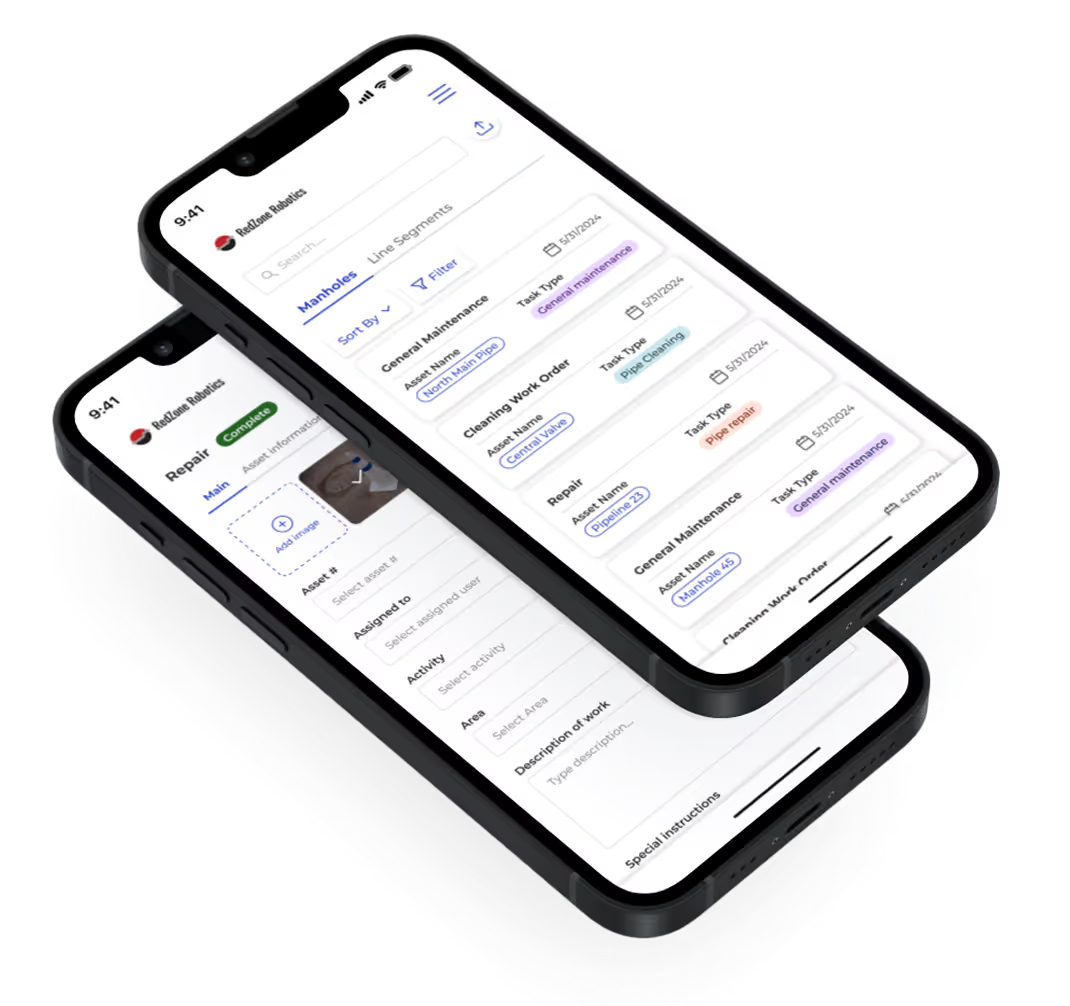

Why Does Mobile App Onboarding Matter So Much?
Mobile app onboarding determines whether users reach the activation moment that creates long-term engagement, with 77% of users churning within 3 days of installation.
Mobile app onboarding is the most leveraged screen real estate in your entire product. The first 60 seconds set the tone for everything that follows. Users form opinions about your app within 3 to 7 seconds and those opinions are remarkably sticky.
- Day-1 retention averages 25% across all app categories, but apps with optimized mobile app onboarding consistently achieve 40% or higher
- Activation rates double when mobile app onboarding guides users to complete one meaningful action before showing the full interface
- Support ticket volume drops by 30 to 50% when mobile app onboarding proactively addresses common confusion points upfront
- Lifetime value correlates directly with onboarding completion rates because users who finish mobile app onboarding are 3x more likely to convert to paid
- App store ratings improve when mobile app onboarding reduces the learning curve and prevents negative first impressions from confused users
Investing in mobile app onboarding best practices yields compounding returns. Every percentage point of improvement in onboarding completion multiplies across your entire user base for the lifetime of the app.
What Are the Core Mobile App Onboarding Patterns?
The three core mobile app onboarding patterns are progressive onboarding, function-oriented onboarding, and benefits-oriented onboarding, each suited to different app complexity levels.
Choosing the right mobile app onboarding pattern depends on how complex your app is and what users need to understand before they can extract value. Most successful apps combine elements from multiple patterns rather than using one exclusively.
- Progressive onboarding reveals features gradually as users encounter them, making mobile app onboarding feel natural rather than instructional or forced
- Function-oriented onboarding walks users through specific actions step-by-step, ideal for mobile app onboarding in apps with unique interaction patterns
- Benefits-oriented onboarding shows users what they will gain from the app before asking for any commitment or account creation
- Hybrid approaches combine benefit screens with progressive feature reveals so mobile app onboarding balances motivation with education
- Contextual onboarding triggers helpful tooltips at the exact moment users need them, extending mobile app onboarding beyond the first session
The right mobile app design decisions during onboarding depend on understanding which pattern matches your app's complexity and your users' expectations.
How Many Screens Should Mobile App Onboarding Have?
Effective mobile app onboarding uses 3 to 5 screens maximum, with each screen serving a single clear purpose and moving users closer to their first meaningful action.
Screen count is one of the most debated topics in mobile app onboarding. Research from Appcues shows that completion rates drop by 15% for every additional onboarding screen beyond five. But cutting screens just to hit a number can create confusion if critical steps get skipped.
- Three screens work best for simple apps where mobile app onboarding only needs to communicate the value proposition and collect minimal information
- Five screens suit complex apps where mobile app onboarding must cover permissions, personalization, and a guided first action without overwhelming users
- Progress indicators like dots or step counts reduce anxiety during mobile app onboarding by showing users exactly how many screens remain
- Skip buttons on every screen respect users who want to explore mobile app onboarding independently and already understand the app's purpose
- One concept per screen keeps mobile app onboarding focused so users absorb each piece of information before moving to the next step
The real metric is not screen count but time-to-value. If your mobile app onboarding gets users to their first meaningful outcome faster with 5 screens than with 3, use 5 screens.
What Should You Ask During Mobile App Onboarding?
Ask only questions that visibly change the user's experience during mobile app onboarding, typically 2 to 3 preference questions that enable meaningful personalization.
Every question during mobile app onboarding is a cost-benefit calculation. Each field adds friction and increases abandonment risk. Only ask for information that immediately improves the experience the user is about to have.
- Personalization questions like goals or interests during mobile app onboarding should directly filter content or customize the home screen that users see next
- Permission requests for notifications, location, and camera should appear in mobile app onboarding only when tied to a feature the user just requested
- Account creation should be delayed until after mobile app onboarding delivers initial value, since requiring signup before experience increases abandonment by 56%
- Social login options reduce mobile app onboarding friction by replacing a 4-field form with a single tap through Google, Apple, or existing accounts
- Progressive profiling spreads data collection across multiple mobile app onboarding sessions rather than front-loading every question into the first open
Tracking mobile app metrics and retention helps you determine which onboarding questions actually correlate with improved long-term engagement and which are just adding friction.
How Do You Measure Mobile App Onboarding Success?
Measure mobile app onboarding success through completion rate, time to first key action, day-1 and day-7 retention of onboarded users, and drop-off rates at each individual step.
Without measurement, mobile app onboarding improvements are guesswork. You need specific metrics at specific points in the funnel to understand where users succeed, where they struggle, and where they leave.
- Step-by-step completion rates show exactly which screen in mobile app onboarding loses the most users so you can fix the highest-impact problem first
- Time to activation measures how many seconds elapse between app open and first meaningful action, revealing mobile app onboarding efficiency
- Day-1 retention by cohort compares users who completed mobile app onboarding versus those who skipped or abandoned to quantify onboarding's retention impact
- Permission grant rates indicate whether mobile app onboarding times permission requests well or triggers reflexive denials from users
- A/B test velocity determines how quickly your team can test mobile app onboarding variations to converge on the highest-performing flow
At LOW/CODE Agency, we build analytics into every mobile app onboarding flow from day one. Measurement is not an afterthought. It is part of the mobile app testing and QA process that ensures what you ship actually works for real users.
What Are the Biggest Mobile App Onboarding Mistakes?
The biggest mobile app onboarding mistakes are front-loading information, requiring account creation before value delivery, ignoring platform conventions, and treating onboarding as a one-time event.
Mobile app onboarding mistakes are costly because they compound at scale. If your onboarding flow loses 40% of users at step two, fixing that single screen could double your active user base without spending an additional dollar on acquisition.
- Information overload tries to explain everything at once, but effective mobile app onboarding teaches through doing rather than telling
- Mandatory registration before any value delivery makes mobile app onboarding feel like a gate instead of a welcome and costs you the majority of potential users
- Ignoring the back button creates dead-end screens in mobile app onboarding where users feel trapped rather than guided through a natural flow
- Generic experiences treat all users identically even though mobile app onboarding data shows different segments need different paths to activation
- One-and-done thinking treats mobile app onboarding as a first-open event rather than an ongoing re-engagement strategy for dormant and returning users
Avoiding these mistakes requires testing with real users early and often. Allocating part of your mobile app marketing budget to onboarding optimization delivers better ROI than spending the same amount on user acquisition alone.
How Do Top Apps Handle Mobile App Onboarding?
Top-performing apps use mobile app onboarding patterns like deferred registration, value-first experiences, gamified progress, and personalized content delivery within the first 30 seconds.
Studying how successful apps handle mobile app onboarding reveals patterns you can adapt for your own product. These are not theoretical best practices but proven approaches from apps with millions of active users.
- Duolingo lets users complete a full lesson before requiring signup, demonstrating mobile app onboarding that proves value before asking for commitment
- TikTok skips traditional onboarding entirely by showing content immediately, proving mobile app onboarding does not always need explicit tutorial screens
- Headspace uses a mood check-in as mobile app onboarding that simultaneously collects personalization data and delivers an immediate micro-experience
- Notion offers template selection during mobile app onboarding so users start with a populated workspace instead of a blank page
- Spotify asks for 3 music preferences during mobile app onboarding and immediately generates a personalized playlist that demonstrates core product value
These examples share a common principle. The best mobile app onboarding makes users feel successful within seconds. Your mobile app growth guide should treat onboarding optimization as the single highest-leverage growth activity.
How Do You A/B Test Mobile App Onboarding?
A/B test mobile app onboarding by running controlled experiments on specific screens, copy, flow length, and personalization elements while measuring completion rate, activation, and downstream retention.
A/B testing transforms mobile app onboarding from opinion-driven design into evidence-based optimization. Every element of onboarding can be tested, but effective testing prioritizes the changes most likely to impact downstream metrics.
- Screen sequence tests compare different mobile app onboarding flow orders to determine which arrangement produces the highest completion and activation rates
- Copy variations test different value propositions, CTAs, and instructional text at each mobile app onboarding step to find language that resonates with users
- Visual design tests compare illustration styles, color schemes, and layout options within mobile app onboarding to identify which visual approach drives progression
- Personalization depth experiments test whether asking more or fewer questions during mobile app onboarding improves long-term engagement enough to justify the friction
- Statistical significance requires running mobile app onboarding tests for at least 2 weeks with a minimum of 1,000 users per variant before drawing conclusions
Run one mobile app onboarding test at a time unless you have enough traffic to isolate multiple variables simultaneously. Overlapping tests contaminate results and make it impossible to attribute improvements to specific changes.
How Should Mobile App Onboarding Evolve After Launch?
Mobile app onboarding should evolve through continuous A/B testing, cohort analysis, and seasonal updates to match changing user expectations and new feature introductions.
Shipping your mobile app onboarding flow is not the end. It is the baseline. User expectations shift as competing apps raise the bar, and your own product evolves with new features that change what users need to learn first.
- Quarterly onboarding audits compare your mobile app onboarding metrics against industry benchmarks to identify performance gaps and improvement opportunities
- Feature-triggered updates revise mobile app onboarding when major new capabilities launch so existing users learn about additions and new users see current value
- Cohort comparison between old and new mobile app onboarding versions proves which changes actually moved retention instead of just engagement vanity metrics
- Re-onboarding flows for returning users who have been inactive for 30 or more days bring them back to speed without repeating mobile app onboarding basics
- Seasonal adjustments update mobile app onboarding for holidays, promotional periods, or market shifts that change what users expect to see first
Building your mobile app business strategy around continuous onboarding optimization creates a compounding advantage that gets harder for competitors to replicate over time.
How Do You Handle Permissions During Mobile App Onboarding?
Handle permissions during mobile app onboarding by requesting each permission at the moment it becomes relevant, explaining why it is needed, and always providing a graceful fallback if the user declines.
Permission handling is one of the most sensitive moments in mobile app onboarding. Asking for camera, location, notifications, and contacts all at once triggers a reflexive "deny all" response from users who feel overwhelmed. Timing and context change everything.
- Just-in-time requests wait until the user attempts an action that requires the permission, making mobile app onboarding permission prompts feel logical rather than invasive
- Pre-permission screens explain the benefit of granting access before the system dialog appears, increasing mobile app onboarding permission grant rates by 30 to 40%
- Graceful degradation ensures the app remains functional when users deny permissions so mobile app onboarding does not dead-end at a mandatory access wall
- Re-request strategy offers a second chance to grant denied permissions later when users naturally encounter features that need them during mobile app onboarding
- Permission audit reviews all requested permissions quarterly to ensure mobile app onboarding only asks for access that the current feature set actually requires
Notification permissions deserve special attention during mobile app onboarding. Apps that explain what notifications will contain and how frequently they will arrive see 50% higher opt-in rates than apps that use the default system prompt without context.
How LOW/CODE Agency Builds Onboarding That Retains Users
LOW/CODE Agency designs mobile app onboarding as a strategic retention system, not a set of tutorial screens.
- Data-driven design grounds every mobile app onboarding decision in user research, analytics, and A/B testing rather than assumptions
- Value-first architecture structures mobile app onboarding so users experience core product value before encountering any registration or permission gates
- Built-in analytics instruments every onboarding step with event tracking so you can measure and optimize mobile app onboarding continuously
- Cross-platform consistency delivers cohesive mobile app onboarding experiences across iOS and Android while respecting platform-specific conventions
- Iterative optimization treats mobile app onboarding as an evolving system with quarterly review cycles baked into the post-launch maintenance plan
With 450+ projects completed for clients including Medtronic, American Express, Coca-Cola, Zapier, and Sotheby's, we have built onboarding flows across every app category.
Related Articles
- No-Code vs Custom Mobile App: Which to Build?
- MVP Mobile App Timeline: How Long It Takes
- Mobile Workforce Management App: What You Need
- Mobile App Commerce Examples That Work in 2026
- Mobile App Testing & QA Process: Full Guide
- Mobile App Team Change Risk: How to Prepare
Our custom app development team builds mobile apps designed around your exact requirements.
Our Zapier development team builds automations that save your business hours every week.
Last updated on
October 16, 2026
.

Jesus is a visionary entrepreneur and tech expert. After nearly a decade working in web development, he founded LOW/CODE Agency to help businesses optimize their operations through custom software solutions.


FAQs
Why is mobile app onboarding so important for retention?
What are the best practices for mobile app onboarding in 2026?
How many steps should a mobile app onboarding flow have?
When should a mobile app ask for notification permissions during onboarding?
What is a good mobile app onboarding completion rate?
How do I test and improve my mobile app onboarding?
Related Articles
Mobile App Development
Native Mobile App Development with No-code
Learn how to build native mobile apps using no-code platforms like FlutterFlow and Bubble — fast, cost-effective, and app store ready

Mobile App Development
Mobile App ROI: Bootstrap vs Raise Capital
Should you bootstrap or raise capital for your mobile app? Learn how to evaluate ROI and choose the funding path that fits your goals.

Mobile App Development
Prevent Scope Creep in Mobile App Projects
Scope creep is the silent killer of mobile app projects. Learn how to spot it early and put boundaries in place before it costs you.

Mobile App Development
Cost to Publish an App on the App Store (Full Breakdown)
Cost to publish an app on the App Store explained. See Apple Developer fees, yearly charges, in-app purchase costs, and hidden expenses before launch.


Why customers trust us for no-code development


