

Best Way to Build a Mobile App in 2026
12 min
read
Confused about how to build a mobile app in 2026? Explore your options and find the best approach for your budget and goals.


The best way to build a mobile app depends on your budget, timeline, technical requirements, and long-term product strategy. There is no single right approach for every project.
Cross-platform frameworks, native development, no-code tools, and progressive web apps each solve different problems. Choosing the best way to build a mobile app starts with understanding which trade-offs matter most for your specific situation.
Key Takeaways
- Cross-platform frameworks are the best choice for most companies that need iOS and Android apps from a single codebase
- Native development is the best approach when you need maximum performance, platform-specific features, or hardware integration
- No-code tools are ideal for validation and internal tools where speed matters more than customization
- PWAs work best when app store distribution is unnecessary and web access is the primary user channel
- Best approach evolves as your product matures, user base grows, and technical requirements change over time
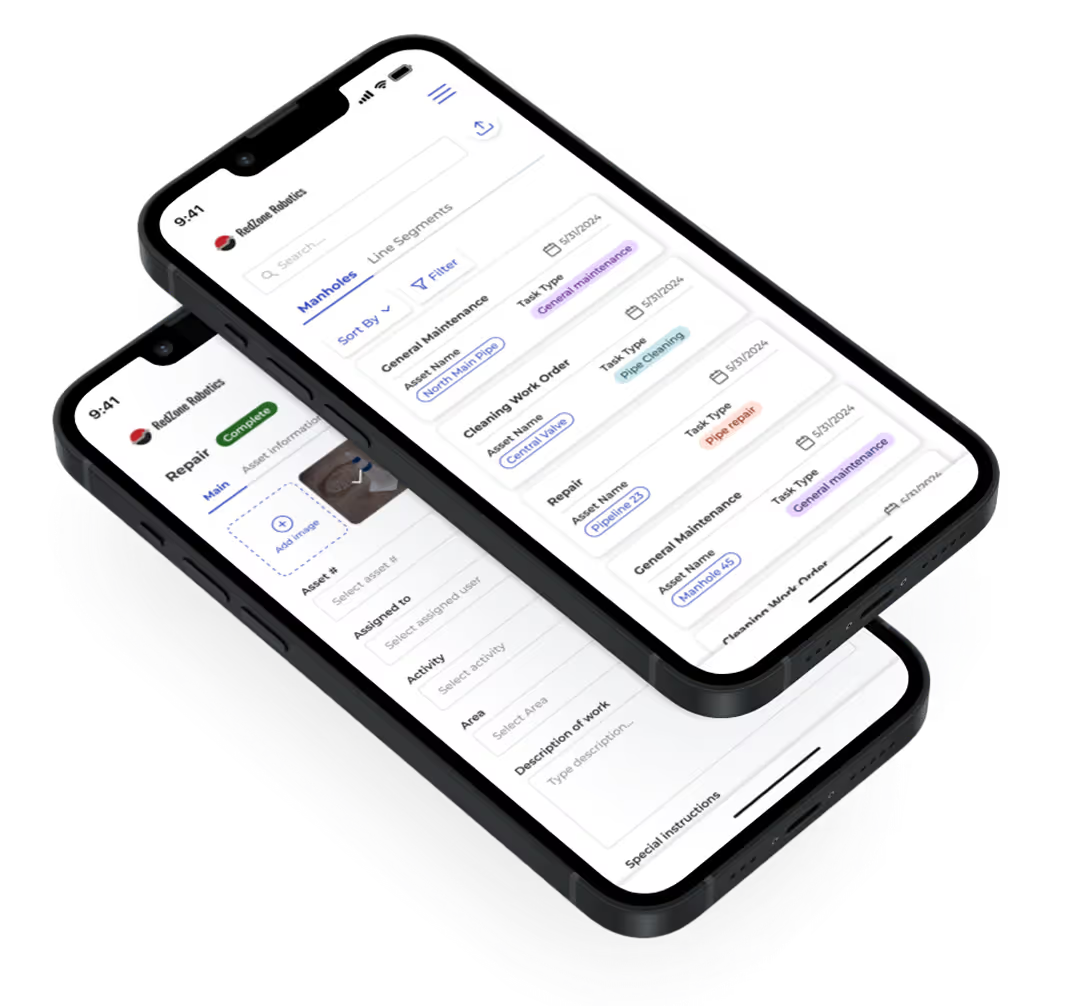

What Is the Best Way to Build a Mobile App for Most Companies?
The best way to build a mobile app for most companies in 2026 is using a cross-platform framework like Flutter or React Native. These frameworks let you ship on iOS and Android from one codebase at .
Cross-platform development has matured to the point where performance differences are negligible for the vast majority of mobile apps. The best way to build a mobile app used to require separate native teams. Now frameworks like Flutter and React Native produce apps that users cannot distinguish from native ones.
- Dual-platform savings: cross-platform development saves 30 to 40 percent over separate native builds for iOS and Android launch
- Single codebase: cross-platform is ideal when your team wants to maintain one codebase instead of two separate ones
- Near-native performance: Flutter and React Native deliver near-native performance without native complexity for most mobile apps
- Budget efficiency: cross-platform halves the engineering effort required, making it the right choice for limited budgets
- Simultaneous launch: cross-platform development ships to both app stores at the same time without parallel team coordination
The best way to build a mobile app for your company specifically depends on factors beyond framework choice. Your timeline, team skills, feature requirements, and growth plans all influence which approach delivers the best outcome.
When Is Native Development the Best Way to Build a Mobile App?
Native development is the best way to build a mobile app when you need maximum performance, deep hardware integration, platform-specific UX patterns, or features that depend on the latest iOS or Android capabilities released each year.
The comparison between Flutter, React Native, and native comes down to trade-offs. Native development is the best way to build a mobile app that pushes platform boundaries. Games, augmented reality apps, camera-intensive apps, and apps requiring complex animations all benefit from native code.
- Hardware-intensive features: native development is required for real-time camera processing, AR features, or advanced GPU rendering
- Platform-specific design: native gives you full access to each OS design system for authentic platform-specific user experiences
- Performance differentiation: native development is the right choice when performance is a competitive differentiator for your product
- Bleeding-edge features: native apps access the latest platform capabilities immediately, since cross-platform frameworks lag behind
- Existing native teams: native development makes sense when you have separate iOS and Android teams already staffed and experienced
Native development doubles your engineering investment because you maintain two separate codebases. The best way to build a mobile app natively is with teams that specialize in each platform and a product manager who keeps both apps in sync.
Is No-Code the Best Way to Build a Mobile App?
No-code is the best way to build a mobile app when speed matters more than customization. Platforms like FlutterFlow, Glide, and Bubble let non-technical founders launch functional mobile apps in weeks instead of months. The trade-off is limited flexibility as your product requirements grow.
- Idea validation speed: no-code lets you test with real users in 2 to 4 weeks, making it ideal for early-stage validation
- Internal tool fit: internal company tools often work well in no-code because customization needs are typically modest and stable
- Budget threshold: no-code is the practical choice when your budget is under $30,000 and you need a functional product quickly
- Platform matching: building with no-code requires choosing a platform that matches your specific feature requirements carefully
- Customization ceiling: no-code is not the right approach for apps that need complex custom logic, heavy integrations, or unique user experiences
No-code tools are the best way to build a mobile app at the start of your product journey. Many successful mobile apps launched on no-code platforms and later migrated to custom code once they validated demand and secured funding.
Should You Build a PWA Instead of a Mobile App?
A to a mobile app when your users primarily access your product through web browsers and you want to avoid app store distribution requirements and review processes.
PWAs are the best way to build a mobile app experience when you want broad reach without app store friction. They work across all devices through a browser, can be installed on home screens, and support offline functionality. The trade-off is limited access to native device features.
- Content-heavy products: PWAs are well-suited for news, documentation, and e-commerce apps with browser-first audiences
- No app store dependency: a PWA lets users install your product directly from your website, bypassing app store gatekeeping entirely
- Web team advantage: PWAs are the right choice when your development team specializes in web technologies rather than native platforms
- Cross-device reach: a well-designed responsive PWA works on every device including desktop without separate builds
- Native feature limits: PWAs are not suitable for apps that need push notifications on iOS, camera access, or background processing
The web app vs mobile app decision shapes your distribution strategy. PWAs split the difference by offering app-like experiences without app store gatekeeping, making them the best way to build a mobile app for certain business models.
How Do You Choose the Best Way to Build a Mobile App?
The best way to build a mobile app starts with listing your requirements across five dimensions: performance needs, platform coverage, budget constraints, timeline targets, and team capabilities. The framework that satisfies the most critical requirements wins.
Choosing the best way to build a mobile app requires honest prioritization. Every approach involves trade-offs. The best way to build a mobile app is the approach where the trade-offs matter least for your specific product and user base.
- Must-have features first: define your core feature requirements before evaluating which approach can deliver them within your constraints
- Realistic budget assessment: consider your mobile app development budget honestly because the right approach for your budget may differ from your ideal
- Existing team skills: evaluate your team's capabilities because the best approach leverages existing strengths rather than requiring new expertise
- Three-year roadmap: think about your product evolution because the right approach today may not scale for your future needs
- Platform distribution: map your users across iOS and Android to determine if single-platform launch is viable as an initial strategy
- Competitor research: understand what the leading apps in your market use to inform your own development approach
The best way to build a mobile app evolves as your product matures. Starting with no-code for validation, moving to cross-platform for growth, and potentially adopting native for optimization is a legitimate and common path.
What Role Does Your Tech Stack Play?
Your determine the best way to build a mobile app for long-term maintainability. A future-proof stack reduces the cost of changes, attracts better talent, and keeps your mobile app competitive for years.
The best way to build a mobile app includes choosing technologies with strong ecosystem support, active communities, and clear upgrade paths. Frameworks that lose community momentum become liabilities because finding developers, solving problems, and adding features all get harder.
- React Native fit: React Native is the natural choice when your team already uses React for web development
- Flutter versatility: Flutter is the right pick when you want a single framework for mobile, web, and desktop targets
- CI/CD from day one: a solid tech stack includes CI/CD pipelines, automated testing, and monitoring built in from the start
- Widely adopted tools: choosing well-supported tools ensures future developers can understand and extend your mobile app easily
- Avoid niche frameworks: small-community frameworks become liabilities over time regardless of their current feature advantages
Your tech stack is a long-term commitment. The best way to build a mobile app prioritizes boring, proven technologies over exciting but unproven ones. Stability and community support matter more than cutting-edge features for production mobile apps.
What Does the Mobile App Development Process Look Like?
The follows a predictable path regardless of which approach you choose: discovery, design, development, testing, deployment, and iteration. The best way to build a mobile app follows all six stages.
Skipping stages is not the best way to build a mobile app faster. It is the fastest way to build a mobile app that fails. Each stage exists because decades of software development have proven that the cost of fixing problems increases exponentially the later they are discovered.
- Discovery first: starting with a discovery phase validates requirements before you commit budget to development
- Design before development: designing screens before writing code produces apps that users actually enjoy interacting with daily
- Iterative development: building in short cycles delivers working features you can test and validate throughout the project
- Automated testing: building a test suite prevents new features from breaking existing functionality as complexity grows
- Continuous deployment: automated release pipelines let your mobile app improve rapidly based on real user feedback
The best way to build a mobile app is the approach that respects the process while adapting it to your specific constraints. Full-service mobile app development covers all stages under one team, which reduces handoff friction and keeps the project moving.
How Do You Future-Proof Your Mobile App?
The best way to build a mobile app that lasts is choosing proven technologies, writing maintainable code, designing modular architecture, and planning for the features and scale you will need in 2 to 3 years, not just today.
Future-proofing does not mean predicting the future. The best way to build a mobile app for longevity is designing it so that change is cheap. Modular architecture, clean APIs, and automated tests make your mobile app adaptable regardless of what changes come next.
- Scalable architecture: choosing horizontal scaling patterns from the start prevents costly rewrites as user volume grows
- Modular design: modular architecture lets you add features without rewriting existing functionality as the product expands
- Automated testing: a solid test suite keeps the app stable as complexity grows over months and years of iteration
- Surviving team turnover: clean, documented code with consistent patterns keeps the project maintainable regardless of who works on it
- API-first architecture: designing around APIs from the start lets your mobile app integrate with new services as your business evolves
The best way to build a mobile app balances present needs with future flexibility. Over-engineering for hypothetical scale is wasteful. Under-engineering for certain growth is reckless. The best approach prepares for probable growth without paying for speculative features.
What Mistakes Should You Avoid When Choosing How to Build a Mobile App?
The most common mistake is choosing the best way to build a mobile app based on developer preference rather than business requirements. Teams that let technology enthusiasm drive decisions build impressive engineering that users do not need.
Avoiding common mistakes is just as important as making the right choice. The best way to build a mobile app requires discipline to match technology decisions to business outcomes rather than following trends or copying what competitors built.
- Avoid investor optics: do not choose native development solely because it sounds more impressive to investors or advisors
- Avoid bandwagon picks: do not select a framework just because a popular company uses it without verifying your app has similar requirements
- Skip discovery at your peril: assumptions about requirements are regularly wrong, making the discovery phase essential before committing to an approach
- Avoid over-engineering: building for hypothetical future scale slows shipping today without delivering real near-term value
- Total cost matters: do not choose the cheapest option without calculating total cost including ongoing maintenance and iteration expenses
The best way to build a mobile app avoids both over-engineering and under-engineering. Match your technology investment to your validated requirements, plan for probable growth, and stay willing to evolve your approach as your product and user base mature.
Conclusion
The best way to build a mobile app in 2026 depends on your specific requirements, not on what is trending. Cross-platform frameworks serve most companies well.
Native development serves performance-critical apps. No-code tools serve validation and internal use cases. PWAs serve web-first products. Choose the approach that matches your priorities today while leaving room to evolve as your product grows.
Build Your Mobile App the Right Way
As AI development experts, we at LOW/CODE Agency help SMBs ship real software — web and mobile applications, intelligent chatbots, RAG pipelines, and autonomous AI agents built for businesses that need results, not platforms. We help you choose the best way to build a mobile app based on your requirements, not based on what is easiest for us to deliver.
- Platform-agnostic recommendations: based on your specific mobile app requirements, budget, and growth trajectory
- Full-service development: covering discovery, design, development, testing, and app store launch under one team
- Multi-approach expertise: across native, cross-platform, no-code, and hybrid approaches to recommend the best fit for your project
- Transparent pricing: detailed scope documents so you know exactly what you are paying for and why
- Future-proof architecture: decisions that keep your mobile app competitive and maintainable for years after launch
- Proven methodology: refined across 350 plus projects for clients including Medtronic, American Express, Coca-Cola, Zapier, and Sotheby's
- Post-launch support: ongoing iteration to keep your mobile app improving based on real user feedback
Related Articles
Last updated on
September 3, 2026
.

Jesus is a visionary entrepreneur and tech expert. After nearly a decade working in web development, he founded LOW/CODE Agency to help businesses optimize their operations through custom software solutions.


FAQs
What is the best way to build a mobile app in 2026?
Should I build a native or cross-platform mobile app in 2026?
How much does it cost to build a mobile app in 2026?
Can I build a mobile app without coding in 2026?
How long does it take to build a mobile app in 2026?
Should I hire a mobile app agency or build in-house in 2026?
Related Articles
Mobile App Development
Types of Mobile Apps: What Are Your Options?
Not sure which type of mobile app to build? Learn the differences between native, hybrid, cross-platform, and web apps explained clearly.

Mobile App Development
White Label Mobile Apps: Are They Worth It?
Considering a white label mobile app? Learn the pros, cons, hidden costs, and limitations before choosing it over custom development.

Mobile App Development
Mobile App Testing & QA Process: Full Guide
Skipping QA is how mobile apps fail at launch. Learn how the testing and quality assurance process works and what it should include.

Mobile App Development
Best Mobile App Design Software in 2026
Which design tool is best for your mobile app in 2026? Compare the top options for prototyping, UI design, and team collaboration.

Why customers trust us for no-code development


