

Employee Communication Mobile App: What to Build
14 min
read
Thinking of building an employee communication mobile app? Learn what features matter most and what to avoid before you start.


Poor internal communication costs companies millions in lost productivity every year. Emails get buried, messages scatter across platforms, and critical updates never reach the people who need them.
An employee communication app centralizes everything your team needs to stay aligned. This guide covers the features, benefits, and development process behind building one that actually gets adopted.
Key Takeaways
- Centralized communication reduces noise by replacing scattered emails, texts, and calls with one platform everyone checks daily.
- Mobile-first design is essential because frontline and remote workers need access to company updates from any device, anywhere.
- Adoption depends on simplicity since employees will ignore complex tools and revert to informal channels like personal texting.
- Integration matters because your communication app must connect to HR systems, calendars, and project management platforms.
- Security protects sensitive conversations through encryption, access controls, and compliance features that meet enterprise requirements.
- ROI measurement justifies the investment when you track engagement rates, response times, and reduction in missed communications.
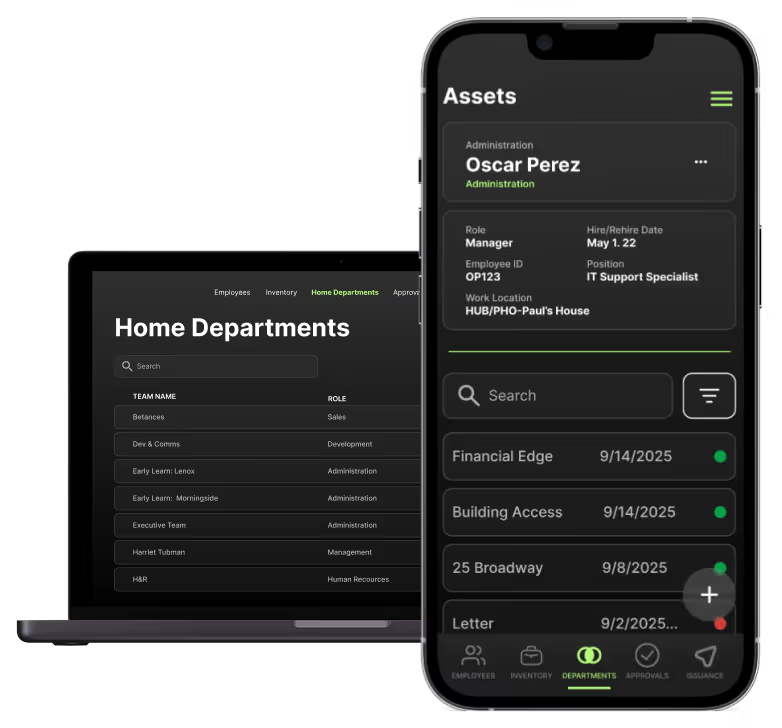

Why Do Companies Need an Employee Communication App?
Companies need employee communication apps because traditional channels like email and meetings fail to reach distributed, frontline, and hybrid workforces quickly and consistently.
Internal communication breakdowns are not just frustrating. They are expensive. Missed updates cause duplicated work, delayed projects, and disengaged employees who feel disconnected from company direction.
- Email overload buries important messages because employees receive hundreds of emails weekly and critical updates get lost in the noise.
- Frontline workers lack desktop access so company-wide emails and intranet posts never reach the people on the ground.
- Remote teams need async communication that works across time zones without requiring everyone to be online simultaneously.
- Instant messaging reduces response times from hours or days with email to minutes with mobile push notifications.
- Company culture strengthens when employees feel connected through shared channels, recognition features, and transparent leadership updates.
- Compliance documentation improves when conversations happen in a searchable, auditable platform instead of scattered personal messages.
Building an employee communication app addresses these problems directly. The companies that understand their target audience of internal users build tools that employees actually want to open every day.
What Features Should an Employee Communication App Include?
An employee communication app needs direct messaging, group channels, push notifications, file sharing, and a company news feed at minimum. Advanced features include video calls, surveys, and directory search.
Feature selection determines whether your employee communication app gets adopted or ignored. The right features solve daily pain points without overwhelming users with unnecessary complexity.
- Direct and group messaging lets employees communicate one-on-one or in team channels organized by department, project, or topic.
- Push notifications for urgent updates ensure time-sensitive information reaches every employee immediately, even when the app is closed.
- News feed centralizes announcements so leadership updates, policy changes, and company news live in one searchable place.
- File and document sharing lets teams exchange PDFs, images, and documents directly within conversations without switching platforms.
- Employee directory with search helps people find and contact coworkers by name, department, role, or location instantly.
- Read receipts and analytics give communicators visibility into who has seen important messages and where engagement drops off.
Start with core messaging and notification features for your first release. Layer in advanced features like video calling, surveys, and integrations based on what employees actually request after launch.
The feature roadmap should be driven by adoption data and employee feedback rather than executive assumptions about what the workforce needs.
How Does an Employee Communication App Differ From Slack or Teams?
Custom employee communication apps differ from Slack and Teams by serving non-desk workers, simplifying the interface for less technical users, and integrating directly with company-specific workflows.
Slack and Microsoft Teams work well for knowledge workers at desks. They fall short for organizations with large frontline, retail, manufacturing, or field workforces who need something simpler and mobile-native.
- Simplified interfaces reduce training because frontline workers need intuitive apps that require zero onboarding or technical knowledge.
- Custom branding builds company identity by making the app feel like an internal tool rather than a generic third-party platform.
- Targeted delivery ensures relevance by showing employees only the channels and updates that apply to their role and location.
- Offline access supports field workers who operate in areas with limited connectivity but still need access to schedules and documents.
- Custom integrations connect internal systems like shift scheduling, time tracking, and HR platforms that generic tools do not support natively.
- Data ownership stays with your company instead of residing on a third-party vendor's servers under their terms of service.
The decision between building custom and using existing tools depends on your type of mobile app requirements. Companies with large frontline workforces almost always benefit from a purpose-built employee communication app.
The total cost of licensing Slack or Teams for thousands of frontline workers who use only basic features often exceeds the cost of building a focused custom solution.
How Much Does It Cost to Build an Employee Communication App?
Building an employee communication app costs between $40,000 and $200,000 depending on feature complexity, platform choice, security requirements, and integration needs with existing enterprise systems.
Cost varies widely based on whether you build a basic messaging tool or a full-featured communication platform with video, analytics, and deep integrations into your HR tech stack.
- Basic messaging apps cost $40,000 to $80,000 with core features like channels, direct messages, push notifications, and a news feed.
- Mid-range builds run $80,000 to $140,000 adding video calls, file sharing, employee directories, and integrations with HR systems.
- Enterprise platforms exceed $140,000 when they require advanced security, compliance features, analytics dashboards, and multi-language support.
- Low-code platforms reduce costs 40 to 60 percent by accelerating development with pre-built components and visual development tools.
- Ongoing costs add 15 to 20 percent yearly for hosting, maintenance, security updates, and feature iterations after initial launch.
Understanding mobile app development cost helps you set realistic expectations. Start with an MVP that solves your biggest communication pain point, then expand based on employee feedback and adoption data.
What Content Strategy Keeps Employees Engaged in the App?
A content strategy keeps employees engaged by delivering relevant, timely, and varied content types including leadership updates, peer recognition, operational alerts, and interactive polls through the communication app.
Building the app is only the first step. Without a content strategy, even the best-designed employee communication app becomes a ghost town that nobody opens after the first week.
- Leadership messages build trust and transparency when executives share company updates, strategic direction, and honest assessments regularly.
- Peer recognition drives engagement by letting employees publicly celebrate coworkers for achievements and helpful contributions.
- Operational updates provide daily value by delivering shift schedules, policy changes, and deadline reminders that employees need immediately.
- Polls and surveys invite participation by giving employees a voice on decisions that affect their daily work and environment.
- Training content adds utility by sharing learning resources, certification opportunities, and skill-building material through the app.
- Photo and video humanize the experience by showing team events, project milestones, and behind-the-scenes content that builds community.
Content freshness directly correlates with app engagement metrics. Assign dedicated content owners for each channel or department to maintain a steady stream of relevant material. The most successful employee communication apps treat content planning with the same rigor they give to external marketing.
Schedule a weekly content calendar, assign owners to each content type, and review engagement analytics monthly to understand what employees actually read and respond to versus what gets ignored.
How Do You Drive Adoption of an Employee Communication App?
Drive adoption through executive sponsorship, mandatory onboarding, simple UX, relevant content, and by making the app the only channel for certain critical communications.
Building the app is the easy part. Getting employees to actually use it instead of their existing habits requires a deliberate adoption strategy that addresses resistance directly.
- Executive sponsorship signals importance when leadership actively uses and promotes the app, making adoption a top-down priority.
- Mandatory channel forces adoption by making the app the only place to find schedules, policy changes, or pay information.
- Simple onboarding reduces friction with a setup process that takes under two minutes and requires no technical knowledge whatsoever.
- Relevant content keeps employees returning because nobody opens an app filled with irrelevant announcements or outdated company news.
- Feedback loops show responsiveness when employees see their suggestions implemented, building trust that the platform is worth using.
- Department champions accelerate peer adoption when influential employees within each team model active usage and encourage their coworkers.
Adoption is a change management challenge, not a technology problem. Plan your rollout strategy with the same care you give to the mobile workforce management features inside the app itself.
What Security Features Does an Employee Communication App Need?
Employee communication apps need end-to-end encryption, role-based access controls, remote device wipe, data retention policies, and compliance with industry regulations like GDPR or HIPAA.
Internal communications often contain sensitive business information, employee data, and strategic discussions. Security failures in employee apps create legal liability and erode workforce trust immediately.
- End-to-end encryption protects messages so conversations between employees cannot be intercepted or read by unauthorized parties.
- Role-based access controls limit visibility by ensuring employees only see channels and content appropriate to their role and clearance level.
- Remote wipe capabilities protect data by letting IT teams erase app data from lost or stolen devices instantly.
- Data retention policies enforce compliance by automatically archiving or deleting messages according to your legal and regulatory requirements.
- Multi-factor authentication prevents unauthorized access by requiring a second verification step beyond passwords for every login.
- Audit logs track activity by recording who accessed what information and when, supporting compliance audits and investigations.
Security is not optional for employee communication apps. Your post-launch maintenance plan must include regular security patches, penetration testing, and compliance reviews throughout the app's lifecycle.
How Do You Integrate an Employee Communication App With HR Systems?
Integrate with HR systems by connecting the app to your HRIS, payroll platform, scheduling software, and learning management system through APIs that keep employee data synchronized automatically.
An employee communication app delivers the most value when it connects to the systems employees already depend on. Isolated communication tools add another login and another platform to check instead of reducing complexity.
Integration reduces manual data entry and ensures the communication app always reflects current organizational structure. When an employee changes departments, their channel access updates automatically without IT intervention.
How Do You Measure the ROI of an Employee Communication App?
Measure ROI by tracking employee engagement rates, reduction in email volume, faster response times to urgent communications, and improvements in employee satisfaction survey scores.
Justifying the investment in an employee communication app requires concrete metrics that connect the tool to business outcomes. Qualitative improvements matter, but numbers drive continued executive support.
- Message read rates show engagement by measuring what percentage of employees actually see and open important company communications.
- Response time improvements quantify speed when comparing how quickly teams coordinate through the app versus previous channels.
- Email volume reduction proves consolidation as employees shift routine communication from overcrowded inboxes to organized app channels.
- Employee satisfaction scores improve when workers feel more informed, connected, and aligned with company goals and direction.
- Incident response times decrease when urgent communications reach the right people faster through targeted push notifications.
- Onboarding time shrinks measurably when new hires access training materials, team introductions, and company information through the app.
Track these metrics from day one so you can demonstrate clear before-and-after improvements. Data-driven results make it easier to secure budget for future enhancements and expanded features.
Read more | Best Mobile App Development Agencies
How Do You Scale an Employee Communication App Across Multiple Locations?
Scale across locations by implementing location-based channels, regional content targeting, multi-language support, timezone-aware notifications, and role-based information architecture that keeps content relevant for every employee.
Growing organizations face a unique challenge with employee communication apps. What works for 200 employees in one office breaks down for 5,000 employees across 20 locations with different schedules, languages, and operational needs.
- Location-based channels prevent information overload by routing facility-specific announcements only to employees at that location.
- Multi-language delivery serves diverse workforces by translating critical updates into every language your employees speak natively.
- Timezone-aware notification scheduling ensures push notifications arrive during work hours regardless of where each employee is located.
- Regional admin roles distribute content management by empowering local managers to post updates without bottlenecking through central communications.
- Scalable infrastructure handles concurrent usage spikes when all-company announcements trigger thousands of simultaneous app opens across time zones.
- Consistent branding with local customization maintains corporate identity while allowing individual locations to share content relevant to their teams.
Scalability planning should happen during discovery, not after your app struggles under the weight of rapid organizational growth. The architecture decisions you make for 500 employees determine whether the app still works for 10,000.
Ready to Build an Employee Communication App That Gets Used?
An employee communication app only delivers value when people actually use it. Success depends on building the right features, designing for simplicity, and executing a thoughtful adoption strategy.
At LOW/CODE Agency, we started as builders and that has not changed. Today we build AI-powered products — web apps, mobile apps, RAG systems, chatbots, and AI agents — specifically for SMBs that want real software, not a SaaS subscription. We build employee communication apps that fit your organization's structure, integrate with your existing tools, and drive genuine adoption.
- Discovery workshops map communication gaps so the app solves real problems your employees experience, not theoretical ones.
- Design prioritizes simplicity with interfaces that frontline workers, remote teams, and office staff all find intuitive immediately.
- Build integrates with your HR stack connecting to scheduling, payroll, directory, and project management systems your teams already use.
- Scalability supports organizational growth so the app handles thousands of employees across locations without performance degradation.
- Delivery includes rollout strategy with adoption playbooks, training materials, and onboarding flows designed to maximize day-one engagement.
- Partnership means ongoing iteration through usage analytics, employee feedback collection, and feature updates that keep the app relevant.
Over 350 projects delivered for clients including Medtronic, American Express, Coca-Cola, Zapier, and Sotheby's. We build across FlutterFlow, Bubble, Glide, Webflow, Make, n8n, and Zapier.
If you are serious about building an employee communication app that gets adopted, let's build it properly. Our team at LOW/CODE Agency will help you design, build, and launch an internal tool your workforce will actually use.
Related Articles
Last updated on
September 3, 2026
.

Jesus is a visionary entrepreneur and tech expert. After nearly a decade working in web development, he founded LOW/CODE Agency to help businesses optimize their operations through custom software solutions.


FAQs
What features should an employee communication mobile app have?
Should I build a custom employee communication mobile app or use an existing tool?
How do you ensure adoption of an employee communication mobile app?
What industries benefit most from custom employee communication mobile apps?
How much does it cost to build an employee communication mobile app?
What security considerations apply to employee communication mobile apps?
Related Articles
Mobile App Development
Types of Mobile Apps: What Are Your Options?
Not sure which type of mobile app to build? Learn the differences between native, hybrid, cross-platform, and web apps explained clearly.
Mobile App Development
Mobile App Development Process: Full Guide
What does the mobile app development process actually look like? Get a full breakdown of every stage from idea to launch.

Mobile App Development
MVP
MVP Mobile App Cost and Scope (Real Budget & Planning Guide)
MVP mobile app cost explained for founders. See real budgets, feature scope, timelines, and how to plan version 1 without overspending or overbuilding.
Mobile App Development
Is the Mobile App Discovery Phase Worth It?
Should you pay for a mobile app discovery phase? Learn what it includes, what it costs, and whether it's worth it for your project.

Why customers trust us for no-code development


