

How to Build a DJ Booking Marketplace
Learn step-by-step how to create a DJ booking marketplace with essential features, marketing tips, and revenue models for success.


Event organizers currently book DJs through personal referrals, agency websites, and social media profiles, with no reliable way to compare mixes, verify experience, or book with financial protection. A DJ booking marketplace changes this by creating a verified network where event organizers discover the right DJ, hear demo mixes before committing, and book with deposit protection.
This guide explains how to build one that works from the first enquiry to the post-event payout.
Key Takeaways
- Demo mix audio is the single most important conversion feature: Event organizers cannot book a DJ they cannot hear; embedded audio mix demos are the difference between a directory and a booking platform.
- Event type specialization drives search behavior: Wedding DJs, club DJs, corporate event DJs, and festival DJs are distinct markets with different equipment, repertoire, and pricing requirements.
- Quote-based pricing dominates this market: Most professional DJ bookings involve a custom quote based on event type, duration, travel, and equipment requirements; the platform must support a full quote workflow.
- Deposits are non-negotiable: The industry standard is a 25–50% booking deposit; the platform must enforce this through escrow, not trust it to informal arrangements between DJ and organizer.
- Equipment requirements must be captured at booking: The difference between "DJ provides full PA" and "DJ requires house PA" is significant; bookings made without capturing this detail create last-minute disputes.
- Venue residency bookings are a separate high-value use case: Nightclubs and hospitality venues booking DJs on regular residency arrangements represent a different buyer journey and higher annual booking value.

What Type of Marketplace Is a DJ Booking Platform?
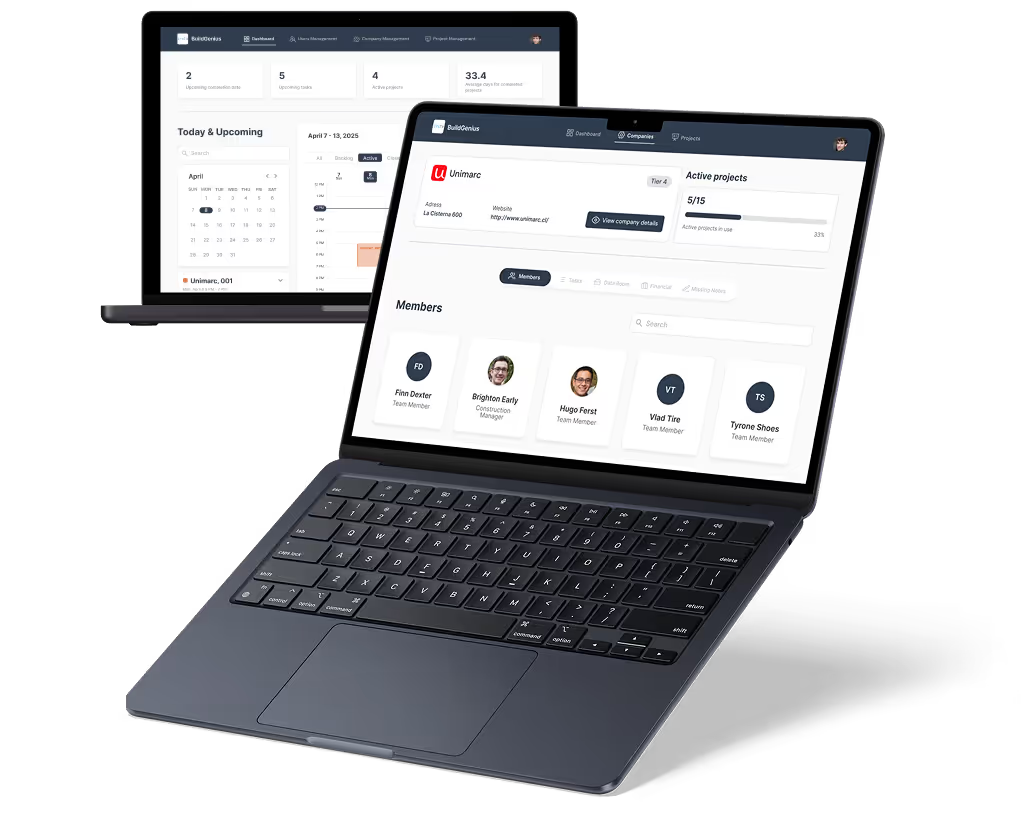
A DJ booking platform follows the principles of on-demand marketplace development. But the event-specific, custom-quoted, and equipment-dependent nature of DJ bookings requires workflow complexity that standard on-demand templates do not support.
Understanding the category structure before building prevents architecture choices you cannot undo.
- Project-based, not appointment-based: Each booking is event-specific, a defined date, venue, duration, event type, and technical setup, not a recurring service or a standard appointment slot.
- Event type spectrum: Wedding (ceremony and reception music, MC capability), club and venue (technical skills and genre specialism), corporate event (background music and branded playlist management), and private party (flexibility and crowd reading) each require different DJ types.
- Equipment specification as a functional requirement: A DJ's controller setup, CDJs, PA provision or requirement, and lighting rig must be captured and communicated before booking; undisclosed equipment requirements create last-minute problems.
- Why standard booking platforms fail this market: Appointment booking tools cannot handle custom quotes, multi-line pricing, technical rider management, or event-specific contract terms; purpose-built platform logic is required.
- Geographic reach consideration: DJs often travel nationally for significant events; search and matching should capture DJ travel policy and display associated travel fees before the quote stage.
Appointment booking tools create the booking flow. DJ booking platforms require a custom quote and contract workflow before any booking is confirmed.
What Features Must a DJ Booking Marketplace Include?
The DJ-specific quote, audio, and equipment features build on a foundation of core marketplace app features, profiles, search, messaging, payment, and reviews, that must be reliable before specialist functionality is added.
Features divide across DJ-side, event organizer-side, and shared workflow tools.
- DJ-side profile features: Event type specializations, genre expertise, mix demo audio player, live performance video, professional event photos, equipment specification, travel policy and radius, pricing structure, availability calendar, contract template management, and earnings reporting.
- Event organizer-side features: Search by event type, genre, equipment capability, location, price range, and availability; DJ profile browsing with audio mix playback; quote request submission with full event brief; booking management; messaging; and post-event review submission.
- Quote workflow (most critical feature): Structured quote request form, DJ quote response with itemised pricing, negotiation messaging, quote acceptance, and deposit payment trigger; this is the workflow that separates a professional booking platform from a directory with a payment button.
- Equipment and technical requirement capture: At quote stage, the platform should require the DJ to confirm PA provision, lighting inclusion, and what the venue must provide; this information should appear on the booking confirmation.
- Digital contract system: Platform-generated booking contract with event-specific variables, e-signature for both parties, and stored contract access; reducing the informal agreement patterns that create most DJ booking disputes.
The audio demo player and quote workflow are the two features that differentiate this platform most clearly. Build them before anything else.
How Do You Verify and Onboard DJs?
DJ verification is primarily about professional quality evidence rather than formal certification.
- Identity and professional verification: Government ID verification for all DJs, and company registration verification for DJs operating as limited companies; the baseline that prevents fraudulent profiles.
- Audio mix quality review: Platform should establish a minimum audio demo quality standard; mixes should be representative of the DJ's performance for the event types they list for; a human review of demo quality for the initial cohort is worth the operational cost.
- Equipment inventory verification: For DJs claiming to provide full PA systems, optional proof of equipment ownership, photos, insurance documentation, prevents equipment disputes at events.
- Public liability insurance: Professional DJs performing at events should hold public liability insurance; verify and display coverage on DJ profiles, as venues and event insurers increasingly require this.
- Professional references: For new DJs with no platform booking history, professional references from past clients or venues with contact details provide a quality signal during the first-cohort onboarding period.
Insurance verification displayed prominently on DJ profiles is one of the highest-trust signals for event organizers comparing unfamiliar professionals.
How Do Payments and Deposits Work for DJ Bookings?
The deposit-and-balance structure in DJ booking payment systems must be enforced at the payment layer, not the contractual layer alone. Manual cancellation fee negotiation creates disputes that undermine platform trust on both sides.
Payment architecture for DJ bookings must cover four distinct scenarios.
- Booking deposit structure: A 25–50% non-refundable deposit paid when the event organizer accepts the DJ's quote; the deposit holds the date and compensates the DJ if the organizer cancels.
- Balance payment timing and automation: The remaining balance is due 2–4 weeks before the event; the platform should automate balance payment prompts and enforcement; balance non-payment is the most common financial dispute in DJ bookings.
- Itemised quote and additional charge handling: DJ quotes often include separate line items for travel, extended hours, equipment hire, and accommodation; the quote and payment system must support itemised pricing that maps to the final invoice.
- Commission deduction and payout timing: The platform deducts commission before releasing the DJ's payout; payout timing of 48–72 hours post-event with a dispute hold window is standard; payout reliability is a critical retention factor for the supply side.
DJs who do not receive timely payouts abandon platforms quickly regardless of booking volume.
How Do You Structure Escrow and Deposits for Event Bookings?
The escrow and deposit structure for DJ bookings requires precise definition of the release trigger, the cancellation deadline conversion logic, and the force majeure policy before the first booking is confirmed, not as a dispute resolution afterthought.
Escrow mechanics for event-based bookings are more complex than standard marketplace payments.
- Escrow hold from booking to event completion: The platform holds the deposit and balance in escrow between booking confirmation and event completion; releasing the DJ's share only after the event organizer confirms performance delivery or after a 48-hour auto-release window.
- Deposit conversion on cancellation deadline: When the agreed cancellation deadline passes without cancellation, the deposit converts from conditionally refundable to non-refundable automatically; this conversion must be documented in the booking terms at confirmation.
- Partial refunds for partial cancellation: If an event is shortened due to venue issues, the refund calculation must be defined in the contract and enforceable in the payment system; most platforms leave this undefined and face manual negotiation for every occurrence.
- DJ cancellation handling: When the DJ cancels, the platform must return the full deposit and any balance paid to the event organizer; track DJ cancellation history and suppress or flag DJs with repeated cancellations from search results.
- Force majeure policy: Events canceled due to circumstances beyond either party's control require a tiered policy, full refund within X hours of discovery, partial refund after, no refund after the booking balance date, that is fair to both sides and legally defensible.
Force majeure provisions must be defined before launch, not created in response to the first disputed cancellation.
How Do You Build the Trust That Converts Enquiries Into Bookings?
A DJ rating and review system that captures event type and performance context in reviews gives event organizers the specific social proof needed to commit to a booking, far more useful than a generic star rating without context.
Trust conversion in DJ booking requires multiple signals working together.
- Demo mix audio as the primary conversion tool: A well-produced, event-appropriate audio demo is the single most powerful conversion feature; the platform should actively prompt DJs to upload multiple mixes for different event types.
- Verified booking history and event record: The number and type of events performed through the platform provides a track record signal that demo audio alone cannot give; guide new DJs on how to build this history quickly.
- Response rate and quote turnaround: DJs who respond to quote requests within 24 hours and submit professional, itemised quotes convert significantly more enquiries than those who respond slowly.
- The digital contract as a trust signal: The existence of a platform-generated contract with e-signature tells the event organizer the booking is legally documented and that the platform takes both parties' obligations seriously.
Trust is built across every touchpoint, not created by a single feature.
What Does the Build Process Look Like Step by Step?
A phased build sequence prioritizes the quote workflow and payment infrastructure before launch.
Phase 1: Scope and Validate (Weeks 1–3)
Define the primary event types the platform will serve at launch. Wedding and private events are the highest-value starting point. Interview 10–15 professional DJs and 10 event organizers to understand current booking process friction before writing a line of code.
Phase 2: Core Platform Build (Weeks 4–14)
Build DJ onboarding and media upload, the audio demo player is highest priority. Build profile creation with event type and genre specialization, availability calendar, quote request and response workflow, deposit payment and booking confirmation, in-app messaging, and event organizer search and filtering.
Phase 3: Contract and Escrow Layer (Weeks 10–16)
Build digital contract generation and e-signature flow, escrow hold-and-release logic, balance payment automation, cancellation fee enforcement, and the review and rating system. Do not promote the platform publicly until this layer is complete and tested.
Phase 4: Seeded Supply Launch (Weeks 14–18)
Onboard 30–50 verified DJs in the launch event categories before event organizer acquisition. Seed reviews through early bookings using a reduced-commission or free-first-booking offer for DJs who bring their first bookings through the platform.
Phase 5: Venue Channel and Scale (Ongoing from Week 18)
Track quote-to-booking conversion rate, cancellation rate, and DJ churn rate. Build the venue operator account type, a dedicated booking flow for nightclubs, bars, and hospitality venues booking DJs on residency arrangements; this buyer type generates higher annual booking value than private event organizers.
Conclusion
A DJ booking marketplace earns its bookings by making a high-trust, high-risk decision, committing hundreds or thousands of pounds to a performer for a single irreversible event, feel safe and professional.
The audio demo quality, the quote workflow, the digital contract, and the escrow payment mechanics are not secondary features. They are what separates a professional booking platform from a directory with a payment button attached.
Building a DJ Booking Marketplace and Need the Quote, Contract, and Escrow Architecture Right?
Most DJ booking marketplace builds get the design right and the workflow wrong. The quote system is too simple. The escrow logic is not defined. The contract is a PDF attached to an email. By the time the first disputed booking arrives, the platform has no structured resolution path.
We are LOW/CODE Agency — an AI product development company for SMBs. We build across the full stack: web apps, mobile apps, AI chatbots, RAG pipelines, and autonomous agents. Custom software, built by experts. We handle the audio demo integration, custom quote workflows, digital contract generation, and deposit escrow systems so the platform handles real DJ bookings from the first enquiry to the post-event payout.
- Audio demo player build: We implement SoundCloud, Mixcloud, and native audio embedding with multiple mix type support so every DJ's profile gives event organizers the audition they cannot get in person.
- Quote workflow architecture: We build the structured quote request form, itemised DJ response, negotiation messaging, and deposit payment trigger as a complete end-to-end workflow.
- Digital contract generation: We implement platform-generated booking contracts with event-specific variables, e-signature for both parties, and stored contract access available post-booking.
- Escrow and deposit system: We design the escrow hold, cancellation deadline conversion logic, force majeure policy, and auto-release window so every payment scenario is handled without manual intervention.
- Verification and vendor management: We build the identity verification, insurance confirmation, booking history tracking, and performance monitoring that keeps the DJ roster trustworthy as the platform scales.
- Venue operator account type: We build the residency booking flow and corporate account management tools that unlock the high-value venue booking segment as a distinct revenue channel.
- Full product team: Strategy, design, development, and QA from a single team that understands event industry booking dynamics and builds to match them.
We have built 350+ products for clients including Coca-Cola, American Express, and Sotheby's. We know exactly what it takes to build a booking platform that handles the complexity of professional event bookings reliably.
Related Articles
- How to Build a Dog Walker Marketplace
- How to Build a Doctor Consultation Marketplace
- How to Build a Doctor Booking Marketplace
- How to Build a DJ and Entertainment Services Marketplace
- How to Build a Digital Art Marketplace
- How to Build a Designer Boutique Marketplace
Partner with our mobile app development experts to launch your product faster.
Last updated on
September 28, 2026
.

Jesus is a visionary entrepreneur and tech expert. After nearly a decade working in web development, he founded LOW/CODE Agency to help businesses optimize their operations through custom software solutions.


FAQs
What are the key features needed for a DJ booking platform?
How can I attract DJs and clients to my marketplace?
What technology stack is best for building a booking marketplace?
How do I ensure secure payments on my DJ booking site?
What revenue models work for DJ booking marketplaces?
How can I handle cancellations and disputes effectively?
Related Articles

Marketplace
How to Build a Community Marketplace App
Step-by-step guide to create a community marketplace app with key features, costs, and best practices for success.
Marketplace
How to Build a Fitness Bootcamp Marketplace
Learn step-by-step how to build a successful fitness bootcamp marketplace with key features and marketing tips.
Marketplace
How to Build a Professional Services Marketplace
Learn key steps to create a successful professional services marketplace with expert tips on design, technology, and user engagement.
Marketplace
How to Build a 3D Model Marketplace
Learn how to create a 3D model marketplace with key steps, platform choices, and tips for success. Start your marketplace today.
Why customers trust us for no-code development


