

How to Build a Quality Inspection Checklist App with FlutterFlow
14 min
read
Learn how to build a quality inspection checklist app using FlutterFlow with step-by-step guidance and best practices.


A FlutterFlow quality inspection checklist app replaces paper forms that get lost, smudged, and filed in folders nobody opens. The real challenge is building something inspectors will actually use on a factory floor or inspection bay.
FlutterFlow handles conditional logic, photo capture, and NCR triggering well for most quality inspection use cases. This guide covers what it builds, what it costs to deliver, and where offline reliability and compliance requirements create real limits.
Key Takeaways
- Core fit is strong: FlutterFlow builds digital quality inspection checklist apps with conditional logic, photo capture, and pass/fail scoring without custom code.
- Photo evidence built in: Device camera integration lets inspectors attach photos to defect findings without any third-party plugin required.
- Offline mode is not default: Reliable offline inspection capture in areas with no Wi-Fi requires custom Dart code beyond FlutterFlow's standard capabilities.
- Cost range is $10,000 to $35,000: Platform fees are low; the bulk of cost is developer time building conditional logic, photo storage, and QMS integration.
- Compliance note: For ISO 9001, IATF 16949, or FDA-regulated inspection records, your data architecture must support audit trail and record integrity requirements.

What Can FlutterFlow Build for a Quality Inspection Checklist App?
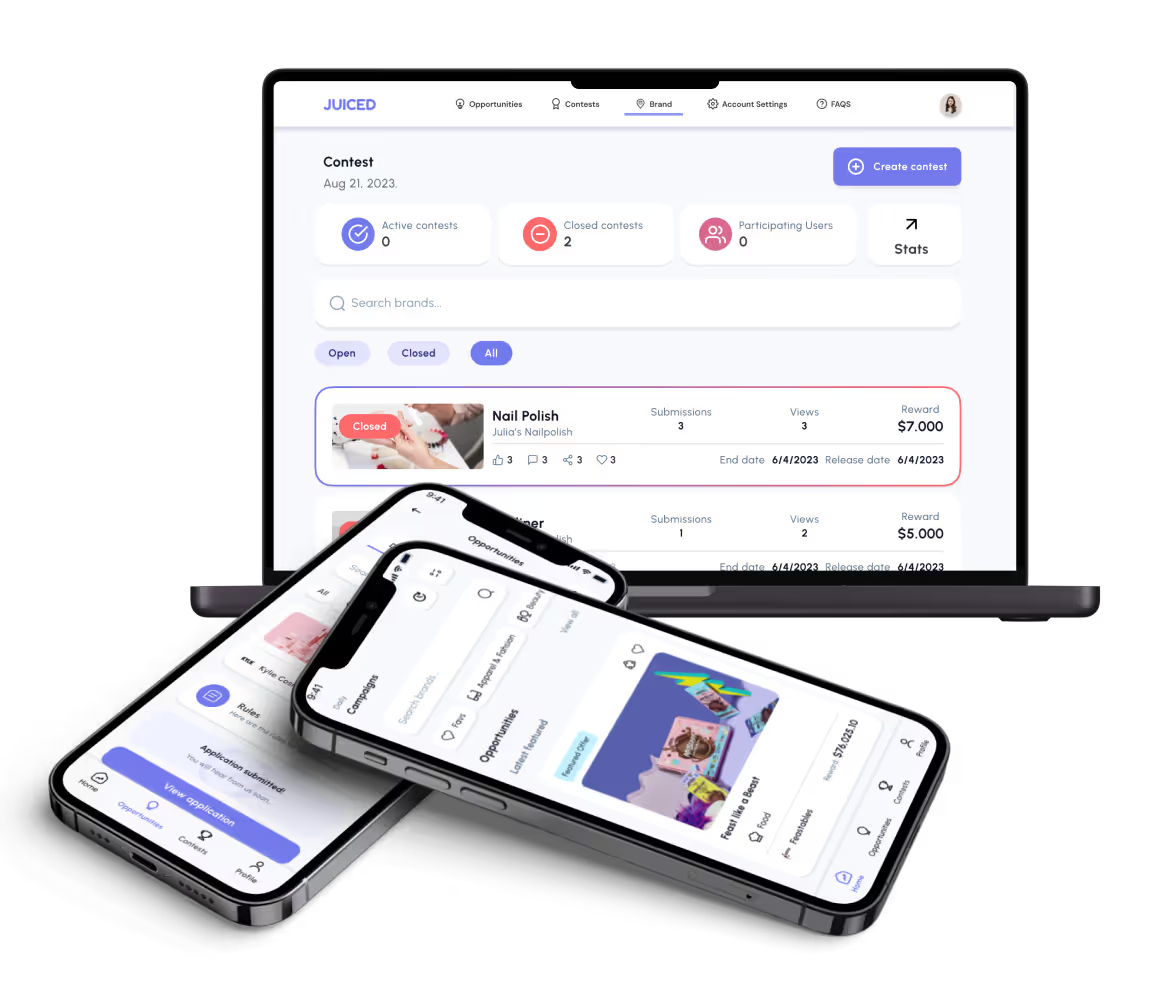
FlutterFlow can build a complete digital quality inspection checklist app: configurable templates, conditional skip logic, photo and annotation capture, defect scoring, digital signatures, inspection history, and non-conformance report triggering. Reviewing FlutterFlow checklist app examples shows how teams in manufacturing, construction, and field service have already replaced paper processes with digital inspection workflows.
FlutterFlow covers the core inspection workflow without requiring custom code for most standard use cases. Here is what each module delivers.
Dynamic Checklist Builder
Configurable inspection checklists support multiple question types: pass/fail, numeric entry, dropdown selection, and text observation fields. Templates build in the admin panel and deploy to inspector devices.
Each checklist template stores in Firestore with a version field, enabling updates to be rolled out without rebuilding the app.
- Multiple question types: Pass/fail toggles, numeric measurement entry, dropdown selectors, and free-text observation fields cover the majority of inspection item formats.
- Template versioning: Checklist templates store with a version field in Firestore, ensuring inspectors always use the current approved template for each inspection type.
- Admin template management: Quality managers build and update checklist templates in an admin panel without developer involvement after initial setup.
Conditional Logic and Skip Rules
Show or hide checklist items based on previous answers. Inspectors see only the questions relevant to the product type or inspection stage they are currently working through.
Conditional logic reduces inspection time and error rates by eliminating irrelevant questions that inspectors would otherwise skip manually.
- Answer-dependent visibility: A fail result on one item automatically surfaces follow-up questions specific to that failure mode, keeping the checklist focused.
- Product type branching: Selecting a product type at the start of an inspection loads the relevant subset of items, reducing checklist length for each specific product.
- Stage-based progression: Inspection stages such as incoming, in-process, and final each show only the relevant item set, preventing out-of-sequence responses.
Photo and Annotation Capture
Inspectors photograph defects, annotate images with markers, and attach them directly to the relevant checklist item. Device camera integration is native in FlutterFlow.
Photos store in Firebase Storage with references in the inspection record, enabling retrieval during corrective action review.
- In-app photo capture: Inspectors photograph defects at the point of finding using the device camera, without switching between apps or uploading later.
- Image annotation: Markup tools let inspectors circle or arrow defect locations on a photo before attaching it to the checklist item.
- Storage reference linking: Each photo stores in Firebase Storage with its URL written to the checklist item record, keeping images tied to specific findings.
Defect Classification and Severity Scoring
Defects classify by type, severity, and location using standardised codes. An inspection score or outcome calculates automatically based on the findings recorded.
Standardised defect codes enable trend analysis across inspections, identifying recurring defect patterns without manual data extraction.
- Defect code selection: Inspectors select from a standardised defect code library, ensuring consistent classification across all inspectors and shifts.
- Severity rating: Critical, major, and minor severity levels assign to each finding, weighted in the automatic score calculation for the overall inspection outcome.
- Automatic outcome calculation: The inspection passes or fails automatically based on configured scoring rules, without requiring inspector judgment on the final outcome.
Digital Signature Sign-Off
Inspector and supervisor signatures capture on completed inspections before the record submits and locks. Signature data stores as an image against the inspection record.
Digital sign-off replaces the paper handover step and provides a tamper-evident record of who approved each inspection outcome.
- Inspector signature: The completing inspector signs the checklist before submission, confirming that all findings were recorded accurately and completely.
- Supervisor sign-off: Failed inspections or critical findings route to a supervisor for countersignature before the record closes, enforcing a second review step.
- Signature locking: Once signed and submitted, inspection records lock and become read-only, preventing post-submission amendments to the finding data.
Inspection History and Traceability
All completed inspections store with inspector ID, timestamp, part number, and outcome. Records are searchable by date, product, production line, or inspector.
Traceability back to a specific inspection record is essential for responding to customer complaints or supplier disputes about product quality.
- Searchable history: Quality managers search completed inspections by part number, date range, production line, or outcome to identify patterns and outliers.
- Inspector traceability: Every record links to the inspector's user ID, enabling performance review and accountability across the inspection team.
- Part number traceability: Searching by part number returns all inspections for that product across dates, supporting customer complaint investigation and lot traceability.
Non-Conformance Report Triggering
When an inspection fails, an NCR record generates automatically and routes to quality managers for corrective action assignment. The NCR links to the originating inspection record.
Automatic NCR triggering removes the manual step of writing up a separate report after a failed inspection, ensuring no failures go unrecorded.
- Automatic NCR creation: A failed inspection or critical finding triggers a Cloud Function that creates a linked NCR record in Firestore without inspector action.
- Corrective action routing: NCRs route to the designated quality manager based on defect type and severity, with a notification sent to the assigned owner.
- NCR-to-inspection link: The NCR references the originating inspection record, providing full context for the corrective action team without searching separately.
How Long Does It Take to Build a Quality Inspection Checklist App with FlutterFlow?
A simple checklist MVP covering a single inspection type with pass/fail questions and photo capture takes 3 to 5 weeks. A full inspection app with multiple checklist types, conditional logic, NCR triggering, and reporting takes 8 to 14 weeks.
Timeline extends most when offline mode, QMS integration, digital signature requirements, or compliance-grade audit trail design are in scope.
- Simple MVP timeline: A single inspection template with pass/fail, photo capture, and basic history ships in 3 to 5 weeks with focused scope.
- Full app timeline: Multiple checklist types, conditional logic, NCR workflow, digital signatures, and a reporting dashboard extend the build to 8 to 14 weeks.
- Offline mode scope: Custom Dart code for reliable offline capture and sync adds 2 to 4 weeks depending on the complexity of the sync conflict resolution logic.
- QMS integration time: Connecting to Qualio, MasterControl, or SAP QM via API adds 2 to 4 weeks depending on the target system's API documentation.
- Speed advantage: FlutterFlow checklist apps ship in roughly half the time of a comparable custom Flutter build, with the same native mobile performance.
The phased approach is strongly recommended. Launch a single inspection type in phase one, then add additional templates and NCR workflow in phase two.
What Does It Cost to Build a FlutterFlow Quality Inspection Checklist App?
The FlutterFlow pricing breakdown is straightforward, but the total cost of a quality inspection app includes backend storage for photos and audit records that accumulate at volume. Full build costs range from $10,000 to $45,000 depending on scope.
- Enterprise QMS comparison: Dedicated QMS platforms like Qualio and MasterControl cost $500 to $5,000 or more per month; a FlutterFlow build replaces or supplements them at a fraction of the annual cost.
- Photo storage costs at volume: Industrial inspection programmes generating hundreds of photo-rich records per month need a CDN and storage cost management strategy from day one.
- Offline adds to build cost: Reliable offline sync is not included in a standard FlutterFlow build and requires custom Dart engineering that adds $5,000 to $15,000 depending on complexity.
- QMS integration adds cost: Connecting to a quality management system via API is a backend engineering task that often matches or exceeds the core app build cost.
- Hidden cost: compliance audit trail: Designing immutable inspection records that satisfy ISO 9001 or IATF 16949 audit requirements adds backend engineering time that initial quotes often exclude.
Budget a 15 to 20 percent contingency for photo storage growth and offline sync complexity that surface after the first production inspection month.
How Does FlutterFlow Compare to Custom Development or Enterprise Software for Quality Inspection?
FlutterFlow builds a quality inspection checklist app in 3 to 14 weeks at 3 to 5 times less cost than a dedicated enterprise QMS platform for a focused checklist solution. The capability ceiling sits at 21 CFR Part 11 compliance, advanced SPC charting, and ISO audit-ready QMS integration.
- Speed is the decisive advantage: FlutterFlow delivers a working inspection checklist in weeks; custom builds and enterprise QMS implementations take months to reach the same state.
- Template update speed: Quality managers add or modify checklist templates directly in the admin panel without raising a developer change request or waiting for a release.
- When FlutterFlow wins: Teams moving from paper or spreadsheets who need a fast, affordable digital checklist with photo capture and NCR triggering.
- When custom or enterprise wins: Regulated industries requiring 21 CFR Part 11 compliance, ISO audit-ready QMS integration at scale, or advanced SPC statistical analytics.
If FlutterFlow's capability ceiling does not meet your compliance requirements, exploring alternatives to FlutterFlow, including custom builds or dedicated QMS platforms, is the right next step.
What Are the Limitations of FlutterFlow for Quality Inspection Checklist Apps?
Understanding FlutterFlow data scale limits matters when an inspection programme generates thousands of photo-rich records per month. Storage costs and query performance both become significant concerns at industrial inspection volumes.
Offline reliability and regulatory compliance are the two limits that matter most for manufacturing and regulated industry buyers.
- Offline reliability requires custom code: Inspection environments with poor Wi-Fi demand offline-first architecture with local data queuing and sync conflict resolution, which requires custom Dart code beyond FlutterFlow defaults.
- FDA 21 CFR Part 11 gap: Part 11 requires specific audit trail controls, e-signature validation, and data integrity mechanisms beyond default FlutterFlow and Firebase configurations.
- Photo storage costs at scale: Industrial inspection programmes generating hundreds of photo-rich records per month accumulate significant Firebase Storage or Supabase costs without a cost management strategy.
- Complex conditional logic at scale: Deeply nested inspection branching with 50 or more conditions becomes difficult to manage and audit in the visual editor.
- QMS integration complexity: Connecting to Qualio, MasterControl, or SAP QM requires custom API actions and middleware that sits outside the visual builder entirely.
- Vendor dependency: Inspection record logic and checklist templates tie to FlutterFlow; code export on paid plans mitigates vendor lock-in for organisations needing full codebase ownership.
Knowing these limits before scoping prevents the most consequential failure: discovering a compliance or offline requirement after the product is deployed with inspectors and live quality data.
How Do You Get a FlutterFlow Quality Inspection Checklist App Built?
To hire a FlutterFlow developer for a quality inspection project, prioritise candidates with experience in offline-capable data collection apps and knowledge of manufacturing or quality management processes. Generic FlutterFlow UI experience is not sufficient for this use case.
Look for developers who can demonstrate experience with data-heavy mobile apps, not just visually polished FlutterFlow projects.
- Offline architecture knowledge: Ask specifically how they handle offline inspection capture, local data queuing, and sync conflict resolution before referencing any FlutterFlow project.
- Photo storage design: Your developer must explain how inspection photos are stored, compressed, retrieved at scale, and how storage costs are managed before the build begins.
- Conditional logic experience: Request examples of checklist apps with branching question logic, not just simple form-and-submit builds, before evaluating any candidate.
- Compliance awareness: Developers working in manufacturing or regulated industries must ask about ISO 9001, IATF 16949, or FDA requirements before scoping; a developer who does not ask is a red flag.
- Freelancer vs agency: Freelancers can deliver a simple single-checklist app; agencies are better for multi-template, compliance-adjacent inspection platforms with QMS integration.
- Expected prototype timeline: A working prototype with at least one live checklist template, conditional logic, and photo capture is a reasonable expectation within 3 to 4 weeks of starting.
Interview at least two developers, ask for examples with conditional question logic, and verify they can show photo storage and retrieval from a previous production app.
Conclusion
FlutterFlow is a fast and cost-effective way to build a quality inspection checklist app that replaces paper with digital capture, conditional logic, and photo evidence.
Document your most-used inspection checklist template, confirm whether offline use is required, and request a scoping call to define the MVP checklist set before any build begins.
Building a Quality Inspection Checklist App with FlutterFlow? Here Is How LOW/CODE Agency Approaches It.
Quality inspection apps look simple until you hit offline sync requirements, photo storage costs at scale, and compliance audit trail design. Those are the parts that most generalist teams handle incorrectly.
As AI development experts, we at LOW/CODE Agency help SMBs ship real software — web and mobile applications, intelligent chatbots, RAG pipelines, and autonomous AI agents built for businesses that need results, not platforms. We build FlutterFlow quality inspection checklist apps with conditional logic design, Firebase photo storage architecture, offline sync capability, NCR workflow engineering, and compliance-aware data structures for manufacturing and field operations teams.
- Conditional checklist design: We map your inspection logic into branching question structures that reduce inspector completion time and eliminate irrelevant question exposure.
- Photo capture and storage: We build the full photo pipeline including in-app capture, compression, Firebase Storage organisation, and retrieval at production inspection volumes.
- Offline architecture: Where factory floors or inspection sites have unreliable Wi-Fi, we implement custom Dart-based offline queuing and sync for reliable data capture.
- NCR workflow design: We build automatic non-conformance report triggering, corrective action routing, and NCR-to-inspection linking as a complete quality workflow.
- Digital signature implementation: We implement inspector and supervisor sign-off with tamper-evident locking that satisfies quality management audit requirements.
- Compliance-aware data structure: We design inspection record schemas with immutability, audit trail fields, and data integrity controls for ISO 9001 and IATF 16949 adjacent requirements.
- Full product team: Strategy, UX, development, and QA from a single team so your inspection app is production-ready for day one deployment on the factory floor.
We have built 350+ products for clients including Coca-Cola, American Express, and Sotheby's. We know what separates a checklist app that inspectors actually use from one that sits uninstalled after the first shift.
Related Articles
- How to Build a Realtor CRM Platform with FlutterFlow
- How to Build a Real Estate Agent Marketplace with FlutterFlow
- How to Build a Real Estate App with FlutterFlow
- How to Build a Purchase Order Automation App with FlutterFlow
- How to Build Property Management Software with FlutterFlow
- How to Build a Property Listing App with FlutterFlow
Last updated on
September 24, 2026
.

Jesus is a visionary entrepreneur and tech expert. After nearly a decade working in web development, he founded LOW/CODE Agency to help businesses optimize their operations through custom software solutions.


FAQs
What are the key features of a quality inspection checklist app?
How does FlutterFlow simplify app development for inspection checklists?
Can I integrate offline functionality in a FlutterFlow checklist app?
What are common challenges when building inspection apps with FlutterFlow?
How do I ensure data accuracy in a checklist app built with FlutterFlow?
Is it possible to export inspection reports from a FlutterFlow app?
Related Articles
FlutterFlow
How to Build a Training Management System with FlutterFlow
Learn how to create a training management system using FlutterFlow with step-by-step guidance and best practices.

FlutterFlow
How to Build a Creator Fan Subscription App with FlutterFlow
Learn how to create a creator fan subscription app using FlutterFlow with step-by-step guidance and best practices.

FlutterFlow
How to Build a Freelancer Marketplace App with FlutterFlow
Learn how to create a freelancer marketplace app using FlutterFlow with step-by-step guidance and key features explained.

FlutterFlow
How to Build a Spa Appointment App with FlutterFlow
Learn how to create a spa booking app using FlutterFlow with step-by-step guidance and essential features for smooth appointments.

Why customers trust us for no-code development


