

How to Build Legal Tech Apps with FlutterFlow
12 min
read
Learn how to create legal tech apps using FlutterFlow with step-by-step tips and best practices for efficient development.


FlutterFlow legal tech apps open a third path for law firms and legal teams. Expensive enterprise practice management software and jury-rigged combinations of email and spreadsheets have been the only two options, until now.
But the legal sector has specific confidentiality obligations, data regulations, and security requirements that demand scrutiny before any build begins. This guide covers what FlutterFlow can deliver, realistic costs and timelines, honest limitations, and what to look for when hiring.
Key Takeaways
- Viable use cases: FlutterFlow legal tech apps work well for client intake, case tracking, document management portals, billing dashboards, and internal workflow tools.
- Security imperative: Attorney-client privilege and legal data confidentiality require deliberate security architecture beyond FlutterFlow defaults.
- Document automation limits: Basic document generation is achievable; complex clause-level document assembly requires integration with dedicated tools such as Documate or HotDocs.
- Cost range: Legal apps built with FlutterFlow typically cost $20,000–$70,000 depending on workflow complexity and integration requirements.
- Compliance note: GDPR, CCPA, and jurisdiction-specific legal data regulations must be designed into the architecture from the start, not added after launch.
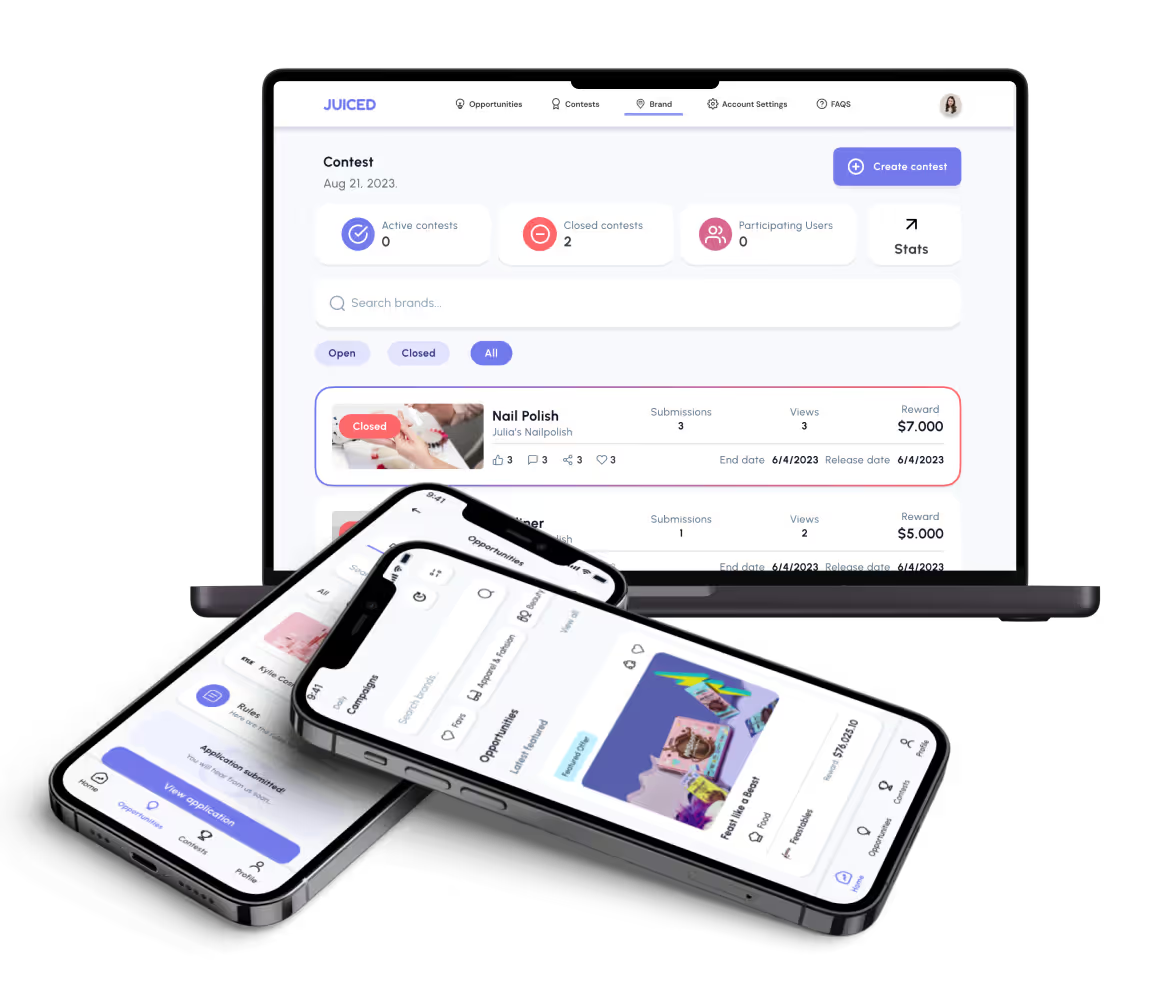

What Can FlutterFlow Build for Legal Tech?
FlutterFlow can build client intake flows, matter and case tracking dashboards, document management portals, billing interfaces, court date calendars, client communication portals, and conflict check workflows. Each of these is achievable within FlutterFlow's visual builder connected to a properly secured backend.
Looking at legal FlutterFlow app examples shows that client portals, intake forms, and billing dashboards are the most common starting points for law firms going digital.
Client Intake and Onboarding Forms
- Structured digital intake flows: Multi-step forms capture client details, matter type, conflict check data, and initial instructions in a guided sequence.
- Conditional logic by matter type: Form fields adjust dynamically based on the matter type selected, reducing irrelevant questions for each client.
- Conflict check data capture: The intake flow collects the specific fields the conflicts team needs to run a preliminary review before matter acceptance.
Matter and Case Tracking Dashboard
- Active matter status display: Responsible attorney, matter status, key dates, and task progress appear in a structured case management interface.
- Matter-level task management: Attorneys and paralegals add, assign, and complete tasks directly within the matter record, keeping all activity in one place.
- Date and deadline visibility: Critical dates such as court dates and filing deadlines surface on the matter record with colour-coded urgency indicators.
Document Upload and Management Portal
- Client and team document upload: Both clients and staff upload matter documents through a structured interface with folder organisation and access controls.
- Access control by role: Clients see only their documents; attorneys see all matter files; administrators access across all matters with appropriate permissions.
- Document metadata and search: Files are tagged by type, date, and matter, making retrieval by any team member fast without navigating complex folder structures.
Legal Billing and Time Entry Interface
- Mobile time logging for fee earners: Attorneys log billable time with matter selection and activity description from any device immediately after completing work.
- Disbursement recording: Court fees, expert costs, and travel expenses log directly in the app with receipt capture and matter linkage.
- Matter billing summary view: Partners see total hours, accrued fees, disbursements, and billing status per matter in a single dashboard view.
Court Date and Deadline Calendar
- Matter-linked calendar entries: Court dates, filing deadlines, and limitation dates link directly to the relevant matter record for full context.
- Push notification reminders: The app sends configurable advance warnings before critical dates, reducing reliance on manual calendar management.
- Shared team calendar view: All attorneys on a matter see each other's relevant dates, preventing scheduling conflicts and missed deadlines.
Client Communication Portal
- Secure in-app messaging: Encrypted message threads between clients and their legal team replace unencrypted email for sensitive matter communications.
- Message delivery confirmation: Clients see read receipts; attorneys know when communications have been received without following up separately.
- Document sharing within the portal: Attorneys share documents directly through the messaging thread rather than by email attachment, maintaining a complete audit trail.
Conflict Check Submission Flow
- Structured conflict check requests: Staff complete a guided form that captures all the information needed for a preliminary conflicts review before matter acceptance.
- Routing to conflicts team: Submissions route automatically to the designated partner or conflicts team member, with a defined response time and escalation path.
- Status tracking for the submitter: The requesting attorney can see whether the conflict check is pending, approved, or flagged without chasing the conflicts team directly.
How Long Does It Take to Build a Legal Tech App with FlutterFlow?
A simple legal app MVP covering intake, matter tracking, and a document portal takes 5–8 weeks. A full legal platform with intake, billing, calendar, client portal, and conflict checks takes 14–24 weeks. Security architecture complexity and e-signature integration are the main timeline drivers.
The phased approach delivers value faster: launch client intake and matter tracking first, add billing and the client portal in phase two.
- Security architecture adds timeline: Designing Firebase security rules, access controls, and audit logging correctly for a legal app takes more time than for a standard business tool.
- Practice area variations add scope: Each additional practice area with distinct workflow steps adds 1–3 weeks to the build for form logic, matter templates, and task structures.
- E-signature adds meaningful scope: DocuSign or Adobe Sign integration via custom API actions requires careful document handling flows and testing beyond standard FlutterFlow builds.
FlutterFlow legal apps typically deliver in roughly half the time of custom-coded practice management tools, with comparable quality for firms that do not need court filing integration or advanced legal AI.
What Does It Cost to Build a FlutterFlow Legal Tech App?
A FlutterFlow legal tech app costs $15,000–$80,000 depending on workflow complexity, number of integrations, and security architecture requirements. Ongoing costs include backend hosting, e-signature provider fees, secure document storage, and compliance maintenance.
FlutterFlow pricing and plans are affordable compared to practice management SaaS, but the total cost of a secure legal app must include data protection infrastructure and integration fees.
- FlutterFlow is 3–6x cheaper than custom development: A full legal platform at $60,000 in FlutterFlow compares to $150,000–$300,000 for equivalent custom-built software.
- Legal data encryption adds cost: Field-level encryption for sensitive client data and audit logging infrastructure are not standard build items; they add $5,000–$15,000 to project cost.
- GDPR data residency adds backend complexity: If client data must reside in a specific jurisdiction, the Firebase configuration and potential alternative hosting adds cost and architectural decisions.
At 10 or more users, a $50,000 FlutterFlow build with $12,000 per year in operating costs typically beats practice management SaaS on a 3-year total cost of ownership.
How Does FlutterFlow Compare to Custom Development or Enterprise Software for Legal Tech?
FlutterFlow builds legal apps in 8–24 weeks versus 10–24 months for custom development. It is 3–6x cheaper and delivers full customisation for firms that do not need court filing system integration or advanced multi-party litigation management.
A clear assessment of FlutterFlow pros and cons in a legal context reveals that the speed and cost advantage is real, but legal data requirements demand security investment that generic low-code apps often skip.
- FlutterFlow wins for boutique firms and legal startups: Client intake, matter tracking, and custom document portals at a fraction of the cost of enterprise practice management software.
- Enterprise PMS wins on compliance: Clio, MyCase, and Filevine have SRA and state bar compliance, LEDES billing, and court filing integrations built in as standard features.
- Custom development wins for complex multi-practice environments: Large firms managing multi-party litigation, court filing system integration, or certified compliance environments need a bespoke platform.
For in-house legal teams and legal tech startups building their first digital workflow tool, FlutterFlow is a credible starting point that does not require a million-dollar build budget.
What Are the Limitations of FlutterFlow for Legal Tech Apps?
FlutterFlow's default configuration is not suitable for legal data without deliberate security engineering. Attorney-client privilege protection, document version control, e-signature flows, court filing integration, GDPR data residency, and complex billing rules all require work beyond what FlutterFlow provides out of the box.
Understanding FlutterFlow security architecture is the starting point for any legal app project, given the attorney-client privilege and data confidentiality obligations that attach to legal information.
- Attorney-client privilege requires deliberate design: Confidential communications stored in Firebase need explicit encryption, access controls, and audit logging; FlutterFlow defaults do not provide this.
- Document version control needs external tools: Legal document versioning, redlining, and approval workflows require integration with dedicated tools or custom code beyond the visual editor.
- E-signature integration requires custom actions: DocuSign and Adobe Sign integrate via API but require careful document handling flows that go beyond FlutterFlow's standard configuration.
- Court filing system integration is bespoke: Filing directly with eCourt, PACER, or HMCTS requires bespoke API integration that FlutterFlow cannot provide natively.
- GDPR data residency may require custom hosting: Firebase's default multi-region deployment may not satisfy jurisdiction-specific data residency requirements for EU or UK client data.
- Complex billing rules exceed visual logic: Contingency fee calculations, split billing, and multi-party cost allocation require server-side logic that FlutterFlow's visual builder cannot execute.
Do not treat legal data as equivalent to standard business data. The confidentiality and regulatory obligations require explicit engineering decisions at every layer of the architecture.
How Do You Get a FlutterFlow Legal Tech App Built?
Hire a team with Firebase security rules expertise, e-signature API integration experience, and genuine understanding of legal workflows and data sensitivity. Security and compliance experience must rank alongside technical skill for any legal app project.
When you hire FlutterFlow legal app developers, security and compliance experience must rank alongside technical skill. Legal data is among the most sensitive your organisation handles.
- Firebase security rules expertise is non-negotiable: Ask specifically how they implement field-level security and access control for sensitive legal data; a vague answer is a red flag.
- E-signature API integration experience: Confirm they have integrated DocuSign or Adobe Sign via API before, including document preparation and signing flow design.
- Legal workflow knowledge: A developer who has not worked on legal tech before will misunderstand critical data relationships; ask for prior legal or regulated-industry app examples.
- GDPR-aware development practices: Confirm they address data residency, consent logging, and data subject access requirements as standard parts of the build, not afterthoughts.
- Red flag to avoid: Developers who do not ask about encryption, access controls, or your jurisdiction in the first conversation are not suitable for legal app development.
A working prototype with intake flow and basic matter tracker is achievable within four to five weeks with the right developer. Security architecture, e-signature, and billing integration are the phases that follow.
Conclusion
FlutterFlow is a viable platform for building legal tech apps covering client intake, matter tracking, billing interfaces, and client portals. The legal sector's confidentiality obligations and data regulations require deliberate security engineering that goes beyond what FlutterFlow configures by default.
Document your most critical legal workflow, identify your data residency and encryption requirements, and book a security-first scoping session before any development begins.
Building a Legal Tech App with FlutterFlow? Here Is How LOW/CODE Agency Approaches It.
Most legal tech app builds underestimate the security engineering required. Developers who work primarily in standard business apps miss the confidentiality and access control requirements that legal data demands. Getting the architecture wrong creates professional and regulatory risk, not just technical debt.
As AI development experts, we at LOW/CODE Agency help SMBs ship real software — web and mobile applications, intelligent chatbots, RAG pipelines, and autonomous AI agents built for businesses that need results, not platforms. We start every legal app project with a security and compliance scoping session before any screens are designed, so the architecture is compliant from the first line of code.
- Security-first architecture: We design Firebase security rules, field-level encryption, and access controls before any FlutterFlow screens are built.
- Legal workflow mapping: We document your intake, matter management, and billing workflows in detail before any configuration begins in the platform.
- E-signature integration: We integrate DocuSign or Adobe Sign with correct document preparation flows and signing sequences for legal document use cases.
- Client portal build: We build the secure in-app messaging, document sharing, and matter status portal that replaces email for sensitive client communications.
- GDPR and data residency design: We address jurisdiction-specific data residency requirements and design the compliance architecture before deployment.
- Billing layer build: We build the time capture, disbursement logging, and invoice approval workflow with the correct system boundary between FlutterFlow and your accounting backend.
- Full product team: Strategy, UX, development, and QA from a single team with experience in regulated-industry app delivery.
We have built 350+ products for clients including Coca-Cola, American Express, and Sotheby's. We apply the same structured, compliance-aware delivery process to legal tech that we bring to financial services.
Related Articles
- How to Build a Livestock Tracking App with FlutterFlow
- How to Build a Live Class Scheduling App with FlutterFlow
- How to Build a Lending Platform App with FlutterFlow
- How to Build a Legal Billing App with FlutterFlow
- How to Build a Lead Tracking CRM with FlutterFlow
- How to Build a Lead Scoring AI App with FlutterFlow
Last updated on
September 24, 2026
.

Jesus is a visionary entrepreneur and tech expert. After nearly a decade working in web development, he founded LOW/CODE Agency to help businesses optimize their operations through custom software solutions.


FAQs
What are the benefits of using FlutterFlow for legal tech app development?
Can FlutterFlow handle complex legal workflows and document management?
How secure are apps built with FlutterFlow for handling sensitive legal data?
Is coding experience necessary to build legal tech apps with FlutterFlow?
How does FlutterFlow compare to traditional coding for legal app development?
What are common challenges when building legal tech apps using FlutterFlow?
Related Articles

FlutterFlow
How to Build a Restaurant Management System with FlutterFlow
Learn how to create a restaurant management system using FlutterFlow with step-by-step guidance and best practices.

Comparison
FlutterFlow
FlutterFlow vs Thunkable: 10 Factors to Decide the Best One
Compare FlutterFlow vs Thunkable across 10 key factors like design, logic, scalability, and publishing to choose the right no-code app builder for your goals

FlutterFlow
How to Build a Client Onboarding Portal with FlutterFlow
Learn how to create a client onboarding portal using FlutterFlow with step-by-step tips and best practices for smooth user experience.

FlutterFlow
What You Can and Can’t Do with FlutterFlow (2026 Guide)
See what you can and can’t do with FlutterFlow in 2026. Learn real capabilities, limits, use cases, and when FlutterFlow is the right fit.


Why customers trust us for no-code development


