

How to Build an Events Marketplace Platform with FlutterFlow
14 min
read
Learn how to create an events marketplace platform using FlutterFlow with step-by-step guidance and best practices.


A FlutterFlow events marketplace platform gives founders a faster path from concept to live product. Event marketplaces fail not because of bad ideas but because of slow, expensive build cycles that outlast the runway.
For platforms connecting organisers with attendees, vendors, or venues, speed to market is often the difference between capturing a niche and losing it. This guide covers what FlutterFlow can actually deliver, realistic timelines and costs, where the platform hits its ceiling, and how to find a team that has built two-sided marketplaces before.
Key Takeaways
- Build timeline: A functional events marketplace MVP takes 6–10 weeks in FlutterFlow versus 4–6 months custom.
- Cost range: Agency-built FlutterFlow marketplaces typically run $20,000–$60,000 depending on feature depth.
- Best use case: FlutterFlow suits early-stage and mid-market events platforms needing fast, validated launches.
- Core limitation: Commission-split logic and real-time seat inventory at scale require custom backend work beyond the visual editor.
- Team requirement: You need a developer with marketplace and Stripe Connect experience, not just FlutterFlow UI skills.

What Can FlutterFlow Build for an Events Marketplace?
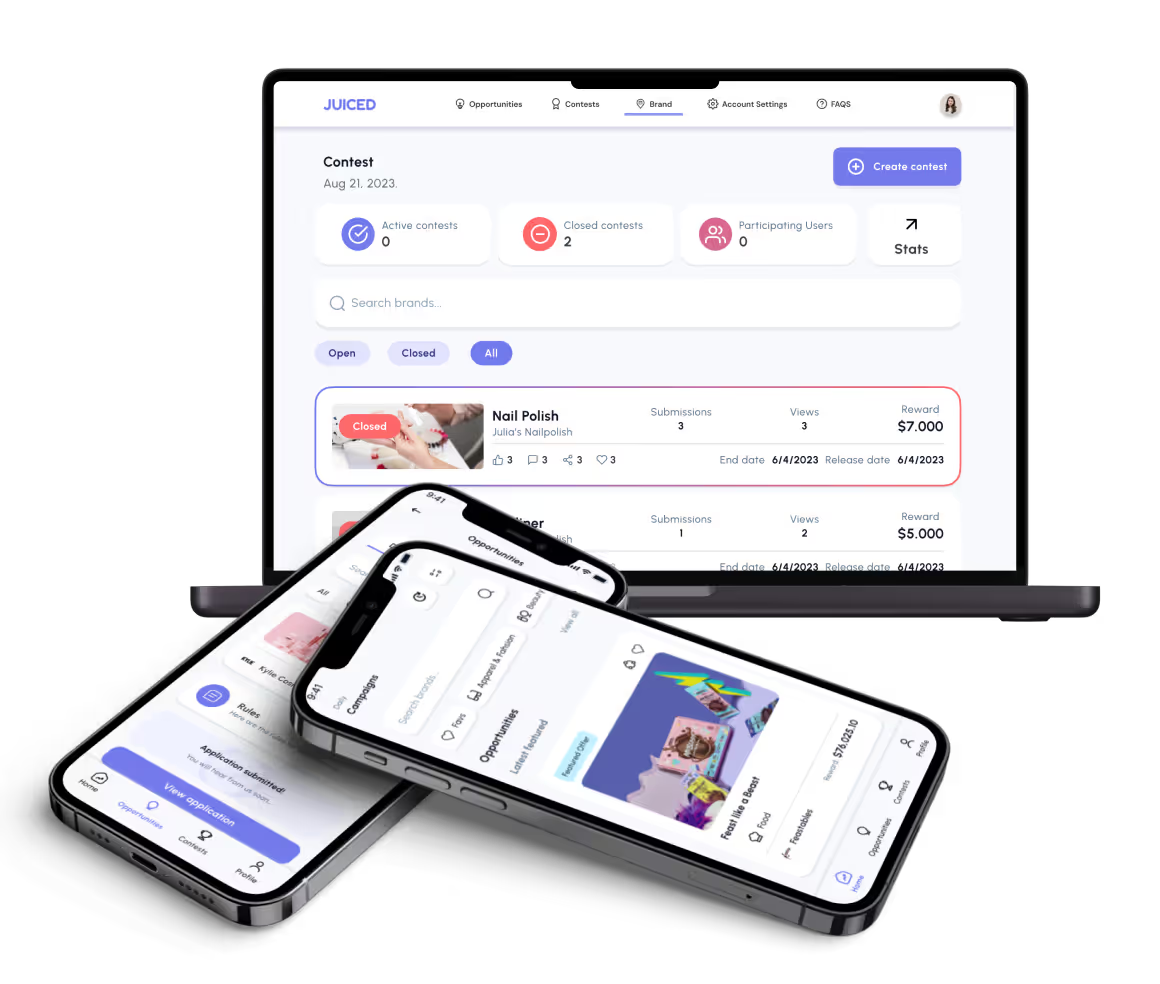
FlutterFlow can build the core of a two-sided events marketplace: organiser onboarding, event listing creation, attendee discovery, Stripe payment, commission dashboards, review systems, push notifications, and dispute flows. Stripe Connect for organiser payouts and automated refund logic require custom API actions beyond FlutterFlow's native Stripe widget.
Before speccing your feature set, it helps to look at real FlutterFlow marketplace builds to understand what production apps actually include versus what gets cut at MVP stage.
Organizer Onboarding and Profile Management
FlutterFlow can build multi-step organiser registration flows with document upload, approval workflows, and public profile pages tied to Firestore or Supabase.
- Multi-step registration: Organisers complete a structured onboarding flow with business details, document upload, and terms acceptance before gaining listing access.
- Admin approval workflow: Submitted organiser profiles enter a review queue. Admin users approve or reject within a configurable dashboard with a single action.
- Public profile pages: Approved organisers get a public-facing profile page showing their events, reviews, and contact information for attendee discovery.
Event Listing Creation and Management
Organisers create, edit, and manage event listings including rich text descriptions, image galleries, date and time pickers, location fields, and category tagging, all buildable with FlutterFlow's native widget set.
- Rich text description editor: FlutterFlow supports rich text input for event descriptions, allowing organisers to format content without developer involvement.
- Image gallery management: Organisers upload multiple event images stored in Firebase Storage, displayed in a gallery on the event detail page.
- Category tagging system: Predefined and custom category tags allow organisers to label events accurately and help attendees filter discovery results.
Attendee Search, Filter, and Discovery
Search bars, category filters, date-range pickers, and map-based discovery via the Google Maps widget can surface relevant events to browsing attendees.
- Keyword search: A Firestore-backed search allows attendees to find events by name, organiser, or keyword across the full listing catalogue.
- Date and category filters: Combined date-range and category filter queries narrow the discovery feed to exactly what each attendee is looking for.
- Map-based discovery: The Google Maps widget displays event pins on an interactive map, letting location-focused attendees browse nearby events visually.
Ticketing and Payment Processing
FlutterFlow supports Stripe integration for ticket purchases including multiple ticket tiers, promo code fields, and order confirmation flows. Stripe Connect for organiser payouts requires custom API actions.
- Multi-tier ticket purchasing: Attendees select from general admission, VIP, and early bird tiers with real-time availability counts pulled from Firestore.
- Promo code validation: Promo codes are stored in Firestore and validated at checkout, applying percentage or fixed discounts before payment confirmation.
- Stripe Connect distinction: Standard Stripe handles attendee payment. Stripe Connect, which splits funds between the platform and organisers, requires custom API action setup beyond FlutterFlow's native Stripe widget.
Commission and Payout Tracking Dashboard
An admin dashboard showing gross ticket sales, platform commission earned, and organiser payout status is buildable using Firestore collections and FlutterFlow's chart widgets.
- Gross sales tracking: Total ticket revenue per event and per organiser is aggregated from Firestore booking records and displayed in the admin view.
- Commission calculation display: Platform commission is calculated as a percentage of gross sales and surfaced alongside organiser net payout amounts.
- Payout status tracking: Each organiser's pending, processing, and completed payouts are tracked in a dedicated admin panel with status indicators.
Review and Rating System
Post-event review prompts, star ratings, and public review displays are standard marketplace features FlutterFlow handles cleanly with Firestore reads and write rules.
- Post-event review prompts: A push notification triggers a review request to attendees 24 hours after the event end time, improving review completion rates.
- Star rating and text review: Attendees submit a 1–5 star rating and optional written review, stored in a Firestore collection linked to the event and organiser.
- Public review display: Reviews appear on the event detail and organiser profile pages, sorted by recency and filtered to remove incomplete submissions.
Push Notifications for Event Reminders
Scheduled push notifications reminding attendees of upcoming events they have purchased tickets for can be triggered via Firebase Cloud Messaging within FlutterFlow.
- Scheduled reminder delivery: Reminders are sent 48 hours and 2 hours before each event, triggered by a Cloud Function reading upcoming events from Firestore.
- Ticket-holder targeting: Notifications are sent only to attendees with confirmed ticket purchases for the specific event, using Firestore user and booking data.
- Organiser update broadcasts: Organisers can send manual push notifications to their ticket holders for event updates, lineup changes, or logistical information.
Dispute and Refund Request Flow
A structured dispute submission form with status tracking and admin review queue can be built in FlutterFlow. Automated refund execution requires a backend Cloud Function.
- Dispute submission form: Attendees describe the dispute, attach evidence, and submit via a structured in-app form that creates a Firestore dispute record.
- Admin review queue: Open disputes appear in the admin panel with event, attendee, and organiser context, allowing the admin to approve or reject with a documented decision.
- Refund execution via Cloud Function: Approved refunds trigger a Cloud Function that calls the Stripe refund API and updates the booking and ticket status in Firestore.
How Long Does It Take to Build an Events Marketplace with FlutterFlow?
A simple events marketplace MVP with organiser listings, attendee purchase, and basic discovery takes 6–10 weeks in FlutterFlow. A full-featured platform with organiser dashboards, Stripe Connect payouts, Google Maps discovery, and admin tools takes 14–20 weeks. Launching with basic listing and purchase first reduces time to revenue significantly.
The phased approach is the single most effective way to de-risk a FlutterFlow marketplace build: launch with listing and purchase, add dashboards and payouts in phase two.
- Stripe Connect setup: Connecting Stripe Connect for organiser payouts with the required KYC and express account setup adds 2–3 weeks to the full platform build.
- Google Maps API integration: Map-based discovery requires Google Maps API configuration, key management, and widget tuning for event pin display.
- Multi-tier ticketing logic: Events with multiple ticket tiers and promo code validation require additional Firestore data model design and Cloud Function logic.
FlutterFlow's UI assembly advantage is 3–5x faster than custom development. The backend complexity in Stripe Connect and inventory locking is the point where the gap narrows.
What Does It Cost to Build a FlutterFlow Events Marketplace Platform?
A FlutterFlow events marketplace built by an agency costs $20,000–$80,000 depending on marketplace complexity. Developer rates run $50–$150 per hour. Custom development for equivalent functionality runs $80,000–$200,000 or more. The platform subscription itself costs $0–$70 per month.
Understanding FlutterFlow plan costs before scoping your marketplace will prevent budget surprises mid-build when you discover the tier you need for multi-role access or custom functions.
- Stripe Connect express account setup: Stripe charges fees on payouts through Connect express accounts. Factor this into your commission model before launch.
- Organiser KYC verification costs: If you require identity verification for organiser onboarding, third-party KYC API costs are an additional ongoing operational expense.
- Email notification service costs: SendGrid or Mailgun for transactional emails to attendees and organisers add a small but real monthly cost that scales with event volume.
The $20,000–$80,000 agency range reflects the significant difference between a simple listing and purchase MVP and a full platform with Stripe Connect, admin tools, and dispute management.
How Does FlutterFlow Compare to Custom Development for an Events Marketplace?
FlutterFlow delivers an events marketplace in 10–16 weeks at $20,000–$60,000. Custom development for the same scope takes 5–9 months at $100,000–$250,000. FlutterFlow wins for MVP validation, sub-$60K budgets, and teams without in-house Flutter engineers. Custom wins for high-volume platforms, complex matching algorithms, and enterprise compliance requirements.
The cost and timeline advantage for FlutterFlow is most pronounced at the MVP and mid-market level. For platforms expecting 100K+ concurrent users with deeply custom matching, custom development becomes the more defensible choice.
- When FlutterFlow wins: MVP validation, early-stage platforms building before product-market fit is confirmed, and teams without in-house Flutter engineering.
- When custom wins: High-volume platforms expecting 100K+ concurrent users, deeply custom organiser-attendee matching algorithms, or enterprise compliance requirements.
- Maintenance consideration: FlutterFlow updates are faster for listing and pricing UI changes but create platform dependency risk for custom widgets and API integrations.
Reviewing FlutterFlow strengths and trade-offs gives you an honest baseline before committing to either path for your events marketplace.
What Are the Limitations of FlutterFlow for an Events Marketplace?
FlutterFlow's main limitations for events marketplaces are real-time seat inventory locking, dynamic pricing rules, complex commission-split logic, and high-traffic ticket drops. Each requires backend Cloud Function work that cannot be expressed through FlutterFlow's visual editor, and each becomes more important as the platform scales.
Understanding FlutterFlow at scale matters especially when your ticketing platform expects high-concurrency events where thousands of attendees attempt to purchase simultaneously.
- Real-time seat inventory locking: FlutterFlow cannot natively prevent double-booking of limited seats without custom Cloud Functions handling optimistic or pessimistic locking logic.
- Dynamic pricing rules: Surge pricing or demand-based ticket pricing requires backend logic that FlutterFlow cannot express visually in its action chain editor.
- Commission-split complexity: Multi-condition commission rules involving organiser tier, event type, and promo code stacking become unwieldy in FlutterFlow's action chains at scale.
- High-concurrency ticket drops: Thousands of simultaneous purchases stress Firestore read and write limits without careful sharding and Cloud Function queue architecture.
- Vendor dependency risk: FlutterFlow platform changes can break custom widgets or API integrations unexpectedly, requiring developer time outside of planned build cycles.
- Code export limitations: Exported Flutter code requires significant cleanup before a custom team can maintain it efficiently. It is an escape valve, not a clean handoff.
The seat inventory locking problem is the most common technical surprise for events marketplace founders using FlutterFlow. Design the Cloud Function concurrency architecture before the build starts, not after your first oversold event.
How Do You Find the Right Team for a FlutterFlow Events Marketplace?
For a FlutterFlow events marketplace, you need a team with Stripe Connect experience, Firebase security rules for multi-tenant data, and two-sided marketplace UX patterns. Agencies are safer than freelancers for commission logic, admin dashboards, and payout flows. Red flags include no marketplace portfolio and quoting under $10,000 for a full two-sided platform.
Knowing how to hire experienced FlutterFlow developers with marketplace backgrounds saves months of rework on payment flows and multi-tenant data architecture.
- Stripe Connect distinction: A developer who knows standard Stripe but has not built Stripe Connect express account flows will add weeks of rework to the payout layer.
- Firebase security rules experience: Multi-tenant data, where organiser data and attendee data must be isolated, requires Firebase rules expertise that not every FlutterFlow developer has.
- Marketplace UX portfolio: Ask for examples of two-sided marketplace apps they have built. Both sides of the market, organiser and attendee, must be represented in their work.
- Red flags when hiring: No marketplace app portfolio, quoting under $10,000 for a full platform, and no discussion of backend function setup for payout logic.
- Questions to ask directly: Have you built Stripe Connect payout flows in FlutterFlow before? How do you handle real-time inventory conflicts? What does your QA process look like for payment flows?
Expect a well-structured project to run 11–14 weeks for discovery, design, build, QA, and launch for a mid-complexity events marketplace with Stripe Connect.
Conclusion
FlutterFlow is a strong fit for events marketplace MVPs and mid-market platforms. The speed advantage, cost reduction, and feature coverage make it the right starting point for founders who need to validate before investing in a full custom build.
Real-time inventory locking, dynamic pricing, and high-scale concurrent ticket drops require careful backend architecture alongside FlutterFlow, not instead of it. Map your must-have features against the capabilities covered here, then brief a team with Stripe Connect and two-sided marketplace experience before committing to a timeline.
Building an Events Marketplace with FlutterFlow? Here Is How LOW/CODE Agency Approaches It.
Most events marketplace builds run into the same two problems: Stripe Connect payout logic that is more complex than expected, and real-time seat inventory that oversells under any meaningful load. Both are solvable, but only if they are designed correctly before the build starts.
As AI development experts, we at LOW/CODE Agency help SMBs ship real software — web and mobile applications, intelligent chatbots, RAG pipelines, and autonomous AI agents built for businesses that need results, not platforms. We scope the two-sided marketplace architecture, Stripe Connect flows, and inventory locking design before any FlutterFlow build begins so your platform is built to hold up from the first event, not just the demo.
- Two-sided marketplace architecture: We design the organiser and attendee data models, permission layers, and onboarding flows before any UI build begins.
- Stripe Connect payout design: We build the full Stripe Connect express account setup, commission calculation, and organiser payout flow as a tested, documented system.
- Inventory locking implementation: We design the Cloud Function concurrency logic to prevent seat overselling under simultaneous purchase load, not just in testing scenarios.
- Discovery and search build: We implement keyword search, category filtering, date-range pickers, and Google Maps event discovery for the attendee-facing app.
- Admin dashboard and dispute management: We deliver the commission tracking, payout status, and dispute resolution admin tools your team needs to operate the platform.
- Post-launch iteration: We stay involved through your first major events to refine the inventory logic, payout flows, and notification timing as real data comes in.
- Full product team: Strategy, UX, development, and QA from a single team with two-sided marketplace and payment split experience.
We have built 350+ products for clients including Coca-Cola, American Express, and Sotheby's. Events marketplace architecture is a known build pattern for our team, and we know where the Stripe Connect and concurrency problems appear before they cost you a launch.
Related Articles
- How to Build a Farmer Marketplace App with FlutterFlow
- How to Build a Farm Management App with FlutterFlow
- How to Build a Factory Operations Dashboard with FlutterFlow
- How to Build an Event Ticketing App with FlutterFlow
- How to Build an Equipment Maintenance Scheduler with FlutterFlow
- How to Build Equipment Rental Tech with FlutterFlow
Partner with our low-code development experts to bring your app idea to life faster.
Last updated on
September 24, 2026
.

Jesus is a visionary entrepreneur and tech expert. After nearly a decade working in web development, he founded LOW/CODE Agency to help businesses optimize their operations through custom software solutions.


FAQs
What are the key features needed for an events marketplace platform?
Can FlutterFlow handle complex backend functions for event management?
How do I integrate payment gateways in a FlutterFlow events app?
Is it possible to customize the UI extensively in FlutterFlow for an events marketplace?
What are common challenges when building an events marketplace with FlutterFlow?
How can I test and deploy my FlutterFlow events marketplace app?
Related Articles

FlutterFlow
How to Build a Subscription Billing App with FlutterFlow
Learn how to create a subscription billing app using FlutterFlow with step-by-step guidance and best practices for seamless payments.
FlutterFlow
Comparison
FlutterFlow vs Noodl | 10 Factors to Decide the Best One
Compare FlutterFlow vs Noodl across 10 key factors like performance, pricing, customization & more to find the best no/low-code platform for your app

FlutterFlow
How to Build a Business Intelligence Dashboard with FlutterFlow
Learn how to create a business intelligence dashboard using FlutterFlow with step-by-step guidance and best practices for data visualization.

FlutterFlow
How to Build an Inventory Scanning App with FlutterFlow
Learn how to create an inventory scanning app using FlutterFlow with step-by-step guidance and best practices for smooth development.


Why customers trust us for no-code development


