

How to Build a Client Onboarding Portal with FlutterFlow
14 min
read
Learn how to create a client onboarding portal using FlutterFlow with step-by-step tips and best practices for smooth user experience.


A FlutterFlow client onboarding portal replaces the email chain, shared folder, and manual follow-up with a structured, branded digital experience. Clients complete intake forms, upload documents, sign contracts, and track their onboarding progress in one place.
For professional services firms, agencies, and SaaS businesses, the onboarding experience is the first real signal of what working with you will be like. This guide covers what FlutterFlow can build, realistic costs and timelines, how it compares to off-the-shelf portal tools, and where it has genuine limitations.
Key Takeaways
- Core capability: FlutterFlow builds branded client intake forms, document collection, contract e-signature flows, progress dashboards, and internal team task views in a single portal.
- Timeline: A client onboarding portal MVP takes 5–8 weeks. A full system with e-signature, CRM sync, and multi-service tracks takes 10–16 weeks.
- Cost: Projects range from $15,000–$55,000 depending on integration complexity and the number of onboarding tracks.
- Best fit: Agencies, consultancies, legal firms, financial advisers, and SaaS businesses that onboard clients through a structured, document-heavy process.
- Key limitation: E-signature and identity verification require third-party API integrations, they are not native FlutterFlow capabilities.
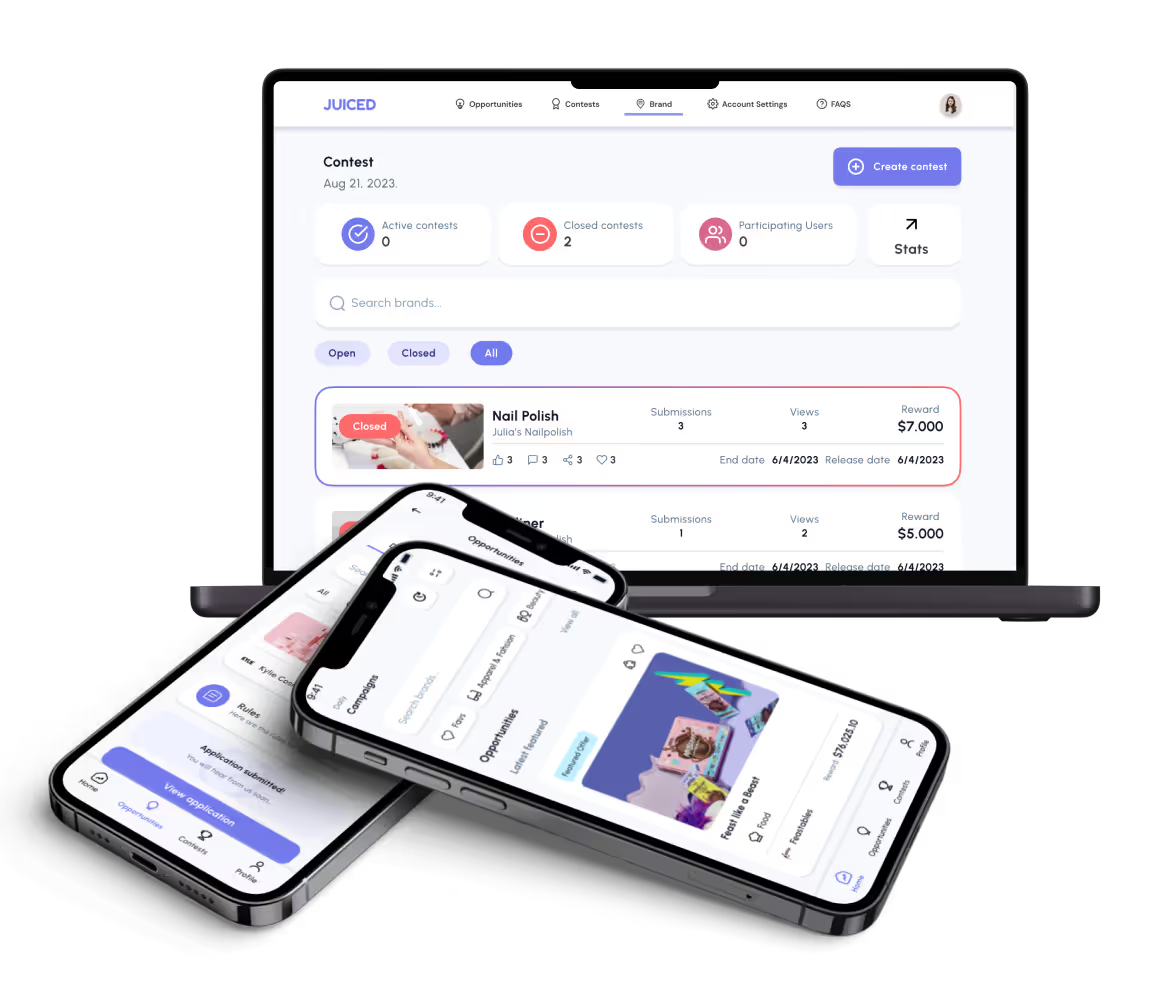

What Can FlutterFlow Build for Client Onboarding?
FlutterFlow builds a fully branded client onboarding portal with intake forms, document collection, e-signature integration, onboarding progress tracking, internal team task views, CRM sync, and automated communications, all in a single custom application.
You can build a client SaaS portal with FlutterFlow that functions as a fully branded, multi-step onboarding experience for professional services clients.
Branded Client Welcome Portal
Build a white-labelled welcome screen with your brand, the client's name, and a clear overview of their onboarding journey.
- Brand-first impression: The welcome screen carries your logo, brand colours, and a personalised greeting before clients take any action.
- Journey overview: Clients see the full onboarding checklist on arrival so they understand the process and what is expected of them.
- Friction reduction: A clear, branded entry screen reduces first-contact confusion and sets a professional tone for the engagement.
- Client-specific content: Each client sees their company name, assigned contact, and relevant service track on login.
The welcome screen is the first branded interaction your client has after signing the contract, and it sets the tone for everything that follows.
Structured Client Intake Forms
Create multi-step intake questionnaires that collect business information, requirements, preferences, and technical details in a single guided flow.
- Multi-step structure: Breaking intake into stages reduces cognitive load and keeps clients focused on one section at a time.
- Conditional questions: Different service types surface different intake questions, so clients are not asked irrelevant fields.
- Progress saving: Clients save their progress and return to the form without losing completed fields.
- Validation rules: Required fields and format checks prevent incomplete or incorrectly formatted submissions from reaching your team.
Completed intake data writes directly to your backend and can sync to your CRM automatically, removing manual re-entry.
Document Upload and Collection
Build guided document submission flows where clients upload required files with validation, progress tracking, and confirmation receipts.
- Guided upload steps: Clients are told which document is required at each step, reducing the "what do you need from me?" support queries.
- File validation: Format and size restrictions are applied per document type so only acceptable files reach the review queue.
- Progress tracking: A visual indicator shows which documents have been uploaded, which are pending review, and which have been approved.
- Confirmation receipts: Clients receive a confirmation message when each document is accepted, removing uncertainty about what has been received.
All uploaded documents attach to the client record automatically, giving your team a single location for every submission.
Contract and Agreement E-Signature
Integrate with DocuSign or HelloSign to route service agreements, NDAs, and statements of work for legally binding electronic signature within the portal.
- In-portal signing: Clients receive, review, and sign contracts without leaving the onboarding portal or switching to an external tool.
- Automated routing: When a client completes intake, the relevant agreement is sent automatically without manual document preparation.
- Signed document storage: Executed agreements store against the client record with timestamp and signer identity confirmation.
- Multi-party signing: Agreements requiring multiple signatories (client, director, guarantor) are routed sequentially within the same workflow.
E-signature integration is not a native FlutterFlow feature. It requires a DocuSign or HelloSign API connection, which adds build time and API subscription costs.
Onboarding Progress Tracker
Show clients a visual progress view of their onboarding checklist, including completed steps, pending items, and what is coming next.
- Visual checklist: Clients see a step-by-step progress view that makes outstanding items clear without relying on email reminders.
- Status updates in real time: Completed steps update the progress tracker automatically as actions are verified by your team.
- Reduced status enquiries: Clients who can see their own progress status generate fewer inbound calls and emails asking where things stand.
- Next step prompts: When a step completes, the tracker highlights the next required action and links directly to it.
The progress tracker reduces the administrative overhead of managing onboarding for multiple clients simultaneously.
Internal Team Task and Handoff View
Give your team a matching internal view of where each client is in the onboarding process, with task assignment, status tracking, and alerts for stalled clients.
- Team dashboard: Internal staff see every active onboarding, current status, assigned owner, and outstanding actions in one view.
- Task assignment: Onboarding tasks are assigned to specific team members from within the dashboard, with due dates and completion tracking.
- Stall alerts: Clients who have not completed an action within a defined period trigger an alert to the assigned team member for follow-up.
- Handoff triggers: When a client completes onboarding, a handoff task is created automatically for the relevant account manager or service team.
The internal view eliminates the need for separate spreadsheet-based onboarding trackers that go out of date the moment they are created.
CRM and Project Management Integration
Sync completed onboarding data to your CRM and project management tools automatically, eliminating manual data re-entry on completion.
- CRM sync: Completed intake data populates HubSpot or Salesforce records directly, with field mapping defined during setup.
- Project tool creation: When onboarding completes, a project is created automatically in Asana or ClickUp with the client's information pre-populated.
- Bi-directional updates: Changes to client status in the CRM can update the portal record and vice versa, keeping both systems aligned.
- Integration maintenance: CRM sync requires ongoing maintenance, field mapping changes in either system can break the connection and must be monitored.
CRM sync reliability is a real operational risk. Bi-directional sync failures are common post-launch and should be flagged as a maintenance consideration from day one.
Automated Welcome and Reminder Communications
Trigger automated welcome emails, step completion confirmations, and reminder nudges for clients who have not completed onboarding tasks within a set timeframe.
- Welcome email sequence: New clients receive a branded welcome message immediately after portal access is provisioned, with login instructions and a summary of next steps.
- Step completion messages: Each completed onboarding step triggers a confirmation so clients know their submission has been received and is under review.
- Reminder cadence: Clients who have not completed a required step within a defined period receive automated reminders at set intervals.
- Escalation to account manager: If a client remains stalled after multiple automated reminders, an escalation alert goes to the assigned team member.
Automated communications are configured through a transactional email provider (SendGrid or Postmark) integrated into the portal workflow.
How Long Does It Take to Build a Client Onboarding Portal with FlutterFlow?
A simple onboarding portal MVP with intake forms, document upload, and a progress tracker takes 5–8 weeks. A full multi-track portal with e-signature, CRM sync, internal task management, automated communications, and multiple service tracks takes 10–16 weeks.
Timeline is driven primarily by the number of onboarding tracks, e-signature API integration, and CRM connection complexity.
- Phased delivery: Launch intake and document collection first, then add e-signature, CRM sync, and automated reminders in phase two.
- Generic portal tools activate faster: Copilot or Notion portals go live same-day but cannot match a custom intake structure or deep CRM integration.
- Design adds time: A fully branded portal with custom screens for each service track adds 1–2 weeks beyond a standard design implementation.
The phased approach means your team has a working digital intake portal within 5–8 weeks rather than waiting the full 16 weeks for every feature.
What Does It Cost to Build a FlutterFlow Client Onboarding Portal?
A FlutterFlow client onboarding portal costs $25,000–$70,000 for a full agency build with e-signature, CRM integration, and automated communications. The platform itself costs $0–$70 per month. The investment is in development, design, and integration work.
Review FlutterFlow pricing plans explained before budgeting, the platform cost is consistently the smallest component of the total investment.
- Copilot comparison: Copilot costs $29–$119 per month with limited customisation. At $119 per month, that is $1,428 per year for a product your clients can immediately tell is not yours.
- Amortised cost: A $40,000 FlutterFlow portal build amortised over five years costs $8,000 per year for a fully branded, custom system.
- Hidden costs to budget: E-signature API fees, branded design work, CRM integration development, and email deliverability setup each add to the total cost.
The economic case for building a custom portal strengthens as the number of clients onboarded and the complexity of the intake process increases.
How Does FlutterFlow Compare to Off-the-Shelf Client Portal Software?
FlutterFlow takes 8–16 weeks to build versus same-day activation for Copilot or ClientVenue. The tradeoff is total customisation control and deep CRM integration against speed and zero development cost.
For firms with complex multi-step intake, multiple service lines, or a need for deep CRM integration, off-the-shelf tools create too many compromises.
- When FlutterFlow wins: Firms with complex multi-step intake processes, multiple service lines with different onboarding tracks, or a need for deep CRM integration.
- When off-the-shelf wins: Small agencies needing a simple client-facing file sharing and communication hub with no engineering resource available.
- Volume threshold: The custom portal investment pays off when it serves 20+ active client onboardings per year and reduces manual administration time measurably.
If you are evaluating no-code platforms for this build, Bubble versus FlutterFlow for portals covers the key architectural differences between the two options.
What Are the Limitations of FlutterFlow for Client Onboarding?
E-signature, identity verification, and GDPR consent management are not native FlutterFlow capabilities. They require deliberate API integration, third-party services, and backend design from the start of the project.
Reviewing FlutterFlow security for client data before finalising your data architecture and consent management approach is a prerequisite for any client-facing portal handling sensitive information.
- E-signature is not native: DocuSign or HelloSign API integration is required for legally binding signatures, adding API fees, dependency risk, and configuration complexity.
- Identity verification gap: KYC and right-to-work checks (relevant for legal, financial, and recruitment firms) require a third-party identity API such as Onfido or Jumio.
- GDPR consent design: Collecting business and personal data from clients requires consent capture, data retention policies, and deletion workflows built into the architecture deliberately.
- Conditional intake complexity: Intake forms with many conditional branches based on client type or service selection can become unwieldy in the visual builder at high complexity levels.
- White-label depth: Deep white-labelling (custom domain per client, client-specific colour schemes) requires additional development effort beyond standard brand customisation.
- CRM sync reliability: Bi-directional sync with Salesforce or HubSpot requires ongoing maintenance. Field mapping changes in either system can break the sync and must be monitored.
These limitations do not make FlutterFlow the wrong choice. They are scoping requirements that must be addressed through third-party services and deliberate architecture from day one.
How Do You Get a FlutterFlow Client Portal Built?
The expertise required covers client portal UX, FlutterFlow development, e-signature API integration, CRM connection knowledge, and GDPR data compliance. Missing any one of these creates operational or legal risk post-launch.
When you hire FlutterFlow developers for a client portal, look specifically for experience with e-signature APIs and CRM integrations, these are the technically demanding components.
- E-signature experience: Ask for examples of previous portals where DocuSign or HelloSign was integrated, including how multi-party signing was handled.
- CRM integration depth: Confirm the team has completed bi-directional CRM sync projects and understands the field mapping and maintenance requirements.
- GDPR compliance approach: Ask directly how they handle consent capture, data retention, and deletion workflows in a Firebase data model.
- Freelancer versus agency: Simple intake portals can be freelancer projects. Multi-track portals with e-signature, CRM sync, and automated communications need a structured team.
- Red flag to avoid: Any team that is vague about GDPR data handling or has no e-signature integration track record should not be building a client-facing portal.
Expect 10–14 weeks from a good team for a full client onboarding portal with e-signature, CRM integration, and automated communications.
Conclusion
A FlutterFlow client onboarding portal is worth building when your intake process is complex enough that Copilot or generic portal tools create too many compromises.
E-signature, identity verification, and CRM integration all require deliberate API work. These should be scoped from the start, not added as afterthoughts once the portal is live.
Map your current onboarding process step by step, identify which steps require signature or identity verification, and document your CRM integration requirements. That is the complete scope document your developer needs to provide an accurate quote.
Building a Custom FlutterFlow Client Onboarding Portal? Here Is How LOW/CODE Agency Approaches It.
An email-based onboarding process signals to new clients that your internal operations are as disorganised as their inbox. A custom portal changes that perception from the first login.
At LOW/CODE Agency, we help SMBs compete with AI-powered software built for them — custom web and mobile apps, RAG systems, chatbots, and intelligent agents delivered by a senior development team. We build FlutterFlow client onboarding portals for professional services firms, agencies, and SaaS businesses, with e-signature integration, CRM sync, and GDPR-compliant data architecture built in from the start.
- Onboarding flow mapping: We document your current onboarding process step by step before any design or build work begins.
- Branded portal design: We design a portal that carries your brand identity and presents your onboarding process as a professional, structured experience.
- E-signature integration: We connect DocuSign or HelloSign to your portal workflow so contracts are signed within the platform, not via separate email chains.
- CRM and project tool sync: We build and maintain the integration between your portal and your CRM or project management tool to eliminate manual data re-entry.
- GDPR-compliant architecture: We design consent capture, data retention, and deletion workflows into the portal from day one.
- Internal team dashboard: We build the team-facing view that gives your staff visibility of every active onboarding without a separate tracker.
- Post-launch maintenance: We stay involved to monitor CRM sync reliability, handle field mapping changes, and add new service tracks as your business grows.
We have built 350+ products for clients including Coca-Cola, American Express, and Sotheby's. We know exactly what makes client portal builds succeed and what causes them to underperform post-launch.
Related Articles
- How to Build a Coaching App with FlutterFlow
- How to Build a Cloud Kitchen Management App with FlutterFlow
- How to Build a Clinic Management System with FlutterFlow
- How to Build a Client Intake System with FlutterFlow
- How to Build a Claims Workflow App with FlutterFlow
- How to Build a Chat App with FlutterFlow
Last updated on
September 24, 2026
.

Jesus is a visionary entrepreneur and tech expert. After nearly a decade working in web development, he founded LOW/CODE Agency to help businesses optimize their operations through custom software solutions.


FAQs
What are the first steps to create a client onboarding portal in FlutterFlow?
How can I integrate user authentication in a FlutterFlow onboarding portal?
What database options work best with FlutterFlow for onboarding portals?
How do I ensure a smooth user experience in a FlutterFlow onboarding portal?
Can I customize the onboarding portal’s design in FlutterFlow?
What are common challenges when building onboarding portals with FlutterFlow?
Related Articles

FlutterFlow
How to Build Equipment Rental Tech with FlutterFlow
Learn how to create equipment rental software using FlutterFlow with ease and speed. Start building your app today.

FlutterFlow
5 Real FlutterFlow App Examples (Live Product Use Cases)
Explore 5 real FlutterFlow app examples with live product use cases. See how teams build scalable mobile apps, MVPs, and production-ready solutions using FlutterFlow.

FlutterFlow
How to Build an Influencer Marketplace with FlutterFlow
Learn how to create an influencer marketplace using FlutterFlow with step-by-step guidance and best practices for success.

FlutterFlow
How to Build a Tutoring App with FlutterFlow
Learn step-by-step how to create a tutoring app using FlutterFlow with no coding skills required. Start building your app today.


Why customers trust us for no-code development


