

How to Build an AI Chatbot App with FlutterFlow
11 min
read
Learn how to create an AI chatbot app using FlutterFlow with step-by-step guidance and best practices for smooth development.


A FlutterFlow AI chatbot app that controls token costs, handles edge cases, and delivers responses users trust requires deliberate architecture. A demo is straightforward. A production chatbot is not.
This guide covers what FlutterFlow can and cannot do in a chatbot build. Real numbers on cost, timeline, and back-end work show what separates a production tool from a demo.
Key Takeaways
- FlutterFlow delivers chat UI: Message thread display, input handling, and LLM API connection via action blocks are within scope.
- Conversation context requires management: LLM APIs are stateless; history must be assembled and sent with each API call.
- Model selection determines cost: GPT-4 is significantly more capable and more expensive than GPT-3.5-turbo or Claude Haiku.
- Streaming responses need middleware: Real-time token-by-token streaming needs a server-sent events or WebSocket layer not native to FlutterFlow.
- RAG is required for accuracy: Without retrieval-augmented generation, LLM chatbots hallucinate on questions outside their training data.
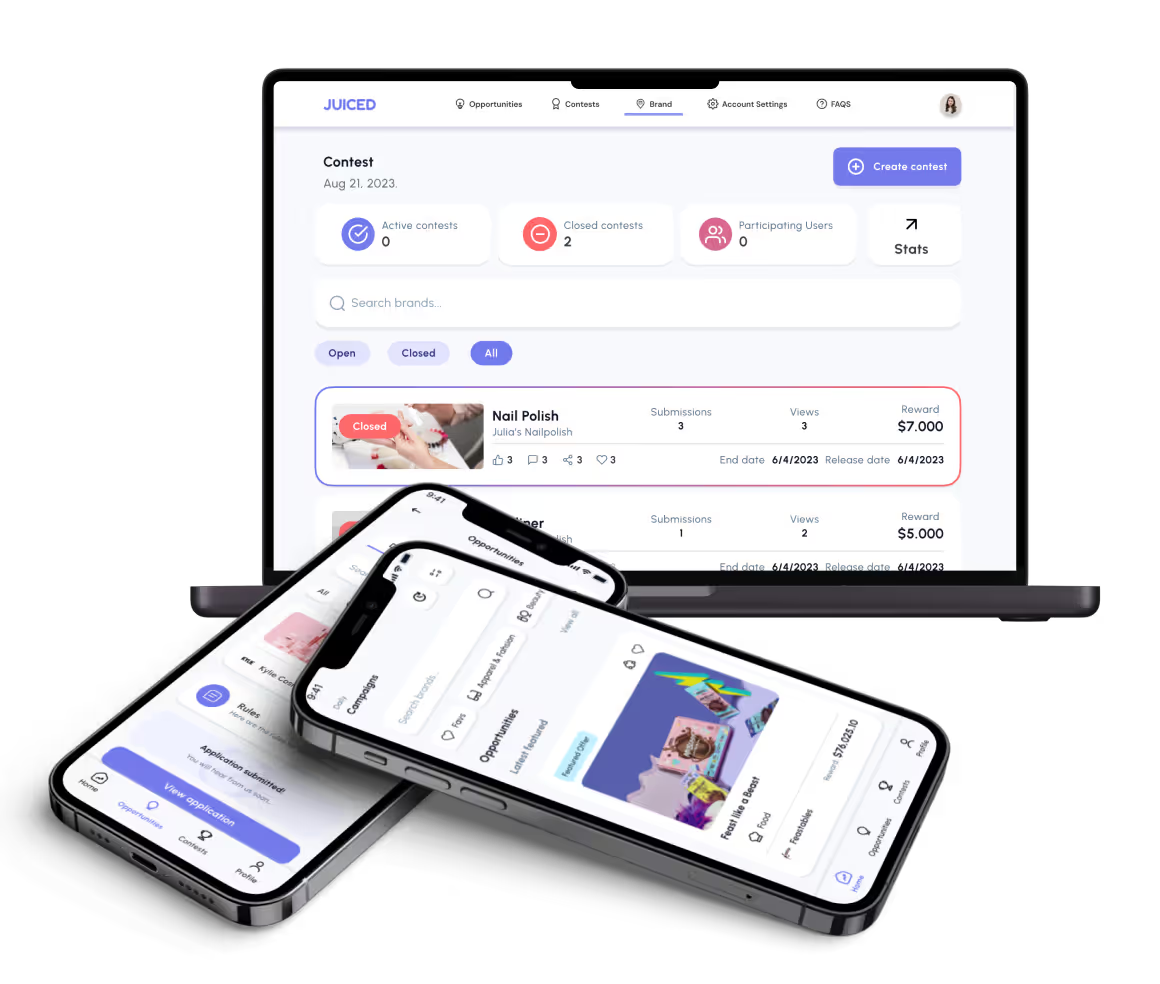

What Can FlutterFlow Build for an AI Chatbot App?
FlutterFlow can build the full conversational UI, connect to LLM APIs, store conversation history in Firebase, and surface suggested questions. The chat interface, API wiring, and data layer are well within scope.
Teams that want to build AI chatbot apps FlutterFlow natively can cover more ground than most expect without custom code.
- Scrollable chat interface: A ListView component handles distinct message bubbles, typing indicators, and auto-scroll to the latest message.
- LLM API action blocks: FlutterFlow connects to OpenAI, Anthropic, or Google Gemini, passing system prompt and conversation history.
- Firebase system prompt storage: An editable system prompt defining persona, tone, and knowledge limits stores in Firestore without redeployment.
- Per-user session history: Firestore records each conversation session per user account, giving continuity when users return to the app.
- Suggested question chips: Pre-built chips below the input field reduce blank-canvas friction for users on their first session.
- Multi-session conversation list: A dedicated screen lists past conversations with date labels and topic summaries for easy navigation.
FlutterFlow covers the interface, API connection, and data storage layer well. The gaps appear when streaming, RAG, and context window management become requirements.
Conversational Message Thread UI
FlutterFlow's ListView component handles scrollable chat threads natively. Distinct bubbles for user and AI messages, typing indicators, and auto-scroll are achievable without custom widgets.
No custom Dart code is required for a standard chat thread layout.
LLM API Integration via Action Blocks
FlutterFlow's API action blocks call OpenAI, Anthropic, or Google Gemini endpoints directly. You pass the system prompt and assembled conversation history as the request body.
No custom Dart code is required for basic synchronous LLM calls.
System Prompt Configuration
The system prompt defines the chatbot's persona, knowledge limits, and tone. Storing it in Firebase Firestore lets an admin update it without a new app deployment.
This matters most when prompt tuning is frequent during early rollout.
Conversation History Storage
Each conversation session stores as a Firestore document per user. When the user opens the app again, the session loads and the chat continues.
This is the data foundation for multi-session context, not a substitute for context window management logic.
Suggested Question Chips
Question chips below the input field give new users a clear starting point. In FlutterFlow, these are a Row of Chip widgets populated from a Firestore collection.
The collection updates remotely without a new app deployment.
Multi-Session Conversation Management
A dedicated screen lists past conversations with timestamps and auto-generated topic summaries. This gives returning users navigational context across sessions.
Topic summaries come from a second LLM call that summarises the exchange and writes to Firestore.
AI Response Rating and Flagging
Thumbs up, thumbs down, and a flag-for-review option on each AI response create a feedback loop. Ratings write to Firestore alongside the original prompt and response.
This data informs prompt engineering improvements and surfaces knowledge gaps early.
How Long Does It Take to Build an AI Chatbot App with FlutterFlow?
A simple FlutterFlow chatbot MVP takes 3 to 6 weeks. A full production chatbot with conversation management, RAG, streaming middleware, user accounts, and a feedback loop takes 12 to 20 weeks.
Timeline is driven less by FlutterFlow UI work and more by the back-end AI infrastructure that makes the chatbot reliable in production.
- Simple MVP timeline: Single LLM API call, basic chat UI, no persistent history, no streaming. Three to six weeks total.
- Full production timeline: Context management, RAG pipeline, streaming middleware, and a feedback loop together require twelve to twenty weeks.
- RAG adds weeks independently: Vector database setup and document ingestion are a two to four week workstream before UI.
- Streaming middleware separately: A WebSocket or SSE back-end project needs its own architecture, testing, and deployment outside FlutterFlow.
- Prompt cycles are non-linear: AI output quality testing adds two to four weeks across the build, spread throughout.
The phased approach works well here. Build with a system prompt first. Add conversation history in phase two. Add RAG and the feedback loop in phase three.
FlutterFlow chat UI builds two to three times faster than custom mobile development. Back-end AI middleware timelines are comparable regardless of front-end choice.
What Does It Cost to Build a FlutterFlow AI Chatbot App?
Costs range from $12,000 for a simple MVP to $70,000 or more for a full-service production chatbot with RAG, streaming, and multi-session features. Ongoing AI API costs are a separate and significant variable.
Understanding FlutterFlow pricing plans for chatbots is one input. Developer rates, agency fees, and AI API costs together form the real number.
- Platform subscription: FlutterFlow costs $0 to $70 per month depending on the plan tier and your team size.
- Developer project cost: Independent developers charge $50 to $150 per hour; project total ranges from $12,000 to $55,000.
- Full agency delivery: Full-service builds with back-end AI middleware, vector database setup, and QA run $20,000 to $70,000.
- GPT-4 Turbo API costs: At $0.01 per 1,000 tokens, 1,000 daily users at 20 turns costs $3,000 to $15,000.
- RAG infrastructure cost: Pinecone starts at $70 per month; document embedding generation adds a one-time cost at launch.
- Hidden cost categories: Document embedding, human review for flagged responses, and prompt engineering time are often omitted from scopes.
Off-the-shelf tools like Intercom AI and Drift charge per seat or per interaction. A fine-tuned custom model runs $200,000 to $600,000 or more.
FlutterFlow with a well-structured RAG pipeline sits between those two extremes on cost and capability.
How Does FlutterFlow Compare to Custom Development for an AI Chatbot App?
FlutterFlow is 50 to 65 percent cheaper than custom development for the UI and LLM integration layer. RAG pipeline and streaming middleware costs are comparable regardless of which front end you choose.
The comparison holds only when you separate UI work from AI infrastructure. FlutterFlow wins clearly on the former. Neither path shortcuts the latter.
- UI delivery speed: FlutterFlow delivers a chat interface with LLM integration in three to eight weeks, not months for custom.
- Cost advantage on UI: FlutterFlow cuts UI and LLM integration cost by 50 to 65 percent versus equivalent custom Flutter.
- Capability ceiling: Sub-100ms streaming latency, custom model fine-tuning, and multi-agent orchestration still require custom engineering either way.
- Maintenance trade-off: FlutterFlow enables rapid UI and prompt updates; custom code provides deeper context management and conversation logic control.
- FlutterFlow wins for: Customer support chatbots, internal knowledge base assistants, and consumer AI companion apps at standard latency.
- Custom wins for: Enterprise AI with proprietary fine-tuned models, real-time multi-agent systems, and contractual sub-100ms latency requirements.
Teams evaluating FlutterFlow alternatives for AI apps will find the trade-off consistent: lower cost and faster UI delivery in exchange for some ceiling on infrastructure-level control.
What Are the Limitations of FlutterFlow for an AI Chatbot App?
FlutterFlow has no native streaming, no built-in context window management, and no hallucination protection. These are architecture gaps, not platform bugs, and each one requires deliberate engineering to address.
Reviewing FlutterFlow data privacy for chatbots is a necessary step before building any chatbot that handles sensitive user data at scale.
- No native streaming: API action blocks make synchronous calls only; streaming tokens requires a back-end WebSocket or SSE layer.
- Context window cost growth: Sending full conversation history with each call compounds token costs rapidly; trimming requires back-end logic.
- Domain hallucination risk: Without RAG grounding, an LLM answers domain questions confidently and incorrectly, worse than no answer.
- Regulatory exposure: User messages go to OpenAI or Anthropic servers; healthcare and legal chatbots must assess HIPAA compliance.
- LLM API latency: LLM calls take two to ten seconds; without loading states, users assume the chatbot is broken.
- Token cost spikes: One unmanaged long conversation can exceed 50,000 tokens, creating cost spikes that compound badly at scale.
Each limitation has a known engineering solution. None is a reason to avoid FlutterFlow for chatbot development.
They are reasons to scope the back-end work correctly before the first screen is designed.
How Do You Get a FlutterFlow AI Chatbot App Built?
You need a developer or team with direct LLM API experience, RAG pipeline knowledge, and context window management skills. Chat UI experience alone is not sufficient for a production chatbot.
To hire FlutterFlow AI developers with the right specialisation, the interview questions matter as much as the portfolio review.
- Core expertise required: LLM API integration, context window management, RAG pipeline setup, and token cost modeling are all needed.
- Freelancer vs agency: A freelancer works for a basic system prompt chatbot; an agency is right for RAG and streaming.
- Red flags in screening: Inability to explain context window management or no RAG pipeline experience are clear disqualifiers.
- Key interview questions: Ask about context window management approach, RAG architecture, streaming response handling, and token cost projection methodology.
- Phase timelines: LLM integration runs two to four weeks; RAG two to four; FlutterFlow UI four to eight weeks.
At LOW/CODE Agency, every FlutterFlow chatbot scope starts with a back-end AI architecture review before any UI work begins. The architecture determines whether the chatbot earns trust.
Conclusion
A FlutterFlow AI chatbot app ships faster and cheaper than a custom build. Context management, RAG grounding, and token cost architecture are what separate a production chatbot from a demo.
Define your chatbot's knowledge boundary before writing a prompt. What it will not answer is as important as what it will. That boundary determines whether RAG is required.
Building an AI Chatbot App with FlutterFlow? Here Is How LOW/CODE Agency Approaches It.
Most FlutterFlow chatbot projects stall not on the UI but on the back-end AI architecture. Context management and token cost modeling are where production quality is decided.
We build AI products for SMBs. At LOW/CODE Agency, our work spans custom web applications, mobile apps, AI chatbots, retrieval-augmented generation systems, and autonomous AI agents — the full scope of what an expert software agency delivers. We build FlutterFlow AI chatbot apps with full LLM integration and RAG grounding.
Our process starts with architecture before any interface design begins.
- Back-end AI architecture first: We scope context management, streaming approach, and RAG requirements before any FlutterFlow screen is designed.
- RAG pipeline setup: We configure Pinecone or Weaviate, handle document ingestion, and structure retrieval logic for accurate domain responses.
- Token cost modeling: We model AI API spend at your usage volume and design trimming logic to keep costs predictable.
- FlutterFlow UI build: We build the chat interface with message threads, typing indicators, session management, and response rating components.
- Streaming middleware: Where required, we build the WebSocket or SSE layer that connects FlutterFlow to the LLM response stream.
- Prompt engineering and QA: We test AI outputs against your domain before launch, with documented accuracy rates at sign-off.
- Post-launch iteration: We stay involved through the first eight weeks, refining prompts and context logic as user inputs surface issues.
We have built 350+ products for clients including Coca-Cola, American Express, Sotheby's, Medtronic, Zapier, and Dataiku.
Related Articles
- How to Build AI-Enabled Apps with FlutterFlow
- How to Build an AI Document Processing Tool with FlutterFlow
- How to Build a FlutterFlow AI CRM Automation App
- How to Build an Agriculture App with FlutterFlow
- How to Build an Accounting App with FlutterFlow
- Top AI Workflow Automation Tools for Operations Teams
Partner with our low-code development experts to bring your app idea to life faster.
Last updated on
September 24, 2026
.

Jesus is a visionary entrepreneur and tech expert. After nearly a decade working in web development, he founded LOW/CODE Agency to help businesses optimize their operations through custom software solutions.


FAQs
What are the first steps to create an AI chatbot app in FlutterFlow?
Can FlutterFlow handle AI chatbot logic without coding?
How do I integrate AI APIs into a FlutterFlow chatbot app?
What are common challenges when building AI chatbots with FlutterFlow?
Is FlutterFlow suitable for deploying AI chatbot apps on multiple platforms?
How can I test and improve my AI chatbot app built with FlutterFlow?
Related Articles

FlutterFlow
How to Build a Rental Marketplace App with FlutterFlow
Learn how to create a rental marketplace app using FlutterFlow with step-by-step tips and best practices for smooth development.
FlutterFlow
How to Build a Student Portal with FlutterFlow
Learn how to create a student portal using FlutterFlow with step-by-step guidance and tips for beginners and developers.
FlutterFlow
How to Build a Rental Vehicle App with FlutterFlow
Learn how to create a rental vehicle app using FlutterFlow with step-by-step guidance and best practices for smooth development.

FlutterFlow
How to Build a Movie Streaming Dashboard with FlutterFlow
Learn how to create a movie streaming dashboard using FlutterFlow with step-by-step guidance and best practices.


Why customers trust us for no-code development


