

Flutter Mobile App Development: Full Guide
14 min
read
Is Flutter right for your mobile app? Get a complete guide to Flutter development, costs, pros, cons, and when to use it.

Flutter mobile app development lets you build beautiful, high-performance apps for iOS and Android from a single codebase. Google's open-source framework has become the leading choice for cross-platform mobile products.
If you want to reach both platforms without doubling your budget, Flutter mobile app development offers the best balance of performance and efficiency. This guide covers architecture, costs, timelines, and how to find the right Flutter team.
Key Takeaways
- Flutter uses Dart and a single codebase to produce native-quality apps for iOS, Android, web, and desktop simultaneously.
- 80-95% code sharing across platforms in Flutter mobile app development significantly reduces total development cost compared to building two native apps.
- Flutter costs less at 30-40% below native while delivering near-native performance through its custom rendering engine.
- Hot reload speeds up Flutter mobile app development by letting developers see UI changes instantly without restarting the entire application.
- Enterprise adoption proven by Google, BMW, and eBay, confirming that Flutter handles enterprise-scale applications with complex requirements.
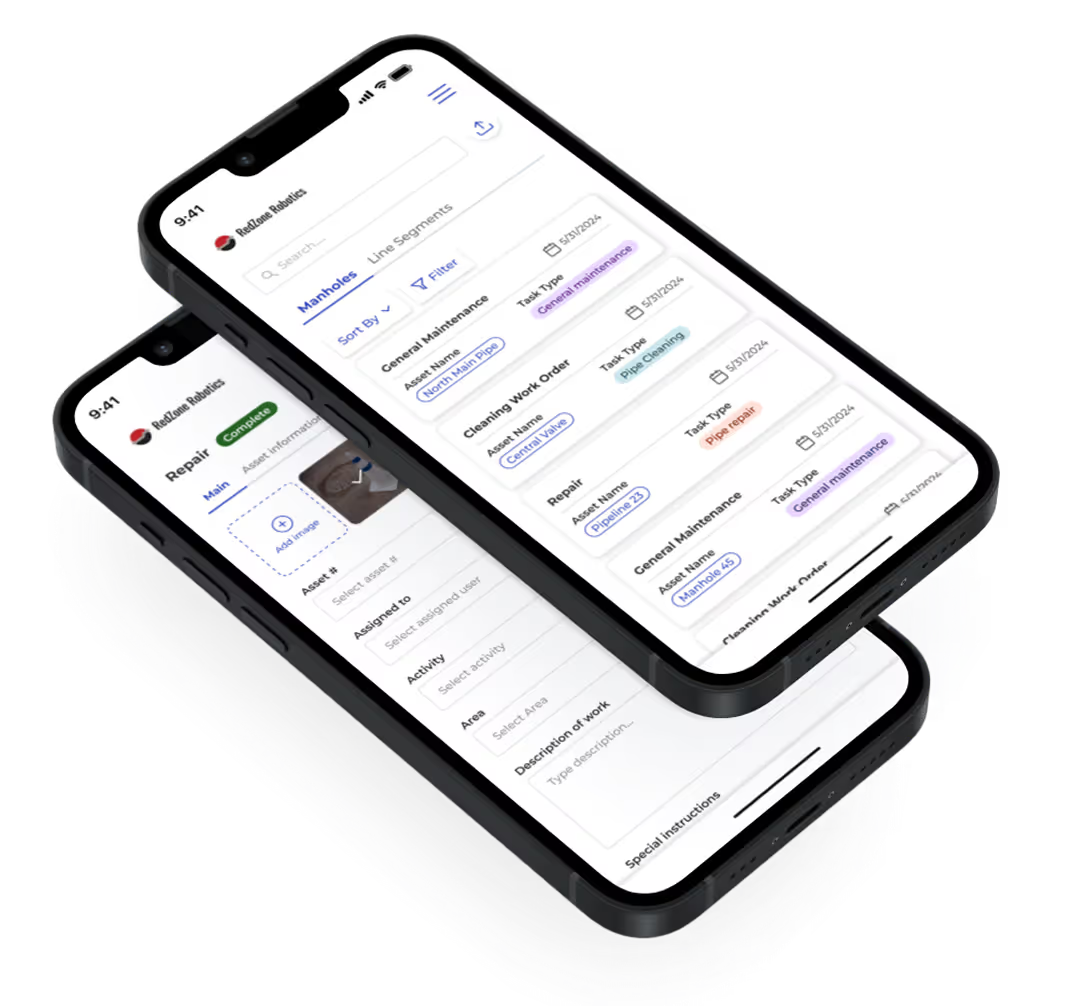

What Is Flutter Mobile App Development?
Flutter mobile app development is the process of building cross-platform applications using Google's Flutter framework and the Dart programming language.
Unlike web-view and bridge-based cross-platform development approaches, Flutter mobile app development does not rely on web views or platform bridges. It uses a custom rendering engine called Skia that draws every pixel directly, giving Flutter mobile app development its signature smooth performance.
- Dart is Flutter's programming language offering strong typing, async support, and ahead-of-time compilation for Flutter mobile app development performance
- Widgets are the building blocks of Flutter where every UI element is a composable widget that Flutter mobile app development teams customize freely
- Flutter's rendering engine bypasses platform UI components which means Flutter mobile app development produces identical visuals on iOS and Android
- Material Design and Cupertino widgets ship built-in so Flutter mobile app development can match either Android or iOS design conventions natively
- Flutter supports iOS, Android, web, macOS, Windows, and Linux making Flutter mobile app development a true multi-platform investment
- Impeller is Flutter's next-generation rendering engine delivering smoother animations and lower latency than Skia for performance-critical Flutter mobile app development projects
Understanding Flutter's architecture helps you evaluate whether it fits your product requirements. Flutter mobile app development works best when visual consistency across platforms matters more than deep platform-specific integrations.
How Does Flutter Compare to React Native and Native Development?
Flutter mobile app development outperforms React Native in rendering speed and offers better code sharing, while native development provides deeper platform integration.
Choosing between Flutter mobile app development and alternatives is a critical early decision. Each approach involves different tradeoffs in performance, cost, an
d maintenance that affect your product for years after launch.
- Flutter compiles to native ARM code while React Native uses a JavaScript bridge, giving Flutter mobile app development a measurable performance advantage
- React Native has a larger developer community but Flutter mobile app development is growing faster and has surpassed React Native in GitHub stars
- Native development accesses 100% of platform APIs while Flutter mobile app development covers most but occasionally needs platform channels for edge cases
- Flutter mobile app development shares more code than React Native typically achieving 90%+ code reuse versus React Native's 70-85% range
- Maintenance is simpler with Flutter since one codebase and one team handle everything, unlike native iOS mobile app development requiring separate specialists
The right framework depends on your specific product requirements. Flutter mobile app development wins for most business applications, while native development suits apps that heavily depend on platform-specific hardware features.
How Much Does Flutter Mobile App Development Cost?
Flutter mobile app development costs between $40,000 and $250,000, with most commercial apps falling in the $60K to $150K range for both platforms.
Budget is where Flutter mobile app development truly shines compared to building separate native apps. The total development cost drops significantly because one team writes one codebase that deploys to multiple platforms simultaneously.
- Simple Flutter mobile app development costs $40K to $70K for apps with standard features, basic UI, and straightforward backend requirements
- Mid-range Flutter apps cost $70K to $150K including custom animations, complex state management, and multiple third-party integrations
- Complex Flutter mobile app development exceeds $150K when projects need real-time data, offline sync, AI features, or enterprise security requirements
- Compared to two native apps at $100K each Flutter mobile app development saves $50K to $100K while delivering comparable quality across both platforms
- Annual maintenance runs 15-20% of initial cost covering OS updates, dependency upgrades, and feature enhancements after Flutter mobile app development completes
Request itemized proposals from multiple Flutter mobile app development teams to benchmark costs. Teams that specialize in custom mobile app development estimate more accurately than generalists learning the framework on your project.
What Does the Flutter Mobile App Development Process Look Like?
The Flutter mobile app development process includes discovery, UI/UX design, iterative development with hot reload, automated testing, and deployment to both app stores.
Successful Flutter mobile app development follows a structured product development lifecycle that reduces risk at each stage. Flutter's tooling accelerates certain phases, particularly design iteration and testing.
- Discovery defines requirements for both platforms simultaneously since Flutter mobile app development serves iOS and Android users from the same specifications
- UI/UX design accounts for platform conventions with Flutter mobile app development teams creating adaptive layouts that feel native on each platform
- Hot reload accelerates development sprints allowing Flutter mobile app development teams to iterate on UI changes in under one second without restarting
- Widget testing catches UI bugs early because Flutter mobile app development includes a rich testing framework for unit, widget, and integration tests
- CI/CD pipelines build both platform artifacts from the same Flutter mobile app development codebase, streamlining deployment to Google Play and the App Store
Ask your Flutter mobile app development partner to demonstrate their hot reload workflow and testing strategy. Teams that leverage Flutter's built-in tooling deliver higher quality apps in shorter timeframes.
When Should You Choose Flutter Over Other Frameworks?
Choose Flutter mobile app development when you need both iOS and Android, want consistent UI across platforms, and prioritize fast development cycles.
Not every project suits Flutter mobile app development. Understanding the ideal use cases helps you avoid choosing the wrong approach and wasting budget on technology that does not match your product needs.
- Flutter mobile app development excels for MVP launches when speed to market across both platforms matters more than platform-specific polish
- Custom UI-heavy apps benefit from Flutter's rendering engine since Flutter mobile app development draws every pixel without platform UI limitations
- E-commerce and content apps work perfectly with Flutter because these categories prioritize consistent branding across iOS and Android experiences
- Apps needing Bluetooth, AR, or deep hardware access may face limitations in Flutter mobile app development requiring native platform channel workarounds
- Existing native apps are harder to migrate to Flutter mobile app development, making greenfield projects the strongest candidates for Flutter adoption
Evaluate your feature requirements honestly before committing to Flutter mobile app development. The framework handles 90% of mobile use cases well, but that remaining 10% matters if your app falls in it.
What State Management Approach Works Best for Flutter?
The best state management approach for Flutter mobile app development depends on your app's complexity, with Riverpod and Bloc leading for production applications and Provider suitable for simpler projects.
State management is where Flutter mobile app development teams spend the most architectural decision-making time. The approach you choose affects code maintainability, testability, and team productivity for the entire project lifecycle.
- Riverpod offers the most modern and flexible approach with compile-time safety and excellent testability that experienced Flutter mobile app development teams prefer
- Bloc provides strict separation of business logic and UI making it ideal for Flutter mobile app development projects with complex data flows and team collaboration
- Provider works well for simpler applications where Flutter mobile app development teams need lightweight state management without heavy architectural overhead
- GetX attracts beginners but concerns senior developers because its all-in-one approach can make Flutter mobile app development harder to test and maintain at scale
- Choosing wrong creates expensive refactoring later since migrating state management mid-project requires touching nearly every screen in the application
- Team expertise should influence the choice because a pattern your Flutter mobile app development team knows well outperforms a theoretically superior one they are learning
Ask your Flutter mobile app development team to justify their state management choice with specific reasoning tied to your project requirements. Teams that default to one pattern for every project may not be evaluating your needs carefully.
How Do You Hire a Flutter Mobile App Development Team?
Hire Flutter mobile app development teams by evaluating their published Flutter apps, Dart proficiency, state management expertise, and cross-platform testing practices.
The quality of your Flutter mobile app development team determines your project's success more than any other factor. Since Flutter is relatively newer, finding experienced partners requires asking the right questions about real-world Flutter delivery.
- Check their published Flutter apps on both stores to verify their Flutter mobile app development experience extends beyond tutorials and demo projects
- Ask about state management approaches since experienced Flutter mobile app development teams have strong opinions on Riverpod, Bloc, or Provider patterns
- Evaluate their platform channel experience to confirm they can bridge Flutter mobile app development to native code when platform-specific features require it
- Review their testing strategy ensuring Flutter mobile app development includes widget tests, integration tests, and device-specific quality assurance processes
- Confirm they handle App Store and Play Store deployment since Flutter mobile app development teams should manage submission requirements for both platforms
Take time to review actual Flutter apps your potential partner has shipped. The best Flutter mobile app development teams proudly showcase their work and provide client references you can verify.
How Do You Test Flutter Mobile Apps Effectively?
Test Flutter mobile apps using the framework's three-tier testing approach: unit tests for business logic, widget tests for UI components, and integration tests for end-to-end user flows across both platforms.
Flutter mobile app development includes one of the most comprehensive testing frameworks available for cross-platform development. Teams that leverage this tooling ship fewer bugs and iterate faster than teams that rely on manual testing alone.
- Unit tests validate business logic independently ensuring calculations, data transformations, and state management work correctly without rendering any UI
- Widget tests verify UI components in isolation rendering individual widgets and simulating user interactions to confirm visual behavior matches expectations
- Integration tests run full user flows on real devices simulating taps, scrolls, and navigation to catch issues that only appear when all components work together
- Golden file testing catches visual regressions by comparing rendered widget screenshots against approved baseline images pixel by pixel
- Platform-specific test configurations ensure both targets pass since Flutter mobile app development teams must verify tests succeed on both iOS and Android
- Code coverage tools measure testing completeness helping Flutter mobile app development teams identify untested code paths that could harbor hidden bugs
Aim for 80%+ code coverage on business logic and 60%+ on widget tests. Flutter mobile app development projects with strong test coverage ship updates confidently because regressions are caught before they reach users.
What Are Common Challenges in Flutter Mobile App Development?
Common Flutter mobile app development challenges include large app sizes, platform-specific edge cases, and finding senior Dart developers with production experience.
Every framework has tradeoffs, and understanding Flutter mobile app development challenges helps you plan around them. Most challenges are manageable with experienced teams, but knowing them upfront prevents surprises during development.
- Flutter apps tend to be larger than native apps with minimum binary sizes around 5-7MB due to the bundled rendering engine
- Platform-specific behavior requires separate handling when Flutter mobile app development encounters differences in iOS and Android system interactions
- The Dart developer pool is smaller than JavaScript or Swift making senior Flutter mobile app development talent harder to find and sometimes more expensive
- Third-party plugin quality varies significantly requiring Flutter mobile app development teams to evaluate, test, and sometimes fork community packages
- iOS design purists may notice subtle differences since Flutter mobile app development renders its own UI rather than using native iOS components
These challenges rarely outweigh Flutter's benefits for most business applications. Experienced Flutter mobile app development teams have established patterns for handling each issue effectively.
How Long Does Flutter Mobile App Development Take?
Flutter mobile app development takes 2 to 8 months for most projects, with MVPs launching in 2-3 months and complex apps requiring 5-8 months.
Timeline efficiency is a major reason companies choose Flutter mobile app development. Building one codebase instead of two cuts the overall development timeline significantly compared to parallel native development efforts.
- Flutter MVP development takes 2-3 months when scope is well-defined and the team focuses on core features without scope creep
- Mid-complexity Flutter apps need 3-5 months including custom animations, offline capability, and integration with external APIs and services
- Enterprise Flutter mobile app development requires 5-8 months for projects involving compliance requirements, complex backends, and extensive testing cycles
- Hot reload saves 20-30% of UI development time compared to native development where Flutter mobile app development teams would wait for full rebuilds
- Simultaneous platform deployment eliminates staggered launches since Flutter mobile app development produces both iOS and Android builds from every sprint
Factor in App Store and Play Store review times when planning your Flutter mobile app development timeline. Both stores add 1-7 days per submission, and rejections require additional time.
Conclusion
Flutter mobile app development delivers the best balance of cost, performance, and development speed for teams targeting both iOS and Android. Google's continued investment in the framework and its growing enterprise adoption make it a safe long-term choice.
Start with a clear MVP scope, choose the right state management approach for your complexity, hire a team with real Flutter production experience, and plan for iterative improvements after launch.
The companies winning with Flutter mobile app development are the ones that treat it as a product investment, not just a technical decision.
Launch Your Flutter App with LOW/CODE Agency
As AI development experts, we at LOW/CODE Agency help SMBs ship real software — web and mobile applications, intelligent chatbots, RAG pipelines, and autonomous AI agents built for businesses that need results, not platforms. We bring Flutter mobile app development expertise combined with product thinking that ensures your app succeeds in the market, not just compiles without errors.
- Cross-platform specialization matches the right framework to your goals with deep Flutter, React Native, and native expertise
- End-to-end Flutter mobile app development from product strategy and UX design through App Store and Play Store deployment and beyond
- State management architecture tailored to your project with experienced teams who evaluate Riverpod, Bloc, and Provider against your specific requirements
- 450+ projects delivered across healthcare, finance, e-commerce, and enterprise verticals with cross-platform mobile expertise
- Trusted by Medtronic, American Express, Coca-Cola, Zapier, and Sotheby's to build mobile products that scale reliably across platforms
- Transparent 2-week sprint cycles with live demos so you see Flutter mobile app development progress and guide decisions throughout the engagement
Related Articles
Last updated on
September 3, 2026
.

Jesus is a visionary entrepreneur and tech expert. After nearly a decade working in web development, he founded LOW/CODE Agency to help businesses optimize their operations through custom software solutions.


FAQs
What is Flutter and why is it used for mobile app development?
Is Flutter good for production mobile app development?
How does Flutter compare to React Native for mobile app development?
What types of mobile apps is Flutter best suited for?
How much does Flutter mobile app development cost?
Can Flutter mobile apps access native device features?
Related Articles

Mobile App Development
How to Validate Your Mobile App Idea First
Don't build a mobile app nobody wants. Learn how to validate your idea with real users before spending time and money on development.

Mobile App Development
Cross Platform App Development: Tools, Costs & Challenges
Learn what cross platform app development is, how it compares to native apps, key challenges, costs, and when it’s the right choice for your product.
Mobile App Development
Mobile App Escrow, Code Ownership & Exit
Who owns your mobile app code? Learn how escrow, IP ownership, and exit clauses work before you sign with any development agency.

Mobile App Development
How to Define Your Mobile App Target Audience
Building for the wrong users kills mobile apps. Learn how to clearly define your target audience before a single line of code is written.
Why customers trust us for no-code development


