

How to Build a Subcontractor Management App with Bubble
12 min
read
Build a subcontractor management app with Bubble no code required. Track contracts, tasks, and payments step-by-step with this no-code tutorial.


Building a subcontractor management app with Bubble gives general contractors and project managers a centralized platform for onboarding, scope tracking, reporting, and payments.
Bubble handles the complex multi-party workflows of subcontractor management without the overhead of enterprise construction software.
Key Takeaways
- Scope of work is the anchor record: A ScopeOfWork data type linked to the Subcontractor and project record drives every downstream workflow from daily reports to payment draws.
- Lien waiver tracking prevents legal exposure: A dedicated LienWaiver data type with collection and execution status fields ensures no payment is released without the required documentation.
- Draw request workflows need approval chains: Multi-step approval workflows with GC and PM sign-off steps prevent unauthorized payment releases.
- Daily reports build the audit trail: Structured DailyReport submissions tied to scope of work records create documented progress evidence for disputes or change orders.
- Option sets enforce consistent status: Using option sets for SOW status, draw status, and lien waiver status ensures filters and dashboard views work reliably.
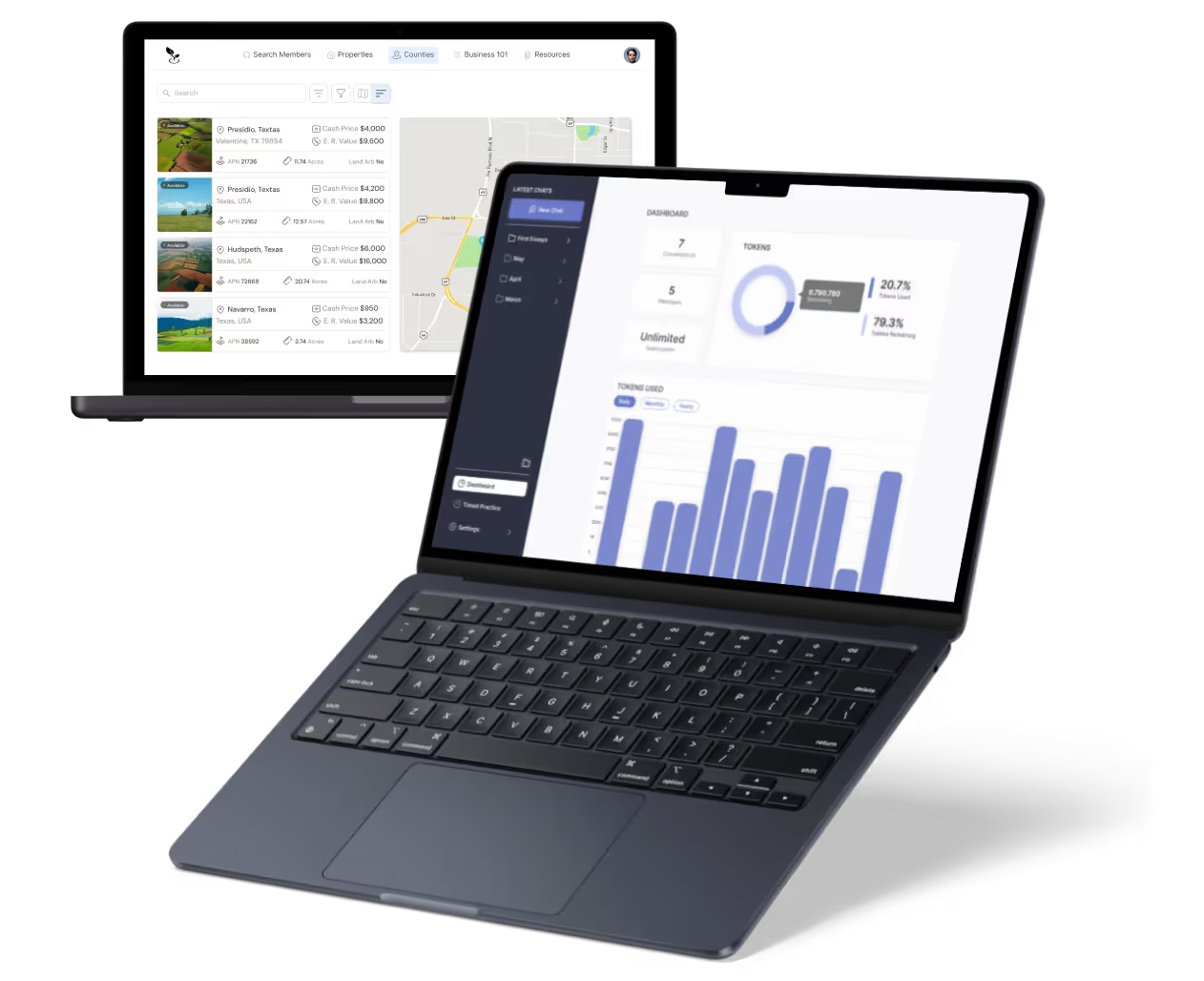

What Is a Subcontractor Management App — and Why Build It with Bubble?
A subcontractor management app is a platform that manages the relationship between a general contractor and their subcontractors across onboarding, scope approval, daily reporting, and financial draws.
Bubble is a practical starting point for construction companies that want a custom platform without enterprise software contracts. Bubble MVP development is an effective approach for GCs who need a working system fast and can expand it after the first project cycle.
- Structured sub onboarding: Replace email intake with a sub portal where subcontractors submit credentials, insurance, W-9s, and bank details through a guided form.
- Scope of work tracking: Link each sub to their specific scope, approved quantities, rates, and completion milestones so billing disputes are resolved with documented records.
- Daily progress reports: Subcontractors submit structured daily reports that feed directly into project progress dashboards for the GC and project owner.
- Lien waiver management: Track conditional and unconditional lien waiver status per payment period so releases happen only when documentation is complete.
- Draw request workflow: Subcontractors request payment draws linked to their approved scope progress, with GC and PM approval steps before any funds are released.
Bubble's visual environment means a construction operations team can model their specific workflow without writing a line of code.
What Features Should a Subcontractor Management App Include?
A subcontractor management app needs a sub-facing portal for submissions and reporting and a GC-facing admin layer for approvals, compliance, and payments.
Both sides must share data in real time so project managers are never waiting for status updates to arrive by email.
- Subcontractor onboarding portal: A self-service intake form collecting company details, trade type, insurance certificates, W-9 or tax forms, bonding information, and banking details.
- Scope of work management: Creates and tracks each subcontractor's approved scope with line items, unit prices, quantities, and completion percentage tied to draw eligibility.
- Daily progress reports: Subcontractors submit structured daily reports including crew count, work completed, materials used, equipment on site, and any issues or delays.
- Lien waiver collection: Tracks conditional and unconditional lien waiver submission and execution status per sub per payment period with document storage and status flags.
- Draw request and approval: Subcontractors submit draw requests tied to completed scope items. GC and PM approve sequentially before payment is released.
- Compliance monitoring dashboard: Displays insurance expiry, bonding status, and outstanding lien waivers per sub so GC staff can see compliance at a glance before any payment.
Add a change order tracking feature so scope modifications and price adjustments are documented and approved before they appear on draw requests.
How Do You Structure the Database for a Subcontractor Management App in Bubble?
The data model centers on Subcontractor, ScopeOfWork, DailyReport, LienWaiver, and DrawRequest data types organized around project and trade relationships.
A well-structured data model makes it possible to query all financial exposure for a subcontractor or all outstanding compliance items for a project in a single Bubble search.
- Subcontractor data type: Fields include user (User), company-name (text), trade-type (option set), status (option set: Active, Inactive, Suspended), insurance-expiry (date), bonding-status (option set), tax-id (text), and bank-details (text, privacy-restricted).
- ScopeOfWork data type: Fields include subcontractor (Subcontractor), project (text), description (text), contract-value (number), approved-date (date), completion-percent (number), status (option set: Draft, Approved, In Progress, Complete, Disputed), and line-items (list of SOWLineItem).
- DailyReport data type: Fields include subcontractor (Subcontractor), scope (ScopeOfWork), report-date (date), crew-count (number), work-completed (text), materials-used (text), issues (text), photos (list of files), and submitted-by (User).
- LienWaiver data type: Fields include subcontractor (Subcontractor), payment-period (text), waiver-type (option set: Conditional, Unconditional), status (option set: Pending, Submitted, Executed), document (file), submitted-date (date), and executed-date (date).
- DrawRequest data type: Fields include subcontractor (Subcontractor), scope (ScopeOfWork), amount-requested (number), supporting-docs (list of files), gc-approval (yes/no), pm-approval (yes/no), status (option set: Submitted, Under Review, Approved, Paid, Rejected), and paid-date (date).
- SOWLineItem data type: Fields include scope (ScopeOfWork), description (text), unit (text), quantity (number), unit-price (number), and completed-quantity (number). Supports granular billing and progress tracking.
Store contract value and draw amounts as number fields. Never use text fields for financial data that needs to be summed, compared, or reported.
How Do You Build the Core Workflows for a Subcontractor Management App in Bubble?
The five critical workflow groups are sub onboarding, SOW approval, daily report submission, draw request approval, and lien waiver collection.
Understanding Bubble's capabilities and limitations informs how to structure multi-step approval chains and complex conditional logic within Bubble's workflow engine.
- Sub onboarding workflow: Triggered on form submit. Creates Subcontractor record, creates placeholder ComplianceRecord entries for each required document type, sends a welcome email via SendGrid, notifies the assigned project manager.
- SOW approval workflow: Triggered when a PM approves a scope submission. Updates ScopeOfWork status to Approved, records approved-date, sends a confirmation email to the subcontractor with the approved scope details attached.
- Daily report submission workflow: Triggered on report form submit. Creates DailyReport record linked to the subcontractor and scope, uploads attached photos, sends a notification to the PM that a new report has been submitted.
- Draw request approval workflow: Two-step backend workflow. Step one: GC approves, sets gc-approval to yes, notifies PM. Step two: PM approves, sets pm-approval to yes, updates status to Approved, triggers Stripe payment via API connector.
- Lien waiver collection workflow: Triggered after draw approval. Creates a LienWaiver record for the payment period with status Pending, sends an email requesting waiver submission, monitors for document upload to change status to Submitted.
- Insurance expiry alert workflow: Scheduled backend workflow runs weekly. Finds Subcontractors where insurance-expiry is within 30 days. Sends alert email to the GC and flags the sub record in the compliance dashboard.
Use Bubble's "Only when" conditions on draw approval workflows to block payment processing if any required lien waiver has not reached Executed status.
What Security and Data Requirements Apply to a Subcontractor Management App?
Subcontractors see only their own records and submissions. GC staff see all subs on their projects. Project managers see scope, reports, and draw requests for projects they manage.
Construction projects involve sensitive financial, legal, and tax data. Privacy rules must prevent any subcontractor from seeing another sub's scope values, draw amounts, or compliance documents.
- Subcontractor portal privacy rule: Sub users see only their own Subcontractor record, ScopeOfWork records, DailyReports, LienWaivers, and DrawRequests. No cross-sub visibility.
- ScopeOfWork privacy rule: Restrict to the owning sub, the assigned PM, the GC Admin role. Scope values are commercially sensitive and should not be visible to other subcontractors.
- DrawRequest privacy rule: Subs see their own draw requests and status updates. GC and PM roles see all draw requests for their projects. Finance role has full visibility.
- LienWaiver document privacy: Executed lien waiver documents are legal instruments. Restrict access to the owning sub, GC, and Admin roles. Do not display in shared views.
- Tax and banking field restrictions: Apply Bubble's field-level privacy to exclude tax ID and bank account fields from all roles except Admin and Finance. Mask these values in all UI displays.
- Daily report visibility: GC and PM roles should see all daily reports for their projects. Subcontractors see only their own submissions. Do not allow cross-sub report access.
Test all privacy rules in staging with dedicated accounts for Sub, PM, GC, and Admin roles before inviting any real users to the platform.
What Plugins and Integrations Does a Subcontractor Management App Need?
The plugin stack for a subcontractor management app focuses on payment processing, document signing, email notifications, and optional ERP or PM software connectors.
Select integrations that connect directly with your existing financial and project management systems to eliminate duplicate data entry.
- Stripe plugin: Processes draw request payments and handles sub payouts. Configure Stripe webhooks to update DrawRequest paid-date and status fields automatically on payment confirmation.
- SignWell or DocuSign plugin: Enables digital lien waiver signing within the Bubble portal. Returns executed documents to the LienWaiver record and updates status to Executed automatically.
- SendGrid plugin: Handles all transactional email including onboarding confirmations, SOW approval notices, draw status updates, and compliance expiry alerts.
- Bubble's native file uploader: Manages compliance document, lien waiver, daily report photo, and draw request supporting document uploads within the portal.
- Documint or Air PDF plugin: Generates formatted draw request summaries, SOW reports, or compliance status reports for project owner review.
- Zapier connector: Connects to Procore or Autodesk Construction Cloud for project-level data sync, or to QuickBooks for accounting integration without custom API development.
Verify that your DocuSign or SignWell integration correctly handles lien waiver completion webhooks before using it in a live payment workflow.
How Long Does It Take and What Does It Cost to Build a Subcontractor Management App with Bubble?
A production-ready subcontractor management app takes seven to fourteen weeks, with draw approval workflows, lien waiver tracking, and Stripe integration representing the most complex components.
Reviewing Bubble's pricing plans before finalizing build scope helps align the Bubble plan tier with your expected user count and workflow execution volume.
- DIY timeline: Ten to fourteen weeks for an experienced Bubble builder covering sub portal, SOW management, draw approvals, lien waivers, and Stripe payment integration.
- Agency timeline: Six to ten weeks for a dedicated Bubble development team with full project scoping, design, workflow engineering, and QA.
- Bubble plan requirement: Growth plan for initial production. Team plan required for multi-editor builds and separate staging environments. Enterprise plan for large-scale deployments.
- Development cost (agency): A complete subcontractor management app ranges from $18,000 to $45,000 depending on the number of projects, approval chain complexity, and ERP integrations.
- Stripe transaction fees: 2.9% plus $0.30 per payment. For high-value construction draws, consider Stripe's ACH transfer option at lower per-transaction rates.
- Maintenance budget: Five to six hours per month for workflow adjustments, new trade type additions, and integration maintenance as external APIs update.
Build the sub portal, SOW management, and daily reporting core first. Add draw requests and lien waiver workflows in phase two after validating the base data model.
Conclusion
Bubble replaces fragmented email chains and shared spreadsheet tracking with a structured portal connecting subs, GC staff, and project managers in one operational system.
Build the multi-step draw approval workflow and lien waiver collection before enabling any payment processing. These workflows must be validated with correct privacy rules before real money moves.
Build Your Subcontractor Management App With Expert Bubble Developers
Subcontractor management apps require multi-step financial approval chains and lien waiver tracking with document signing that must function correctly before any real money moves. Misconfigured approval logic or broken Stripe webhooks create direct financial exposure.
At LOW/CODE Agency, we started as builders and that has not changed. Today we build AI-powered products — web apps, mobile apps, RAG systems, chatbots, and AI agents — specifically for SMBs that want real software, not a SaaS subscription. We scope the architecture, engineer the workflows, and stay involved through launch and beyond.
- Data architecture: We design your data types, option sets, and privacy rules before writing a single element on the canvas.
- Workflow engineering: We build backend workflows, scheduled jobs, and API integrations with proper logic and error handling.
- Plugin configuration: We select and configure the right Bubble plugins for your feature set without unnecessary bloat.
- Role-based access: We implement privacy rules at the database level, not just conditional UI visibility.
- Integration setup: We connect your Bubble app to Stripe, SendGrid, Twilio, and other services correctly from day one.
- Pre-launch testing: We test against real data before deployment so every workflow performs correctly under live conditions.
- Post-launch support: We stay involved after go-live to optimize as real usage data shapes the app.
We have built 350+ products for clients including Coca-Cola, American Express, Sotheby's, and Medtronic. We know exactly where Bubble builds fail and we address those problems before they surface.
Related Articles
Last updated on
September 24, 2026
.

Jesus is a visionary entrepreneur and tech expert. After nearly a decade working in web development, he founded LOW/CODE Agency to help businesses optimize their operations through custom software solutions.


FAQs
Can you build a subcontractor management app without coding using Bubble?
How do you onboard subcontractors in a Bubble subcontractor management app?
How do you track subcontractor licenses and insurance in Bubble?
How do you assign and manage work orders for subcontractors in Bubble?
How do you handle subcontractor invoicing in a Bubble app?
How do you track subcontractor performance in Bubble?
Related Articles

Bubble
How to Build a Tax Management App with Bubble
Launch a tax management app with Bubble no coding needed. Track filings, manage deadlines, and stay compliant fast with this no-code step-by-step guide.
Bubble
How to Build a Warehouse Management App with Bubble
Build a warehouse management app with Bubble no coding needed. Track inventory, manage stock & optimize fulfillment step-by-step with no-code.

Bubble
How to Build an Event Budget Management App with Bubble
Control event budgets with Bubble. Build a no-code budget management app step-by-step track spend, forecast costs & avoid overruns without coding.
Bubble
Comparison
Bubble vs Backendless | 10 Factors to Decide the Best One
Compare Bubble vs Backendless across 9 factors like UI, logic, API, and scalability to find the best no-code platform for your app’s needs


Why customers trust us for no-code development


