

Build a SaaS Onboarding App with Bubble
11 min
read
Learn how to build a SaaS onboarding app with Bubble. Guide new users through setup steps, checklists, and activation flows — no code required.

Most SaaS products lose users in the first session, not after months of use. The difference between a user who activates and a user who churns in week one is almost always onboarding. Building a proper SaaS onboarding flow on Bubble is one of the highest-leverage investments in your product.
This guide covers how to build a SaaS onboarding system with Bubble: activation flows, progress tracking, contextual prompts, email sequences, and how to measure whether onboarding is actually working.
Key Takeaways
- Onboarding is not a feature, it is a system: registration, welcome flow, activation checklist, empty states, and email sequences must work together to move users to their first value moment.
- Bubble handles onboarding logic natively: conditional visibility, workflow triggers, progress tracking, and email automation are all achievable without third-party tools.
- Activation events, not sign-ups, determine retention: define the specific in-product action that correlates with long-term use and build onboarding to drive users toward it.
- A complete onboarding system on Bubble takes 2-4 weeks as a standalone build, or adds 2-3 weeks to a full SaaS product engagement.
- Onboarding must be tested with real users: developers and founders are the worst testers of their own onboarding, get uninitiated users through the flow before launch.
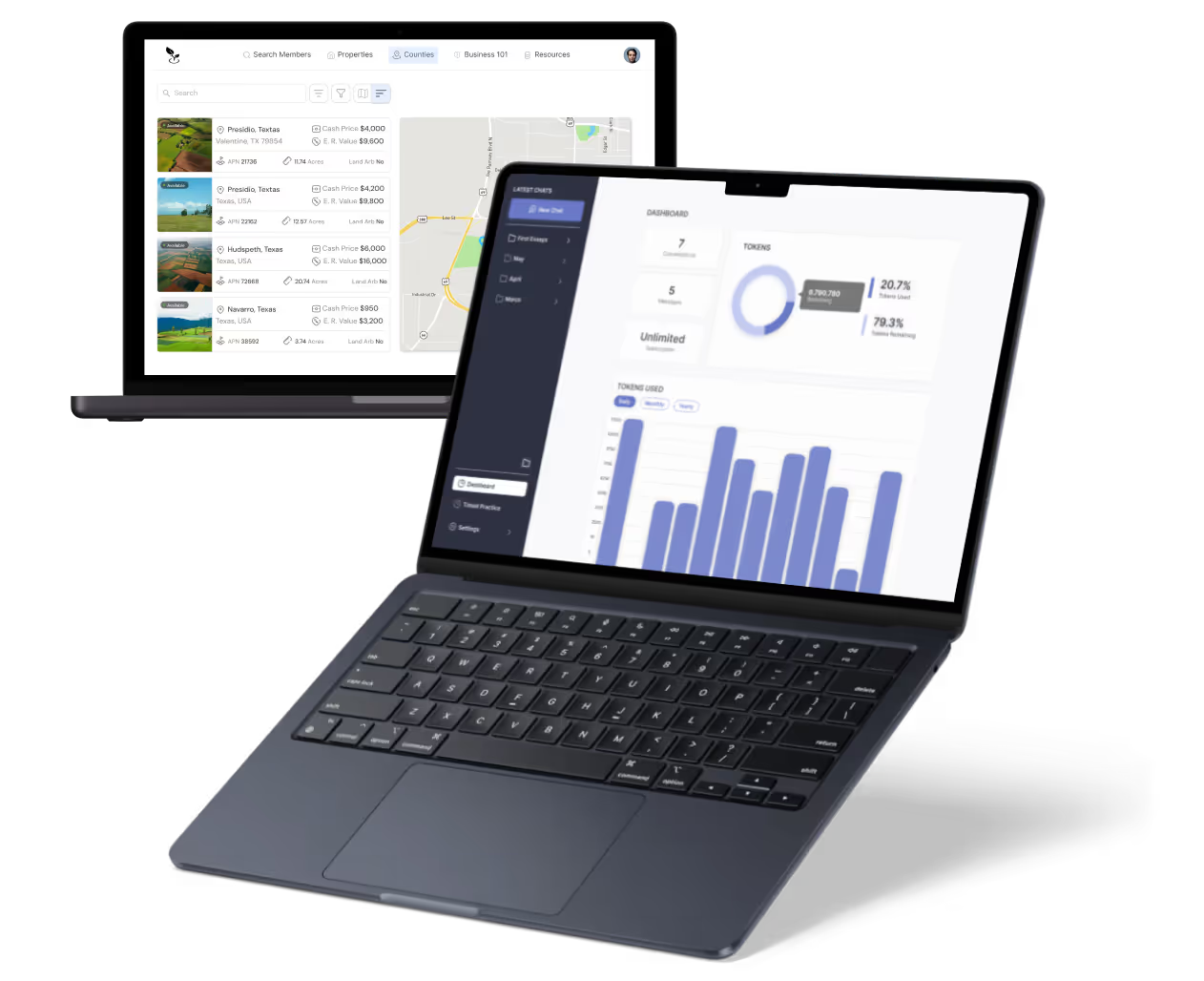

What Components Does a SaaS Onboarding System on Bubble Include?
A SaaS onboarding system includes registration and welcome flow, profile setup, activation checklist, contextual empty states, in-app prompts, and an email nurture sequence.
Each component serves a different stage of the user's journey from sign-up to activated. A user who completes all of them should reach the product's core value without needing to ask for help.
- Registration and welcome flow: the steps immediately after sign-up that collect essential information and introduce the product before the user reaches the dashboard.
- Profile and workspace setup: guided configuration of the settings required to use the product, kept to the absolute minimum necessary.
- Activation checklist: a short list of value-generating actions that move the user toward the product's core job. Visible on the dashboard. Dismissible only after completion.
- Contextual empty states: when users visit a section with no data yet, show a specific action prompt rather than a blank list.
- In-app prompts and tooltips: contextual guidance that appears when a user visits a feature area for the first time, explaining what to do next.
- Email onboarding sequence: a series of triggered emails that correspond to the user's progress, surfacing features they have not used and reinforcing value they have experienced.
Bubble app examples include SaaS products with production onboarding flows where activation checklists, progress states, and email sequences work together to drive early-stage retention.
How Do You Define an Activation Event for a SaaS Product?
Define an activation event as the single in-product action that most strongly correlates with long-term retention, the moment a user first experiences the product's core value.
Activation events are product-specific. A project management tool might measure "created first task." A reporting tool might measure "generated first report." The activation event is not sign-up, it is the moment the product becomes real to the user.
- Identify correlation, not completion: the activation event is the action that predicts retention, not the action that completes setup.
- Make it achievable in the first session: if users cannot reach the activation event in their first visit, most of them never will.
- Track it explicitly in Bubble: store a boolean or timestamp on the user record when they complete the activation event. Use this to measure activation rate.
- Build onboarding to drive toward it: every onboarding step should reduce the friction between sign-up and the activation event, not add to it.
- Review activation rate regularly: track the percentage of new sign-ups who complete the activation event within 24, 48, and 72 hours of registration.
Bubble's security model is relevant during onboarding because email verification, session management, and privacy rules for user data all need to be correctly configured before onboarding flows handle new user data.
How Do You Build an Activation Checklist in Bubble?
Build an activation checklist by creating a list of onboarding tasks as a data type, storing completion status per task per user, and displaying a progress indicator that updates as tasks are completed.
Activation checklists work because they make the path to value visible. Users who can see what they need to do next are more likely to do it than users facing a blank dashboard.
- Onboarding task data type: create a data type with fields for task name, description, required action, and completion status. Link it to the user.
- Task completion triggers: add a server-side workflow step to mark the relevant task complete whenever the user performs the corresponding action.
- Progress indicator: display a progress bar or checklist widget showing completed and remaining tasks. Place it prominently on the dashboard, not buried in settings.
- Completion reward: when all checklist items are complete, show a congratulatory state and optionally unlock a feature, apply a discount, or extend a trial.
- Dismissal option: allow users to dismiss the checklist after completing the core items. Users who have been in the product for 30 days should not see a beginner checklist.
Keep the checklist to 4-6 items maximum. Each item should be a distinct, achievable action. More than 6 items feels like work rather than guidance.
How Do You Build an Email Onboarding Sequence in Bubble?
Build an email onboarding sequence by triggering emails from Bubble server-side workflows based on user events, time elapsed since sign-up, and feature usage, not just on a fixed time schedule.
Event-triggered onboarding emails outperform fixed-schedule sequences because they arrive at the moment they are relevant. An email about a feature a user just visited converts better than the same email sent on day 4 of a fixed sequence.
- Day 0: Welcome email: triggered immediately on registration. Confirms sign-up, sets expectations, and gives one clear next step.
- Day 1: Activation prompt: triggered if the user has not completed the activation event within 24 hours. Surfaces the core action with direct instructions.
- Day 3: Feature highlight: triggered if the user has not visited a key feature. Highlights its value with a specific use case relevant to the user's profile.
- Day 7: Social proof or usage summary: a success story or a summary of what the user has accomplished. Reinforces value for active users, re-engages dormant ones.
- Pre-trial-end email: triggered 3 days before trial expiry. Connects trial usage to paid plan benefits. Includes an upgrade CTA.
Review Bubble pricing plans when choosing your email delivery integration. Transactional email via SendGrid or Postmark adds per-email cost that scales with registration volume.
What Does the Development Process Look Like for a Bubble SaaS Onboarding System?
The development process runs four phases: activation event definition, registration and welcome flow build, in-app onboarding elements, and email sequence configuration.
Onboarding development should happen after the core product workflow is complete, not before. You cannot design effective onboarding for a product feature that does not yet exist in its final form.
- Phase 1: Activation definition: define the activation event, identify every step between registration and activation, and map friction points in the current or planned flow.
- Phase 2: Registration and welcome flow: build the post-registration steps, profile setup, and welcome screen. Test with uninitiated users.
- Phase 3: In-app onboarding elements: activation checklist, empty states, contextual prompts, and progress tracking for the core product sections.
- Phase 4: Email sequence: trigger configuration for each email, template design, and link tracking setup. Test each trigger manually in development.
A complete onboarding system takes 2-4 weeks. Adding A/B testing infrastructure for onboarding variants or integration with a dedicated onboarding tool adds 1-2 weeks.
How Much Does It Cost to Build a SaaS Onboarding System on Bubble?
Building a complete SaaS onboarding system on Bubble costs between $6,000 and $15,000 as a standalone build, or is included as an additional 2-3 week phase in a full SaaS product engagement.
Onboarding has one of the highest ROI profiles of any SaaS development investment. A 10% improvement in activation rate compounds across your entire subscriber acquisition effort.
- Basic onboarding with welcome flow, activation checklist, and triggered welcome email: $6,000 to $8,000.
- Full onboarding system with activation checklist, contextual empty states, in-app prompts, and full email sequence: $10,000 to $15,000.
- Email platform integration: SendGrid, Postmark, or Customer.io integration adds $2,000 to $4,000 depending on the sequence complexity.
- Ongoing optimization: budget for periodic onboarding audits and A/B tests to improve activation rate as the user base grows.
An onboarding system that improves activation rate by 15% on a product with 100 new sign-ups per month and $50 ACV generates significantly more monthly revenue than its build cost within the first quarter.
What Are the Limitations of Building SaaS Onboarding on Bubble?
Key limitations include the absence of native A/B testing for onboarding variants, limited in-app tooltip and product tour libraries, the complexity of highly personalized onboarding paths, and dependency on third-party email platforms for advanced sequence logic.
Bubble's capabilities and limitations matter for onboarding when your product requires sophisticated personalization, different onboarding paths based on user persona, industry, or use case, which pushes beyond what Bubble's conditional logic handles cleanly.
- No native A/B testing: testing onboarding variant performance requires a third-party integration or manual cohort tracking.
- Limited product tour tools: guided tooltip libraries like Appcues or Userflow require custom integration with Bubble and may not work perfectly with Bubble's DOM structure.
- Email sequence complexity: advanced conditional email logic, branching sequences based on feature usage, is better handled by a dedicated tool like Customer.io than native Bubble workflows.
- Highly segmented onboarding: if users need fundamentally different onboarding paths based on their role or use case, the conditional logic in Bubble workflows becomes complex and difficult to maintain.
Bubble's scalability ceiling affects onboarding email sequences when registration volume is high, Bubble's scheduled workflow throughput has limits at high event volumes.
When Does Bubble Make Sense for SaaS Onboarding?
Bubble makes sense for onboarding when you need a functional, event-triggered system built alongside the product, your user persona is reasonably uniform, and you do not yet need sophisticated personalization or A/B testing infrastructure.
Bubble pros and cons favor onboarding systems built natively in Bubble because it eliminates the integration complexity of third-party onboarding tools for most early and growth-stage SaaS products.
- SaaS products with a single user persona get fully functional onboarding from Bubble's native workflow and visibility tools.
- Early-stage products benefit from building onboarding in Bubble because it can be iterated quickly as you learn what drives activation.
- Products that use Bubble for the full SaaS stack should build onboarding in Bubble too, it shares the data model and avoids unnecessary third-party dependencies.
- Teams without a dedicated growth engineer get event-triggered email sequences and in-app prompts from Bubble without learning a separate tool.
When onboarding requires multi-path personalization, sophisticated A/B testing, or high-volume email automation beyond what Bubble handles, Bubble alternatives include both dedicated onboarding platforms and full-stack custom development options.
Want to Build a SaaS Onboarding System on Bubble?
Onboarding is the difference between a user who stays and a user who never comes back. Building it as an afterthought produces an afterthought result.
LOW/CODE Agency is the AI product development partner built for SMBs. We build and ship web apps, mobile apps, chatbots, RAG systems, and AI agents — end to end, without the enterprise overhead. We map activation journeys, build in-app flows, configure email sequences, and set up the tracking needed to measure and improve onboarding performance.
- Activation event definition: we identify the in-product action that predicts retention and design onboarding to drive users toward it.
- Registration and welcome flow: post-registration steps, profile setup, and welcome screens tested with real uninitiated users.
- Activation checklist build: task data types, completion triggers, progress indicators, and dashboard placement for maximum visibility.
- In-app prompts and empty states: contextual guidance for every key product section that users encounter for the first time.
- Email sequence configuration: event-triggered emails for welcome, activation, feature highlights, and trial conversion built and tested.
- Activation rate tracking: we set up the measurement infrastructure to track activation rates and identify where users drop off.
We have delivered 450+ products for clients including Zapier and Sotheby's. Bubble development services include onboarding systems as standalone builds or as part of full SaaS engagements; most onboarding builds start around $8,000 USD.
Related Articles
Last updated on
September 28, 2026
.

Jesus is a visionary entrepreneur and tech expert. After nearly a decade working in web development, he founded LOW/CODE Agency to help businesses optimize their operations through custom software solutions.


FAQs
Can you build a SaaS onboarding flow with Bubble?
How do you build a multi-step onboarding wizard in Bubble?
How do you track onboarding completion in Bubble?
How do you personalize onboarding based on user role in Bubble?
How do you build a product tour in a Bubble SaaS app?
How do you measure the effectiveness of your Bubble onboarding flow?
Related Articles
Bubble
How to Build an Event Lead Capture App with Bubble
Capture more leads at events with Bubble. Build a no-code lead capture app step-by-step collect, qualify & follow up on contacts without coding.

Bubble
Bubble Web Development | Guide to Building Real Web Apps
Learn Bubble web development, how Bubble works, what web apps you can build, real use cases, limits, and when Bubble is the right choice for your project.

Bubble
How to Build a HIPAA Compliance Platform App with Bubble
Build a HIPAA compliance app with Bubble no coding required. Protect patient data, automate audits, and stay compliant with a no-code setup.

Bubble
How to Build a Restaurant Analytics App with Bubble
Build a restaurant analytics app with Bubble no coding needed. Track sales, monitor trends, and optimize performance with this no-code step-by-step guide.


Why customers trust us for no-code development


