

Build a SaaS Analytics Dashboard with Bubble
10 min
read
Learn how to build a SaaS analytics dashboard with Bubble. Visualize user data, track KPIs, and surface insights for your customers — no code required.

SaaS products live or die on whether users understand the value they are getting. A well-built analytics dashboard makes that value visible every time someone logs in. Building a SaaS analytics dashboard on Bubble gives you full control over what data you surface, how it is visualized, and how it adapts to each user's context.
This guide covers how to build a SaaS analytics dashboard with Bubble: data architecture, chart and visualization options, filtering systems, multi-tenant scoping, and performance considerations for growing data volumes.
Key Takeaways
- Bubble supports analytics dashboards through its database query system, chart plugins, and repeating groups that display aggregated data in configurable layouts.
- Data aggregation is the core challenge: Bubble can count, sum, and filter records natively, but complex multi-step aggregations require pre-computed fields or scheduled backend workflows.
- Filtering and date range controls give users the ability to slice their own data without accessing raw records, making dashboards genuinely useful rather than decorative.
- A functional analytics dashboard MVP on Bubble takes 6-10 weeks and costs between $12,000 and $28,000 depending on visualization complexity and data volume.
- Performance degrades with large datasets: analytics dashboards that query thousands of records on every page load require pre-aggregation strategies to stay responsive.
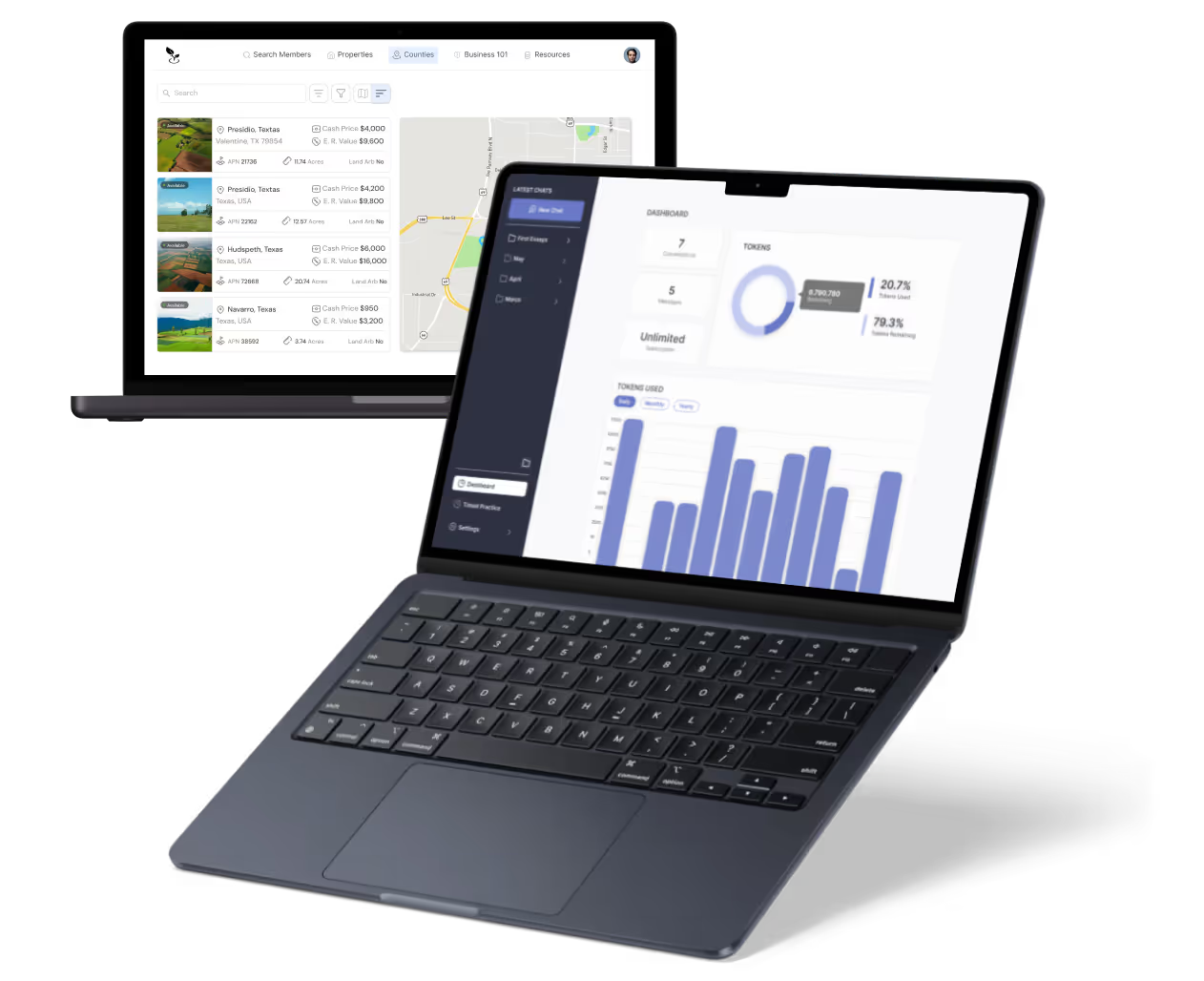

What Features Does a SaaS Analytics Dashboard on Bubble Need?
A SaaS analytics dashboard needs metric cards for key numbers, charts for trend visualization, filterable data tables, date range selectors, role-based data scoping, and an export function for offline reporting.
The dashboard is not just a display layer. It is the primary tool through which users measure the value your SaaS delivers. Every element should answer a question your users care about, not just fill visual space.
- Metric cards: display single key numbers such as total users, revenue, active sessions, or task completion rates with period-over-period comparisons.
- Chart visualizations: line charts for trends over time, bar charts for categorical comparisons, and pie charts for composition breakdowns of key metrics.
- Filterable data tables: a sortable, searchable table view of underlying records that users can drill into after seeing a high-level metric.
- Date range selector: allows users to filter all dashboard data to a specific time window, such as last 7 days, last 30 days, or a custom range.
- Role-based scoping: ensures each user sees only the data relevant to their account, team, or role rather than platform-wide aggregates.
- Export function: a CSV or PDF export of the currently filtered view for users who need to share data outside the platform.
Bubble app examples include operations dashboards and SaaS products where Bubble's database and chart plugins deliver real-time metric views to paying customers.
How Do You Structure Data for a Bubble Analytics Dashboard?
Structure analytics data by designing your core data types to support aggregation queries, adding pre-computed summary fields to frequently queried records, and using scheduled workflows to update aggregate totals on a regular cadence.
Bubble's native database can handle most analytics queries for moderate data volumes. The risk is querying large tables repeatedly for every dashboard load, which creates noticeable performance issues as your data grows.
- Event data type: log key user actions such as logins, feature uses, and completions as individual records with a timestamp, user reference, and event type field.
- Daily summary records: a scheduled backend workflow runs nightly to aggregate the previous day's event counts into a DailySummary data type, reducing live query load.
- Pre-computed totals: store running totals on the User or Account data type rather than counting all child records on every dashboard load.
- Indexed fields: ensure date, account, and status fields used in dashboard queries are set to searchable in Bubble's field settings for faster query performance.
- Snapshot records: for metrics that change over time, store periodic snapshots rather than recalculating historical values from raw event data.
Review Bubble pricing plans when planning your data architecture. Bubble's database query limits and workflow execution capacity affect how much real-time aggregation your dashboard can perform at each plan tier.
How Do You Build Charts and Visualizations in Bubble?
Build charts in Bubble using chart plugins such as ApexCharts or Chart.js, which accept data lists from Bubble's database queries and render them as interactive SVG visualizations within your dashboard layout.
Bubble's native UI elements do not include charts. Third-party chart plugins installed from the Bubble plugin marketplace fill this gap. The plugin handles rendering; Bubble handles the data preparation and query.
- ApexCharts plugin: the most commonly used chart plugin for Bubble, supporting line, bar, area, pie, and scatter chart types with interactive tooltips and responsive sizing.
- Data preparation: before passing data to a chart plugin, use Bubble's list operations to extract the values and labels the chart expects, often using repeating group sources as intermediaries.
- Dynamic chart updates: connect filter controls such as date range pickers and dropdowns to the chart's data source so the visualization updates automatically when users change their selections.
- Color and brand consistency: configure chart colors to match your SaaS product's brand palette so the dashboard feels integrated rather than bolted on.
- Mobile responsiveness: test all chart visualizations on mobile screen sizes. Chart plugins often require explicit width and height constraints to render correctly on smaller viewports.
Bubble's capabilities and limitations are relevant to dashboard design because complex interactive charts, real-time data streaming, and drill-down visualizations require plugin support or custom JavaScript that goes beyond Bubble's native elements.
How Do You Build Filtering and Date Range Controls?
Build filtering by connecting dropdown menus, date pickers, and toggle inputs to custom states, then using those custom state values as dynamic constraints on every data source and chart query in the dashboard.
Filtering is the feature that transforms a static summary into a useful investigation tool. Users need to narrow down data to the specific context they care about, whether that is a date range, a team, a product line, or a status value.
- Custom state setup: create custom states at the page level for each active filter value: start date, end date, selected category, selected user or team, and any other relevant dimension.
- Filter control layout: place filter controls at the top of the dashboard in a consistent bar so users understand filtering is global rather than per-chart.
- Dynamic constraints: apply the custom state values as constraints on every repeating group and chart data source in the dashboard, so all elements update together when a filter changes.
- Default filter values: set sensible defaults such as the last 30 days so the dashboard opens with meaningful data rather than all-time records.
- Clear filter option: include a reset button that returns all custom states to their default values, allowing users to quickly return to the standard view.
How Do You Scope Analytics Data by Tenant in a Multi-Tenant SaaS?
Scope analytics data by always including an account or tenant constraint on every dashboard query, enforcing the constraint in Bubble's privacy rules at the data type level, and never relying solely on UI-level filtering for data isolation.
Analytics dashboards in multi-tenant SaaS products must show each account only their own data. A query that accidentally surfaces another tenant's metrics is a serious privacy failure, not just a display bug.
- Account field on all records: every event record, summary record, and data type used by the dashboard must have an account or tenant field populated at creation time.
- Privacy rule enforcement: configure Bubble's privacy rules so records are only visible to users whose account matches the record's account field, regardless of UI state.
- UI-level account constraint: in addition to privacy rules, explicitly add the current user's account as a constraint on every dashboard data source as a defense-in-depth measure.
- Admin override view: for platform admins who need to see cross-account aggregates, build a separate admin-only dashboard section with explicit scope controls rather than relaxing the standard user view.
- Audit trail for admin access: log every admin-level data access so platform operators can review cross-account queries if a data incident is reported.
Bubble's security model covers privacy rule configuration, account-level data isolation, and the patterns that prevent cross-tenant data exposure in multi-account SaaS products.
How Much Does It Cost to Build a SaaS Analytics Dashboard on Bubble?
Building a SaaS analytics dashboard on Bubble costs between $12,000 and $30,000 depending on the number of metrics tracked, visualization complexity, filtering depth, and whether pre-aggregation workflows are required.
Analytics dashboards look straightforward but involve significant backend data architecture. The front-end chart layouts are fast to build; the data preparation, aggregation logic, and performance optimization take most of the time.
- Simple metrics dashboard with 4-6 KPI cards, one or two chart types, and basic date filtering: $12,000 to $18,000.
- Full analytics platform with multiple chart types, drill-down tables, multi-dimension filtering, pre-aggregation workflows, and CSV export: $22,000 to $30,000.
- Bubble growth plan: $119 per month supports moderate dashboard usage; high-traffic analytics products should evaluate the production plan for additional capacity.
- Ongoing dashboard evolution: adding new metrics and visualizations as your product grows typically requires 3-5 days per quarter of iteration work.
What Are the Limitations of Building Analytics Dashboards on Bubble?
Key limitations include query performance at large data volumes, the absence of native real-time data streaming, limited chart customization depth compared to dedicated analytics libraries, and the absence of native data warehouse connectivity.
Bubble's scalability ceiling is the primary concern for analytics-heavy products. Dashboards that query millions of records or require sub-second refresh rates will hit Bubble's database performance limits before they outgrow the platform in other ways.
- Query performance at scale: dashboards querying tens of thousands of records for every filter change will become slow. Pre-aggregation and summary records are required for large datasets.
- No real-time streaming: Bubble's database does not push live updates to the dashboard. Users must refresh the page or trigger a manual reload to see new data.
- Chart customization limits: chart plugin options are constrained by what each plugin exposes. Highly custom visualizations requiring specific layouts or interactions may not be achievable.
- No data warehouse integration: connecting Bubble dashboards to external data warehouses such as BigQuery or Redshift requires API connector configuration and is not a native capability.
Bubble pros and cons favor analytics dashboards where data volumes are moderate, refresh requirements are not real-time, and the visualization types needed are standard rather than custom. For products that need live data feeds or deep BI functionality, Bubble alternatives with dedicated analytics infrastructure are worth evaluating.
Want to Build a SaaS Analytics Dashboard on Bubble?
Analytics dashboards that show users their own progress and results are among the highest-retention features in any SaaS product. Getting the data architecture right from the start determines whether the dashboard stays fast as your product scales.
SMBs do not need a no-code tool. They need an AI product team. At LOW/CODE Agency, we build custom web apps, mobile apps, chatbots, and AI agents — software that actually scales with your business. We handle data architecture, pre-aggregation logic, visualization builds, and multi-tenant scoping as one integrated engagement.
- Data architecture design: event data types, summary records, pre-computation workflows, and indexed field configuration before any UI development.
- Chart and visualization build: ApexCharts or Chart.js plugin configuration, data source preparation, and interactive filtering connections.
- Filter and date range system: custom state architecture, filter control layout, and dynamic constraint application across all dashboard elements.
- Multi-tenant scoping: privacy rule configuration, account-level constraints, and admin override views with audit trail logging.
- Performance optimization: query analysis, pre-aggregation scheduling, and pagination strategies for dashboards with large underlying datasets.
- Export and reporting: CSV export workflows and PDF generation for users who need offline or shareable versions of their dashboard data.
We have delivered 450+ products for clients including Medtronic and American Express. Bubble development services cover analytics dashboard builds from data architecture to production deployment; most analytics dashboard engagements start around $12,000 USD.
Related Articles
Last updated on
September 28, 2026
.

Jesus is a visionary entrepreneur and tech expert. After nearly a decade working in web development, he founded LOW/CODE Agency to help businesses optimize their operations through custom software solutions.


FAQs
Can you build a SaaS analytics dashboard with Bubble?
How do you aggregate usage data for a Bubble analytics dashboard?
Can you build time-series charts in a Bubble analytics dashboard?
How do you build per-user analytics in a Bubble SaaS dashboard?
How do you build filterable analytics reports in Bubble?
What are the limits of Bubble for building a SaaS analytics dashboard?
Related Articles
Bubble
Comparison
Bubble vs OutSystems | 10 Factors to Decide the Best One
Compare Bubble vs OutSystems for web and mobile app development. Find out which no-code or low-code tool fits your team’s goals in 2025

Bubble
How to Build a Time Tracking App with Bubble
Build a time tracking app with Bubble. Log hours, track by project, and generate timesheets automatically — a custom tool that fits your billing workflow.

Bubble
How to Build a CRM App with Bubble
Build a custom CRM with Bubble. Manage contacts, track deals, and automate follow-ups — tailored to your sales process, no code required.

Bubble
How to Build a 360 Feedback App With Bubble
Build a 360 feedback app with Bubble — no code needed. Collect multi-source reviews, automate cycles, and track growth. Launch in weeks, not months.


Why customers trust us for no-code development


