

Build a Multi-Tenant SaaS App with Bubble
12 min
read
Learn how to build a multi-tenant SaaS app with Bubble. Isolate client data, manage workspaces, and scale across customers — no backend code required.

Multi-tenancy is where most no-code SaaS builds go wrong. Getting it right on Bubble requires deliberate database architecture, strict privacy rules, and access control designed before any feature development begins.
This guide covers how to build a multi-tenant SaaS app with Bubble: tenant isolation architecture, user and role management, data partitioning, billing per workspace, and where Bubble handles this pattern well versus where it requires extra care.
Key Takeaways
- Multi-tenancy on Bubble is achievable but requires a workspace or account data type that owns all tenant data, with privacy rules enforced at the database level.
- Tenant isolation is the critical requirement: every data type must be linked to a tenant and every search must be scoped to the current user's tenant.
- Role-based access within tenants adds a second layer of complexity, users need different permissions within their own workspace, not just across workspaces.
- A multi-tenant MVP on Bubble takes 10-16 weeks and costs between $20,000 and $50,000 depending on permission complexity and feature scope.
- Bubble's privacy rules are the enforcement layer: if a privacy rule is misconfigured, tenant A can see tenant B's data. Test exhaustively before going live.
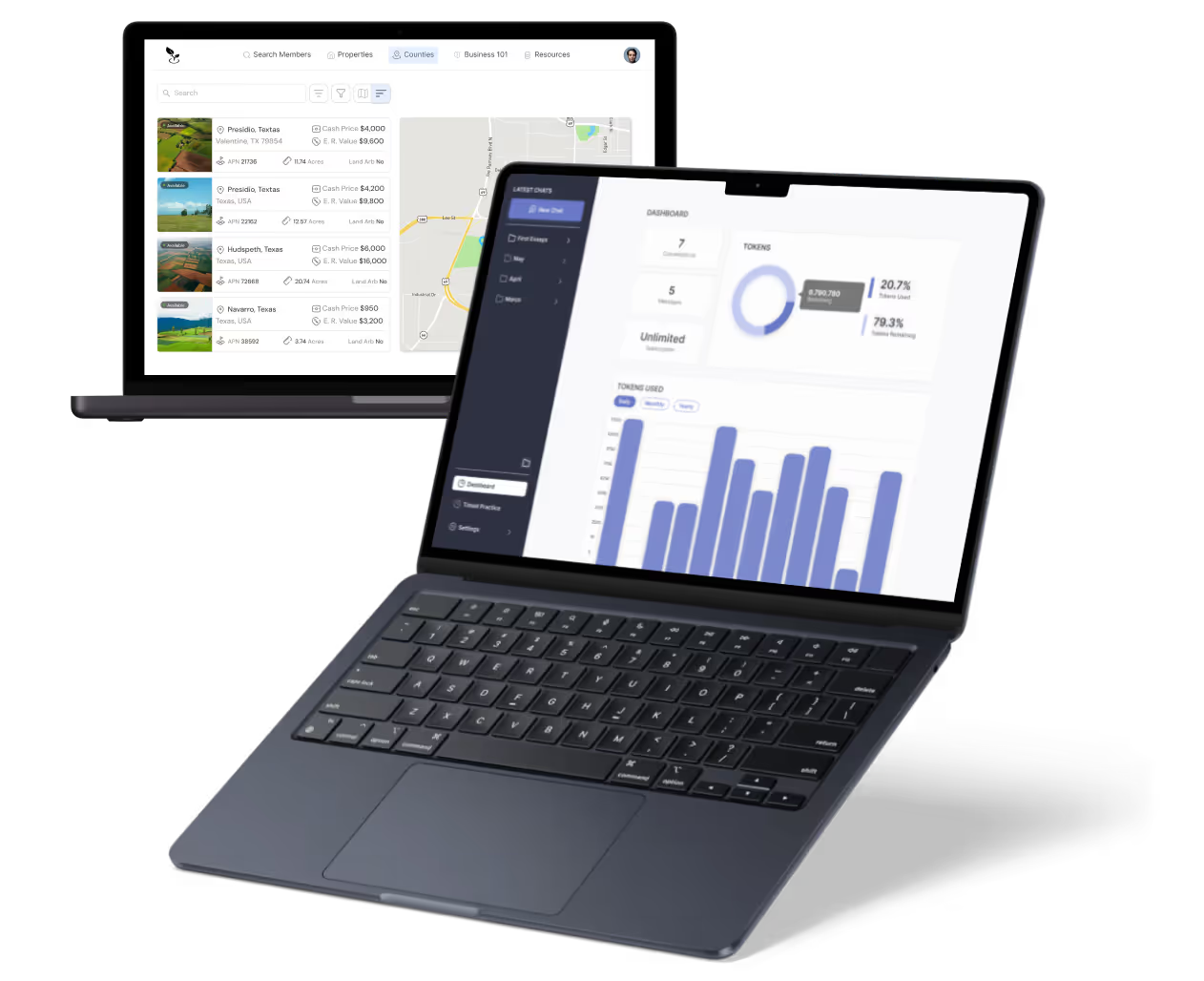

What Is Multi-Tenancy and Why Does It Matter in Bubble?
Multi-tenancy means multiple customers (tenants) use the same application instance, each seeing only their own data, users, and settings.
In Bubble, there is no native multi-tenant mode. You build it deliberately through data architecture, privacy rules, and workflow logic. Every data type that belongs to a tenant must carry a reference to that tenant, and every privacy rule must enforce that reference.
- Tenant data isolation: every record in your database must be owned by a tenant and inaccessible to users of other tenants.
- Tenant-scoped user management: users belong to one or more tenants, with roles that apply within that tenant's context.
- Tenant-specific settings: each tenant can configure their own branding, notification preferences, and workflow settings independently.
- Shared infrastructure: all tenants run on the same Bubble app and database. The separation is logical, not physical.
- Billing per tenant: each workspace has its own Stripe customer, subscription, and plan, independent of other tenants.
Bubble app examples of multi-tenant SaaS products show how workspace architecture, user roles, and tenant-scoped data combine in production applications.
How Do You Architect Multi-Tenancy in Bubble?
Architect multi-tenancy by creating a Workspace or Organization data type that owns all tenant data, linking every other data type to it, and configuring privacy rules to scope access by workspace membership.
The workspace data type is the anchor of every multi-tenant Bubble app. Everything else connects to it. If you add this as an afterthought, retrofitting it into existing data types and workflows is one of the most expensive mistakes in Bubble development.
- Workspace data type: stores tenant name, Stripe customer ID, subscription plan, settings, and a list of member users with their roles.
- Membership data type: links a user to a workspace with a role field. One user can be a member of multiple workspaces with different roles in each.
- Data ownership rule: every data type that belongs to a tenant must include a Workspace field. Never create tenant data without this reference.
- Privacy rules on all data types: configure "Who can do searches for this data type" to restrict results to records owned by the current user's active workspace.
- Active workspace state: store the user's currently active workspace in a custom state or the user data type to scope all database operations correctly.
Design the workspace and membership architecture before creating any other data types. It is the foundation that every other feature depends on.
How Do You Handle User Roles Within a Tenant in Bubble?
Handle user roles by storing role information on the Membership data type rather than the User data type, then checking role on every workflow and privacy rule that requires permission enforcement.
Roles in multi-tenant SaaS apply within a tenant context, not globally. The same user can be an Admin in one workspace and a Viewer in another. This requires role data to live on the membership record, not the user record.
- Role field on Membership: use options or text field with values like Owner, Admin, Member, Viewer. The Membership record is the source of truth for permissions within a workspace.
- Permission checks in workflows: before any sensitive action, deleting records, inviting users, changing settings, check the current user's role in the active workspace.
- Feature gating by role: use conditional visibility and workflow conditions to show or hide features based on the user's role in the current workspace context.
- Owner protection: the workspace Owner role should be non-removable and non-transferable except through an explicit ownership transfer workflow.
- Invitation flow: workspace admins invite users by email. The system creates a Membership record with the invited role when the user accepts.
Bubble's security model covers the privacy rule configuration and workflow-level permission enforcement patterns that multi-tenant apps require.
How Do You Isolate Tenant Data with Privacy Rules in Bubble?
Isolate tenant data by configuring every data type's privacy rules to restrict searches and field access to records where the Workspace field matches the current user's active workspace.
Privacy rules are Bubble's enforcement layer for tenant isolation. A user can only access data that their privacy rules allow. This is not just a UI restriction, it applies to all searches, including those made via the API or data API.
- "Do searches for this type" rule: configure this to return only records where
Workspace = Current User's active workspace. Apply this to every tenant-owned data type. - "View all fields" rule: restrict field-level access so users cannot read sensitive fields on records outside their workspace even if a search somehow returns them.
- Test with multiple test accounts: create test accounts in two different workspaces and verify that searching for data from workspace A returns nothing when logged in as workspace B.
- No workspace field is a privacy failure: any data type missing a Workspace reference is visible to all users. Audit every data type before launch.
- API calls must respect privacy rules: if you expose a data API endpoint, privacy rules still apply. Do not disable privacy rules for convenience in development.
Test tenant isolation before building any features on top of it. A privacy rule misconfiguration found in production is far more expensive to fix than one found in development.
How Do You Set Up Billing Per Tenant in a Multi-Tenant Bubble App?
Set up per-tenant billing by creating a Stripe customer for each workspace at creation time, then managing subscriptions, plan limits, and payment events at the workspace level.
Billing belongs to the workspace, not the individual user. The workspace owner manages payment, and the subscription determines what all members of that workspace can access.
- Stripe customer per workspace: when a workspace is created, trigger a Stripe API call to create a customer and store the customer ID on the Workspace data type.
- Subscription on workspace: store plan name, Stripe subscription ID, trial end date, and subscription status on the Workspace record.
- Plan access gates: check the workspace subscription plan before granting access to premium features. Users inherit the plan of their workspace.
- Webhook events at workspace level: Stripe webhooks update the Workspace subscription status when payments succeed, fail, or subscriptions are cancelled.
- Seat-based billing: if your pricing model charges per seat, count active Membership records for the workspace and enforce seat limits in your invitation workflow.
Review Bubble pricing plans as part of your billing model planning, your Bubble infrastructure cost is a fixed per-month overhead that needs to sit within your unit economics at each subscription tier.
What Does the Development Process Look Like for a Multi-Tenant Bubble App?
The development process runs six phases: architecture design, workspace and membership setup, tenant data isolation, billing integration, core feature build, and QA with isolation testing.
Architecture design is not optional for multi-tenant builds. Teams that skip it and start building features always encounter the same problems: data leaking between tenants, permission logic scattered across workflows, and billing disconnected from access control.
- Phase 1: Architecture design: map tenant ownership, user roles, data types, and billing model before opening Bubble.
- Phase 2: Workspace and membership setup: build the Workspace and Membership data types, configure privacy rules, and test tenant isolation with dummy data.
- Phase 3: Auth and invitation flow: implement registration, workspace creation on sign-up, invitation emails, and membership acceptance.
- Phase 4: Billing integration: Stripe customer creation on workspace setup, checkout, webhook handling, and plan access gates.
- Phase 5: Core feature build: the actual product functionality, built on top of the tenant-scoped data and access control layer.
- Phase 6: Isolation and QA testing: create multiple test tenants, verify data isolation, test all roles, and audit privacy rules before launch.
A multi-tenant SaaS MVP on Bubble takes 10-16 weeks. Complexity increases significantly with advanced role hierarchies, cross-workspace features, or enterprise SSO requirements.
How Much Does It Cost to Build a Multi-Tenant SaaS App on Bubble?
Building a multi-tenant SaaS app on Bubble costs between $20,000 and $60,000 depending on permission complexity, number of product features, and integration requirements.
Multi-tenant builds cost more than single-user SaaS products because the architecture phase is longer and isolation testing is thorough. Cutting corners on architecture to reduce build cost is the most common and most expensive mistake.
- Lean multi-tenant MVP with workspace management, basic roles, billing, and one core feature: $20,000 to $30,000.
- Full multi-tenant platform with advanced role hierarchies, team management, integrations, and admin tooling: $35,000 to $60,000.
- Bubble production plan: $32 to $349 per month. Multi-tenant apps with many workspaces often need a higher-capacity plan.
- Stripe fees: 2.9% plus $0.30 per transaction. Per-seat or per-workspace billing models also need Stripe usage metering configured.
- Ongoing QA: multi-tenant apps require regular isolation audits when new features are added. Budget for this ongoing compliance work.
Custom multi-tenant SaaS development starts at $100,000 and typically takes 12-18 months. Bubble delivers a validated multi-tenant product in 3-4 months.
What Are the Limitations of Building Multi-Tenant SaaS on Bubble?
Key limitations include the manual nature of tenant isolation, privacy rule complexity at scale, performance constraints with many tenants, and the absence of native row-level security.
Bubble's capabilities and limitations become particularly relevant for multi-tenant apps because the isolation layer is entirely your responsibility, unlike databases that offer native row-level security or schema-per-tenant isolation.
- Manual privacy enforcement: every data type needs its own privacy rules. One missed configuration creates a data leak across tenants.
- Query performance: searching tenant-scoped data with multiple filters slows down as the total record count grows across all tenants.
- No native row-level security: Bubble's privacy rules approximate row-level security but are not as robust as database-native implementations.
- Cross-tenant features are complex: any feature that needs to share data across workspaces, marketplaces, shared templates, public profiles, requires careful architecture to avoid leaking tenant data.
- Enterprise SSO: SAML and SCIM support for enterprise customers requires custom API integration or third-party auth services.
Bubble's scalability ceiling determines how many tenants and total records the platform can support before query performance becomes a customer-facing problem.
When Should You Use Bubble for a Multi-Tenant SaaS?
Use Bubble for multi-tenant SaaS when you are in the validation stage, serving SMB customers with moderate data volumes, and need to get to market quickly with a minimal infrastructure investment.
Bubble pros and cons are particularly relevant for multi-tenant decisions because the isolation architecture adds complexity that does not exist in single-tenant builds.
- SMB-focused B2B products with workspaces of 5-50 users are well within Bubble's multi-tenant performance range.
- Vertical SaaS for specific industries can use Bubble to validate the workflow and pricing model before investing in a custom build.
- Early-stage teams that need to demonstrate product-market fit to investors benefit from the speed and cost advantages Bubble provides.
- Products with eventual enterprise ambitions should use Bubble to reach initial revenue, then plan a rebuild once enterprise customers require SSO, audit logs, or compliance certifications.
For multi-tenant products with enterprise scale requirements, high data volumes, or complex cross-tenant features, Bubble alternatives are worth evaluating before committing to an architecture that will need to change.
Want to Build a Multi-Tenant SaaS App on Bubble?
Multi-tenancy is the most architecturally demanding type of Bubble project. Getting the isolation layer right requires experience, not just following documentation.
SMBs do not need a no-code tool. They need an AI product team. At LOW/CODE Agency, we build custom web apps, mobile apps, chatbots, and AI agents — software that actually scales with your business. We design tenant architecture, implement isolation rules, configure billing, and build core product features as one end-to-end process.
- Workspace architecture design: we map tenant ownership, membership roles, data types, and privacy rules before writing a single workflow.
- Tenant isolation implementation: we build and test privacy rules across every data type, verifying isolation with multiple test tenant accounts.
- Role-based access control: we implement membership roles, permission checks, and feature gates at the workflow and database level.
- Per-tenant billing: Stripe customer creation, subscription management, plan access gates, and webhook handling built in sprint two.
- Core product build: the actual SaaS workflow built on the isolated, permission-controlled foundation.
- Long-term product partnership: we stay involved after launch to add features and maintain the isolation layer as the product evolves.
We have delivered 450+ products for clients including Zapier and American Express. Bubble development services cover multi-tenant architecture through to live product; most engagements start around $20,000 USD.
Related Articles
Last updated on
September 28, 2026
.

Jesus is a visionary entrepreneur and tech expert. After nearly a decade working in web development, he founded LOW/CODE Agency to help businesses optimize their operations through custom software solutions.


FAQs
Can Bubble support multi-tenant SaaS architecture?
How do you implement data isolation between tenants in Bubble?
How do you handle tenant-specific custom settings in a Bubble multi-tenant SaaS?
Can you white-label a multi-tenant Bubble SaaS for each customer?
How do you manage tenant onboarding in a Bubble multi-tenant SaaS?
What are the scalability limits of multi-tenant architecture in Bubble?
Related Articles

Bubble
How to Build a Supply Chain Analytics App with Bubble
Build a supply chain analytics app in Bubble without coding. Visualize data, track KPIs, and optimize operations with this no-code step-by-step guide.

Bubble
How to Build a Field Reporting App with Bubble
Build a field operations app with Bubble no coding required. Coordinate teams, track tasks, and manage workflows step-by-step easily.
Bubble
How to Build a Clinical Trials Management App with Bubble
Launch a legal client portal with Bubble no coding needed. Share documents, track cases, and communicate securely step-by-step.
Bubble
How to Build a Mortgage Platform App with Bubble
Launch a mortgage platform with Bubble without writing code. Streamline applications, approvals, and closings step-by-step build faster today.

Why customers trust us for no-code development


