

Build an Internal SaaS Tool with Bubble
10 min
read
Learn how to build an internal SaaS tool with Bubble. Streamline team workflows, manage data, and automate operations — built visually without code.

Internal tools are the most underbuilt category of business software. Most companies run critical operations on spreadsheets, email threads, and ad-hoc workarounds because proper internal tools are treated as low priority. Building an internal SaaS tool on Bubble changes that equation: the cost and time to build a proper internal system drops to a level where every operations, HR, or finance team can justify it.
This guide covers how to build an internal SaaS tool with Bubble: the use cases it handles best, the architecture decisions that matter, access control, and how to measure success.
Key Takeaways
- Bubble is exceptionally well-suited to internal tools: structured data workflows, custom views, and admin interfaces are exactly what the platform does best, without the consumer UX pressure.
- Internal tools do not need to be pretty, they need to be fast and reliable: a clean, functional layout outperforms a polished design if it loads quickly and does exactly what your team needs.
- Access control for internal tools is simpler than customer-facing SaaS but still essential. Different team roles need different views and actions.
- An internal tool MVP on Bubble takes 4-8 weeks and costs between $8,000 and $25,000 depending on workflow complexity and integration requirements.
- The biggest risk is scope creep: internal stakeholders often expand requirements mid-build. Define the minimum viable workflow before development starts.

What Types of Internal Tools Work Best on Bubble?
Bubble works best for internal tools that manage structured data, automate repetitive manual workflows, or replace spreadsheets and email chains with a purpose-built interface.
The most successful internal tools on Bubble are those that have a clear, repeatable workflow at their core. Tools that require complex real-time collaboration, heavy file processing, or sub-second performance are better served by other approaches.
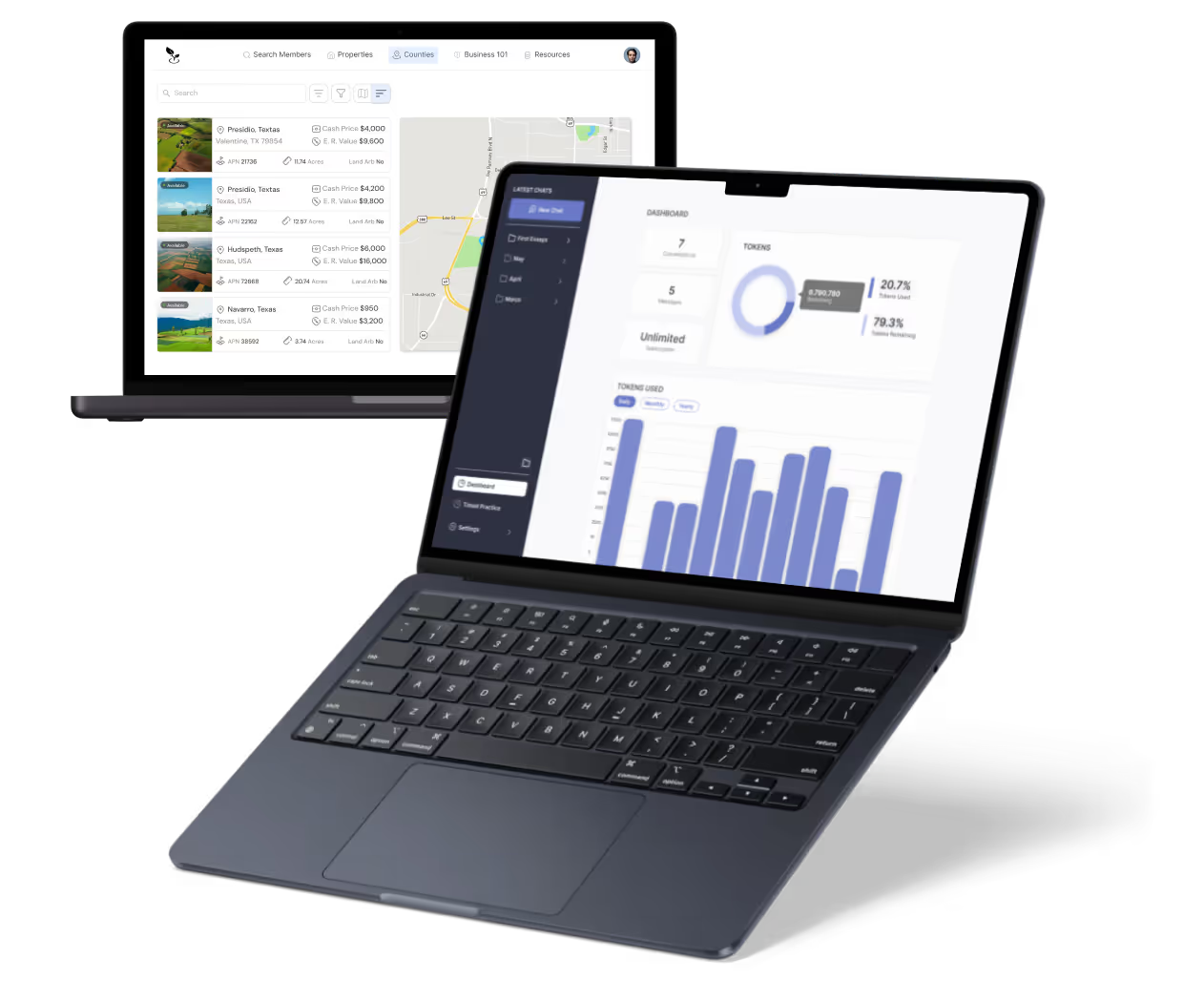
- Operations dashboards that track KPIs, task status, team workloads, and pipeline metrics in one configurable view.
- Approval and review workflows that route requests, documents, or decisions through defined stages with role-appropriate actions at each step.
- Client and project management tools that replace spreadsheets with searchable, filterable records linked to contacts, deliverables, and timelines.
- HR and people tools for managing onboarding checklists, time-off requests, employee records, and performance review workflows.
- Inventory and procurement systems that track stock levels, purchase orders, supplier contacts, and delivery status.
- Customer success tools that give your support and account management teams a unified view of customer health, activity, and communication history.
Bubble app examples of internal tools and operations platforms show how workflow-driven applications replace manual processes in growing teams.
How Do You Define the Right Scope for an Internal Tool Build?
Define scope by mapping the specific workflow your team does most frequently, identifying where it breaks down or wastes time, and building only the features that fix those specific breakdowns.
Internal tool projects fail most often due to over-scoping. The first version should solve the most painful workflow problem, not replace every tool the team uses at once.
- Workflow audit: spend one week documenting the specific steps your team follows for the target workflow, including every tool they touch and every handoff that causes friction.
- Pain point ranking: list the top 3 problems in the current workflow. Build the tool to fix those three problems. Add everything else in later sprints.
- Data mapping: identify every piece of data the tool needs to capture, display, and act on. This list becomes the foundation of your Bubble data types.
- User role definition: identify who uses the tool and what each person needs to do. Avoid building a single universal view that tries to serve everyone.
- Success metric: define what success looks like before building. A good internal tool has a measurable outcome: hours saved per week, errors reduced, approvals processed faster.
Bubble's security model is relevant even for internal tools. Data about employees, clients, or operations is sensitive. Configure privacy rules and role-based access before building user-facing features.
How Do You Set Up Access Control for an Internal Tool on Bubble?
Set up access control by assigning role fields to your User data type, configuring privacy rules to match each role's data access requirements, and using conditional visibility to show role-appropriate actions in the UI.
Internal tools typically have fewer roles than customer-facing SaaS, but the enforcement still matters. An employee should not be able to edit records above their authority level, and managers should not accidentally modify data outside their team's scope.
- Role definition: define the roles relevant to the tool, such as Viewer, Editor, Manager, and Admin. Keep the role count as small as the workflow genuinely requires.
- Privacy rules by role: configure Bubble's privacy rules so records are only visible and modifiable by users with the appropriate role.
- Conditional UI: show edit buttons, delete actions, and approval controls only to the roles that have authority to use them. This reduces error and trains correct usage.
- Department or team scoping: if the tool serves multiple departments, add a department field to records and scope each team's view to their own records by default.
- Admin override: include a clear Admin role that can view and edit all records for support and management purposes.
Define role-appropriate views before building any UI. Internal tools that show every user the same interface, regardless of role, generate confusion and support requests that eat the time savings the tool was meant to create.
What Integrations Does an Internal Tool on Bubble Typically Need?
An internal tool typically integrates with email for notifications, Slack for alerts, a CRM or ERP for data import, Google Sheets for reporting exports, and optionally document storage for file management.
Internal tools gain most of their value from connecting data that currently lives in separate systems. Each integration eliminates a manual copy-paste or handoff step.
- Email notifications: SendGrid or Postmark sends workflow trigger emails, such as approval requests, status changes, and deadline alerts.
- Slack integration: a Slack API connection fires messages to relevant channels when workflow events occur, keeping teams informed without logging into the tool.
- Google Sheets or Airtable sync: for teams that still need spreadsheet exports for reporting, a Bubble backend workflow can push data to Google Sheets via the Sheets API.
- CRM integration: connecting to Salesforce, HubSpot, or Pipedrive via API connector allows the internal tool to pull customer data without manual data entry.
- Document storage: Google Drive or Dropbox integration via API connector allows files attached to records to be stored in existing document management infrastructure.
Review Bubble pricing plans when planning integrations. Third-party API calls are counted against Bubble's workflow action limits at lower plan tiers, which can affect tools with high-frequency integration activity.
How Much Does It Cost to Build an Internal Tool on Bubble?
Building an internal tool on Bubble costs between $8,000 and $30,000 depending on workflow complexity, the number of integrations, and the number of distinct user roles requiring custom views.
Internal tools have a clear ROI framework. Calculate the hours saved per week for your team, multiply by fully-loaded cost per hour, and compare to the build cost. Most well-scoped internal tools pay for themselves within 3-6 months.
- Simple workflow tool replacing a spreadsheet or email process with one core workflow: $8,000 to $14,000.
- Multi-workflow operations platform with several interconnected workflows, multiple roles, and 2-3 integrations: $16,000 to $30,000.
- Bubble growth plan: $119 per month is usually sufficient for internal tools with moderate team sizes and workflow volumes.
- Ongoing updates: internal tools evolve as the business grows. Budget 5-10 days per quarter for adding new workflows, adjusting views, and updating integrations.
What Are the Limitations of Building Internal Tools on Bubble?
Key limitations include vendor lock-in for business-critical workflows, database query performance at large data volumes, the absence of offline access, and the complexity of integrating with legacy enterprise systems.
Bubble's capabilities and limitations matter most for internal tools when the workflow involves large historical datasets, real-time multi-user editing, or complex document manipulation.
- Vendor lock-in risk for critical workflows: business-critical operations that run through a Bubble internal tool create dependency. Plan for migration scenarios before building on Bubble for mission-critical processes.
- No offline access: Bubble requires internet connectivity. Internal tools used by field teams in low-connectivity environments need offline capability that Bubble cannot provide.
- Large historical data: internal tools that need to query years of historical records across large datasets hit Bubble's query performance limits. Pagination and pre-aggregation help but add complexity.
- Legacy system integration: connecting to legacy ERP, accounting, or HR systems with non-standard APIs or file-based data exchange is possible but requires careful API connector configuration.
Bubble's scalability ceiling is less of a concern for internal tools than for consumer SaaS products, because team size and usage volume are naturally bounded. However, tools that store large operational datasets grow into performance issues over multi-year timelines.
When Does Bubble Make Sense for an Internal Tool?
Bubble makes sense for internal tools when the workflow is clearly defined, the team size is moderate, the tool does not need to work offline, and the cost of building custom is prohibitive relative to the team's size and budget.
Bubble pros and cons align especially well with internal tooling. The speed and cost advantages are at their most impactful when the alternative is a spreadsheet or a $50,000 custom development project.
- Operations teams replacing manual spreadsheet workflows with a structured, searchable system get immediate productivity gains from Bubble internal tools.
- Growing startups that cannot justify hiring a developer to build internal tooling can use Bubble to professionalize their operations without engineering resources.
- Teams with a specific, bounded workflow problem benefit from Bubble's ability to target exactly that workflow without building a broader platform.
- Companies evaluating whether a workflow is worth automating can use a Bubble internal tool as a validation step before investing in enterprise software.
For internal tools that grow into mission-critical infrastructure, require deep ERP integration, or need to serve large remote teams with offline requirements, Bubble alternatives including purpose-built internal tool platforms are worth evaluating.
Want to Build an Internal Tool on Bubble?
Internal tools that are built well become the backbone of how teams operate. Tools built poorly become shadow IT that teams work around. The difference is clarity of scope and quality of execution.
SMBs do not need a no-code tool. They need an AI product team. At LOW/CODE Agency, we build custom web apps, mobile apps, chatbots, and AI agents — software that actually scales with your business. We scope workflows with your team, design role-appropriate interfaces, connect your existing systems, and deliver tools your team actually uses.
- Workflow scoping and pain point analysis: we map your current process, identify the highest-value breakdowns, and define the minimum viable build before any development starts.
- Data architecture: Bubble data types, privacy rules, and role-based access configured before any UI is built.
- Role-appropriate UI design: separate views for each role, built around the specific tasks each person needs to accomplish.
- Integration build: Slack, email, CRM, Google Sheets, and other system connections that eliminate manual data transfer.
- Team training and documentation: we ensure your team can operate and maintain the tool after handoff without developer support for routine changes.
- Ongoing iteration support: we stay available to add workflows and adjust the tool as your operations evolve.
We have delivered 450+ products including internal tools for Medtronic and American Express. Bubble development services include internal tool builds from workflow scoping to live deployment; most internal tool engagements start around $10,000 USD.
Related Articles
Last updated on
September 28, 2026
.

Jesus is a visionary entrepreneur and tech expert. After nearly a decade working in web development, he founded LOW/CODE Agency to help businesses optimize their operations through custom software solutions.


FAQs
Why use Bubble to build internal SaaS tools?
What kinds of internal tools can you build with Bubble?
How do you connect a Bubble internal tool to existing business databases?
How do you control access in a Bubble internal tool for different departments?
Can you replace expensive SaaS tools with a custom Bubble internal tool?
How long does it take to build an internal tool on Bubble?
Related Articles

Bubble
How to Build a Beneficiary Tracking App with Bubble
Create a beneficiary tracking app with Bubble without coding. Manage records, automate updates, and streamline workflows fast.

Bubble
How to Build a Student Portal App with Bubble
Create a student portal app with Bubble no coding needed. Share grades, resources, and announcements step-by-step with this easy no-code tutorial.

Bubble
How to Build a Mental Health Platform App with Bubble
Launch a mental health platform with Bubble without writing code. Connect patients, therapists, and resources step-by-step no developer needed.
Bubble
Comparison
Bubble vs PowerApps | 10 Factors to Decide the Best One
Compare Bubble vs PowerApps across 10 key factors to find the best no-code platform for your app, workflow, or business needs


Why customers trust us for no-code development


