

How to Build a Co-living Management App with Bubble
13 min
read
Build a CMMS platform with Bubble without coding. Schedule maintenance, track assets, and manage work orders step-by-step with no-code.


Building a co-living management app with Bubble gives operators a purpose-built platform for room tracking, flexible leases, shared billing, and resident self-service in one system.
Co-living operators managing dozens of rooms, rotating tenants, and shared expenses across multiple properties have no good off-the-shelf tool designed for their model. Bubble fills that gap.
Key Takeaways
- Co-living has unique management requirements: Room-level tracking, shared facility bookings, community features, and flexible lease terms distinguish it from standard rental property management.
- Bubble handles the multi-layer data model: House, Room, Resident, Lease, Bill, and Booking data types cover the full co-living operation without requiring a custom backend.
- Resident self-service reduces operator workload: Maintenance requests, bill payments, and room transfer requests handled through the app save hours per week per property.
- Community features drive resident retention: Event boards, house rule acknowledgements, and resident communication tools make the app a platform residents return to daily.
- Flexible billing is the hardest workflow: Variable lease start dates, shared utility splits across residents, and monthly payment tracking require careful data model design upfront.
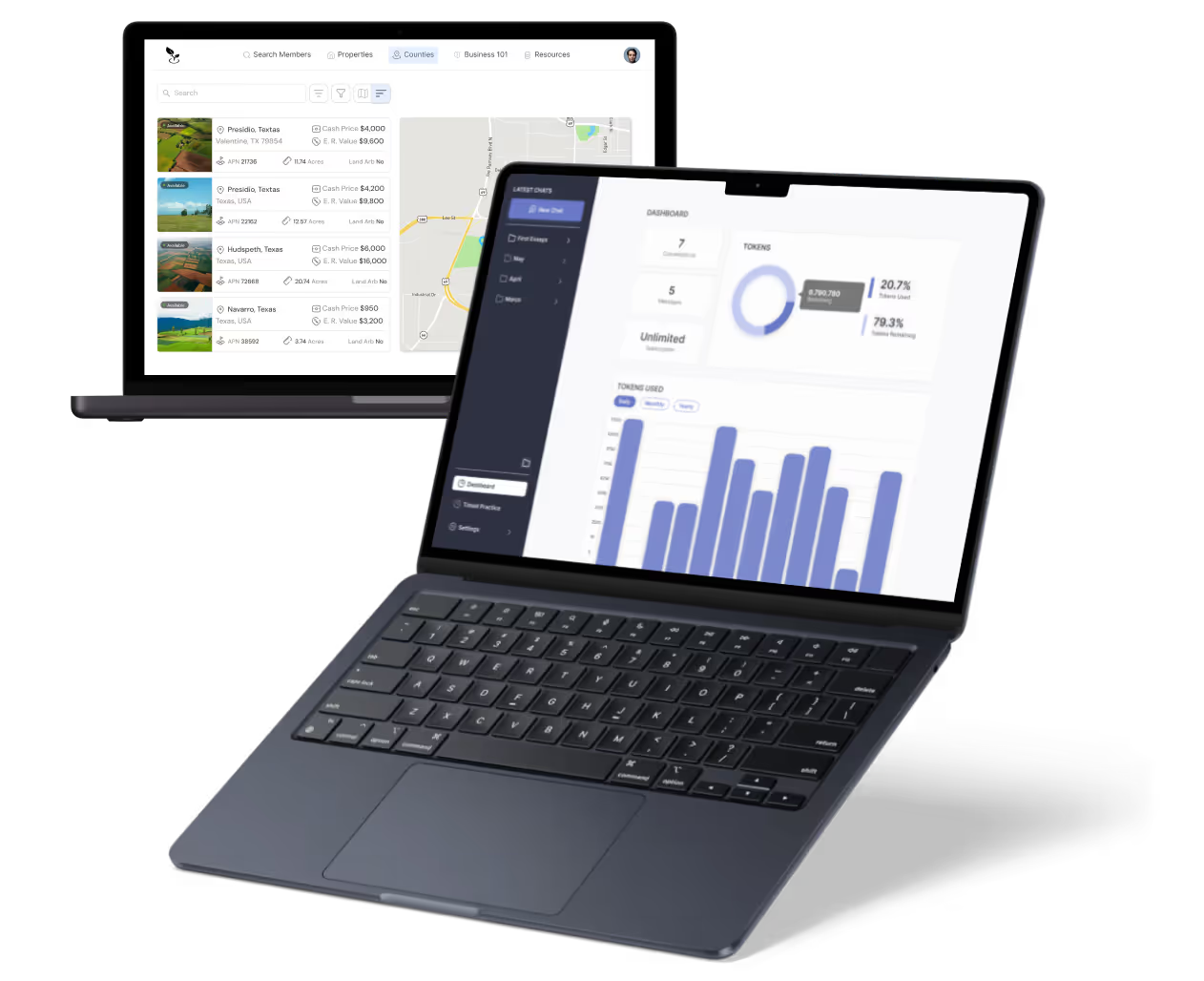

What Is a Co-living Management App — and Why Build It with Bubble?
A co-living management app is a platform for managing co-living properties: rooms, residents, leases, shared facilities, billing, and community features, from both an operator dashboard and a resident portal.
Standard property management software handles flat or house leases. It doesn't do room-level occupancy, shared utility splitting, flexible monthly terms, or community event boards.
- Room-level granularity: Bubble's data model supports individual Room records linked to Properties, each with their own occupancy status, room type, pricing tier, and resident history.
- Flexible lease terms: Co-living leases are often monthly rolling or short-term fixed. Bubble's Lease data type handles variable start dates, durations, and pricing without hardcoded assumptions.
- Shared cost management: Utility costs that split equally or by usage across multiple residents per property require workflow logic that standard software doesn't offer.
- Community as a product: Co-living brands differentiate on community experience. A Bubble app can include noticeboard posts, event RSVPs, and house rule acknowledgements as native features.
Co-living operators building a multi-property management platform often work with a Bubble SaaS development agency to build a product they can scale to new locations without rebuilding the platform architecture each time.
What Features Should a Co-living Management App Include?
An MVP co-living management app needs property and room management, resident onboarding, lease tracking, monthly billing, maintenance requests, and a basic resident communication channel.
Build the operator dashboard and billing workflow first. Those two features reduce manual workload immediately, before resident-facing community features are added in phase two.
- Property and room dashboard: The operator views all properties, room occupancy status by room (vacant/occupied/reserved), upcoming move-out dates, and revenue summary per property.
- Resident onboarding: An application form collects resident details, triggers ID verification, and on approval creates a Lease, assigns the Room, and sends a digital lease for signing.
- Flexible lease management: Each Lease record links a Room, a Resident, and specifies start date, end date or rolling status, monthly rent, and deposit amount independently per resident.
- Monthly billing and payment tracking: Automated bill generation on the 1st of each month creates Bill records per resident, splits shared utilities, and allows Stripe payment directly from the resident portal.
- Maintenance request system: Residents submit requests from their portal; operators see all requests by property and priority; status updates notify residents at each stage.
- Shared facility booking: A calendar-based booking system for kitchen slots, laundry machines, gym access, meeting rooms, or any shared amenity, with conflict detection preventing double-booking.
- Community noticeboard and events: Operator-posted announcements and resident-submitted events display on a community board visible to all residents in the same property.
- Resident-to-operator messaging: A deal-linked message thread keeps communication in context and searchable rather than scattered across email and WhatsApp.
A resident portal that requires login to access billing and maintenance, rather than just email links, dramatically increases self-service usage and reduces inbound operator queries.
How Do You Structure the Database for a Co-living Management App in Bubble?
The database needs seven types: Property, Room, Resident, Lease, Bill, Maintenance Request, and Shared Facility Booking, with Room as the key linking record between the property and the resident.
Shared Facility Booking conflict detection depends on the booking records being queryable by facility, date, and time range simultaneously. Index those fields appropriately from the start.
- Property: Fields include property name (text), address (text), total room count (number), amenities list (list of text), and operator (User).
- Room: Fields include room number (text), room type (option set: single/double/en-suite/studio/pod), monthly rate (number), occupancy status (option set: vacant/occupied/reserved), floor (number), and linked Property (Property).
- Resident: Fields include full name (text), email (text), phone (text), move-in date (date), ID verification status (option set), linked User (User), and linked Room (Room).
- Lease: Fields include start date (date), end date (date - nullable for rolling), monthly rent (number), deposit amount (number), lease status (option set: active/expired/notice-period), linked Room (Room), and linked Resident (Resident).
- Bill: Fields include billing month (text formatted as YYYY-MM), total rent amount (number), utilities share (number), additional charges (number), total due (number), payment status (option set: unpaid/paid/partial), Stripe payment intent ID (text), and linked Resident (Resident).
- Maintenance Request: Fields include description (text), priority (option set: low/medium/high/emergency), status (option set: submitted/in-progress/resolved), photos (list of images), submitted by (Resident), linked Room (Room).
- Shared Facility Booking: Fields include facility name (option set), booking date (date), start time (text), end time (text), booked by (Resident), confirmed status (yes/no), and linked Property (Property).
Storing billing month as a text field (YYYY-MM format) rather than a date makes billing period queries and display significantly simpler than managing date-range constraints.
How Do You Build the Core Workflows for a Co-living Management App in Bubble?
Core workflows handle resident onboarding, monthly billing generation, Stripe payment collection, room transfers, maintenance routing, facility conflict detection, and lease expiry alerts.
The monthly billing workflow is the most operationally critical. Test it thoroughly with edge cases including partial-month stays, late joiners, and residents with different utility split arrangements.
- Resident onboarding: The application form creates a Resident record, triggers a Persona ID verification API call via API Connector, and on verification success creates the Lease record, updates Room status to "occupied", and sends a DocuSign lease signing request.
- Monthly billing generation: A scheduled backend workflow runs on the 1st of each month; it searches for all active Leases, creates a Bill record per Resident with monthly rent plus each resident's share of that month's utility costs, and sends a SendGrid payment reminder.
- Payment processing: The resident clicks "Pay Now" in their portal, triggering a Stripe payment workflow; on Stripe webhook confirmation of payment, a backend workflow updates the Bill's payment status to "paid" and sends a receipt email.
- Room transfer request: A resident submits a transfer request selecting an available Room; the operator approves from the dashboard; approval workflow sets current Lease status to "expired", creates a new Lease for the new Room, and updates both Room occupancy statuses.
- Maintenance routing: On Maintenance Request creation, a backend workflow sends a SendGrid email to the property manager with request details and priority; each status update by the manager triggers a notification email back to the resident.
- Facility booking conflict check: On booking form submit, a backend workflow searches existing Shared Facility Booking records for the same facility, same date, and overlapping time range; if conflicts exist, it returns an error and blocks creation; if clear, it creates the booking and confirms.
- Lease expiry alert: A nightly scheduled workflow finds Leases where end date is within 30 days and status is "active"; it sends renewal option emails to residents and alert emails to the assigned operator.
Understanding Bubble's capabilities and limitations helps co-living operators determine which billing logic and community features to build natively in Bubble versus where third-party integrations like Stripe or DocuSign are the right tool.
What Security and Data Requirements Apply to a Co-living Management App?
Privacy rules must ensure residents can only access their own records, operators only see their own properties' data, and community features share only the information residents have consented to display.
A resident seeing another resident's lease amount or payment history is a confidentiality breach. It happens immediately if privacy rules are not set before the first resident is onboarded.
- Resident privacy rule: Residents see only their own Resident record; operators see all Residents linked to their Properties. "This Resident is visible when: Current User is this Resident's linked User OR Current User is this Resident's linked Property's operator."
- Lease privacy rule: A resident sees only Leases where "this Lease's linked Resident's linked User is Current User." Operators see all Leases for their properties.
- Bill privacy rule: Bills are visible only to the Resident they belong to and the operator of the linked property. No resident can see another resident's payment status.
- Maintenance Request privacy: Residents see only their own requests; operators see all requests for their properties. Status updates are visible to the submitting resident only.
- Facility Booking visibility: All authenticated residents in the same Property can view facility bookings for scheduling purposes. "Can edit" is scoped to the booking creator only.
- Community noticeboard: Posts and event listings are visible to all Users who are linked as Residents to the same Property, scoped by Property rather than individual Resident.
What Plugins and Integrations Does a Co-living Management App Need?
A co-living app needs payment processing, ID verification, lease signing, notifications, a booking calendar, and PDF document generation as core integrations beyond Bubble's native features.
Test the Stripe recurring payment flow and DocuSign signing journey with real test accounts before launch. Those two workflows are resident-facing and must work flawlessly from day one.
- Stripe plugin (official): Handles monthly rent collection, deposit charging, and optional one-time fees with webhook-triggered Bill status updates on payment confirmation.
- Persona or Veriff (via API Connector): KYC identity verification for resident onboarding; webhook returns verification result to update the Resident record's verification status field.
- DocuSign or HelloSign (via API Connector): Sends digital tenancy agreements for e-signature during onboarding; signed document URL saves to a Document record linked to the Lease.
- SendGrid plugin: Sends payment reminders, lease expiry notices, maintenance status updates, booking confirmations, and community event notifications with per-type email templates.
- Twilio plugin: SMS reminders for rent due dates, emergency maintenance status updates, and move-in confirmation for residents who prefer text over email.
- FullCalendar plugin or Bubble native calendar: Displays shared facility bookings in a calendar format for residents to view availability before submitting a booking request.
- Air PDF Conjurer: Generates formatted tenancy agreement PDFs, monthly billing statements, and move-out confirmation letters from Bubble data.
- Intercom or Crisp (via API Connector): Adds live chat support for residents who need help with the portal, payments, or maintenance requests during operator business hours.
How Long Does It Take and What Does It Cost to Build a Co-living Management App with Bubble?
A co-living management MVP takes 8 to 14 weeks; a full multi-property platform with community features and advanced billing takes 14 to 20 weeks.
Monthly billing generation and facility conflict detection are the two workflows that take longer to build and test than most people estimate. Both require extensive edge case QA.
- Solo MVP build: 10 to 14 weeks at 180 to 260 hours; covers room and property management, resident profiles, lease tracking, manual bill creation, and maintenance requests.
- Agency build: 8 to 12 weeks with a team; includes Stripe monthly billing, facility booking with conflict detection, DocuSign lease signing, community noticeboard, and ID verification.
- Full multi-property platform: 14 to 20 weeks; adds multi-operator support, advanced utility billing splits, community event RSVP, analytics dashboard, and white-label resident portals per property.
- Bubble plan recommendation: Growth plan at $119/month for a single property; Team plan at $349/month for multi-property deployments with daily facility bookings and monthly scheduled billing workflows.
- Stripe transaction fees: 2.9% plus 30 cents per payment; a property with 20 residents paying £800/month generates approximately £12 in fees per resident per month.
- Persona verification costs: Approximately $1.50 per resident identity verification; a 30-unit property onboarding quarterly adds approximately $45 to quarterly operating costs.
- DocuSign costs: Individual plans start at approximately $10 per user per month for standard signing; API-triggered sending for automated lease workflows requires a business plan.
Co-living platforms with daily facility bookings and monthly automated billing workflows benefit from reviewing Bubble's pricing plans to ensure scheduled workflow server capacity matches property count and resident volume.
Conclusion
Bubble gives co-living operators a path to a purpose-built management platform that handles room-level complexity, flexible billing, and community features that generic property management software ignores entirely.
Map your room types and billing structure before designing any data types. Those two inputs determine the option sets and workflow logic that every other feature depends on.
Need Help Building Your Co-living Management App on Bubble?
Co-living platforms combine resident billing, shared facility scheduling, community features, and flexible lease logic in a single app. Getting any layer of the data architecture wrong creates operational problems that multiply as the resident count grows.
A billing workflow that fails to split utilities correctly, or a facility booking conflict check that allows double-bookings, creates trust problems with residents that are difficult to recover from.
At LOW/CODE Agency, we build AI-powered products for SMBs — custom web apps, mobile apps, chatbots, RAG systems, and AI agents, delivered with the depth and standards of a specialist software team. We scope the architecture, engineer the workflows, and stay involved through launch and beyond.
- Data architecture: We design your data types, option sets, and privacy rules before writing a single element on the canvas.
- Workflow engineering: We build backend workflows, scheduled jobs, and API integrations with proper logic and error handling.
- Plugin configuration: We select and configure the right Bubble plugins for your feature set without unnecessary bloat.
- Role-based access: We implement privacy rules at the database level, not just conditional UI visibility.
- Integration setup: We connect your Bubble app to Stripe, SendGrid, Twilio, and other services correctly from day one.
- Pre-launch testing: We test against real data before deployment so every workflow performs correctly under live conditions.
- Post-launch support: We stay involved after go-live to optimize as real usage data shapes the app.
We have built 350+ products for clients including Coca-Cola, American Express, Sotheby's, and Medtronic. We know exactly where Bubble builds fail and we address those problems before they surface.
Related Articles
- How to Build a Commercial Real Estate Management App with Bubble
- How to Build a Cold Chain Management App with Bubble
- How to Build a Coaching Platform App with Bubble
- How to Build a CMMS Platform with Bubble
- How to Build a Cloud Kitchen Management App with Bubble
- How to Build a Clinical Trials Management App with Bubble
Last updated on
September 24, 2026
.

Jesus is a visionary entrepreneur and tech expert. After nearly a decade working in web development, he founded LOW/CODE Agency to help businesses optimize their operations through custom software solutions.


FAQs
Can you build a CMMS platform without coding using Bubble?
How do you create and assign work orders in a Bubble CMMS platform?
How do you set up preventive maintenance schedules in Bubble?
How do you track asset maintenance history in a Bubble CMMS?
How do you manage spare parts inventory in a Bubble CMMS?
How do you measure mean time between failures in a Bubble CMMS?
Related Articles
Bubble
How to Build a Legal Team Collaboration App with Bubble
Boost legal team productivity with a no-code Bubble collaboration app. Share cases, documents, and updates without coding build it step-by-step.

Bubble
How to Build an Insurance Claims App with Bubble
Streamline insurance claims with Bubble no coding required. Build an app to submit, track & resolve claims step-by-step using no-code tools fast.

Bubble
How to Build a Home Care Management App with Bubble
Launch a HIPAA compliance platform on Bubble without coding. Manage policies, training, and risk assessments step-by-step no developer needed.
Bubble
How to Build an Online Course Platform App with Bubble
Launch an online course platform with Bubble no coding required. Sell courses, manage lessons & engage learners step-by-step using no-code tools.


Why customers trust us for no-code development


