

How to Build a Capacity Planning App with Bubble
9 min
read
Build a capacity planning app with Bubble. Visualize team workload, forecast demand, and prevent burnout — custom to your ops, no code required.


Capacity planning apps give project managers a live view of available team hours versus booked demand so resource gaps surface before they become project delays. Bubble's visual development environment lets you build a custom capacity planning app with role-based capacity pools, scenario planning, and hiring gap dashboards without writing code.
Key Takeaways
- Role-based capacity pools: Bubble tracks available hours per role so managers can see exactly where demand exceeds supply across teams.
- Scenario planning tools: Draft capacity scenarios against projected demand before committing headcount or adjusting timelines for the team.
- Hiring gap identification: Dashboards surface roles where booked hours consistently exceed available capacity, triggering data-backed hiring requests.
- Live demand dashboards: Capacity versus demand views update in real time as projects are added, modified, or closed in the system.
- Approval workflows: Capacity requests route to department leads for review before hours are confirmed and locked against a project.
- Build cost range: MVP capacity planning apps on Bubble typically start around $16,000 depending on scope and data complexity.
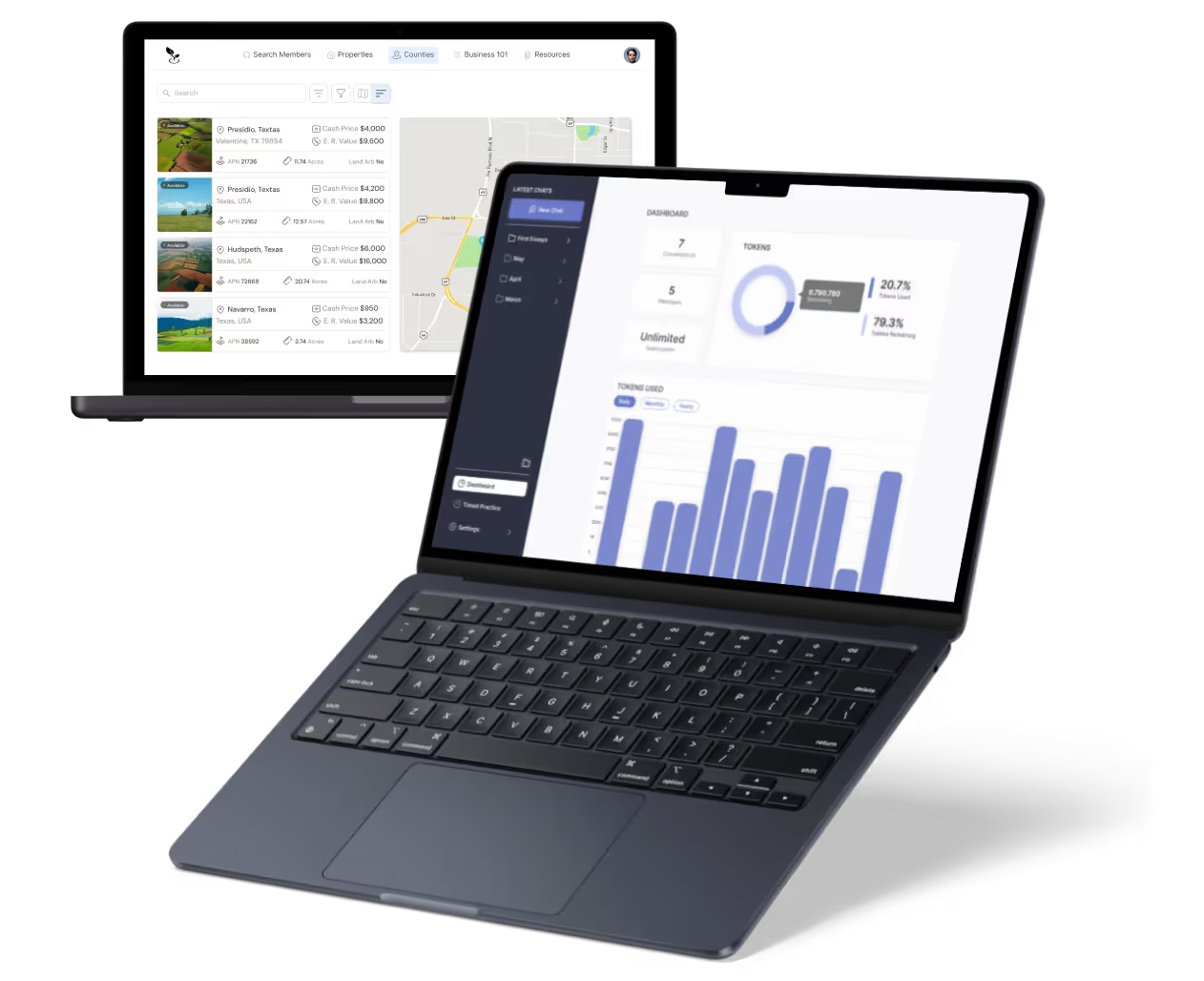

What Data Architecture Does a Bubble Capacity Planning App Need?
A Bubble capacity planning app requires six core data types: Employee, Role, CapacityPool, Project, Allocation, and ScenarioPlan. These types together support available-hours tracking, demand booking, and scenario modeling in one connected system.
Getting these six types structured correctly before building any page prevents logic errors in availability calculations and keeps scenario planning workflows clean.
- Employee type: Stores name, role reference, department, FTE percentage, and working hours per week for each team member.
- Role type: Defines the role name, default weekly hours, department owner, and links to all employees assigned to that role.
- CapacityPool type: Holds role reference, planning period, total available hours, booked hours, and remaining hours calculated dynamically.
- Project type: Stores project name, start and end date, project manager, status, and total allocated hours from the team.
- Allocation type: References Employee, Project, Role, period, and allocated hours so demand is tracked at the individual level precisely.
- ScenarioPlan type: Stores scenario name, planning period, draft allocations, and status so multiple demand scenarios can be compared before committing.
See Bubble apps built across industries to understand how production workforce planning tools structure similar data types at scale.
How Do You Build Capacity Availability Tracking in Bubble?
Bubble tracks available capacity by calculating the difference between each role's total hours for a period and the sum of all confirmed Allocation records linked to that role during the same period.
This dynamic calculation means availability updates automatically as new allocations are created, modified, or removed without any manual recalculation steps.
- Available hours field: CapacityPool stores total hours as a fixed number and calculates remaining hours from linked Allocation records dynamically.
- Utilization percentage: A calculated field divides booked hours by total hours and displays the result as a color-coded percentage bar.
- Period filtering: Date range selectors filter CapacityPool records to weekly, monthly, or quarterly views depending on planning horizon.
- Role aggregation: The dashboard aggregates remaining hours across all employees in a role to show pool-level availability instantly.
- Overbooked flag: When booked hours exceed available hours, the CapacityPool record is flagged and appears in the overbooked alerts view.
- Team calendar overlay: A Gantt-style repeating group visualizes each employee's allocations across the planning period on one timeline.
A capacity status summary at the top of the planning dashboard gives managers an at-a-glance view before drilling into individual role pools.
How Do You Build Project Demand and Allocation Workflows in Bubble?
Project demand is captured through an allocation request form where project managers specify the role, hours needed, and period required. A workflow creates the Allocation record and updates the linked CapacityPool booked hours immediately.
Routing allocation requests through an approval step prevents overbooking and ensures department leads control how their team's hours are committed across projects.
- Allocation request form: Project managers select role, employee, project, period, and required hours and submit for capacity lead review.
- Approval routing: Submitted allocations trigger a notification to the department lead, who approves or adjusts before the record is confirmed.
- Conflict detection: Before saving, the workflow checks whether adding the requested hours would exceed the employee's remaining available hours.
- Confirmed allocation: Approved Allocation records update the CapacityPool booked hours field and appear on the team timeline immediately.
- Reallocation workflow: Managers can modify confirmed allocations; the workflow recalculates CapacityPool totals automatically after each change.
- Demand forecast view: A forward-looking table shows total demand by role for each upcoming period based on confirmed and pending allocations.
Bubble's privacy rules and data access controls ensure project managers only see capacity data for roles they are authorized to request against.
How Do You Build Scenario Planning in Bubble?
Scenario planning in Bubble uses a ScenarioPlan data type to hold draft allocations against projected demand without affecting confirmed capacity. Planners model multiple headcount and project combinations before committing to any one plan.
This draft-layer approach keeps live capacity data clean while letting planners test assumptions, compare options, and share scenarios with leadership for review.
- New scenario form: Planners create a named ScenarioPlan with a period and status of Draft, then add draft allocations without touching confirmed records.
- Draft allocation layer: Scenario allocations write to ScenarioPlan rather than CapacityPool so live availability totals remain unaffected during modeling.
- Scenario comparison view: A side-by-side table shows utilization percentages across two or more ScenarioPlan records for the same period.
- Hiring gap analysis: When a scenario shows a role consistently overbooked, the app calculates additional FTE needed and surfaces a hiring gap flag.
- Scenario approval: Leadership reviews a shared scenario view and marks the preferred plan as Approved to convert drafts to confirmed allocations.
- Promote to live: Approving a scenario triggers a workflow that creates confirmed Allocation records from all draft allocations in the plan.
Scenario planning is the highest-value feature in any capacity app. Build it as a distinct layer from the start rather than retrofitting it later.
How Much Does It Cost to Build a Capacity Planning App on Bubble?
A Bubble capacity planning app costs between $16,000 and $44,000 depending on scope, with MVP versions covering availability tracking, basic allocation, and a capacity dashboard.
Choosing a Bubble pricing plan adds a monthly hosting cost; a capacity app with multiple planners and live dashboards typically runs on the Growth or Team plan.
- MVP scope: Covers role-based capacity pools, allocation request forms, availability calculations, and a basic utilization dashboard.
- Full build scope: Adds scenario planning, hiring gap identification, approval routing, team Gantt timeline, and period comparison views.
- Bubble hosting cost: Growth and Team plans range from $119 to $349 per month for apps with real-time data and multiple concurrent users.
- Maintenance budget: Allocate 10 to 15 percent of build cost annually for role additions, workflow adjustments, and dashboard updates.
Total cost of ownership is substantially lower than licensing dedicated workforce planning software with comparable forecasting and scenario modeling depth.
What Are the Limitations of Building a Capacity Planning App on Bubble?
Bubble handles capacity pools, allocations, and scenario planning well, but complex resource optimization algorithms, real-time HRIS sync, and multi-thousand-employee scale have meaningful platform constraints.
Understanding these constraints before scoping the build avoids expensive rework when requirements around automation depth or data volume exceed Bubble's native capabilities.
- Optimization algorithms: Automated resource optimization that solves for maximum utilization across projects requires external logic Bubble cannot run natively.
- HRIS sync: Pulling live headcount and FTE data from Workday or BambooHR requires API connector workflows and scheduled sync logic.
- Large workforce scale: Capacity apps serving thousands of employees with complex allocation matrices may face performance limits at high data volume.
- Offline access: Bubble requires a live internet connection; planners in offline environments cannot access or update capacity data without connectivity.
Review Bubble's native vs. integrated capabilities and a balanced look at Bubble's pros and cons before finalizing your feature scope. Teams needing AI-driven optimization should also consider exploring alternatives to Bubble.
Conclusion
Bubble is a strong fit for capacity planning apps that need role-based pools, demand allocation workflows, and scenario modeling without a long custom development cycle. The data structure and allocation logic are well within what Bubble handles reliably.
Getting the CapacityPool and ScenarioPlan data types right before building dashboards saves significant rework. A clean foundation makes every availability calculation, hiring gap report, and scenario comparison accurate and easy to maintain.
Build Your Capacity Planning App with Bubble
At LOW/CODE Agency, we build capacity planning applications on Bubble that handle role-based pools, allocation workflows, scenario planning, and hiring gap analysis as one complete platform.
- Data architecture: Employee, Role, CapacityPool, Project, Allocation, and ScenarioPlan types structured for accurate availability tracking and demand modeling.
- Allocation workflows: Request forms, conflict detection, approval routing, and confirmed allocation logic built to prevent overbooking across teams.
- Scenario planning: Draft allocation layer, scenario comparison views, hiring gap identification, and promote-to-live workflow fully included.
- Capacity dashboards: Role utilization percentages, overbooked flags, team Gantt timeline, and forward-looking demand forecast views.
- Access controls: Privacy rules ensuring planners and project managers see only the capacity data their role authorizes them to access.
We have delivered 450+ products for clients including Coca-Cola and American Express. Bubble development services cover capacity planning builds from architecture through production launch; most engagements start around $16,000 USD.
Related Articles
Last updated on
September 28, 2026
.

Jesus is a visionary entrepreneur and tech expert. After nearly a decade working in web development, he founded LOW/CODE Agency to help businesses optimize their operations through custom software solutions.


FAQs
Can you build a capacity planning app with Bubble?
How do you track team member availability in a Bubble capacity planning app?
How do you map project demand to team capacity in Bubble?
How do you build utilization reports in a Bubble capacity planning app?
How do you handle scenario planning in a Bubble capacity tool?
How do you alert managers about capacity risks in Bubble?
Related Articles

Bubble
How to Build an E-Discovery Platform App with Bubble
Build an e-discovery platform with Bubble without coding. Organize legal documents, tag evidence & manage review step-by-step using no-code tools.
Bubble
How to Build a Community Forum App with Bubble
Build a commercial real estate management app with Bubble no code needed. Manage listings, leases, and clients step-by-step.
Bubble
How to Build a Food Waste Tracking App with Bubble
Create a food traceability app with Bubble without coding. Track ingredients from farm to fork, boost transparency, and meet compliance fast.
.avif)
Bubble
Can I Build Mobile Apps with Bubble (Using the Native Editor)?
Yes, you can build mobile apps in Bubble using the new native editor. Learn its features, limitations, and what’s possible in 2025


Why customers trust us for no-code development


