

How to Build a Real Estate Deal Tracker App with Bubble
14 min
read
Track real estate deals with a Bubble app no coding needed. Monitor pipelines, deadlines, and profits step-by-step with this no-code tutorial.


Building a real estate deal tracker app with Bubble gives acquisition teams a single platform to manage their entire pipeline. From initial lead through LOI, due diligence, and closing. Spreadsheets break the moment two analysts update them at the same time.
The cost of a missed deal is orders of magnitude greater than the cost of a well-built tracking tool. Bubble makes it possible to build that tool in weeks, not months, without an engineering team.
Key Takeaways
- Core purpose: A real estate deal tracker centralizes lead sourcing, underwriting data, deal status, and pipeline reporting for investors and acquisition teams.
- Key features: Deal pipeline with stage tracking, underwriting calculator, document storage, task management, and investor reporting are the MVP essentials.
- Data model: Deal, Property, Contact, Task, and Document are the five core data types.
- Build time: 4-7 weeks solo; 3-4 weeks with an agency.
- Cost: Agency builds run $8,000-$20,000 depending on underwriting complexity and investor portal requirements.
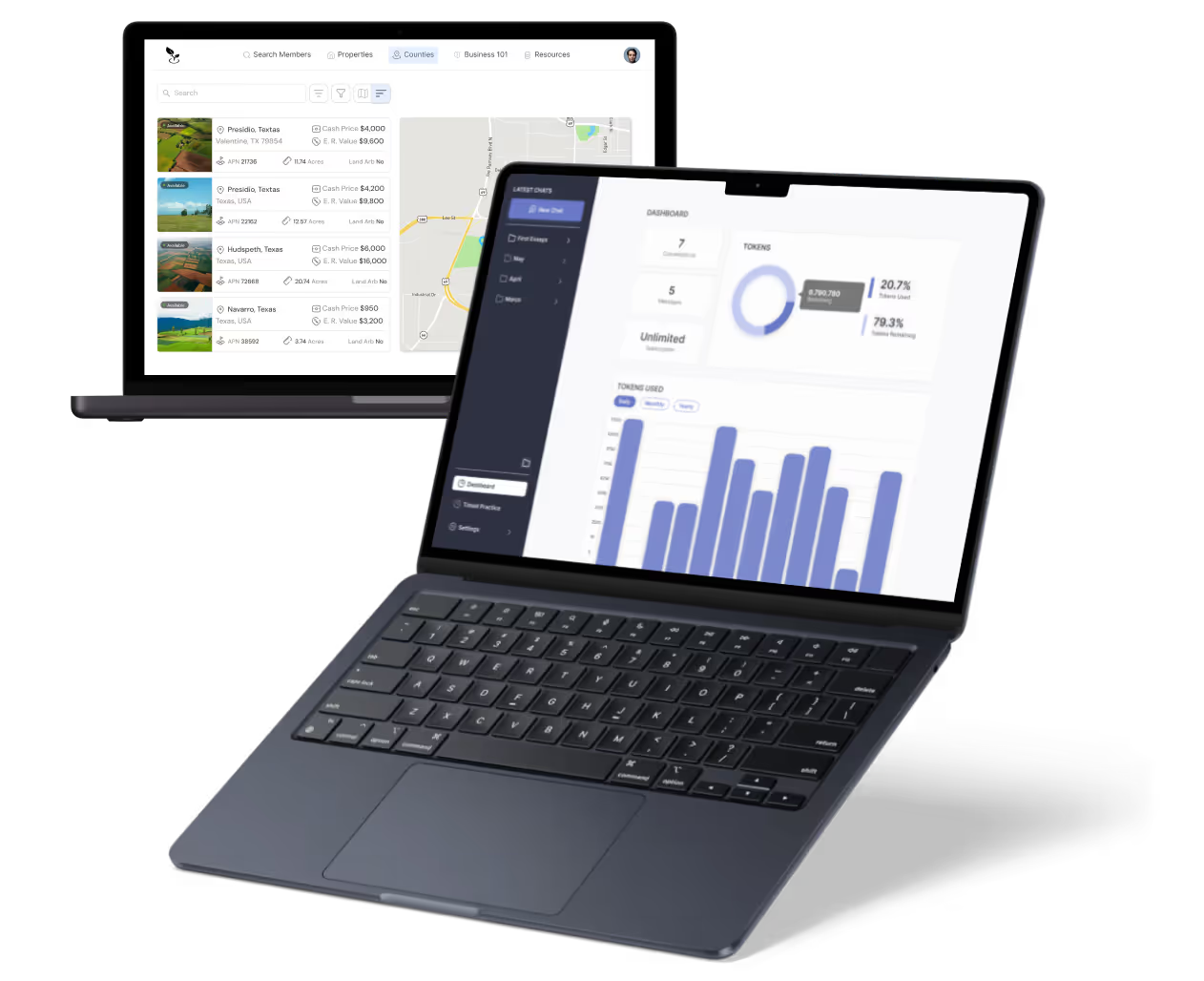

What Is a Real Estate Deal Tracker App — and Why Build It with Bubble?
A real estate deal tracker is the operational backbone of an acquisition team. It stores every deal in a structured pipeline, tracks the analysis and diligence workflow, manages contacts and documents, and gives leadership a live view of the portfolio opportunity set.
Without a purpose-built tool, deal status lives in someone's inbox. Underwriting lives in a spreadsheet no one else can see. Deals die because the next step was never assigned to anyone.
- Shared pipeline visibility: Every team member sees the same deal status in real time. No "which version is current?" questions when leadership asks for a pipeline update.
- Structured underwriting data: Bubble stores cap rate, NOI, LTV, cash-on-cash return, and IRR as calculated fields linked to each deal record. These are not buried in a tab inside a spreadsheet.
- Workflow automation: When a deal moves from Analyzing to LOI, a workflow can automatically create the standard due diligence task list, notify the relevant analyst, and log the stage transition in the activity history.
- Investor reporting: An investor portal page displays only the deals a specific investor is participating in, with a summary of status, returns, and required capital. No full database access required.
For teams evaluating whether to build a custom tool or adapt a CRM, Bubble MVP development is a proven approach for deal trackers. The scope is constrained, the workflow is defined, and a working product is achievable within a standard sprint cadence.
Bubble's visual database, relational data model, and custom calculation fields make it significantly better suited for deal tracking than a CRM. CRMs are designed for sales pipelines, not real estate acquisition workflows with underwriting data.
What Features Should a Real Estate Deal Tracker App Include?
The MVP feature set covers the full deal lifecycle: sourcing through closing. Features that support investor relations and portfolio management can follow in a planned second release.
Define "done" for each deal stage before building the pipeline UI. The stage definitions determine what data fields and task types are associated with each phase.
- Deal pipeline with stage tracking: A Kanban-style board displays all active deals across stages: Lead, Analyzing, LOI Submitted, Under Contract, Due Diligence, Closed, Dead. Each deal card shows property address, asset type, asking price, and assigned analyst.
- Property data entry: Each deal record stores address, asset type (office/retail/multifamily/industrial/land), asking price, units or square footage, year built, and deal source (broker/direct mail/cold call/MLS/off-market).
- Underwriting calculator: Built into the deal record, this section calculates key metrics automatically: cap rate (NOI divided by purchase price), cash-on-cash return (annual cash flow divided by equity invested), and estimated IRR based on a hold period assumption. Inputs are stored as fields; calculations are Bubble expressions.
- Contact management: Each deal links to multiple contacts with their role: listing broker, seller, lender, equity partner, attorney, inspector. Contact records are reusable across deals - one broker appears on multiple deals without duplicate entries.
- Task and deadline tracking: Each deal has an associated task list. Tasks have a description, assigned user, due date, priority, and completion status. A backend workflow sends reminder emails 24 hours before a task is due.
- Document storage: OM, rent roll, trailing 12 financials, inspection reports, LOI drafts, and PSA are stored as files linked to the deal record. Each document has a type tag for easy filtering.
- Notes and activity log: Every stage change, note addition, and document upload generates an Activity Log record with a timestamp and the user who triggered it. The activity log is the audit trail for the deal.
- Investor/partner reporting: A separate investor-facing view shows only deals the investor is participating in, with a summary card per deal showing status, projected returns, and required capital commitment.
Skip the investor portal for the MVP if the team only tracks deals internally. Build it once the core acquisition workflow is validated and investors start asking where to find deal updates.
How Do You Structure the Database for a Real Estate Deal Tracker App in Bubble?
Six data types cover the full deal tracker workflow. The Deal data type is the central record that everything else links to. Get its field structure right before building anything else.
Option sets to create first: Deal Stage, Asset Type, Deal Source, Task Status, Task Priority, Contact Role, Document Type, and User Role.
- Deal: Fields include Address (text), Asset Type (option set), Stage (option set), Source (option set), Asking Price (number), Offer Price (number), Assigned Analyst (User), Created Date (date), Last Updated (date), and Active (yes/no). This is the master record for the entire pipeline.
- Underwriting: Fields include Deal (Deal), Purchase Price (number), Gross Scheduled Income (number), Vacancy Rate (number), Operating Expenses (number), NOI (number - calculated), Cap Rate (number - calculated as NOI divided by Purchase Price), Equity Required (number), LTV (number), Annual Cash Flow (number), Cash on Cash Return (number - calculated), Hold Period Years (number), and Estimated IRR (number).
- Contact: Fields include Name (text), Company (text), Role (option set), Email (text), Phone (text), and Deals (list of Deal). Contacts are stored independently so a broker appears once in the database even if they are involved in ten deals.
- Task: Fields include Deal (Deal), Assigned To (User), Description (text), Due Date (date), Priority (option set: High/Medium/Low), and Status (option set: Open/In Progress/Complete/Overdue).
- Document: Fields include Deal (Deal), Document Type (option set), File (file), Uploaded By (User), and Upload Date (date).
- Activity Log: Fields include Deal (Deal), Action Type (option set: Stage Change/Note Added/Document Uploaded/Task Created/Task Completed), Performed By (User), Timestamp (date), and Notes (text). Append-only - no modification or deletion allowed.
The Underwriting data type is built as a separate record linked to Deal rather than adding all underwriting fields directly to the Deal record. This keeps the Deal record clean and allows multiple underwriting scenarios per deal if the team models different assumptions.
How Do You Build the Core Workflows for a Real Estate Deal Tracker App in Bubble?
Deal tracker workflows are primarily triggered by user actions: creating a deal, moving it through stages, uploading documents, and completing tasks. The automated workflows cover deadline reminders and activity logging.
Build the deal creation and stage progression workflows first. They are the most frequently used and validate the core data structure before you add complexity.
- Deal creation: When an analyst submits the new deal form, a workflow creates the Deal record with Stage set to Lead, creates an Underwriting record linked to the deal, creates an Activity Log entry (Action Type: Stage Change, Notes: "Deal created"), and sends a notification email to the team lead via SendGrid.
- Stage progression: When an analyst moves a deal to a new stage (button click or drag on Kanban), a workflow updates the Deal's Stage field, creates an Activity Log entry recording the old and new stage values, and checks whether the new stage has a standard task template. If it does, a secondary workflow creates the standard task list for that stage.
- Underwriting calculation: As the analyst enters Purchase Price and NOI values in the underwriting section, Bubble expressions calculate Cap Rate, Cash on Cash Return, and other derived metrics in real time using the formula expressions in each field's "Calculate value" settings. These are not workflow actions - they are live-updating calculated fields in the UI.
- Task deadline reminders: A daily scheduled backend workflow searches for all Tasks where Status is Open and Due Date equals tomorrow. For each task, it sends a reminder email to the Assigned To user via SendGrid with the deal name, task description, and due date.
- Document upload: When an analyst uploads a file to the deal document section, a workflow creates a Document record linked to the deal, stores the file, and adds an Activity Log entry (Action Type: Document Uploaded, Notes: document type name).
- Activity logging: Every state-changing workflow includes an action to create an Activity Log record as its last step. This ensures the log is always complete and accurate - no manual note required for automated actions.
- Investor report view: The investor dashboard page queries Deal records where the Current User appears in the Investors list field on the Deal record. A calculated summary shows status, projected returns, and capital commitment for each linked deal.
The Kanban board drag-and-drop stage progression is a UI challenge in Bubble. The cleanest implementation uses a repeating group per stage column, with a workflow triggered by a button on each deal card rather than native drag-and-drop. Native drag-and-drop requires a custom plugin and adds build complexity without proportional user benefit.
What Security and Data Requirements Apply to a Real Estate Deal Tracker App?
Deal data contains confidential financial information. Asking prices, offer strategies, underwriting assumptions, and investor commitments all require access control that matches the organizational structure of the acquisition team.
The biggest security risk in a deal tracker is over-sharing. An investor seeing another investor's commitment level, or an analyst seeing deals they should not be working on, causes irreparable trust damage.
- Analyst access: Privacy rules on Deal and Underwriting records can restrict analysts to records where Assigned Analyst = Current User, or allow all-deals visibility depending on the team's culture. Configure this based on the organization's information-sharing norms.
- Investor access: Investors access only Deal records where they appear in the deal's Investors list. Privacy rules enforce this: Current User is in Deal's Investors. Investors see the investor reporting view, not the analyst workflow.
- Document security: OM documents, rent rolls, and financial statements are stored as private files. Access is restricted to users linked to the specific deal. Public file URLs are not acceptable for confidential deal documents.
- Activity log integrity: Activity Log records must be write-protected after creation. Set privacy rules to prevent modification or deletion of Activity Log records for any user, including admins. Only append operations should be allowed.
- Admin role: An Admin role in the User data type has full read access to all deals across all analysts. Admins can reassign deals, archive dead deals, and access the full pipeline dashboard. Configure Admin access explicitly in privacy rules rather than relying on a hardcoded admin email.
- Audit visibility: Deal stage history should be visible to team leads and admins via the Activity Log. Build a filtered view that shows only Stage Change log entries for leadership review.
Understanding Bubble's security configuration is essential before adding investors to the platform. An investor seeing another investor's commitment level is a relationship-ending event, not a minor bug.
What Plugins and Integrations Does a Real Estate Deal Tracker App Need?
The deal tracker plugin stack is lean compared to transaction management apps. The core tool is primarily internal-facing, and its integration needs are centered on notifications, document handling, and data export.
Do not over-integrate at the MVP stage. Deal trackers deliver most of their value from the core data structure and pipeline visibility. Third-party integrations are enhancements, not requirements.
- Bubble native file uploader: Stores OM, financials, inspection reports, and contracts against each deal. Configure for all file types (PDF, Excel, DOCX) with a 50MB maximum to handle large financial packages.
- SendGrid (API Connector): Task deadline reminders and deal stage change notifications to assigned analysts and team leads. Use templated emails for the standard notification types.
- Google Maps plugin: Property address display on deal cards and detail pages. A map view of the deal pipeline is a useful addition for geographically focused acquisition teams.
- Zapier plugin: Sync deal stage changes to a CRM like HubSpot for firms that track broker relationships alongside deal flow. Also useful for exporting closed deal data to reporting tools.
- Google Sheets or Airtable (API Connector): Export underwriting data for analysts who need to run complex models outside Bubble. A "Push to Sheets" action on the deal's underwriting page keeps external models in sync with the Bubble record.
- DocuSign or SignWell (API Connector): LOI and PSA signature collection. Both parties receive the document for electronic signature and completed documents are automatically stored against the Deal record in Bubble.
- CSV Download plugin: Export the full deal pipeline or filtered subsets (by stage, analyst, asset type) as a CSV for board reporting or investor updates that go outside the platform.
How Long Does It Take and What Does It Cost to Build a Real Estate Deal Tracker App with Bubble?
A deal tracker is one of the more achievable Bubble builds in the real estate category. The workflow is relatively linear, the data model is not deeply nested, and the most complex feature (underwriting calculator) involves expressions rather than workflow logic.
The time variables are the underwriting calculator depth and the investor portal. Both are optional for an internal-only MVP.
- Solo builder - MVP: 4-7 weeks at 15-20 hours per week. Core scope: deal pipeline with Kanban view, property data entry, underwriting fields with calculations, contact management, task tracking, and document storage.
- Agency build - MVP: 3-4 weeks for a production-ready version with QA, privacy rules, and tested notification workflows. Investor portal adds 1 week to this estimate.
- Underwriting calculator depth: A basic cap rate and cash-on-cash calculator is one week of work. An IRR model with hold period assumptions and waterfall calculations adds 2-3 weeks due to the iterative calculation logic.
- Bubble plan: The Starter plan ($32/month) covers internal team use without scheduled workflows. The Growth plan ($119/month) is needed for automated task deadline reminders.
- Agency cost range: $8,000-$20,000. The lower end delivers the core pipeline with basic underwriting. The upper end includes an investor portal, advanced underwriting calculations, and full document management with DocuSign integration.
- Ongoing costs: Bubble hosting ($32-$119/month) is the primary ongoing cost. This is one of the most cost-efficient Bubble apps to maintain because it relies on few third-party paid services.
For acquisition teams planning to scale the tool from 5 to 50+ users, understanding Bubble's scalability helps clarify whether Bubble can handle the data volume and concurrent user load as the team grows.
The highest-leverage investment in a deal tracker build is the underwriting calculator. A well-built calculator that analysts trust and use consistently is worth more than any reporting or investor portal feature.
Conclusion
Bubble gives acquisition teams a constrained, well-scoped deal tracker that maps cleanly to the pipeline view, underwriting fields, and task tracking their workflow requires.
Focus the MVP on those three features. They eliminate the coordination failures that kill deals. Add investor reporting and advanced analytics once the core tool is embedded in daily use.
Need Help Building Your Real Estate Deal Tracker on Bubble?
Underwriting calculations wired to wrong field types silently return incorrect cap rates. Investor privacy rules misconfigured at build expose commitment data across co-investors from day one.
- Data architecture: We design your data types, option sets, and privacy rules before writing a single element on the canvas.
- Workflow engineering: We build backend workflows, scheduled jobs, and API integrations with proper logic and error handling.
- Plugin configuration: We select and configure the right Bubble plugins for your feature set without unnecessary bloat.
- Role-based access: We implement privacy rules at the database level, not just conditional UI visibility.
- Integration setup: We connect your Bubble app to Stripe, SendGrid, Twilio, and other services correctly from day one.
- Pre-launch testing: We test against real data before deployment so every workflow performs correctly under live conditions.
- Post-launch support: We stay involved after go-live to optimize as real usage data shapes the app.
We have built 350+ products for clients including Coca-Cola, American Express, Sotheby's, and Medtronic. We know exactly where Bubble builds fail and we address those problems before they surface.
Related Articles
- How to Build a Recipe Management App with Bubble
- How to Build a Real Estate Marketplace App with Bubble
- How to Build a Real Estate Investment Tracker App with Bubble
- How to Build a Real Estate Analytics App with Bubble
- How to Build a Quiz Platform App with Bubble
- How to Build a Quality Inspection App with Bubble
Last updated on
September 24, 2026
.

Jesus is a visionary entrepreneur and tech expert. After nearly a decade working in web development, he founded LOW/CODE Agency to help businesses optimize their operations through custom software solutions.


FAQs
Can you build a real estate deal tracker app without coding using Bubble?
How do you build a deal pipeline in a Bubble real estate deal tracker app?
How do you track due diligence tasks in a Bubble real estate deal tracker app?
How do you run financial projections in a Bubble real estate deal tracker app?
How do you track offer and counter-offer history in a Bubble real estate deal tracker app?
How do you set closing deadline reminders in a Bubble real estate deal tracker app?
Related Articles

Bubble
Best Bubble Agency for Mobile App Development (6 Top Picks)
Looking for the best Bubble agency for mobile app development? Here are 6 vetted agencies that build fast, scalable mobile apps on Bubble.io in 2026.

Bubble
How to Build a Lab Management App with Bubble
Build a lab management app with Bubble without coding. Streamline sample tracking, workflows, and compliance step-by-step launch faster today.

Bubble
How to Build a Revenue Tracker App with Bubble
Create a revenue tracker app with Bubble no code required. Monitor income streams, forecast growth, and hit targets fast with this no-code guide.

Bubble
How to Build a Cloud Kitchen Management App with Bubble
Build a clinical trials management app with Bubble no code required. Track participants, data, and compliance efficiently without coding.


Why customers trust us for no-code development


