

Build a B2C SaaS App with Bubble
11 min
read
Learn how to build a B2C SaaS app with Bubble. Launch a consumer-facing software product with payments, onboarding, and user accounts — no code required.

Consumer SaaS lives or dies on user experience. Friction in sign-up, confusing onboarding, or slow load times on a consumer product are fatal in a way they are not for enterprise software. Building a B2C SaaS app on Bubble requires understanding where the platform excels for consumer products and where it needs to be supplemented.
This guide covers how to build a B2C SaaS app with Bubble: consumer-grade authentication, freemium and subscription billing, self-serve onboarding, performance considerations, and growth features.
Key Takeaways
- Bubble handles B2C SaaS core features well: self-serve registration, freemium gating, Stripe billing, and user dashboards are all achievable without custom code.
- Consumer UX demands more polish than B2B: responsive design, fast page loads, and frictionless onboarding are non-negotiable for B2C retention.
- Freemium models need careful plan gating: feature restrictions, usage limits, and upgrade prompts must be designed into the product from the start.
- A B2C SaaS MVP on Bubble takes 8-12 weeks and costs between $15,000 and $40,000 depending on consumer feature complexity.
- Bubble's performance ceiling matters more for B2C: consumer products can reach higher user volumes faster, making database performance planning critical from early on.
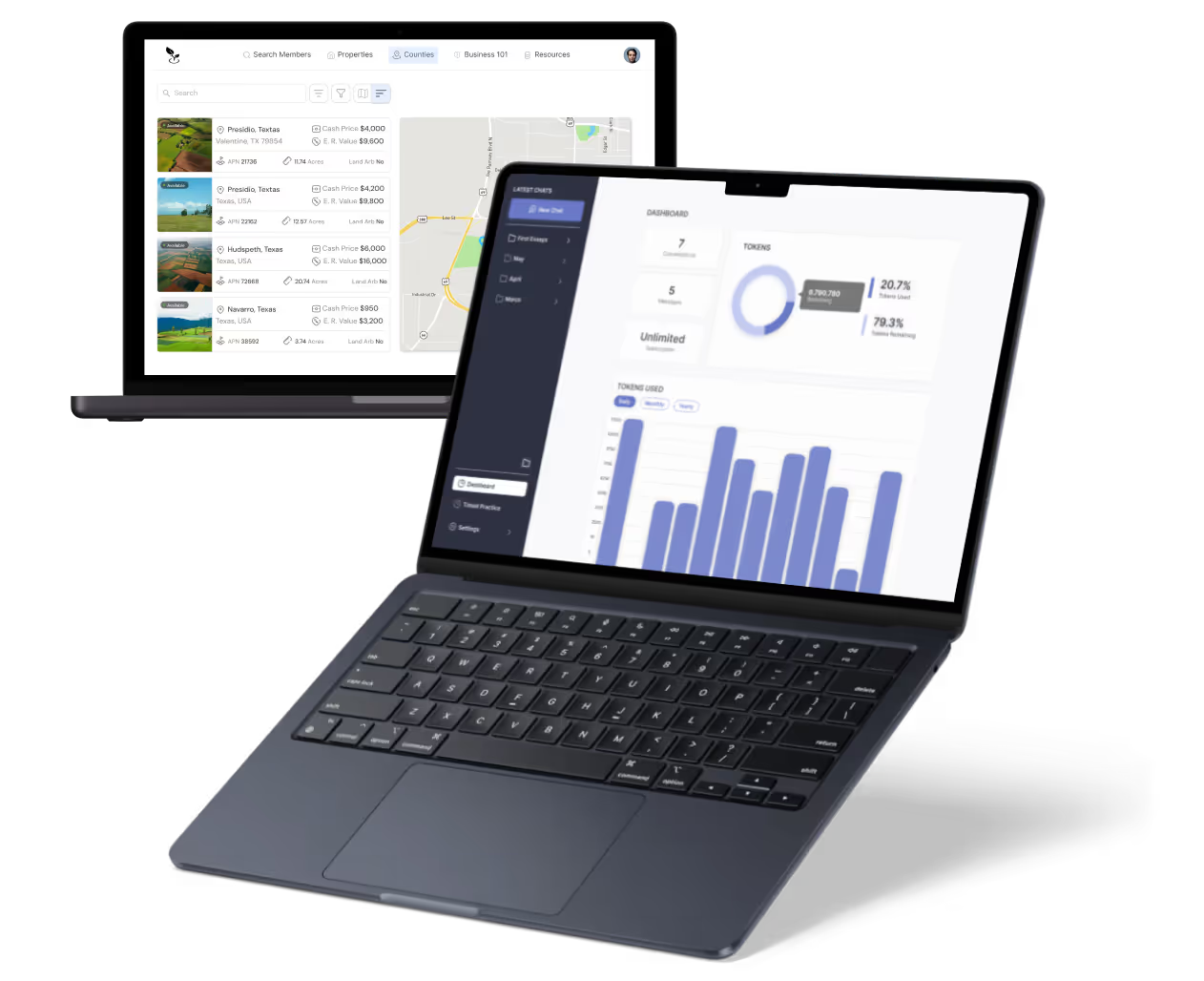

What Features Does a B2C SaaS App on Bubble Need?
A B2C Bubble SaaS app needs self-serve registration, freemium or trial access, a core product experience, upgrade prompts, user settings, and notifications.
B2C users do not have procurement teams or IT departments. They make buying decisions in minutes based on what they experience in the product. The first 10 minutes of using your app determines whether they pay.
- Self-serve registration with email and password or social login. Remove every unnecessary field from the sign-up form.
- Immediate product access after registration. Users who cannot access the product immediately after signing up do not come back.
- Freemium or trial mode gives users enough of the product to understand its value before asking for payment.
- Upgrade prompts appear at the right moment, when a user tries to use a feature they have not unlocked or reaches a usage limit.
- Core product workflow is what the user came for. Every UI decision should reduce friction in completing the main job to be done.
- Notifications and engagement bring users back. Email, in-app, and optionally push notifications for activity, progress, and prompts.
- User settings and profile let users manage their account, subscription, and notification preferences without contacting support.
Bubble app examples of B2C consumer products show how self-serve flows, freemium gates, and engagement features come together in products users actually pay for.
How Do You Design a Freemium Model in a Bubble SaaS App?
Design a freemium model by defining which features are free and which are paid, then enforcing those limits through plan checks in every workflow and feature gate in the UI.
Freemium works when the free tier is genuinely useful and the paid tier is obviously worth paying for. If the free tier is too restrictive, users churn before they see value. If it is too generous, they never upgrade.
- Free tier definition: identify the core job to be done and make it available for free, with limits on quantity or access to advanced features.
- Paid tier features: choose features that power users need and casual users do not, exports, advanced analytics, collaboration, higher limits, or priority support.
- Usage limits: cap the free tier by count, 5 projects, 100 records, 3 exports per month. Store the count on the user record and check it before allowing the action.
- Upgrade prompts: trigger prompts when a user hits a limit or tries to access a paid feature. Show the value of the paid tier in context, not on a pricing page they have to navigate to.
- Paid plan access check: every feature gate checks
Current User's plan = "Pro"(or equivalent) before allowing the action. Never rely on UI-only restrictions.
Free tier design is a product decision, not a development decision. Define it before building, not after, to avoid retroactively adding gates to features that were built without them.
How Do You Implement Self-Serve Billing for a B2C Bubble App?
Implement self-serve billing using Stripe Checkout for instant card payment, then handle subscription lifecycle events through Stripe webhooks that update the user's plan status in Bubble.
B2C billing must be self-serve and instant. Users do not want to contact sales or wait for a quote. Stripe Checkout handles the entire payment flow, card entry, validation, 3D Secure, and receipt.
- Stripe Checkout integration: direct users to a Stripe Checkout page when they click upgrade. On success, Stripe redirects back to the app and fires a webhook.
- Webhook updates user plan: the
checkout.session.completedwebhook updates the user's subscription status and plan in Bubble, granting immediate access to paid features. - Subscription management: give users a link to the Stripe customer portal to manage billing, update cards, view invoices, and cancel their subscription.
- Free trial option: configure a trial period in Stripe. Users enter card details but are not charged until the trial ends. Use Bubble workflows to surface trial status prominently.
- Cancellation flow: when a subscription cancels, a Stripe webhook updates the user's plan to free tier. Do not immediately delete their data, give them a grace period.
Review Bubble pricing plans alongside Stripe fees when modeling your unit economics. Infrastructure costs affect your break-even subscriber count more than most founders expect.
How Do You Build a Self-Serve Onboarding Flow in Bubble?
Build self-serve onboarding by guiding new users through the minimum steps needed to reach the core product value as quickly as possible, with progress tracking and contextual prompts.
Consumer SaaS onboarding must be self-serve by definition. Nobody helps the user. The product itself must explain what to do next and make doing it effortless. Long setup flows kill activation rates.
- Welcome flow: after registration, guide users through 2-3 setup steps that are genuinely required to use the product. Skip optional steps until later.
- Progress indicator: show users where they are in onboarding and what completing it unlocks. Progress bars increase completion rates.
- Contextual empty states: when a user first visits a section with no data, show an action prompt, not a blank screen. "Create your first project" beats an empty list.
- Activation checklist: an optional in-app checklist of value-generating actions (like "Connect your first integration" or "Invite a teammate") guides users toward the behaviors that predict retention.
- Onboarding email sequence: trigger a 3-5 email sequence after registration. Each email highlights one feature or use case. Stop sending when the user has completed onboarding or converted.
Bubble's security model is relevant to onboarding too, email verification, secure token handling for magic links, and session management all affect the security of your registration and onboarding flow.
What Does the Development Process Look Like for a B2C Bubble SaaS App?
The development process runs five phases: user journey mapping, data model and auth, billing and plan gating, core product build, and onboarding with growth loops.
Consumer product development requires user journey thinking from the start. Before opening Bubble, map the new user journey from registration to activation to first payment. Every development decision should serve that journey.
- Phase 1: User journey mapping: define the registration-to-activation path, the freemium feature set, and the upgrade trigger before any design or development begins.
- Phase 2: Data model and auth: build user data types, plan fields, usage counters, privacy rules, and social login configuration.
- Phase 3: Billing and plan gating: Stripe Checkout integration, webhook handling, plan access checks, and upgrade prompt placement.
- Phase 4: Core product build: the main consumer workflow, built with mobile responsiveness and performance in mind from the first sprint.
- Phase 5: Onboarding and growth: welcome flow, activation checklist, empty states, email sequences, and referral or sharing features if applicable.
A B2C SaaS MVP on Bubble takes 8-12 weeks. Adding mobile app wrapping, referral programs, or complex consumer features extends this by 2-4 weeks.
How Much Does It Cost to Build a B2C SaaS App on Bubble?
Building a B2C SaaS app on Bubble costs between $15,000 and $40,000 depending on product complexity, consumer UI polish requirements, and the depth of onboarding and engagement features.
Consumer products require more UX investment than equivalent B2B tools because the user experience is the entire sales pitch. Budget for design iteration alongside development.
- Lean B2C MVP with registration, freemium gating, Stripe billing, and core product workflow: $15,000 to $22,000.
- Full B2C SaaS product with polished onboarding, mobile-responsive UI, engagement features, and growth loops: $25,000 to $40,000.
- Bubble production plan: $32 to $349 per month. Consumer apps with variable traffic spikes may need a higher-capacity plan earlier than B2B products.
- Email platform costs: transactional email via SendGrid or Postmark plus a marketing email platform add $50 to $500 per month depending on subscriber volume.
- Ongoing feature development: consumer SaaS requires faster iteration cycles than B2B. Budget 20% of initial build cost per year for product iterations.
Custom B2C SaaS development starts at $80,000 and takes 10-16 months. Bubble delivers a validated consumer product in 2-3 months at a fraction of that investment.
What Are the Limitations of Building B2C SaaS on Bubble?
Key limitations include performance constraints at high user volumes, limited native mobile output, dependency on Bubble's CDN performance, and the complexity ceiling on highly interactive consumer features.
Bubble's capabilities and limitations are particularly relevant for consumer products because high user volumes and demanding UX expectations push Bubble's performance limits faster than B2B tools with smaller user bases.
- Page load performance: consumer users have zero tolerance for slow pages. Bubble's page load times depend on query complexity and element count. Heavy pages need optimization.
- No native mobile app: Bubble outputs web apps. Wrapping for mobile distribution works but does not match native app performance or store discoverability.
- Real-time features: collaborative or real-time features, live editing, instant messaging, multiplayer, hit Bubble's real-time infrastructure limits at moderate scale.
- High traffic spikes: viral consumer growth can spike traffic beyond what a Bubble plan supports. Upgrading plans mid-crisis is possible but adds cost unexpectedly.
- Complex animations: consumer products often expect smooth animations and micro-interactions that are difficult to achieve within Bubble's visual editor.
Bubble's scalability ceiling determines the user volume at which a consumer product needs to consider migration. Plan your growth targets and evaluate honestly whether Bubble can support the 18-month trajectory.
When Does Bubble Make Sense for a B2C SaaS Build?
Bubble makes sense for B2C SaaS when your consumer product focuses on structured workflows, your initial target is tens of thousands of users rather than millions, and speed to first paying user matters more than platform performance.
Bubble pros and cons for consumer products come down to the same core trade-off: speed and cost to launch versus performance and flexibility at scale.
- Niche consumer tools targeting a specific workflow or user type are well-served by Bubble's feature set and performance range.
- Creator and prosumer products that help individuals accomplish a specific professional task fit naturally within Bubble's strengths.
- Consumer products with clear unit economics can use Bubble to validate willingness to pay before investing in a custom build.
- Products that can tolerate migration at 50,000 users get the most value from Bubble's speed advantages without hitting its performance ceiling prematurely.
When consumer scale, native mobile requirements, or real-time feature demands exceed Bubble's range, Bubble alternatives give you platforms better suited to high-volume consumer products.
Want to Build a B2C SaaS App on Bubble?
Consumer SaaS is won or lost in the first session. The product experience, not the feature list, determines whether users convert and return.
LOW/CODE Agency is the AI product development partner built for SMBs. We build and ship web apps, mobile apps, chatbots, RAG systems, and AI agents — end to end, without the enterprise overhead. We design user journeys, implement freemium models, build self-serve billing, and create onboarding flows that activate users, not just sign them up.
- User journey design: we map the registration-to-activation path and design the product around it, not around a feature list.
- Freemium architecture: we define plan tiers, usage limits, upgrade triggers, and feature gates before building anything.
- Self-serve billing: Stripe Checkout, webhook handling, subscription management, and cancellation flows built in sprint one.
- Consumer-grade UX: responsive layouts, smooth interactions, and mobile-first design that consumer users expect.
- Onboarding and activation: welcome flows, activation checklists, contextual empty states, and email sequences that drive users to their first value moment.
- Long-term product partnership: we stay involved after launch to iterate on conversion, improve activation, and scale the product with user growth.
We have delivered 450+ consumer and SaaS products for clients including Sotheby's and Coca-Cola. Bubble development services cover B2C product design through to live consumer SaaS; most engagements start around $20,000 USD.
Related Articles
Last updated on
September 28, 2026
.

Jesus is a visionary entrepreneur and tech expert. After nearly a decade working in web development, he founded LOW/CODE Agency to help businesses optimize their operations through custom software solutions.


FAQs
Can you build a consumer SaaS app with Bubble?
How do you create a great user onboarding experience in a Bubble B2C SaaS?
How do you implement freemium pricing in a Bubble B2C SaaS?
Can you build a mobile-friendly B2C SaaS on Bubble?
How do you retain users in a B2C Bubble SaaS app?
What features are typically needed for a B2C SaaS app built on Bubble?
Related Articles

Bubble
Bubble Apps Examples: 8 Successful Apps Built With Bubble
Explore Bubble apps examples with 8 successful real apps built with Bubble. See SaaS, marketplaces, MVPs, features, scale, and use cases.
Bubble
How to Build an Agency CRM App with Bubble
Build an agency CRM with Bubble. Manage clients, track deals, and automate follow-ups — a fully custom CRM without the custom dev cost.

Bubble
How to Build a Brewery Management App with Bubble
Build a brewery management app with Bubble no coding required. Track batches, inventory, and sales with this step-by-step no-code guide.

Bubble
How to Build a Sales Pipeline App with Bubble
Build a sales pipeline app with Bubble. Visualize every deal, track stages, and close faster — a lightweight custom tool without CRM bloat.


Why customers trust us for no-code development


