

B2B Website Redesign Guide
A complete guide to B2B website redesign — strategy, buyer journey mapping, lead generation, and how to measure redesign ROI.

Most B2B websites are better designed for internal pride than for pipeline generation.
The leadership team approves the redesign, the design looks impressive in stakeholder review, and six months after launch the inbound lead volume is unchanged. A B2B website redesign done right fixes that pattern.
B2B websites fail for predictable reasons: generic messaging, weak social proof, and no conversion architecture for buyers who are not yet ready to talk to sales. This guide covers how to address each of them.
Key Takeaways
- B2B Serves a Different Conversion Journey: Longer sales cycles, multiple decision-makers, and high-consideration purchases require a distinct design strategy.
- Lead Quality Matters More Than Volume: Optimize for high-fit lead capture, not raw form submissions. Messaging clarity is the primary conversion lever.
- Content Is the Primary B2B Asset: Case studies, thought leadership, and service depth close the credibility gap before prospects speak to sales.
- CRM Integration Is Essential: Without HubSpot, Salesforce, or Marketo integration, a B2B redesign loses most of its pipeline attribution value.
- Design Reflects Brand Credibility: An outdated or unprofessional website can silently disqualify a company before the first sales conversation happens.


Why B2B Websites Fail to Generate Pipeline
The first step in a B2B website redesign is diagnosing what is currently broken. Most B2B pipeline failures trace back to a small set of recurring problems.
For B2B website conversion redesign strategies and conversion architecture details, our dedicated conversion guide provides a deeper framework.
Generic Value Propositions That Don't Differentiate
Most B2B websites use language so similar to competitors that a prospect reading two vendor homepages cannot distinguish between them.
The problem is not visual design. It is that no positioning work was done before the redesign.
"We help businesses grow" and "your trusted partner in success" are placeholders that give prospects no reason to choose one vendor over another.
- Positioning Work Prerequisite: Redesigns that start with visual design before completing positioning work produce beautiful sites with ineffective messaging.
- Differentiation Test: Read your homepage headline and the top two competitor headlines side-by-side. If they are interchangeable, you have a positioning problem to solve first.
- ICP-Specific Language: Strong B2B value propositions name the specific buyer, the specific problem, and the specific outcome. Generic language fails all three.
Poor Service and Solution Page Architecture
B2B service pages typically fail in predictable ways: long blocks of feature descriptions written in the vendor's language, no social proof near the CTA, and no clear next step for visitors at different buying stages.
A prospect in early research has different needs than one who is ready to schedule a demo. Most B2B service pages serve neither audience well.
- Feature vs. Outcome Framing: Feature lists describe the product. Outcome framing describes what the buyer achieves. B2B buyers are buying outcomes.
- Social Proof Placement: Client testimonials and case study references belong adjacent to every CTA, not buried at the bottom of the page.
- Multi-Stage CTA Architecture: "Learn more," "see how it works," and "talk to us" serve different buying stages. Most B2B sites offer only the last option.
Weak or Missing Social Proof
B2B buyers use social proof differently than B2C buyers. They want specific case studies with quantified outcomes from recognizable client names. Generic testimonial quotes without context do not close the credibility gap.
A case study that says "We increased conversion by 40% for [Recognized Client] by restructuring their lead qualification process" is worth 20 generic testimonials.
- Specificity Requirement: Case studies need a named client, a quantified outcome, a before/after framing, and a connection to the service being sold.
- Logo Wall Limitations: Client logos without associated context provide weak social proof. Logos paired with case study links provide strong proof.
- Named Client Preference: Named clients are significantly more credible than anonymized case studies. Negotiate permission to name clients where possible.
No Clear Conversion Architecture for Each Buying Stage
B2B buying involves multiple stakeholders across multiple touchpoints over weeks or months. A site designed only for "ready to buy now" visitors loses the majority of its potentially valuable traffic.
Early-stage visitors need educational content. Mid-stage visitors need comparison tools and case studies. Late-stage visitors need contact options and proof of execution.
- Early-Stage Content: Blog posts, guides, and research content serve visitors who are defining their problem before evaluating solutions.
- Mid-Stage Evidence: Case studies, comparison pages, and ROI calculators serve visitors who are evaluating vendors and building an internal business case.
- Late-Stage Conversion: Demo request forms, consultation booking, and pricing information serve visitors who are ready for a direct conversation.
What a B2B Website Redesign Must Include
The B2B redesign business benefits depend on building these components into the site architecture from the start, not adding them after launch.
Positioning and Messaging Architecture
Every B2B redesign should start with messaging work before any design decisions are made.
Who is the site for, what specific problem does it solve, why this company rather than competitors, and what evidence supports these claims.
Beautiful design built on weak messaging will not improve pipeline.
- ICP Definition: A specific description of the ideal customer including their role, company type, size, and the pain they are experiencing.
- Value Proposition Statement: A single sentence naming who you serve, what you help them achieve, and why you are the best choice for that outcome.
- Proof Point Inventory: A list of the strongest evidence claims the business can make: specific client names, quantified outcomes, and recognizable credentials.
Solution and Service Page Depth
Substantive service pages are a primary ranking and conversion asset for B2B sites. Shallow pages with minimal content do not rank for competitive terms or convert informed buyers.
Each service page should address the problem, the solution, the process, client examples, and a clear conversion path.
- Problem-Solution Framing: Lead with the problem the service solves in the buyer's language, then introduce the solution. Do not lead with product features.
- Process Transparency: Showing how you work reduces purchase risk perception. Buyers are more likely to engage when they understand what happens next.
- Multiple CTA Levels: Offer a "download our guide," "see case studies," and "talk to us" pathway on every service page to serve different intent levels.
Case Study and Social Proof System
The case study architecture that converts B2B prospects includes a named client, a clear before/after problem framing, quantified results, and a direct connection to the service being sold.
A system means consistent structure, searchable filtering, and CTA integration. Not a collection of unstructured PDFs.
- Case Study Template Consistency: All case studies should follow the same structure so prospects can quickly find the information most relevant to them.
- Results Quantification: Every case study should include at least one quantified outcome. "Reduced churn by 22%" outperforms "improved customer retention."
- Cross-Link to Services: Each case study should link directly to the related service page and include a CTA that matches the buying stage the case study serves.
CRM and Marketing Automation Integration
A B2B redesign without HubSpot, Salesforce, Marketo, or equivalent integration loses the ability to attribute leads to content, score leads for sales readiness, and automate nurture sequences.
Integration is not a nice-to-have. It is the mechanism through which the website creates pipeline value, not just lead volume.
- Form to CRM Connection: Every lead capture form must pass data to the CRM with source tracking, page tracking, and UTM parameter capture.
- Lead Scoring Setup: Define the behavioral signals that indicate lead quality (content consumed, pages visited, form completions) and configure scoring rules.
- Nurture Sequence Integration: Connect key content assets to automated email sequences that continue the sales conversation after the initial site visit.
B2B Redesign Cost and Budget
For the detailed B2B redesign budget guide covering cost components and typical ranges, our dedicated pricing guide provides specifics by company type.
The Cost Range for B2B Redesigns
The B2B redesign cost spectrum starts at $15,000 for small B2B services companies and reaches $100,000-plus for complex multi-solution enterprise B2B sites. Mid-market B2B projects typically land in the $40,000-$100,000 range.
What determines where a project falls: solution complexity, page count, CRM integration scope, content production needs, and the amount of positioning work required.
- Small B2B Services ($15K-$40K): 10-20 pages, one to three services, basic CRM integration, and positioning-aligned copy from a quality agency.
- Mid-Market B2B ($40K-$100K): 20-50 pages, multiple solution areas, deeper CRM integration, case study system, and SEO content strategy.
- Enterprise B2B ($100K+): Multi-solution architecture, personalization, complex integrations, multilingual, and multi-phase delivery over 6-18 months.
Why B2B Redesigns Cost More Than B2C
B2B redesigns cost more because the scope is more complex. Strategy and positioning work, solution page depth, case study production, and CRM integration all add cost that B2C redesigns do not typically require.
Multi-stakeholder review processes also extend timelines, which increases project cost.
- Strategy and Positioning Cost: B2B redesigns should allocate 15-25% of total budget to positioning and messaging work before design begins.
- Content Production Depth: B2B service pages require substantive, expert-written content that takes significantly more time to produce than standard marketing copy.
- Multi-Stakeholder Review: Longer approval chains, competing stakeholder priorities, and consensus-building requirements extend B2B timelines and costs predictably.
How to Build the Business Case for the Budget
Model the revenue impact of a 1-point improvement in the inbound lead conversion rate at current traffic levels. That number typically dwarfs the project cost and produces the clearest possible internal justification.
If 1,000 visitors per month convert at 1% to qualified leads, moving to 2% produces 10 additional leads per month.
At a £5,000 average deal value and 20% close rate, that is £10,000 in monthly pipeline.
- Current Baseline Calculation: Document current lead volume, MQL rate, close rate, and average deal value as the foundation of your ROI model.
- Improvement Assumption: A conservative 1-point conversion rate improvement is a defensible assumption for a well-executed B2B redesign.
- Pipeline Value Projection: Monthly lead improvement times average deal value times close rate produces a monthly pipeline impact figure for leadership review.
SEO Strategy for a B2B Redesign
Using the SEO guide for B2B redesign alongside this planning guide provides the technical depth to build organic search into the redesign from the start.
B2B Keyword Strategy: Intent Over Volume
B2B SEO prioritizes transactional and commercial intent keywords, often lower volume but higher value, over the high-volume informational terms that dominate B2C strategies.
A page ranking for "enterprise procurement software ROI calculator" with 200 monthly searches is worth far more than a page ranking for "procurement tips" with 10,000 monthly searches.
- Intent Classification: Map every target keyword to a buying stage: awareness, consideration, or decision. Optimize content to match the intent of each stage.
- Competitor Keyword Gap: Identify keywords where competitors rank and you do not. These represent immediate organic acquisition opportunities.
- Long-Tail Priority: B2B long-tail terms with three to five words and specific intent often convert at 5-10x the rate of broad generic terms.
Solution and Service Pages as the Core SEO Asset
B2B service and solution pages are both the highest-converting pages and the primary organic ranking targets. Their depth, structure, and keyword alignment directly determine organic performance.
A 1,500-word service page optimized for three to five target terms consistently outranks a 400-word page in competitive B2B categories.
- Keyword Mapping Per Page: Map two to three primary target keywords and three to five secondary terms to each service page before writing begins.
- H1-H3 Structure: A clear heading hierarchy with target terms in H1 and H2 positions supports both crawler comprehension and user navigation.
- Internal Linking from Blog: Blog content should systematically link to service and solution pages to build topical authority across the site.
Content Marketing Integration With the Redesigned Site
A B2B redesign should plan for a content ecosystem: blog, case studies, resources, and guides. These content types feed organic search while supporting lead nurture.
The blog and resource library are not add-ons. They are core components of the B2B organic acquisition strategy.
- Content Calendar Integration: Plan the first six months of content alongside the redesign. Blog content and landing pages can be published at launch.
- Case Study SEO Value: Well-written case studies rank for client-company-plus-service terms and product-plus-outcome search phrases.
- Pillar Content Architecture: A small number of comprehensive guide pages supported by related blog content create topical authority clusters that improve rankings across all related terms.
Measuring B2B Redesign ROI
For detailed B2B website redesign ROI measurement frameworks, our dedicated ROI guide covers attribution models and measurement timelines in full. Here is the core measurement framework.
The Primary B2B Redesign KPIs
The metrics that matter most for B2B: inbound lead volume by source, MQL and SQL rate, demo request conversion rate, organic traffic to key solution pages, and pipeline attributed to web-sourced leads.
Vanity metrics including total traffic and social shares are not primary B2B KPIs.
- MQL Rate by Source: Tracking MQL rate by traffic source identifies which channels are delivering leads that sales teams want to work.
- Demo or Consultation Request Rate: The rate at which solution page visitors request a demo or consultation is a direct measure of conversion architecture effectiveness.
- Organic Traffic to Solution Pages: Organic traffic growth to key service and solution pages measures SEO performance on the highest-value pages.
Connecting Web Attribution to CRM Revenue
Attributing closed revenue to website engagement in a long B2B sales cycle requires deliberate attribution configuration in the CRM. Without this, the website's pipeline contribution is invisible.
Set up first-touch, last-touch, and multi-touch attribution models to understand which content and pages influence deals across the full buying cycle.
- First-Touch Attribution: Records which page or content a lead first encountered, identifying which content triggers initial interest.
- Last-Touch Attribution: Records the final interaction before the lead converted, identifying what pushed late-stage buyers to take action.
- Multi-Touch Attribution: Distributes credit across all touchpoints in the buyer journey for a more accurate view of how the site contributes to pipeline.
Setting a Realistic Measurement Timeline for B2B
Conversion rate improvements appear within 30-60 days. SEO improvements take 60-180 days. Pipeline and revenue attribution requires 3-9 months depending on sales cycle length.
Measuring a B2B redesign's ROI at 30 days and concluding it did not work is a common and incorrect mistake.
- 30-Day Conversion Review: Conversion rates on primary CTAs should be measured and compared against pre-launch baselines within the first month.
- 90-Day SEO Assessment: Organic ranking changes and traffic shifts to key service pages become reliably measurable at the 90-day mark.
- Pipeline Attribution Window: For B2B sales cycles of 60-90 days, full pipeline attribution data requires six to nine months post-launch to accumulate meaningfully.
B2B Redesign and Corporate Brand Positioning
The corporate website redesign guide covers the broader brand and positioning work that should underpin any substantial B2B redesign investment.
When to Do Positioning Work Before Redesigning
B2B companies whose current positioning is unclear, undifferentiated, or misaligned with their actual best customers should do positioning work before redesigning. A beautiful website built on weak messaging does not improve pipeline.
If the sales team regularly says "prospects don't understand what we do," the problem is positioning, not design.
- Positioning Clarity Test: If your best salesperson cannot summarize your value proposition in one sentence without hesitation, complete positioning work before briefing a design agency.
- ICP Validation: Ensure the site is designed for your actual best customers, not a theoretical ideal that your sales pipeline does not reflect.
- Competitive Positioning Map: Map your positioning against the top three to five competitors. Identify the white space where your differentiation can be credibly claimed.
Aligning Sales and Marketing on the New Site's Messaging
Misalignment between what the site says and what sales says undermines both. Creating alignment on homepage value proposition, solution page framing, and case study selection before launch prevents this.
The best B2B redesigns are reviewed by the sales team during development, not presented to them at launch.
- Sales Team Design Review: Include your top two to three salespeople in at least one design review. Their objections reveal messaging gaps that will surface in real sales conversations.
- Case Study Selection Alignment: Sales should co-select which case studies are featured based on which client examples resonate most in their conversations.
- Language Consistency: The words used on the website for solutions, outcomes, and processes should match the language used in sales decks and proposals.
Post-Launch Sales Enablement Using the New Site
The redesigned site is a sales tool as much as a marketing tool. Equipping the sales team to use it actively amplifies the return on the redesign investment.
Sales conversations that reference the site, link to specific case studies, and demonstrate specific pages convert faster than those that do not.
- Demo-Ready Site Walkthrough: Train the sales team to walk prospects through the new site as part of the discovery or demo process.
- Case Study Email Links: Create a library of templated sales emails that link to specific case studies relevant to each product and buyer type.
- Sales Conversation Integration: Sales sequences referencing specific site content create a connected experience between marketing and sales touchpoints.
Conclusion
A B2B website redesign that starts with positioning, builds for pipeline, and integrates with the sales team's tools consistently outperforms redesigns that start with visual improvements. The visual quality matters. The strategic foundation matters more.
Pull your current inbound lead volume from the last 90 days and calculate what a 25% improvement would mean in pipeline terms.
That number is the business case your leadership needs to approve the redesign budget, and it is the target your redesign needs to be held accountable for delivering.
LOW/CODE Agency Builds B2B Websites That Work Harder Than They Look
LOW/CODE Agency's B2B redesign process is built around one question: will this site generate more qualified pipeline after launch than it does today?
Positioning-first strategy, solution page architecture, CRM integration, and conversion-focused design are the pillars of every engagement.
We operate as a strategic product team, not a dev shop. That means we bring strategic thinking to every phase of the project, from messaging architecture through to post-launch performance tracking.
- Positioning-First Discovery: Every B2B redesign begins with a positioning and messaging workshop before any design work begins.
- Solution Page Architecture: We build service and solution pages with problem-solution framing, outcome emphasiz, and multi-stage CTA structure.
- Case Study System Development: We design and build a consistent case study architecture that serves prospects at every buying stage.
- CRM Integration: We integrate HubSpot, Salesforce, Marketo, or your CRM of choice with full source tracking and lead scoring configuration.
- B2B SEO Strategy: We map keywords to buying stages and optimize solution pages for high-intent B2B search terms from day one.
- Sales Enablement Handoff: We deliver a sales enablement guide alongside the redesigned site so your team can use it as an active sales tool.
- Post-Launch Attribution Reporting: We configure attribution tracking and deliver a 90-day post-launch performance report against defined KPIs.
We deliver B2B website redesign services for 350-plus products and companies including Coca-Cola, American Express, Sotheby's, Medtronic, Zapier, and Dataiku. Start with a scoping call to discuss your pipeline growth goals.
Last updated on
July 10, 2026
.

Daniel is a Web Developer at LOW/CODE Agency who has been building websites in Webflow since 2022. With a background in graphic design, he turns the design team's concepts into fast, responsive sites


FAQs
Related Articles
Webflow
Webflow SEO Checklist Before You Go Live
The pre-launch Webflow SEO checklist — meta tags, redirects, sitemaps, structured data, and what to verify in Search Console.

Webflow
Comparison
Webflow vs Elementor | 14 Factors to Decide the Best One
Compare Webflow vs Elementor across 14 key factors to choose the best website builder for design, SEO, performance, pricing, and more
Webflow
Webflow Development Cost Breakdown (2026)
Line-by-line breakdown of Webflow development costs — design, build, CMS, integrations, and what inflates the final number.
Webflow
Comparison
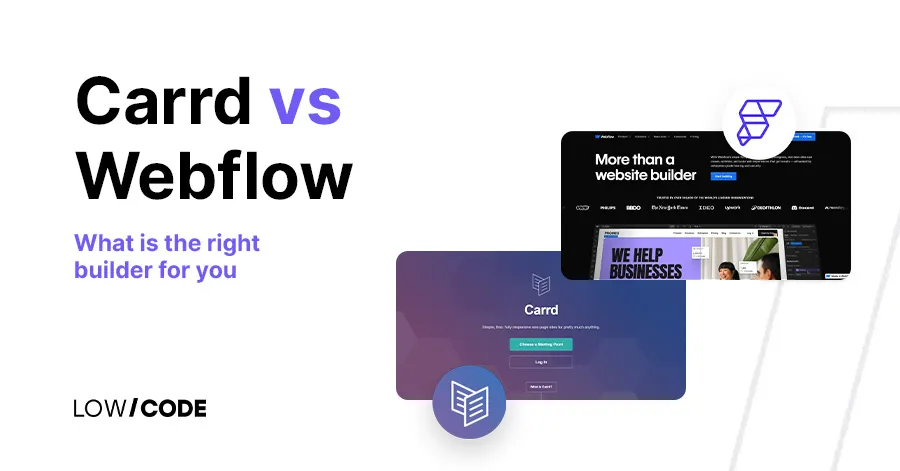
Carrd or Webflow: What is the right builder for you
Carrd or Webflow? Find out which no-code website builder meets your requirements, and start creating like a pro with a platform that aligns with your creative and business goals.

Why customers trust us for no-code development


