

Why Your Business Needs Zapier Automation Today
Discover how Zapier automation can save time, reduce errors, and boost productivity for your business operations.


Your business needs Zapier automation for a straightforward reason: most small and mid-sized businesses are unknowingly spending hours every week on repetitive tasks that a properly configured automation stack could handle entirely on its own.
The cost is not just financial. Every hour a skilled team member spends copying data between apps or sending templated emails is an hour not spent on work that requires their actual expertise.
Key Takeaways
- Automation removes bottlenecks: Zapier automation eliminates manual handoffs between tools, cutting delays that slow sales, support, and operations teams daily.
- No code required: Zapier connects over 7,000 apps without writing a single line of code, making automation accessible to non-technical teams.
- ROI is measurable: Businesses typically recover the cost of Zapier within weeks by eliminating hours of repetitive admin work per employee per month.
- Scales with you: Automated workflows grow alongside your business without adding headcount or compounding operational complexity.
- Wrong tasks cost money: Paying people to do what software handles automatically is a direct drain on profit margins and team morale.


What Is Zapier and How Does It Work?
Understanding how Zapier works is the foundation for seeing why automation delivers such consistent time savings across business functions.
Zapier connects the apps your business uses through automated workflows called Zaps. Each Zap has a trigger: an event in one app that starts the automation, and one or more actions that Zapier performs in other apps in response.
- No-code platform: Any non-technical team member can build a Zap. There is no programming knowledge required to connect most common business apps.
- 7,000-plus integrations: CRM tools, email platforms, payment processors, project management software, communication apps: thebreadth of Zapier's library means your existing tools are almost certainly supported.
- Trigger-action model: When something happens in one app: a form is submitted, a payment is made, a lead enters your CRM: Zapier automatically does something in another app.
- Multi-step workflows: A single trigger can fire multiple sequential actions across different apps. One new form submission can create a CRM record, send a welcome email, notify a sales rep in Slack, and log to a spreadsheet: allautomatically.
How Much Time Are You Losing to Manual Work?
The time lost to manual processes is rarely tracked precisely, but even conservative estimates reveal how quickly the costs accumulate across a small team.
Most businesses assume the time cost of manual tasks is minor. The actual numbers are rarely minor.
- Industry estimates: Research consistently puts the time spent on repetitive, automatable tasks at two to four hours per employee per week across knowledge work roles.
- The compounding calculation: A ten-person business with each person spending three hours per week on automatable tasks accumulates 1,560 hours per year: roughly nine months of full-time work.
- Cost in salary terms: At an average knowledge worker cost of £30 per hour, those 1,560 hours represent £46,800 in annual staff time on tasks that software can handle for under £600 per year.
- Hidden costs beyond time: Every manual data transfer is an error opportunity. Every manual notification is a delay. Every context switch between tools interrupts productive work for two to four minutes.
- Error compounding: Manual data entry errors at a one to five percent rate across hundreds of weekly transactions accumulate into customer complaints, data quality issues, and cleanup work that consumes additional hours.
What Tasks Can Zapier Actually Automate?
The tasks Zapier handles automatically span every department, from sales and marketing through to finance and customer support.
- Lead capture: New form submission → create CRM contact → send welcome email → notify sales rep. The entire sequence runs in under two minutes without a person touching it.
- Customer support: New support ticket → assign to the right agent → log to project management tool → alert the team in Slack.
- Finance: Invoice paid in Stripe → update the accounting spreadsheet → send receipt to the customer → notify the accounts team.
- HR and onboarding: New hire confirmed → create accounts in all required systems → send onboarding emails → schedule orientation calls.
- E-commerce: New order placed → update inventory records → create shipping label → send order confirmation to the customer.
Is Zapier Cheaper Than Hiring Someone?
The debate around Zapier versus hiring staff is most acute for businesses at the five to fifty employee stage where every salary matters and every operational decision has compounding consequences.
Automation does not replace human judgment. It replaces the human hours spent on tasks that do not require judgment.
- Zapier plan costs: Free tier available for basic testing. Starter plan at $19.99 per month. Professional at $49 per month. Team at $69 per month. Enterprise pricing for large organizations.
- Part-time admin equivalent cost: A part-time administrative assistant handling equivalent repetitive tasks costs £1,500 to £3,000 per month: thirty to sixty times the cost of a Zapier Professional plan.
- Automation availability: Zapier runs twenty-four hours a day, seven days a week, including weekends and public holidays. An automated lead notification fires at 2 AM the same as it does at 2 PM.
- When hiring is still right: Complex exception handling, client relationship management, creative decisions, and high-stakes judgment calls all require people. Automation handles the routine layer underneath these activities.
- Total cost of ownership over twelve months: A Zapier Professional plan costs £600 per year. A part-time admin at the lower end costs £18,000. The automation payback period is typically under one month.
How Does Zapier Compare to Other Tools?
Comparing Zapier versus Power Automate reveals that the right choice depends heavily on whether your team lives inside the Microsoft 365 ecosystem or uses a broader mix of third-party SaaS tools.
For most SMEs not heavily invested in Microsoft tools, Zapier wins on three dimensions: app breadth, ease of setup, and time to first automation.
- Zapier versus Make: Zapier is simpler and faster to get started. Make offers more complex logic and cheaper per-operation pricing at higher volumes. Start with Zapier and evaluate Make when complexity grows.
- Zapier versus n8n: Zapier is fully managed, zero infrastructure required. n8n is self-hosted with unlimited tasks and code capability. The right choice depends on your team's technical capacity.
- Zapier versus Power Automate: Zapier has broader third-party app coverage. Power Automate has deeper Microsoft 365 integration and is often included in existing licenses.
- Why Zapier wins for most SMEs: The combination of 7,000-plus integrations, non-technical usability, and managed infrastructure means most growing businesses get more value from Zapier faster than any alternative.
What Are the First Automations Every Business Should Build?
The best automation is the one that is actually running. Start with five Zaps that almost every business can build and use immediately.
- Lead notification Zap: New form submission → notify sales rep immediately in Slack or email, with all lead details. Prevents leads from waiting for someone to check their inbox.
- New customer welcome Zap: New customer in CRM → send personalized welcome email → add to onboarding sequence. Consistent experience from day one without manual effort.
- Invoice follow-up Zap: Invoice overdue by seven days → send automatic payment reminder → notify accounts team if no response after fourteen days.
- Support ticket alert Zap: New support ticket created → notify the appropriate team channel → log ticket details to tracking spreadsheet.
- Appointment confirmation Zap: New booking in scheduling tool → send confirmation email to client → add to CRM → notify staff member.
Automation Is Not a Luxury: It Is an Operational Requirement
Zapier automation is not a luxury for enterprise businesses. It is a practical, affordable tool that pays for itself quickly for companies of almost any size. The businesses that automate early build operational capacity that allows them to grow without proportionally growing their headcount.
Audit one repetitive task this week, map the apps involved, and check whether Zapier supports them. The first Zap is usually live within an hour, and from that point, the time savings start compounding.
Ready to Build Your Zapier Automation Stack?
Many businesses know they should automate but are not sure which processes to start with or how to build automations that work reliably at scale.
We build AI products for SMBs. At LOW/CODE Agency, our work spans custom web applications, mobile apps, AI chatbots, retrieval-augmented generation systems, and autonomous AI agents — the full scope of what an expert software agency delivers. We help businesses identify their highest-value automation opportunities, build them correctly the first time, and maintain them so they keep delivering results.
- Automation audit: We map your processes across every department to identify where the largest time and cost savings are available through automation.
- Priority roadmap: We produce a prioritized list of automation candidates so you know exactly which process to automate first and why.
- Expert builds: We design and build Zapier automations that are tested against real data and edge cases before they touch your live systems.
- Full documentation: Every automation we build is documented so your team can understand, maintain, and extend it without depending on us for every change.
- Cost modeling: We produce clear ROI estimates for every automation we recommend so the business case is visible before the first line of code is written.
- Ongoing maintenance: We offer maintenance retainers for businesses that want their automations actively managed as tools update and business processes change.
- Platform advice: If your requirements go beyond Zapier, we give you an honest assessment of whether Make, n8n, or a custom integration is the right next step.
We have built 450+ products for clients including Coca-Cola, American Express, and Zapier.
Related Articles
- Zapier Automation Audit: Where to Begin in Your Business
- Zapier AI Features: Current Capabilities Explained
- How to Write a Clear Zapier Automation Brief
- When to Use Custom Development for Zapier Automation
- When Zapier Falls Short for Business Automation
- When to Switch from Zapier to a Custom Automation
Ready to automate? Our automation development services handle everything from simple triggers to complex pipelines.
Last updated on
October 16, 2026
.

Jesus is a visionary entrepreneur and tech expert. After nearly a decade working in web development, he founded LOW/CODE Agency to help businesses optimize their operations through custom software solutions.

FAQs
What are the main benefits of using Zapier for business automation?
How does Zapier improve workflow efficiency in small businesses?
Can Zapier automation reduce operational costs for companies?
Is Zapier suitable for businesses without technical expertise?
What risks should businesses consider when implementing Zapier automation?
How does Zapier compare to other automation tools for business use?
Related Articles
Comparison
Business Automation
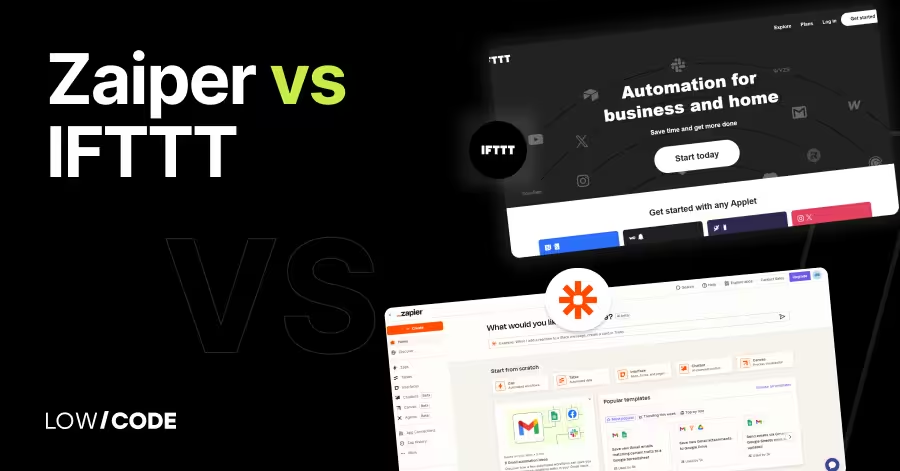
Zapier vs IFTTT | 13 Factors to Decide the Best One
Compare Zapier vs IFTTT across 13 key factors to find the best automation tool for your personal tasks or business workflows

Business Automation
Top Business Tasks Zapier Can Automate for You
Discover key business tasks Zapier automates to save time and boost productivity. Learn how to streamline workflows effectively.
Business Automation
Automate Resume Screening to Shortlist Candidates Fast
Learn how to automate resume screening and speed up candidate shortlisting with effective tools and strategies.
Business Automation
Build AI Contract Analysis Tool to Flag Risks Automatically
Learn how to create an AI contract analysis tool that identifies risks automatically with practical steps and key considerations.


Why customers trust us for no-code development


