

Website Redesign For Ai Search Optimization
AI search tools are changing how buyers find vendors. Here is how to redesign your website so it gets cited in ChatGPT, Perplexity, and AI Overviews.


Don't have time to read this? Schedule a 30-minute call and we will walk you through exactly how this applies to your business. Book a call
Key Takeaways
- AI search tools including ChatGPT, Perplexity, and Google's AI Overviews are becoming a meaningful source of brand discovery for B2B buyers.
- The websites that get cited in AI responses share consistent characteristics: clear, factual, well-structured content that directly answers questions buyers are asking.
- Optimizing for AI search is not a separate strategy from good SEO. It is an extension of it, with additional emphasis on structure, specificity, and authority signals.
- A website redesign is an opportunity to build AI-search-ready content and architecture into the site from the start, rather than retrofitting it later.
How AI Search Tools Select Which Sites to Cite
AI language models do not index the web the same way Google does. They are trained on large datasets and supplemented in real time by web search capabilities.
When a user asks ChatGPT "which agencies do Webflow website redesigns for B2B companies," the model is drawing from:
- Content it has seen during training
- Real-time web search results (for tools with browsing capability)
- Signals about which sources are authoritative, specific, and well-structured
The websites that appear in these responses are the ones that:
- Have clear, specific content about the topic being asked about
- Use structured formatting that makes it easy to extract information
- Are cited by other reputable sources (backlinks and mentions)
- Answer questions in a way that can be directly summarized or quoted
- Have good technical signals (fast load, clean HTML structure, schema markup)
Understanding what an AI-powered redesign process involves as a build methodology is different from optimizing for AI search as a distribution channel, though both are increasingly relevant.
The Content Signals That AI Tools Respond To
Specificity and Factual Density
AI models are trained to prefer content that is specific and factual over content that is vague and promotional.
"We help businesses grow their digital presence" is promotional noise. It does not answer any specific question.
"Our Webflow redesign projects run 10 to 16 weeks, starting with a structured discovery phase that includes analytics audit, user interviews, SEO transition planning, and competitive analysis before any design work begins." This is specific, factual, and directly answers questions about what a redesign engagement involves.
Every core service or product page on the site should be evaluated against this standard: does it contain specific, verifiable information that a buyer researching this service would find useful?
Clear Question-and-Answer Structure
AI search tools excel at finding answers to specific questions. Pages that are structured around questions and answers are more likely to be cited.
This does not mean FAQs at the bottom of every page. It means structuring sections around the questions buyers are asking:
- "How long does a website redesign take?"
- "What does a website redesign cost for a small business?"
- "What is included in a Webflow redesign?"
- "How do you handle SEO during a redesign?"
If the page content addresses these questions clearly, it is positioned to appear in AI responses to those exact queries.
Structured Data and Schema Markup
Schema markup is code added to web pages that helps search engines and AI tools understand the content's structure and meaning.
For a professional services website, relevant schema types include:
- Organization: Company name, description, founding date, location, contact information
- Service: Each service offering with name, description, and pricing information if available
- FAQPage: Question-and-answer content structured for machine readability
- Article / BlogPosting: Blog content with author, publish date, and topic metadata
- BreadcrumbList: Navigation path indicating where the page sits in the site hierarchy
- Review / AggregateRating: Client review information if applicable
Schema markup does not guarantee AI citation. It reduces friction for AI tools trying to interpret and use the page's content.
Author Authority and E-E-A-T Signals
Google's E-E-A-T framework (Experience, Expertise, Authoritativeness, Trustworthiness) has been a ranking signal for years. AI tools apply similar reasoning when deciding which sources to treat as credible.
Building E-E-A-T signals into the redesign:
- Author pages with credentials: Blog and article content attributed to named authors with professional bios
- About page with specific experience signals: Years of operation, project count, named clients, professional background of leadership
- Case studies with specific outcomes: Real project data attributed to real clients, not anonymized success stories
- Transparent pricing or pricing guidance: Sites that give buyers pricing context are treated as more trustworthy than sites that hide all pricing behind contact forms
- External mentions and links: Citations from reputable industry sources, publications, and directories signal authority
Comprehensive Topic Coverage
AI search tools respond well to sites that cover a topic comprehensively rather than addressing only the surface level.
A single landing page for "website redesign services" competes against every other agency's single landing page. A site with 50 well-organized, substantive articles covering every dimension of website redesign, from planning to post-launch measurement, demonstrates topic authority that a single page cannot.
A content cluster strategy, where a pillar page links to a comprehensive set of related supporting articles, builds topical authority in a way that both traditional search engines and AI tools reward.
The comprehensive SEO approach for website redesigns covers how to structure the full SEO strategy around topical authority building rather than individual keyword targeting.
What to Change in the Redesign for AI Search
Rewrite Service Pages for Specificity
Audit every service page against the specificity standard. For each page, ask:
- Does this page contain specific, factual information that answers the most common questions buyers have about this service?
- Are there any vague promotional claims that could be replaced with specific, verifiable statements?
- Does the page describe the process, the timeline, and the deliverables in specific enough terms that a buyer could use this information to evaluate fit?
Service pages that pass this audit are both better for human readers and better positioned for AI citation.
Add Structured Data to Every Page Type
Work with the development team to implement schema markup at the template level so it applies automatically to every page of each type:
| Page Type | Schema Types to Implement |
|---|---|
| Homepage | Organization, WebSite |
| Service pages | Organization, Service |
| Blog posts | Article, BreadcrumbList, Author |
| Case studies | Article, Review (if applicable) |
| About page | Organization, Person (leadership) |
| Contact page | Organization, ContactPoint |
Schema implementation at the template level is a build task during the development phase. Adding it after launch is possible but requires developer time that could have been included in the original scope.
Build Out an Author Structure for Content
AI tools increasingly weight content by author authority. Anonymous content is treated as less reliable than content attributed to a named professional with verifiable credentials.
For the blog and resource section:
- Create author profiles for every team member who contributes content
- Each profile should include name, professional title, areas of expertise, and a photo
- Articles should display the author byline with a link to the author profile
- Author profiles should include external links to professional profiles (LinkedIn, etc.) to support verification
This structure signals that real experts with verifiable credentials are producing the content, which AI tools interpret as an authority signal.
Improve Page Speed and Technical Signals
AI search tools draw from the same web as traditional search engines. Technical signals that indicate a well-maintained, reliable site matter:
- Fast page load times (under 2.5 seconds on mobile)
- Clean HTML structure with correct heading hierarchy
- No crawl errors or redirect chains
- Canonical tags correctly implemented
- Mobile usability passing Google's standards
These are baseline technical requirements for any redesign. They matter for AI search for the same reason they matter for traditional search: they signal a well-maintained site whose content can be trusted.
For a broader view of how AI search fits into the full website redesign best practices picture, the redesign fundamentals still apply. AI search optimization is an extension, not a replacement, of those fundamentals.
A structured website redesign engagement that integrates AI search signals into the content strategy, schema implementation, and technical build from the start produces a site that is positioned for this shift, not scrambling to catch up after it.


AI search visibility requires different site architecture than traditional SEO, and most redesigns are not built for it
Getting cited in ChatGPT, Perplexity, and Google AI Overviews depends on structured content, authoritative depth, and clear entity relationships that most redesign briefs never mention. Teams that optimize for traditional search and ignore AI retrieval patterns are already losing ground to competitors who understand the difference.
LOW/CODE Agency builds for both. Our web development team designs content architecture, structured data, and page structure with AI search retrieval in mind alongside traditional ranking factors.
For teams that want to own their AI search presence as a sustained competitive advantage, our SEO services practice covers the content strategy, entity optimization, and ongoing visibility work that keeps you cited as models update.
After 450+ projects for clients including Medtronic, American Express, and Coca-Cola, we are ahead of the curve on what search visibility actually requires in 2026. Talk to us about your redesign brief.
Last updated on
September 25, 2026
.

Jesus is a visionary entrepreneur and tech expert. After nearly a decade working in web development, he founded LOW/CODE Agency to help businesses optimize their operations through custom software solutions.


FAQs
Related Articles
Comparison
Webflow
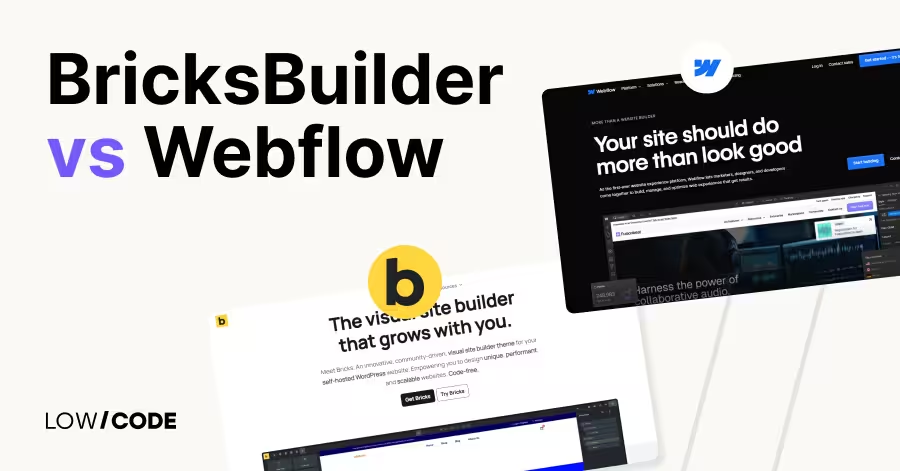
Webflow vs Bricks | 10 Factors to Decide the Best One
Compare Webflow vs Bricks across 10 key factors like design, CMS, SEO, and eCommerce to find the best platform for your next website project
.avif)
Comparison
Webflow
Webflow vs Tilda | 14 Factors to Decide the Best One
Compare Webflow vs Tilda across 14 key factors including design, SEO, CMS, and pricing to choose the best no-code website builder for your needs

Webflow
Small Business Website Redesign Cost
Real cost ranges for small business website redesigns in 2026 — what affects pricing, what's included, and how to budget accurately.

Webflow
Recover SEO Rankings After a Website Redesign
How to recover lost SEO rankings after a website redesign — diagnosing the cause, fixing redirects, and restoring traffic step by step.
Why customers trust us for no-code development


