

Ai Powered Website Redesign What It Means
AI is changing how websites get redesigned, but not always in the ways vendors claim. Here is what AI actually does well in a redesign and where human judgment


Don't have time to read this? Schedule a 30-minute call and we will walk through how AI fits into a well-run redesign process. Book a call
Key Takeaways
- "AI-powered website redesign" describes a range of capabilities from useful to marketing-speak. The label alone tells you nothing useful.
- AI tools genuinely accelerate specific phases of a redesign: content generation, image sourcing, layout iteration, copy testing, and design system documentation.
- AI cannot replace strategic judgment: understanding what a business needs to communicate, what its buyers need to experience, and how the site should be structured to serve both.
- A redesign that uses AI well is faster and less expensive than one that does not. A redesign sold primarily on "AI-powered" as a value proposition is often a tool demonstrating its capabilities, not a strategy serving the business's needs.
Step 1: Separate What AI Does from What AI Is Being Marketed to Do
The AI-in-web-design conversation is obscured by vendor marketing.
Every software tool built since 2022 claims to be AI-powered. Some of these tools automate genuinely useful tasks. Others use the label to describe pattern-matching software that existed before generative AI.
The useful question is not "is this AI-powered?" but "what specific tasks does AI handle in this process, and what tasks require human expertise?"
Step 2: Where AI Genuinely Helps in a Website Redesign
Several phases of a well-run redesign process are genuinely accelerated by AI tools.
Content generation and copywriting. AI writing tools produce draft copy for service pages, about pages, case study summaries, and metadata at a pace no human copywriter matches. The drafts require editing and positioning refinement by someone who understands the business. The raw production speed is dramatically higher.
Design iteration. AI image generation tools and design system tools can produce multiple layout variations from a single brief, allowing design teams to explore more options before committing to a direction. This compresses the exploration phase of the design process.
Photography and visual asset generation. AI image generation can produce custom photography-style images, illustrations, and background visuals for brands that do not have a professional photo library. This removes one of the most common constraints in SMB redesigns.
SEO content strategy. AI tools can analyze keyword clusters, identify content gaps against competitors, and produce initial content briefs at scale. A content strategy that would require weeks of manual research can be scaffolded in days.
Accessibility checking. AI-assisted accessibility tools can identify contrast ratio failures, missing alt text, and ARIA implementation errors across large sites much faster than manual review.
Code generation. AI-assisted development tools accelerate the build phase. Template implementation, component development, and CMS configuration that previously required many developer hours can be completed faster with AI assistance.
Step 3: Where AI Does Not Replace Human Expertise
Strategic positioning. AI can draft a positioning statement given inputs. It cannot determine the correct positioning for a specific business in a specific competitive context. That requires understanding the market, the buyers, the competitors, and the company's genuine differentiation.
Conversion architecture. Designing the page hierarchy, conversion flow, and call-to-action placement that will move a specific buyer through a specific decision process requires understanding how that buyer thinks and what they need at each stage. AI can generate layouts. It cannot design buyer journeys without strategic direction.
Brand judgment. A design system must express a brand correctly. AI can generate design elements. Determining whether a generated design element accurately represents the brand requires a human with judgment about the brand.
Stakeholder navigation. In complex organizations, a redesign involves managing competing stakeholder priorities. AI cannot negotiate between the marketing team's priorities and the sales team's priorities to arrive at a scope that serves the business.
Quality assurance of AI output. AI-generated content, copy, and code requires review. Generative AI produces plausible-sounding errors, outdated information, and brand-inconsistent phrasing with the same confidence it produces good output. Every AI output in a redesign project requires review by someone who can evaluate it against the business's actual needs.
Step 4: What AI-Accelerated Redesign Actually Looks Like in Practice
In a well-structured redesign process, AI tools are integrated at specific phases rather than positioned as a replacement for the process itself.
Discovery phase: AI-assisted competitive analysis, keyword research synthesis, and interview transcript summarization accelerate the research phase without replacing the strategic interpretation of what the research means.
Strategy phase: AI-drafted content briefs and copy outlines reduce the time from strategy to first draft. The strategy decisions themselves remain with the human team.
Design phase: AI layout tools and image generation expand the options explored in early design iteration. Design direction, brand coherence, and conversion architecture decisions remain with the design team.
Build phase: AI-assisted code generation and CMS configuration accelerate template implementation. QA, integration testing, and accessibility review require human attention.
Content phase: AI drafts content at scale. Editors review for brand voice, factual accuracy, and positioning correctness.
The result is a redesign that moves faster and costs less than one that does not use these tools, without sacrificing the strategic quality that determines whether the redesign actually performs.
Step 5: How to Evaluate "AI-Powered" Redesign Claims
When an agency or tool claims to offer AI-powered website redesign, ask these questions:
What specific tasks does the AI handle? A specific answer ("AI drafts initial page copy and generates image options for the visual direction") is substantive. A vague answer ("we use AI throughout the process") is not.
What does the human team handle? If the answer is "the AI handles everything," that is a template-based tool, not a redesign process. The strategic, positioning, and conversion architecture work must involve people with expertise in those areas.
How is AI output reviewed? Any AI-generated content, code, or design element should be reviewed by experts before it reaches the client. A process with no review step produces output that looks plausible but performs poorly.
Does the AI accelerate the process or replace the process? Acceleration with human oversight produces better results in less time. Replacement produces faster output that may not serve the business's actual needs.
Step 6: What AI Means for Redesign Costs and Timelines
AI-assisted redesign processes are faster and, when the savings are passed to clients, less expensive than traditional processes.
The phases most affected: content production, visual asset creation, and template development. These represent a significant portion of total redesign hours.
The phases least affected: strategy, conversion architecture, brand positioning, and stakeholder engagement. These require time proportional to their complexity regardless of AI tools.
A realistic expectation: AI tools reduce total redesign hours by 20 to 40 percent in projects where content and visual production are significant portions of the work.
The best AI tools for website redesign covers the specific tools available for each phase of the redesign process and what each one does well.


Step 7: AI and Website Redesign Trends
AI is changing the economics of web design in ways that will continue to develop.
The clearest near-term trends:
Faster content production at lower cost is already real. Brands that produce high-quality page content at speed have a competitive advantage in organic search and conversion optimization.
More design iteration within budget is already real. Exploring more design directions before committing is producing better-informed design decisions.
AI-generated personalization is emerging. Sites that serve different content to different visitor segments based on company, behavior, or source are becoming more feasible for mid-market companies.
AI-assisted quality assurance is growing. Automated accessibility checks, performance audits, and content quality scoring are becoming standard in redesign processes.
The website redesign trends article covers the broader trajectory of where web design is heading, including how AI fits into larger shifts in how sites are built and maintained.
LOW/CODE Agency is a leading AI product team for SMBs and startups. Companies that want to understand how AI tools are used responsibly in a redesign process, rather than marketed as a replacement for strategic expertise, will find we are specific about what AI handles and what human judgment provides.
Website projects start at $10,000+. Let's talk about your redesign.
Partner with our no-code development experts to build your next digital product.
Last updated on
September 24, 2026
.

Daniel is a Web Developer at LowCode Agency who has been building websites in Webflow since 2022. With a background in graphic design, he turns the design team's concepts into fast, responsive sites built to scale.


FAQs
Related Articles
Webflow
Mobile Website Redesign Guide
How to approach a mobile website redesign — responsive strategy, Core Web Vitals, mobile-first UX, and what most redesigns get wrong.
Comparison
Webflow
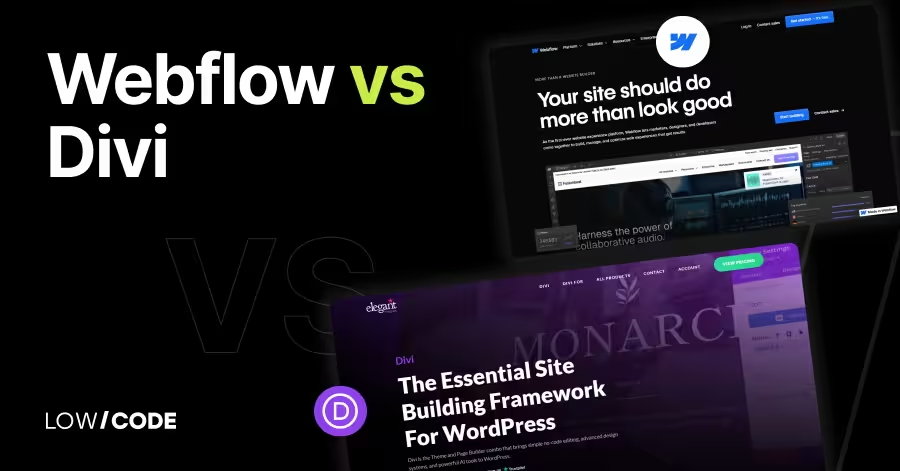
Webflow vs Divi | 10 Factors to Decide the Best One
Compare Webflow vs Divi across 10 key factors—design, SEO, pricing, ease of use, and more to find the best website builder for you
Webflow
Photography Website Redesign Guide
How photographers redesign their websites to showcase work more effectively, attract better clients, and convert more inquiries.
Webflow
Signs Your Website Needs a Redesign
The clear signs your website needs a redesign — performance signals, conversion problems, brand misalignment, and SEO issues explained.


Why customers trust us for no-code development


